
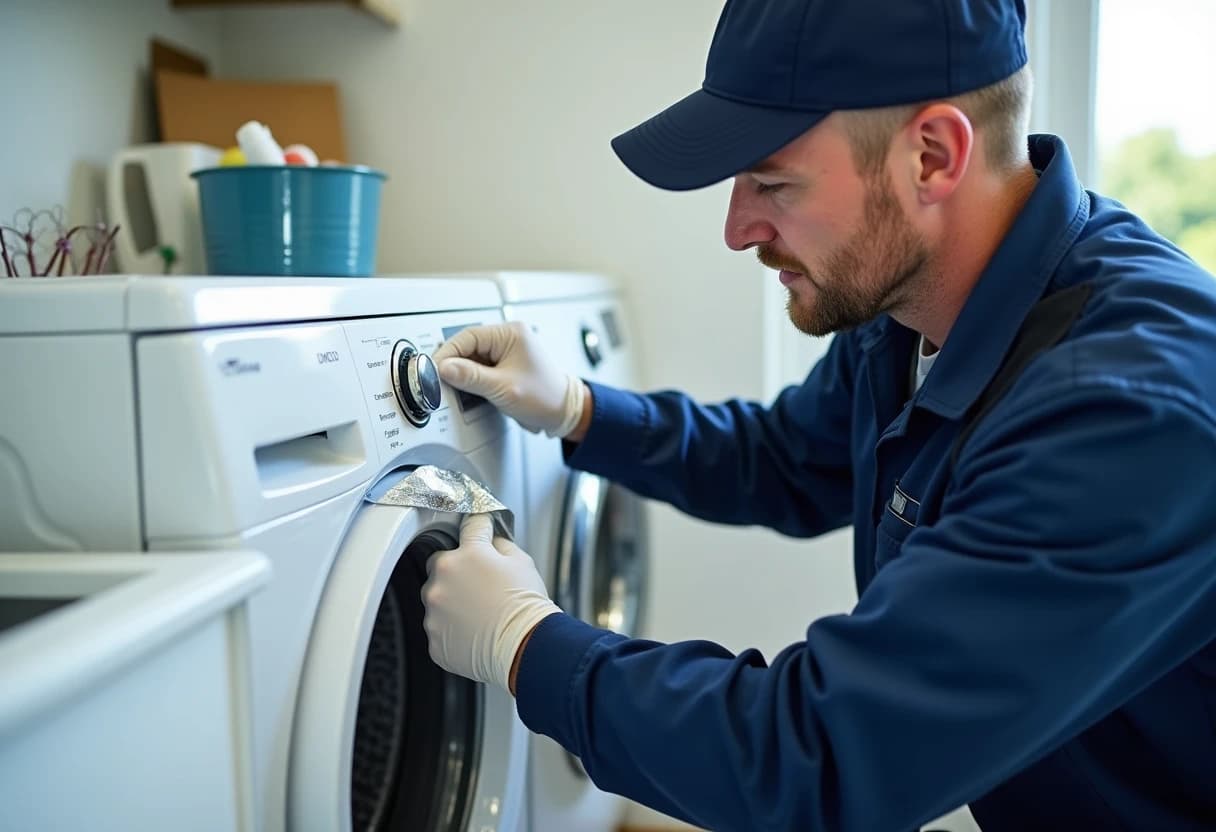
A dryer vent that is crushed, disconnected or leaking cannot be fixed by cleaning — it needs repair. Our Whitman dryer vent repair service restores the exhaust path itself: reconnecting joints that have pulled apart inside walls and ceilings, replacing crushed or kinked sections with smooth rigid metal duct, sealing leaks with proper metal foil tape, and rebuilding exterior hoods whose dampers have broken or rusted shut. Every repair uses code-compliant materials and methods — 4-inch rigid metal, clamped connections with no screws intruding into the airstream — so the finished vent moves full airflow, keeps moisture out of your walls, and stops feeding lint into places it should never go.
Why Dryer Vent Repair Matters for Whitman Homes
Disconnected dryer ducts are far more common than homeowners imagine, because the connections were never robust to begin with. Many vents were assembled with duct tape (which bakes brittle and lets go within a few years of hot exhaust cycles), or with screws driven through the duct wall (which the code prohibits precisely because the protruding tips snag lint until vibration and weight work the joint apart). Add the shove of every appliance delivery, the settling of old framing, and renovation work that jostles concealed runs, and joints quietly separate inside walls and ceilings all over Greater Boston. The dryer keeps running; the exhaust simply goes into the house. We find these failures with airflow testing and inspection — a dryer producing strong drum heat but weak exterior airflow is venting somewhere it should not — then rejoin the duct with proper fittings, clamps and UL-listed foil tape. If lint has been accumulating in the cavity, we document it and vacuum what is accessible, because that hidden pile is a fuel load your home does not need.
Winters around Whitman are hard on dryer vents in ways warmer regions never see. Whitman - famous as the birthplace of the Toll House chocolate chip cookie - is a classic commuter-rail town where older homes change hands quickly, and new owners often discover their duct system was last cleaned decades ago, if ever. The compact lots and full basements typical here also mean dryer vents frequently run long distances to reach an outside wall, a classic lint-fire risk profile. Exhaust moisture condenses and freezes in duct sections crossing cold basements and exterior walls, dampers ice shut, and snow buries grade-level hoods. Whitman grew up around its shoe factories, and the streets near the center still hold the Victorians and workers' cottages of that era, ringed by postwar capes and ranches and a scattering of newer colonials. Many of the factory-era homes have been converted from oil boilers to forced-air systems over the years, often reusing narrow chases never meant for ductwork. Those homes often route vents through the coldest parts of the structure, which is why our Whitman condensation repairs so often involve insulating and re-sloping duct in unheated space. We fix the winter failure and the design weakness behind it, so the same problem does not return with the next cold snap.
Our Dryer Vent Repair Process in Whitman
1Diagnose the Full Exhaust Path
We treat symptoms as evidence: lint in the basement points to a specific joint; a ceiling stain maps to a specific duct section; condensation drips tell us where the run crosses cold space. Correlating symptoms with the physical path usually pinpoints the failure within minutes — and rules out the failures you do not have.
2Protect the Area & Open Access
Before repair work, we protect floors and finishes along the work path, move the dryer out carefully on sliders, and set up at the failure points. Where a concealed joint requires access, we discuss options first — many repairs can be made from existing openings, and when cutting is unavoidable we keep openings minimal and tell you exactly what restoration will involve.
3Reconnect & Properly Fasten Separated Joints
Where lint and moisture have escaped into a cavity through a long-standing disconnection, we vacuum accessible accumulation with HEPA equipment and document conditions with photos. Removing that hidden fuel load matters as much as the reconnection itself — and the photos give you a record for insurance or future renovation planning.
4Replace Crushed, Corroded or Non-Compliant Sections
Duct that is crushed, kinked, rusted through or made of prohibited material gets replaced, not patched. We install 4-inch smooth-interior rigid metal duct — the material the IRC's dryer exhaust rules specify — cut to fit, joined without airstream-piercing fasteners, and supported so it cannot sag into water-pooling bellies.
5Cure Condensation: Slope, Seal & Insulate
Moisture-damaged components are replaced as part of the cure: corroded duct sections, rusted clamps, sodden insulation. We also check the termination damper, since a flap frozen or stuck partly shut is a common hidden cause of the backpressure that drives moist exhaust out through joints in the first place.
6Repair or Replace the Exterior Hood & Damper
Failed terminations get quality metal replacements: a hood sized to the 4-inch duct with a free-swinging damper that opens fully under airflow and closes tight against weather and pests. Screened hoods — a code violation on dryer vents because mesh mats over with lint — are replaced with proper damper-and-guard designs made for dryer exhaust.
7Replace the Transition Duct & Reset the Dryer
This step catches the last common failure point: many 'vent problems' are actually transition hoses flattened to a slot behind the machine. The compliant connector, correctly fitted and protected by proper dryer placement, ensures the airflow we restored in the wall actually reaches the duct from the appliance.
8Verify Airflow & Document the Repair
The proof is at the hood: with the dryer running, the damper should stand fully open under a strong, steady exhaust stream. We verify it together, compare against the pre-repair condition, and confirm no leakage remains at any repaired joint. Then the work area is cleaned, the dryer set, and the laundry room returned to service.
Benefits of Professional Dryer Vent Repair in Whitman
Decades of Reliable Service From One Repair
Repairs also make every future cleaning better: smooth interiors let rotary brushes work at full effectiveness, sealed joints keep the vacuum's suction where it belongs, and a free-swinging damper lets technicians verify airflow honestly. You are not just fixing today's failure — you are buying easier maintenance forever.
A Serious Fire Hazard, Eliminated
A breached or restricted dryer vent combines the two ingredients of the roughly 2,900 annual US dryer fires: accumulating lint and rising exhaust temperatures. Repair removes both — the escape points that seed wall cavities with fuel, and the crush points and blockages that overheat the system. It is fire prevention with a wrench, and it lasts for decades.
Restored Drying Performance
A crushed or separated duct throttles airflow just like a lint clog, and no amount of cleaning fixes it. Repair restores the full 4-inch path, and drying performance returns immediately — one-cycle loads, accurate sensor-dry behavior, and a machine that stops straining against backpressure it was never designed to fight.
Moisture Out of Your Walls and Ceilings
Every load of laundry exhausts about a gallon of water. A repaired, sealed vent delivers all of it outdoors; a leaking one delivers it into insulation, framing and drywall. Stopping that daily soaking is the benefit homeowners feel longest — no more spreading stains, peeling paint, mildew odors or the mold remediation bills that chronic wall moisture eventually writes.
Pest Entry Points Closed
We remove existing nesting material as part of termination repair and clean the affected duct section, because a nest is both a blockage and a sanitation issue in an airstream that passes your clothing. The new hood's pest protection is chosen to exclude animals without the lint-trapping mesh that code prohibits.
Code Compliance & Inspection-Ready Documentation
Dryer venting is a standard flag on Massachusetts home inspections: vinyl flex, taped joints, screened hoods and overlong runs all appear in reports and complicate sales. Our repairs bring the system to current code — rigid metal, compliant joints, proper termination — with photo documentation that answers inspector and buyer questions before they are asked.
Signs Your Whitman Home Needs Dryer Vent Repair
Musty or Mildew Smell in the Laundry Area
If freshly dried clothes pick up a sour or musty note, moisture is lingering somewhere in the exhaust path — often damp lint mats in a bellied or leaking duct section. Cleaning removes the mats; repair fixes the sag or leak that created them. Without the repair, the mats and the smell return.
A Home Inspection or Appliance Tech Flagged the Vent
When an appliance technician condemns your vent while servicing the dryer, believe them: they have just measured the backpressure your machine fights on every load. Repairing the duct protects the repair they made — a new heating element or thermal fuse installed against a failed vent will simply fail again.
Exterior Damper Broken, Stuck or Missing
Look at the hood outside: a damper flap hanging loose, rusted stiff, cracked off, painted shut or missing entirely is a failed termination. Stuck open, it drains heat and admits pests all winter; stuck shut, it blocks the vent completely. Either way the fix is a proper replacement hood — one of the fastest, most cost-effective repairs on our list.
Slow Drying That Cleaning Didn't Fix
The symptom pattern is diagnostic: strong heat in the drum with weak or absent airflow at the exterior hood means exhaust is going somewhere else. That somewhere is the failure point. It is a fifteen-minute find for a technician with airflow instruments and knowledge of how these runs are routed in local housing.
Visibly Damaged, Kinked or Sagging Duct
Trust your eyes: a transition hose flattened behind the dryer, a dented or crushed section in the basement, duct sagging between supports into a low belly, or a run held together with fabric duct tape are all failures in progress. Each restricts airflow, collects lint and moisture, and worsens with time. Photograph what you see and call — the quote is quick.
Lint Appearing Where It Shouldn't
Lint drifting from a basement ceiling, gathering on joists, puffing from a wall register or collecting behind the dryer means exhaust is escaping the duct before the termination. Lint marks the leak like dye in water — follow it and you find the separated joint or breach. This is a repair call, not a cleaning call, and it should not wait.
Dryer Vent Repair Cost in Whitman, MA
It helps to know what drives repair pricing, because the failure type matters more than the home's size. Accessibility is the biggest factor: a joint hanging exposed in a basement is a fast fix, while the same failure above a finished ceiling involves careful access and restoration planning. Materials are second: quality rigid metal duct, UL-listed connectors, foil tape and a solid termination hood carry real parts costs — roughly $30 to $120 of most invoices — but they are why the repair lasts decades. Scope is third: many vents present multiple failures at once (a crushed transition and a failed damper and a leaking joint), and bundling them into one visit is significantly cheaper than three separate calls. What does not drive our pricing: drama. We quote from the diagnosis, show you the photos, and price the fix flat. Massachusetts homeowners have seen enough scare-based selling around dryer fires; the facts are alarming enough without embellishment, and the honest repair is usually a few hundred dollars.
Want the full pricing picture? See our complete Boston-area cost guide or call (617) 390-7145 for an exact flat quote for your Whitman home.
Local Knowledge: Whitman, Plymouth County
What makes Whitman different? Whitman grew up around its shoe factories, and the streets near the center still hold the Victorians and workers' cottages of that era, ringed by postwar capes and ranches and a scattering of newer colonials. Many of the factory-era homes have been converted from oil boilers to forced-air systems over the years, often reusing narrow chases never meant for ductwork. Whitman - famous as the birthplace of the Toll House chocolate chip cookie - is a classic commuter-rail town where older homes change hands quickly, and new owners often discover their duct system was last cleaned decades ago, if ever. The compact lots and full basements typical here also mean dryer vents frequently run long distances to reach an outside wall, a classic lint-fire risk profile. For duct and dryer vent systems, those local factors translate into specific, predictable problems — and predictable problems are the ones we solve fastest. Call (617) 390-7145, tell us your street and home style, and we will quote the job accurately the first time, usually in under five minutes.
The Best Time of Year in Whitman
Humid Massachusetts summers stress the concealed portions of the vent. High dew points mean exhaust barely cools before reaching saturation, so any bellied, unsloped or leaking duct section collects water through the muggy months — soaking lint into mats, feeding the mildew smells homeowners notice in August, and rusting galvanized duct from the inside. Basement laundry areas, already fighting ambient summer humidity, compound the effect. Summer is consequently when condensation damage advances fastest and when its symptoms — sour-smelling laundry, damp walls near the vent path, visible drips at joints — are easiest to catch. A summer diagnostic visit finds the moisture while it is active, which makes the repair scope precise rather than speculative.
Why Choose Boston Air Duct Cleaners
Homeowners across Plymouth County choose Boston Air Duct Cleaners for three reasons. First, honesty: our inspection camera tells you whether your system actually needs cleaning — and sometimes the answer is no. Second, capability: truck-grade negative-air machines, rotary brush systems and HEPA filtration handle everything from antique gravity-furnace conversions to brand-new high-velocity systems. Third, accountability: flat quoted pricing, before-and-after photos, insured technicians, and a real local office you can call at (617) 390-7145. That combination is rarer in this industry than it should be.
Serving Whitman and Surrounding Communities
Whitman sits in the heart of our service area, and neighboring Abington, Brockton, Hanson, East Bridgewater, Rockland, Holbrook appointments share the same routes. That density is why our response times in this part of Plymouth County are among our fastest — and why you will see our trucks in the area week after week.