
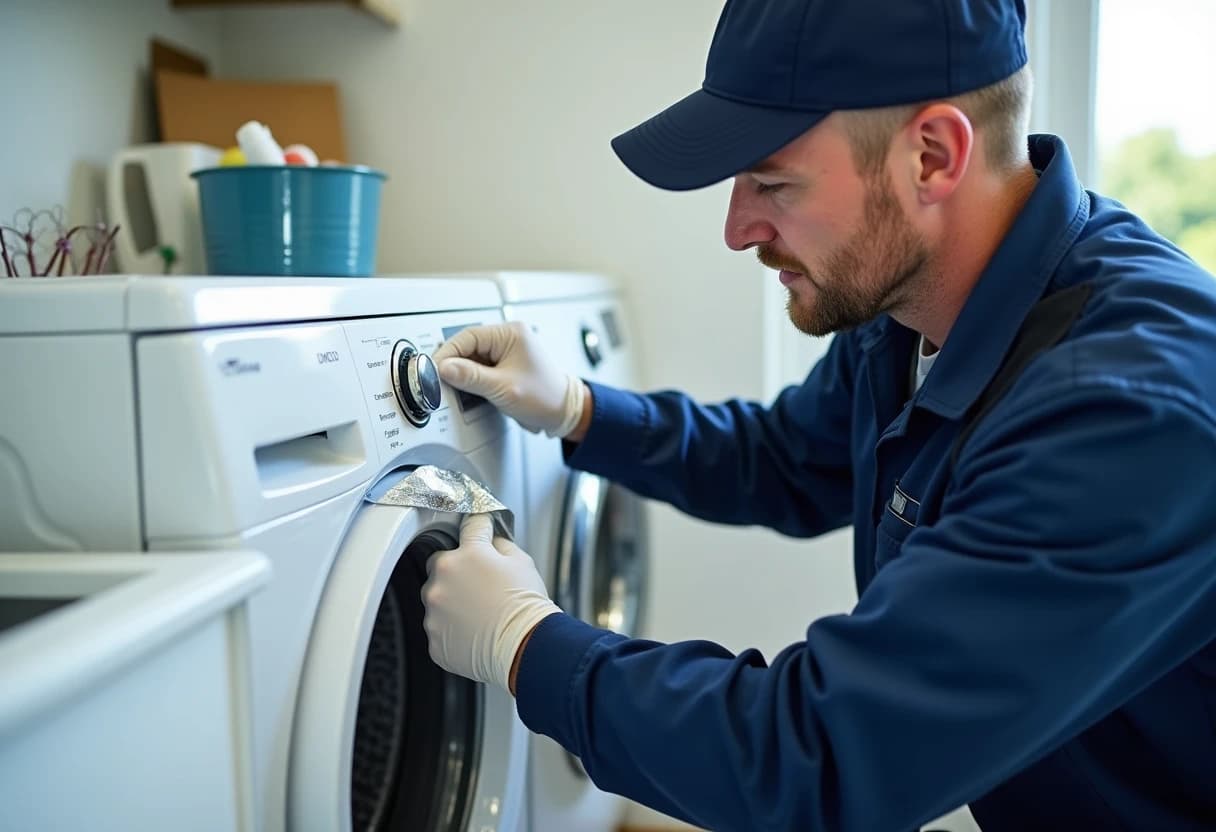
Condensation is the quiet destroyer of dryer vents in New England. Warm, moisture-saturated exhaust travels through ducts that pass cold basements, crawlspaces and exterior wall cavities; wherever the duct runs cold, that vapor condenses, soaking lint into blockage-forming mats, rusting metal duct from the inside, dripping from joints, and staining ceilings below. Our Rockland repair service addresses condensation at its causes: sealing leaking joints, correcting sags where water pools, insulating duct sections that pass through unheated space, restoring proper slope, and replacing corroded runs. The fix is specific to your vent's routing — which is why every repair starts with a full-path inspection, not a guess.
Why Dryer Vent Repair Matters for Rockland Homes
Disconnected dryer ducts are far more common than homeowners imagine, because the connections were never robust to begin with. Many vents were assembled with duct tape (which bakes brittle and lets go within a few years of hot exhaust cycles), or with screws driven through the duct wall (which the code prohibits precisely because the protruding tips snag lint until vibration and weight work the joint apart). Add the shove of every appliance delivery, the settling of old framing, and renovation work that jostles concealed runs, and joints quietly separate inside walls and ceilings all over Greater Boston. The dryer keeps running; the exhaust simply goes into the house. We find these failures with airflow testing and inspection — a dryer producing strong drum heat but weak exterior airflow is venting somewhere it should not — then rejoin the duct with proper fittings, clamps and UL-listed foil tape. If lint has been accumulating in the cavity, we document it and vacuum what is accessible, because that hidden pile is a fuel load your home does not need.
Ask a home inspector working around Union Street what they flag most in Rockland laundry areas and dryer venting is near the top of the list: vinyl accordion hose, duct-taped joints, screened hoods, runs far beyond code length. Rockland grew up around its shoe factories, so the housing core is late-1800s workers' Victorians and folk-style homes near Union Street, filled in with post-war capes and ranches and a scattering of newer subdivisions toward the Hanover line. The older shoe-town homes were built for stoves and steam heat, so their forced-air systems are almost always retrofits with tight, twisting duct paths. Rockland's factory-era housing hides some of the oldest retrofit ductwork we see on the South Shore, often layered through multiple generations of remodeling. The town's mix of long-tenured family homes and recent first-time-buyer turnover means many systems are being inspected for the first time in decades when a house changes hands. We do the corrective work those inspection reports call for — rigid metal replacement, code-compliant reconnections, proper terminations — with documentation that satisfies buyers, sellers and insurers alike. Neighbors in Abington and Hanover use us for the same pre-sale and post-purchase repairs, which keeps our trucks in this corner of Plymouth County nearly every week.
Our Dryer Vent Repair Process in Rockland
1Diagnose the Full Exhaust Path
Repair starts with finding every failure, not just the obvious one. We trace the duct from the dryer's outlet to the exterior termination, inspecting each accessible section and joint, and test airflow at both ends with the dryer running. Weak exterior flow with strong drum heat means the exhaust is escaping en route — and we find where.
2Protect the Area & Open Access
Laundry areas are tight, finished spaces, and we work in them accordingly: drop cloths, boot covers, and careful handling of the appliance and its gas or electrical connections. Gas dryers get particular care around the flexible connector — we never strain a gas line to reach a duct.
3Reconnect & Properly Fasten Separated Joints
Separated joints are rejoined the way code intends: sections fitted male-to-female in the direction of airflow, secured with clamps or mechanical fasteners that do not pierce the airstream, and sealed with UL-listed metal foil tape — never fabric duct tape, which heat destroys, and never screws through the duct wall, whose tips become lint hooks inside the pipe.
4Replace Crushed, Corroded or Non-Compliant Sections
Duct that is crushed, kinked, rusted through or made of prohibited material gets replaced, not patched. We install 4-inch smooth-interior rigid metal duct — the material the IRC's dryer exhaust rules specify — cut to fit, joined without airstream-piercing fasteners, and supported so it cannot sag into water-pooling bellies.
5Cure Condensation: Slope, Seal & Insulate
Where a run's routing makes condensation inevitable — long passages through cold space, low points that cannot be drained — we say so plainly and price the better fix: shortening or rerouting the run, which we quote as a separate option. Honest diagnosis beats a repair that treats symptoms the routing will simply recreate.
6Repair or Replace the Exterior Hood & Damper
Where pests have entered through a failed damper, we remove nesting material from the duct, clean the affected section, and install a termination with pest protection that does not restrict airflow. If the old hood was painted shut — common on older multi-family buildings — we free or replace it and note the repaint risk for the future.
7Replace the Transition Duct & Reset the Dryer
The appliance connection is rebuilt to spec: a UL-listed semi-rigid aluminum transition duct, as short and straight as the layout allows, secured with clamps at both ends. We position the dryer so the connector keeps its full diameter — not crushed against the wall — and mark the safe distance so future pushes do not recreate the old kink.
8Verify Airflow & Document the Repair
Finally we log the service and recommend a cleaning schedule for the repaired system — typically annual. A repaired vent with smooth rigid duct and a proper termination accumulates lint far more slowly than the failed system it replaced, and the documentation we leave shows exactly what is now behind your walls.
Benefits of Professional Dryer Vent Repair in Rockland
Lower Energy and Repair Bills
Blocked and breached vents are behind a large share of dryer service calls: blown thermal fuses, burned heating elements, failed high-limit switches. Each is a $150 to $400 appliance visit that recurs until the vent is fixed. One proper duct repair typically costs less than two of those visits and ends the cycle.
Restored Drying Performance
Customers are often startled by the change: a vent we repaired after years of gradual crushing gives them back the dryer they bought. If your drying times worsened after an appliance delivery, a renovation, or a move of the machine — events that crush transitions and separate joints — repair, not replacement, is very likely the answer.
A Serious Fire Hazard, Eliminated
Lint inside a wall cavity cannot be cleaned on any schedule; the only fix is stopping the leak that puts it there. Repairing disconnections and sealing joints confines lint to the duct, where annual cleaning can manage it. That containment is the difference between a maintainable system and a slowly growing hazard you cannot see.
Decades of Reliable Service From One Repair
Done with rigid metal, mechanical fastening and a quality termination, a dryer vent repair is not a patch — it is infrastructure. Properly installed rigid duct routinely outlasts the dryers connected to it, needing only annual cleaning. The failure-prone materials and joints that caused your problem simply are not there anymore.
Moisture Out of Your Walls and Ceilings
In New England's freeze-thaw climate, moisture in building assemblies does compounding damage each winter. Sealing a leaking dryer vent removes one of the few moisture sources that operates year-round, indoors, by the gallon. Building scientists put exhaust integrity high on the envelope checklist for exactly this reason.
Code Compliance & Inspection-Ready Documentation
Dryer venting is a standard flag on Massachusetts home inspections: vinyl flex, taped joints, screened hoods and overlong runs all appear in reports and complicate sales. Our repairs bring the system to current code — rigid metal, compliant joints, proper termination — with photo documentation that answers inspector and buyer questions before they are asked.
Signs Your Rockland Home Needs Dryer Vent Repair
A Home Inspection or Appliance Tech Flagged the Vent
When an appliance technician condemns your vent while servicing the dryer, believe them: they have just measured the backpressure your machine fights on every load. Repairing the duct protects the repair they made — a new heating element or thermal fuse installed against a failed vent will simply fail again.
Visibly Damaged, Kinked or Sagging Duct
Sag matters more than it looks: a bellied section pools condensate, which soaks lint into a mat, which adds weight, which deepens the sag. The cycle ends in a blocked or rusted-through low point. Adding proper support and restoring slope while the duct is still sound is a small repair that prevents a large one.
Musty or Mildew Smell in the Laundry Area
EPA guidance on mold is unambiguous: control the moisture and you control the growth. In laundry areas the dryer vent is a prime suspect moisture source, and a $150 to $450 repair is dramatically cheaper than the remediation an ignored leak can eventually require.
Lint Appearing Where It Shouldn't
Check the floor and framing along the vent's path, especially in basements where runs hang exposed: a dusting of gray fiber below any joint is a positive test for leakage there. The joint may look intact from below while a gap on top sheds lint and moisture into the cavity above it.
Slow Drying That Cleaning Didn't Fix
If a vent cleaning did not restore drying performance, the airflow restriction is structural: a crushed section, a collapsed inner liner, a separated joint dumping exhaust short of the hood, or a damper that cannot open. The next step is diagnosis, not another cleaning — we trace the path, find the mechanical fault, and quote its repair flat.
Water Stains, Drips or Peeling Paint Near the Vent Path
A ceiling stain below a second-floor laundry, paint bubbling behind the dryer, or drips from a basement duct joint all point to exhaust moisture escaping or condensing in the run. Each load adds another gallon of vapor to the problem. Repair — sealing, sloping, insulating or replacing the affected section — stops the source; cosmetic fixes without it just repaint the symptom.
Dryer Vent Repair Cost in Rockland, MA
Compare the repair cost against what the failure costs to keep. A leaking vent delivers roughly a gallon of water per load into your building assemblies — and chronic wall moisture matures into mold remediation and drywall work that starts around $1,500 and climbs steeply. A crushed or blocked duct overworks the dryer into $150 to $400 appliance repairs (thermal fuses, elements, switches) that recur until the vent is fixed, while adding $10 to $20 a month in energy waste. A failed damper leaks heated air all winter and invites nest blockages every spring. And every one of these failures raises fire risk in a system that already accounts for about 2,900 US home fires a year. Against that ledger, $150 to $450 for a permanent, code-compliant repair is one of the clearest-value maintenance purchases in the home. Most customers who see the diagnostic photos do not need convincing; the duct makes the argument itself.
Want the full pricing picture? See our complete Boston-area cost guide or call (617) 390-7145 for an exact flat quote for your Rockland home.
Local Knowledge: Rockland, Plymouth County
Every town's ductwork tells the story of its housing. Rockland grew up around its shoe factories, so the housing core is late-1800s workers' Victorians and folk-style homes near Union Street, filled in with post-war capes and ranches and a scattering of newer subdivisions toward the Hanover line. The older shoe-town homes were built for stoves and steam heat, so their forced-air systems are almost always retrofits with tight, twisting duct paths. Rockland's factory-era housing hides some of the oldest retrofit ductwork we see on the South Shore, often layered through multiple generations of remodeling. The town's mix of long-tenured family homes and recent first-time-buyer turnover means many systems are being inspected for the first time in decades when a house changes hands. We plan Rockland jobs around those realities, from equipment selection to time on site, and it shows in the results. If you live near Union Street or anywhere across Rockland's 02370 area, we have almost certainly cleaned a system like yours before — and we can tell you exactly what to expect before we arrive.
The Best Time of Year in Rockland
Humid Massachusetts summers stress the concealed portions of the vent. High dew points mean exhaust barely cools before reaching saturation, so any bellied, unsloped or leaking duct section collects water through the muggy months — soaking lint into mats, feeding the mildew smells homeowners notice in August, and rusting galvanized duct from the inside. Basement laundry areas, already fighting ambient summer humidity, compound the effect. Summer is consequently when condensation damage advances fastest and when its symptoms — sour-smelling laundry, damp walls near the vent path, visible drips at joints — are easiest to catch. A summer diagnostic visit finds the moisture while it is active, which makes the repair scope precise rather than speculative.
Why Choose Boston Air Duct Cleaners
Boston Air Duct Cleaners is a local, owner-operated company based at 1121 Washington St in West Newton — not a national franchise dispatching subcontractors. Every crew is our own: background-checked, factory-trained on commercial negative-pressure equipment, and fully insured. We quote flat prices before work begins, document every job with before-and-after photos, and follow NADCA-standard source-removal methods on every system we touch. That is why so much of our work comes from repeat customers, property managers and word-of-mouth referrals across Plymouth County.
Serving Rockland and Surrounding Communities
Beyond Rockland, our crews cover the surrounding communities daily — including Abington, Hanover, Whitman, Hanson, Norwell, Weymouth. Because routes cluster geographically, booking alongside a neighboring appointment often unlocks same-day service and combined-visit savings. Wherever you are in Plymouth County, the same flat-rate pricing, insured technicians and photo-documented process applies.