
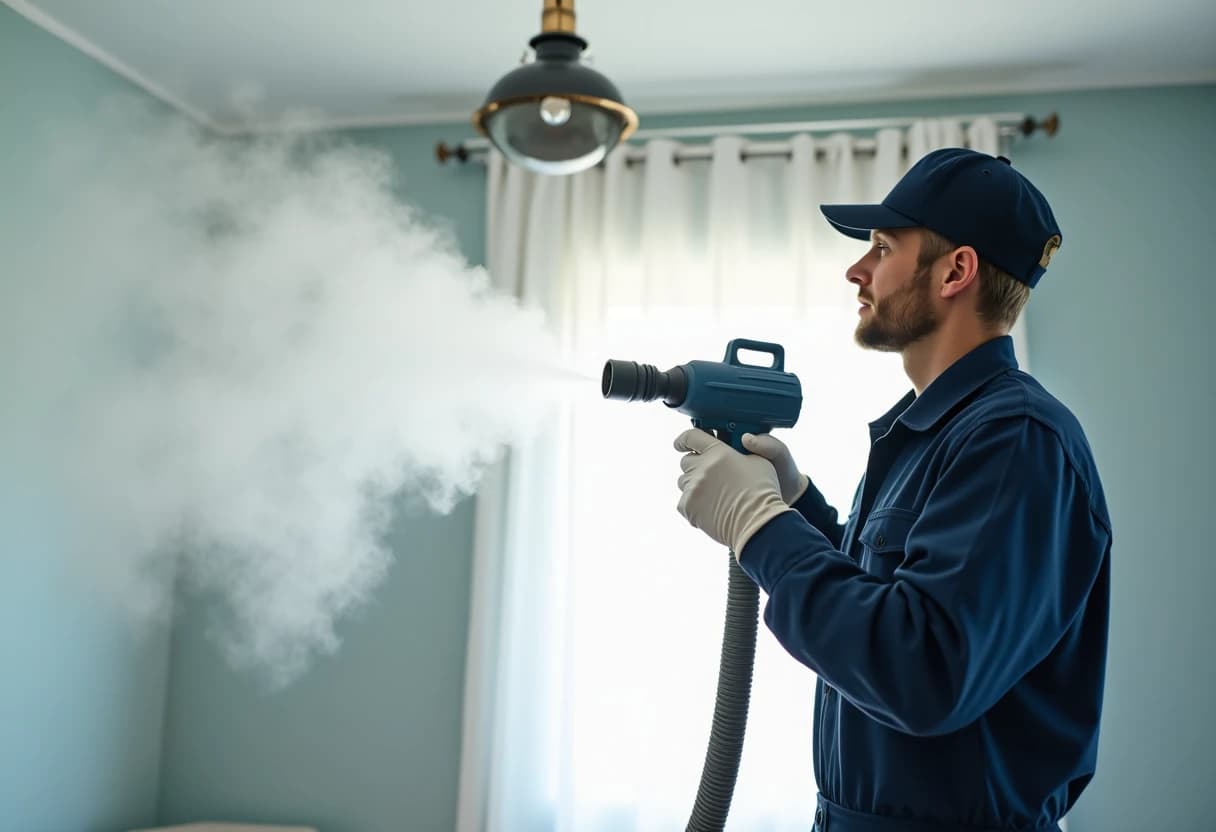
Air duct sanitizing is the finishing treatment that mechanical cleaning alone cannot provide: an EPA-registered antimicrobial, fogged through the freshly cleaned duct system under airflow so it reaches every surface the air touches. Where cleaning removes the dust, sanitizing neutralizes what lives in the residue — odor-causing bacteria, mold spores and the microbial film that gives ducts that stale, musty character. For Whitman homeowners fighting pet odors, previous-owner smells, smoke history or the damp-basement note that rides the airflow every summer, it is the difference between ducts that are clean and ducts that smell clean. We apply it honestly: only after source-removal cleaning, only with HVAC-labeled products, and only when your situation actually warrants it.
Why Air Duct Sanitizing & Deodorizing Matters for Whitman Homes
Pet households face duct odor mechanics that surface cleaning cannot beat. Dander is an aerosol: it rides the return airflow into the duct network, settles into the interior film, and accumulates for as long as the pet lives there — often across multiple pets and many years. The film becomes an odor reservoir with the system's full distribution reach, which is why the smell is strongest when the heat kicks on and why guests detect it instantly while residents have gone nose-blind. The same mechanism archives cigarette and cannabis smoke, cooking oils, and the general biological signature every household writes into its air system over time. When the home changes hands, the new owners inherit the archive. Source-removal cleaning strips the reservoir; EPA-registered fogging neutralizes the residue and the bacteria feeding on it; and the system stops broadcasting. For sellers, this pairing is one of the highest-leverage pre-listing investments available — showings live and die on the first thirty seconds of smell — and for buyers it is the cleanest possible start in a home with an unknown history.
Whitman real estate moves fast, and smell is part of every showing. Whitman grew up around its shoe factories, and the streets near the center still hold the Victorians and workers' cottages of that era, ringed by postwar capes and ranches and a scattering of newer colonials. Many of the factory-era homes have been converted from oil boilers to forced-air systems over the years, often reusing narrow chases never meant for ductwork. Buyers walking into a home that smells of previous owners — pets, smoke, mustiness — mentally discount the price within seconds, and sellers who have lived with the odor for years often cannot detect it at all. Whitman - famous as the birthplace of the Toll House chocolate chip cookie - is a classic commuter-rail town where older homes change hands quickly, and new owners often discover their duct system was last cleaned decades ago, if ever. The compact lots and full basements typical here also mean dryer vents frequently run long distances to reach an outside wall, a classic lint-fire risk profile. We work pre-listing sanitizing jobs across Whitman on tight timelines: source-removal cleaning plus EPA-registered deodorizing treatment, one visit, documented for the disclosure file. Agents in the area refer us for exactly this reason.
Our Air Duct Sanitizing & Deodorizing Process in Whitman
1Odor Assessment & Honest Qualification
First we determine whether sanitizing will actually fix your problem. The technician traces the odor's behavior — does it arrive with airflow, vary by season, concentrate at certain registers — inspects the duct interiors and air handler, and checks for moisture. If the source is your ducts, we quote the treatment flat. If it is not, we say so and point you at the real source.
2Source-Removal Cleaning First
Step one is removing the reservoir. The odor-saturated film lining your ducts is physically extracted under negative pressure — rotary brushes and pneumatic whips strip it from every supply, return and trunk while the HEPA vacuum captures it. Most of the odor leaves the house in this step; the fogging that follows neutralizes what remains and prevents the smell from rebuilding.
3Product Selection & Preparation
Preparation is checklist work that determines results: product selected for your specific odor profile, dilution mixed to label specification, fogging equipment matched to your system's size so droplet distribution covers the full duct network. We also plan the airflow path — which registers stay open, how the blower assists — so the treatment reaches the far end of every run, not just the trunks.
4Whole-System Antimicrobial Fogging
With the system freshly cleaned, the EPA-registered fog does its work at the surface level: contact-killing the bacteria that metabolize duct residue into odor, neutralizing the residual film chemically, and leaving an inhibiting layer that suppresses microbial regrowth. The application follows label contact times precisely — this is regulated chemistry applied to specification, not a scented mist waved through the vents.
5Coil, Drain Pan & Blower Treatment
Every fogging visit includes hands-on treatment of the components the fog alone cannot adequately address: coil fins treated with appropriate cleaner, drain pan scrubbed and sanitized, condensate line flushed, blower compartment wiped and treated. If we find heavy coil fouling or standing water that signals a bigger problem, we document it with photos and quote the fix separately — informed consent, never ambush.
6Deodorizing Pass for Stubborn Odors
Smoke and heavy pet situations get a second, targeted pass with odor-counteractant chemistry — products that bind and neutralize odor molecules rather than perfume over them. Tobacco residue in particular clings aggressively to metal and re-releases for years; the counteractant pass addresses it specifically. This step is included when the assessment calls for it and skipped, with the price reflecting that, when it does not.
7System Airing, Verification & Walkthrough
We leave the system running clean and documented: registers remounted, a fresh filter installed on request, treatment records in your file, and honest guidance on what to expect — a faint clean-neutral note for a day or two as the treatment cures, then nothing. If the odor you hired us to kill ever returns in the following months, you call, we come back. That simple.
Benefits of Professional Air Duct Sanitizing & Deodorizing in Whitman
Small Add-On Cost, Outsized Payoff
Bundled with duct cleaning, sanitizing adds roughly $75 to $200 to the visit — the system is already sealed, accessed and under negative pressure, so you pay for chemistry and application time, not a second mobilization. Against the hundreds homeowners spend annually on masking products that fix nothing, the one-time source treatment is the plainly economical choice.
Pet Odor Elimination That Actually Holds
Multi-pet and long-tenure pet households benefit most: the accumulation scales with animal-years, and no surface cleaning touches the duct-borne share. Post-treatment, the improvement compounds — ongoing dander still sheds, but it lands in a neutral system rather than layering onto decades of saturated film, and routine filter changes keep the new baseline for years.
Smoke Ghosts Finally Evicted
If a home smelled of cigarettes at the showing and still does after renovation, the air system is the unrenovated room. Smoke rode the returns for years, coating the full duct network with residue no one ever addresses. Treating that network is routinely the missing piece that finally clears a smoker's house — and the step savvy buyers now negotiate into the purchase.
Odors Neutralized at the Source, Not Masked
Every consumer odor product adds scent on top of the problem; sanitizing subtracts the problem. With the odor-holding film removed and the residue chemically neutralized, the ducts stop producing smell altogether. The house does not smell like a candle aisle afterward — it smells like nothing, which is what fresh actually is, and what no masking product can counterfeit.
Musty Summer Smell Broken for Good
The musty cycle is self-reinforcing: each humid season's growth adds residue that feeds the next season's growth. Breaking it requires actually removing the substrate, which is what the cleaning-plus-treatment pairing does. Homeowners who assumed the smell was 'just what old houses do' discover it was just what untreated ducts do — old houses smell fine with a neutral air path.
A True Reset for Newly Purchased Homes
You inspected the roof, the furnace and the foundation before buying; the air system's biological history was invisible on every report. A move-in sanitizing closes that gap, decontaminating the one system that touches every room before your family settles in. Scheduled between closing and move-in, it is the cheapest and easiest it will ever be — empty house, open access, one afternoon.
Signs Your Whitman Home Needs Air Duct Sanitizing & Deodorizing
After Pests, Mold or Water in the System
Rodent or insect activity in ductwork leaves droppings, nesting debris and bacterial contamination that mechanical cleaning removes but does not neutralize — the sanitizing pass is what addresses the biological load. Any pest history that touched the air system should end with an EPA-registered treatment, and the odor benefit arrives as a bonus.
Guests Notice a Smell You No Longer Can
A useful self-test: leave home for a full week, then pay attention in the first ten seconds through the front door before your nose recalibrates. Whatever you catch in that window is what everyone else gets every visit. If there is anything there — mustiness, animals, staleness — the air system is the first place to look.
Pets Present or Past
Current pets write dander into the duct film continuously; previous owners' pets left their chapters behind. Either way the system holds an animal-scent reservoir that surface cleaning never touches. If the house smells of pets anywhere, it smells of pets from the registers — and treating the registers' source is the only fix with reach into every room.
Smoke History in the Home
If any era of the home's life included indoor smoking, the duct network carries the tar-and-nicotine film to prove it — and that film off-gasses for years, strongest on warm humid days when the residue softens. Paint and carpet replacement miss it entirely. Counteractant duct treatment is the step that finally clears a smoker's house.
You Just Bought the Home
Even a home that smells fine at purchase benefits from the reset when history is unknown: odor thresholds are personal, previous owners' normal may not be yours, and the first heating season has a way of releasing what summer showings concealed. Buyers who sanitize at move-in never have to wonder what October's first furnace cycle will announce.
Odors Return No Matter How Much You Clean
The tell is the rhythm: rooms smell fine with the system off, and the odor rebuilds when it runs. Surfaces cannot cause that pattern; airflow can. Homeowners often spend months eliminating suspects — carpets, drains, trash areas, basements — before checking the one system that touches every room. The register test takes ten seconds: smell the air it delivers.
Air Duct Sanitizing & Deodorizing Cost in Whitman, MA
Budget by scenario. Bundled with a full cleaning — our most common configuration — sanitizing adds $75 to $200, putting the combined odor-elimination package at roughly $425 to $900 for typical single-family systems. Standalone treatment of a recently, verifiably cleaned system runs $250 to $400 for most homes, $400 to $500 for large or multi-zone systems. Smoke remediation adds $75 to $150 for the counteractant pass. What you should not pay for: 'sanitizing' quoted per vent at prices that balloon past these ranges, mandatory add-on treatments sold from scare photos, or ozone 'shock treatments' — the EPA warns ozone is ineffective against odor sources at safe concentrations and a respiratory irritant at effective ones, so it is a product we simply do not offer. Our quotes are flat, written and scoped to your actual odor situation after the assessment — and when the assessment says your system does not need sanitizing, the quote says that instead, which happens more often than the industry would like you to know.
Want the full pricing picture? See our complete Boston-area cost guide or call (617) 390-7145 for an exact flat quote for your Whitman home.
Local Knowledge: Whitman, Plymouth County
What makes Whitman different? Whitman grew up around its shoe factories, and the streets near the center still hold the Victorians and workers' cottages of that era, ringed by postwar capes and ranches and a scattering of newer colonials. Many of the factory-era homes have been converted from oil boilers to forced-air systems over the years, often reusing narrow chases never meant for ductwork. Whitman - famous as the birthplace of the Toll House chocolate chip cookie - is a classic commuter-rail town where older homes change hands quickly, and new owners often discover their duct system was last cleaned decades ago, if ever. The compact lots and full basements typical here also mean dryer vents frequently run long distances to reach an outside wall, a classic lint-fire risk profile. For duct and dryer vent systems, those local factors translate into specific, predictable problems — and predictable problems are the ones we solve fastest. Call (617) 390-7145, tell us your street and home style, and we will quote the job accurately the first time, usually in under five minutes.
The Best Time of Year in Whitman
The first furnace start of October is New England's annual duct-odor reveal. Summer's humidity left the system's film damp and biologically active; the first heating cycles bake it, and the house fills with a musty-dusty note that is equal parts burnt accumulation and volatilized microbial residue. Households that smelled nothing all summer suddenly field questions at the door. If last October's first fires announced themselves this way, book cleaning and sanitizing in September — the treatment lands on the year's heaviest odor load, and the heating season opens with clean, neutral startup cycles instead. Fall slots fill fastest for exactly this reason; the smart calendar position is ahead of the rush, not inside it.
Why Choose Boston Air Duct Cleaners
As a West Newton-based company, we treat Whitman like the neighborhood it is — because for us, it is. Our reputation lives or dies on local referrals, so every job gets the full process: complete system cleaning under negative pressure, mechanical agitation of every run, blower compartment service, and a documented walkthrough before we leave. We are licensed and insured, our estimates are free and flat, and our schedule holds same-day slots for urgent calls. One visit and you will understand why neighbors keep our magnet on the fridge.
Serving Whitman and Surrounding Communities
Beyond Whitman, our crews cover the surrounding communities daily — including Abington, Brockton, Hanson, East Bridgewater, Rockland, Holbrook. Because routes cluster geographically, booking alongside a neighboring appointment often unlocks same-day service and combined-visit savings. Wherever you are in Plymouth County, the same flat-rate pricing, insured technicians and photo-documented process applies.