
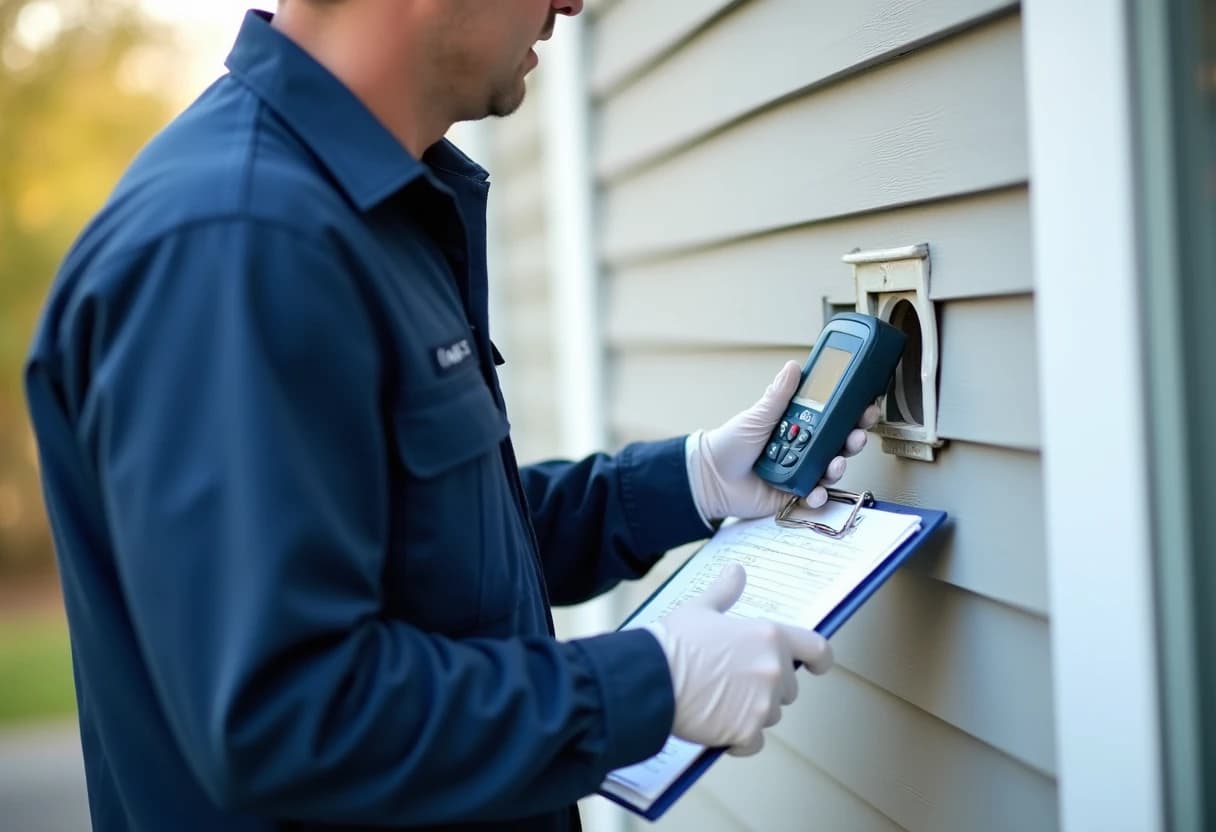
FEMA estimates around 2,900 home clothes dryer fires occur in the United States every year, and failure to clean the vent is the leading contributing factor. The trouble is that the danger is invisible: the lint that matters is not in the trap you clear after each load, it is packed inside the wall, ceiling or crawlspace duct you never see. Our Wakefield dryer vent inspection makes the invisible visible. A camera travels the entire exhaust run from the dryer connection to the outdoor termination, airflow is measured and compared against healthy benchmarks, and every finding is documented in a written report you can act on, file with your insurer, or hand to a home buyer.
Why Dryer Vent Inspection & Safety Check Matters for Wakefield Homes
The mechanical case for annual inspection is about heat and moisture, not just fire. A restricted vent forces the dryer to run longer per load, which costs electricity or gas, wears the appliance, and cooks fabrics. It also raises the temperature inside the dryer cabinet, cycling the high-limit thermostat — a safety component designed for occasional intervention, not daily duty — until it fails, which in Massachusetts usually means a repair call in the middle of winter laundry season. Meanwhile, every minute of restricted exhaust pushes warm, moisture-laden air backward through leaks in the duct, and for gas dryers, impedes the removal of combustion byproducts including carbon monoxide. A vent that measures healthy protects the appliance, the utility bill, the indoor air and the house at once. A vent that measures weak announces the problem years before it announces itself — and an annual inspection is the only way anyone ever hears it.
We inspect dryer vents all over Wakefield — around Breakheart Reservation, out toward Hartshorne House, and everywhere between — and the local pattern is clear: the age of the home predicts the condition of the vent. Wakefield's blocks around Lake Quannapowitt and the Upper Common are lined with Queen Anne Victorians and roomy 1900s-1920s colonials, while Greenwood and Montrose fill in with capes, bungalows and postwar ranches. Many of the older homes began life with steam or hot-water heat and have since gained forced-air or ducted AC threaded through tight balloon-framed walls. Many of these properties still carry original or improvised exhaust runs: plastic or foil flex duct that predates modern code, terminations without functioning dampers, and lengths that exceed the 35-foot equivalent limit once the elbows are counted. Homes near Lake Quannapowitt and Crystal Lake sit in a noticeably damp microclimate, and we frequently find condensation and musty odors in basement duct runs on the lake side of town. Wakefield's older housing also hides a lot of century-old framing cavities used as makeshift return paths, which pull attic and wall dust straight into the airstream. Because our shop is in West Newton, about 17 miles away, a Wakefield inspection is an easy route stop — most appointments are available within days, and combined inspection-plus-cleaning visits are our most-booked option in the area.
Our Dryer Vent Inspection & Safety Check Process in Wakefield
1Interview & Visual Assessment
Every inspection opens with a short conversation and a visual survey. Drying times, error codes, humidity in the laundry room and the age of the installation all steer the inspection. The technician checks the transition duct behind the dryer first — foil accordion duct and plastic flex are immediate findings, since both are recognized fire hazards.
2Airflow Measurement at the Termination
With the dryer running on air-only, we measure exhaust velocity at the exterior termination using a calibrated anemometer and convert it to airflow volume. A healthy vent typically delivers strong, steady flow; a weak reading quantifies restriction before we ever look inside. This number anchors the whole report — objective, repeatable and comparable year over year.
3Full-Length Camera Inspection
The camera answers the question the airflow number raises. We feed it the full length of the duct, documenting interior condition foot by foot: where lint is packing, whether joints have pulled apart inside the wall, whether a previous installer used screws or materials the code prohibits. Nothing in the run stays hidden or hypothetical.
4Termination Hood & Damper Check
We check the exit as carefully as the run. A damper that will not open steals airflow; one that will not close invites cold air, moisture and animals. We also flag code and safety issues here: mesh screens that catch lint, terminations too close to openings or grade, and hoods damaged by weather or renovation work.
5Lint-Load Assessment & Fire-Risk Scoring
We translate the inspection into a plain-English risk score. You will know approximately what percentage of the duct's cross-section remains open, where the worst accumulation sits, and how urgent intervention is. FEMA attributes roughly 2,900 dryer fires a year primarily to lint — the score tells you honestly where your vent stands relative to that risk.
6Code-Compliance Review
Code exists because dryer ducts start fires, so compliance is a safety checklist, not paperwork. The technician verifies duct material and diameter, tallies the equivalent length including elbow penalties, checks joint construction and fastening method, and confirms the termination is damper-equipped and screen-free. Each violation goes in the report with a photo and a recommended fix.
7Written Safety Report & Recommendations
Everything we measured and saw goes into a written safety report delivered the same day. Pass or fail, you have proof of the vent's condition — the document buyers ask for, insurers accept and associations require. If work is warranted, the report doubles as a precise scope, so any quote you gather is comparing the same job.
Benefits of Professional Dryer Vent Inspection & Safety Check in Wakefield
Hidden Code Violations Exposed
Code review matters most at transactions. A non-compliant vent discovered by a buyer's inspector becomes a negotiation weapon; the same finding surfaced by your own inspection becomes a controlled, competitively priced repair. Knowing first is worth far more than the inspection fee.
Lower Drying Costs & Longer Appliance Life
Dryers fail early for one dominant reason: heat stress from poor exhaust. High-limit switches, thermal fuses and heating elements all die young in restricted systems. An annual inspection keeps the appliance operating within its design envelope, which routinely doubles the useful life of components that cost $150+ per repair visit.
No Unnecessary Cleanings
The $79 inspection frequently saves the $200 cleaning. When airflow measures strong and the camera shows light accumulation, we say so in writing and leave. Customers who used to buy blind annual cleanings routinely discover their actual interval is longer — and their total maintenance spend drops accordingly.
Real-Estate & Insurance Documentation
Condo associations and landlords in Massachusetts are steadily adding dryer vent verification to their maintenance requirements after well-publicized multi-family lint fires. Our per-unit reports satisfy property managers and boards in one visit, with scheduling built for buildings — multiple units, one appointment block, individual documentation.
Fire Risk Caught Before It Matters
Lint fires do not announce themselves; they accumulate. An inspection converts that slow, invisible buildup into a number and a photograph you can act on. Homeowners who inspect annually essentially never experience a vent-related fire, because the fuel never gets the chance to reach a dangerous load.
Protection From Moisture & Carbon Monoxide
Gas dryer owners get an extra layer of safety from inspection: the same duct carrying lint and moisture carries combustion exhaust. Verified airflow and a tight, intact run mean carbon monoxide leaves the house completely — a check that takes minutes and covers a risk most homeowners never consider.
Signs Your Wakefield Home Needs Dryer Vent Inspection & Safety Check
Burning or Musty Smells During Operation
Musty smells on 'clean' laundry point to moisture lingering in the duct — often a low spot where condensation pools and lint mats into a damp plug. Beyond the odor, wet lint accumulations restrict flow badly and hide mold. The camera finds the low spot; the fix follows from there.
You Cannot Remember the Last Service
New homeowners inherit the previous owners' laundry habits inside their duct. Unless the sellers produced a dated inspection report, the vent's condition is unknown — and unknown is exactly the wrong state for the home's most fire-prone duct. A move-in inspection resolves it for under $150.
Recent Renovation, New Dryer or New Home
A new dryer on an old duct is a mismatch worth checking: modern high-efficiency machines are sensitive to back pressure, and installers rarely camera the existing run. Manufacturers void heat-related warranty claims on restricted vents, so a post-install inspection protects a four-figure appliance for a two-figure fee.
Insurance, Condo or Sale Requirements
Multi-family buildings across Massachusetts are adding periodic dryer vent verification to bylaws after highly publicized lint fires in stacked-laundry buildings. If a notice has landed in your mailbox, we handle single units and whole buildings, with per-unit documentation the board can file.
The Dryer or Laundry Room Feels Hot
Excess heat and humidity around a running dryer indicate the exhaust system is failing at its one job. Moist air leaking from joints fogs windows and dampens walls; heat backing up trips thermal safeties. Both symptoms show up clearly on an inspection — and both are early warnings worth heeding.
Clothes Take More Than One Cycle
When towels come out damp after a full cycle, most people blame the dryer and call an appliance tech. In our experience the appliance is usually fine — the exhaust path is not. A twenty-minute airflow measurement settles the question before you pay for a repair visit the machine never needed.
Dryer Vent Inspection & Safety Check Cost in Wakefield, MA
For real-estate and compliance uses, pricing stays in the same $79–$149 band with a few specifics. Pre-listing and pre-purchase inspections cost the same as annual ones and include transaction-ready documentation — dated report, photographs, airflow figures and code notes formatted for disclosure packages or inspection responses; rush scheduling for pending closings is usually possible within 48 hours. Condo associations and landlords booking multiple units in one visit receive per-unit pricing that steps down meaningfully with volume — a full triple-decker or small building costs far less per unit than three separate appointments. Annual-plan customers who book recurring inspections lock the current rate and receive reminder scheduling. If the inspection finds work: cleaning typically runs $129–$249 depending on the run, repairs are quoted flat from the camera findings, and nothing proceeds without your written approval. The inspection stands alone; everything beyond it is your decision made with the evidence in hand.
Want the full pricing picture? See our complete Boston-area cost guide or call (617) 390-7145 for an exact flat quote for your Wakefield home.
Local Knowledge: Wakefield, Middlesex County
Serving Wakefield means knowing Wakefield. Wakefield's blocks around Lake Quannapowitt and the Upper Common are lined with Queen Anne Victorians and roomy 1900s-1920s colonials, while Greenwood and Montrose fill in with capes, bungalows and postwar ranches. Many of the older homes began life with steam or hot-water heat and have since gained forced-air or ducted AC threaded through tight balloon-framed walls. Homes near Lake Quannapowitt and Crystal Lake sit in a noticeably damp microclimate, and we frequently find condensation and musty odors in basement duct runs on the lake side of town. Wakefield's older housing also hides a lot of century-old framing cavities used as makeshift return paths, which pull attic and wall dust straight into the airstream. Those conditions shape how we work here: which brush heads come off the truck, how we protect finishes in older interiors, and what we expect to find when the camera goes into a 01880 duct system. Our crews are in and around Wakefield nearly every week — often for neighbors of past customers — so scheduling is fast and our arrival windows hold.
The Best Time of Year in Wakefield
New England's housing stock gives dryer vents a distinctive seasonal biography. In the triple-deckers, capes and colonials that dominate Greater Boston, laundry migrated into basements and upper floors decades after construction, producing long runs through unheated spaces where every winter adds condensation cycles and every summer adds humidity. Many of these ducts also predate modern code — foil flex, excessive length, screened terminations — so seasonal stress lands on installations that were marginal to begin with. That is exactly why the annual inspection matters more here than in newer markets: the older and more improvised the run, the shorter the distance between 'fine last year' and 'hazard this year.'
Why Choose Boston Air Duct Cleaners
Homeowners across Middlesex County choose Boston Air Duct Cleaners for three reasons. First, honesty: our inspection camera tells you whether your system actually needs cleaning — and sometimes the answer is no. Second, capability: truck-grade negative-air machines, rotary brush systems and HEPA filtration handle everything from antique gravity-furnace conversions to brand-new high-velocity systems. Third, accountability: flat quoted pricing, before-and-after photos, insured technicians, and a real local office you can call at (617) 390-7145. That combination is rarer in this industry than it should be.
Serving Wakefield and Surrounding Communities
Wakefield sits in the heart of our service area, and neighboring Stoneham, Melrose, Reading, Lynnfield, Saugus, North Reading appointments share the same routes. That density is why our response times in this part of Middlesex County are among our fastest — and why you will see our trucks in the area week after week.