
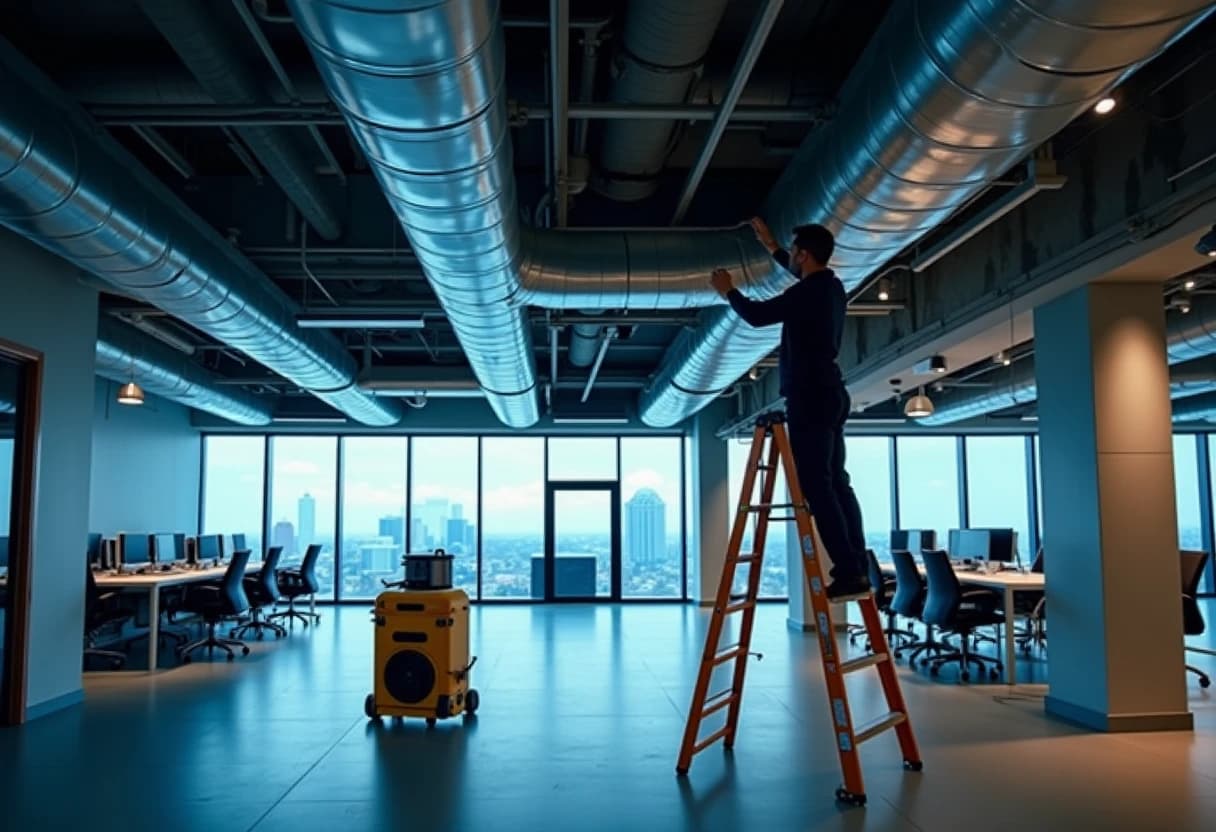
A commercial duct system is a shared resource: one contaminated trunk line serves every office, exam room, dining room or workout floor downstream of it. Our Beacon Hill commercial cleaning service treats it that way, cleaning the complete air path from rooftop unit or air handler through mains, branches and terminal boxes to each diffuser. We use truck-grade and portable HEPA negative-air machines sized to commercial static pressures, rotary brush and compressed-air agitation matched to duct construction, and containment practices that keep finished spaces spotless. Whether you manage a single storefront or a portfolio of properties across Suffolk County, you get one point of contact, flat project pricing quoted from plans or a walkthrough, and reporting formatted for owners, boards and insurance carriers.
Why Commercial Air Duct Cleaning Matters for Beacon Hill Homes
Weigh the cost of cleaning against the cost of not cleaning. A duct cleaning project for a typical commercial space runs a few thousand dollars once every three to five years. On the other side of the ledger: energy waste from fouled coils and choked airflow accruing monthly; premature rooftop unit failures measured in tens of thousands; productivity drag from poor air quality, which peer-reviewed workplace studies tie to slower cognitive performance and higher sick-day rates; tenant turnover costs when IAQ complaints go unresolved through a lease cycle; and the exposure of facing an air-quality claim with no documented maintenance history. Insurers and counsel increasingly treat HVAC hygiene records the way they treat sprinkler inspection records — the absence is the problem. Our commercial service is built to close that gap efficiently: assessment and flat quote from a site walk or mechanical drawings, after-hours execution that costs you zero operating hours, and a completion report with photographic evidence that drops straight into your maintenance file. Few line items in a facilities budget buy this much risk reduction per dollar.
Beacon Hill businesses call us for three commercial scenarios more than any other: post-fit-out cleanings after renovation dust invades the ductwork, odor and stale-air complaints in older buildings, and documentation requirements from insurers or medical tenants. Beacon Hill's Federal and Greek Revival rowhouses date to the early 1800s, making them some of the oldest continuously occupied homes we service anywhere. Behind the brick facades and original shutters, owners have shoehorned modern HVAC into buildings that predate central heating entirely - slim-duct systems in closets, air handlers in former servant stairs, and condensers hidden on rear decks to satisfy the historic commission. Nearly every duct run here is a custom retrofit with tight bends that collect dust aggressively. Two-hundred-year-old plaster, horsehair insulation and crumbling brick party walls shed fine mineral dust that ends up circulating through Beacon Hill's retrofit duct systems. Exterior work requires Beacon Hill Architectural Commission approval, so dryer vents and exhaust terminations are often routed to rear elevations through long concealed runs - exactly the kind of vent that quietly packs with lint. We clean these buildings with the care their age demands. We bring the full commercial setup to every Beacon Hill project — portable and truck-mounted HEPA negative-air machines, rotary brush and air-whip agitation, coil cleaning capability for rooftop and interior units — because commercial trunk lines and VAV systems demand more than residential equipment can deliver. Every project ends with a written completion report, and most are executed entirely outside your business hours.
Our Commercial Air Duct Cleaning Process in Beacon Hill
1Site Walk, System Mapping & Flat Quote
First we scope the job properly: which units serve which spaces, where the trunk lines run, what the ceiling plenum situation looks like, and what condition the ducts are actually in. A borescope camera look at representative runs keeps the assessment honest. The result is a fixed project price and a phasing plan built around your operating hours — no unit rates that balloon mid-project.
2Certificates of Insurance & Scheduling Around Your Operations
We plan commercial projects like contractors, not like a residential crew squeezing in a big job. That means pre-mobilization insurance certificates, coordination with your facilities or property management team, protection plans for finished spaces and merchandise, and crews scheduled for the windows when your building is emptiest — nights, weekends and holidays included at no scheduling premium for standard projects.
3Containment & Protection of Finished Spaces
Retail merchandise, exam rooms, server closets, commercial kitchens — commercial spaces contain things that must not get dusty, and our protection plan is written into every project scope. Sensitive areas are draped or excluded and sequenced appropriately, negative pressure ensures loosened debris travels into HEPA collection rather than the space, and each night's work area is inspected and restored before the crew leaves.
4Negative Pressure on Each Zone
Negative pressure is the backbone of NADCA-standard cleaning, and commercial ductwork tests it: hundred-foot trunk runs, multiple branch takeoffs, VAV boxes and plenum returns all between the debris and the vacuum. We establish collection points strategically along the mains, verify draw at the far ends of each run, and only then begin agitation — ensuring every loosened particle has a clear path out of the building.
5Mechanical Agitation of Trunks, Branches & Terminal Units
This is the labor the price reflects. Every supply branch from diffuser to trunk, every return path including plenum-connected grilles, and every accessible terminal unit gets individual mechanical agitation — not just a blast of air from one end. Stubborn accumulation gets repeat passes until inspection imaging shows clean metal. Access panels are installed where the system lacks them, per NADCA standards, and sealed properly afterward.
6Air Handler, Rooftop Unit & Coil Cleaning
The units themselves get hands-on attention: blower assemblies and housings cleaned, unit cabinets HEPA-vacuumed and wiped, condensate pans cleared and treated, fresh filters installed. Evaporator coil cleaning — the single highest-return item on most commercial systems — is available on every project, and on rooftop units we handle roof access, weather constraints and panel restoration as part of the scope.
7Verification, Restoration & Completion Report
Before the crew demobilizes, every work area is inspected and restored: tiles back, grilles remounted, floors HEPA-vacuumed, protection removed. The final report is a genuine deliverable — photo-documented evidence of cleaned trunks, branches and units, notes on anything we found (disconnections, leaks, insulation damage, pest evidence), and maintenance recommendations with honest intervals. Many clients tell us the report alone justified choosing a certified crew.
Benefits of Professional Commercial Air Duct Cleaning in Beacon Hill
Lower Energy Costs Across Long Operating Hours
Static pressure is a tax on every fan in your building. Dust on blower blades, mats on coil faces and debris in trunk lines all force motors to work harder for less delivered air. Removing that resistance shortens run times, reduces demand peaks, and eases strain on compressors and motors — savings that recur every month the building operates.
Zero Disruption to Business Operations
Overnight, weekend and phased scheduling are the default for our commercial work, not a premium add-on. Retail spaces are cleaned between close and open; offices over weekends; multi-tenant buildings floor by floor with each area restored before occupants return. The only evidence of the project your customers ever see is cleaner air.
Extended Rooftop Unit & Equipment Life
Deferred air-side maintenance shows up later as compressor failures, burned motors and heat-exchanger problems — repairs that dwarf the cost of cleaning. Facilities teams that fold duct and coil cleaning into their preventive maintenance calendar consistently see fewer emergency calls and longer equipment lifecycles, which is exactly the argument that wins budget approval.
Documentation for Insurance, Leases & Compliance
Every project produces a completion report with photographic evidence, scope checklist and service date — the paper trail insurers, medical tenants, franchise inspectors and boards increasingly expect. When an air-quality question arises later, a documented maintenance history is the difference between a closed inquiry and an exposure. We format reports for exactly that use.
A Visibly Cleaner, Fresher-Smelling Space
Odors live in the organic film inside ductwork — cooking residue in food service, sweat and rubber in gyms, general staleness everywhere — and re-release with every operating hour. Air fresheners mask the symptom on top of the cause. Source removal takes the saturated dust out of the building, which is the only fix that survives the week.
Fewer IAQ Complaints, Happier Tenants & Staff
For employers, air quality is a retention and productivity issue — workplace studies consistently link ventilation quality to cognitive performance and absenteeism. For landlords, it is a lease-renewal issue. Removing years of accumulated contamination from the system every occupant shares is one of the few facility investments both groups notice within the first week.
Signs Your Beacon Hill Home Needs Commercial Air Duct Cleaning
Rising Energy Bills or Weak Airflow in Certain Zones
Before your HVAC contractor quotes a rebalancing or an equipment upgrade, verify the air path is clean. We regularly find the 'undersized unit' serving a chronically uncomfortable zone is actually a properly sized unit breathing through a decade of accumulation. The cleaning costs a fraction of the equipment change it prevents.
Water Intrusion, Mold Findings or Pest Evidence
Visible growth on diffusers, unit interiors or duct surfaces is an immediate-action finding in every IAQ framework. It is also a liability accelerant: once observed and reported, an owner's response timeline becomes evidence. Prompt professional cleaning with photographic documentation is both the fix and the defensible record of it.
Tenant or Employee Air Quality Complaints
The complaint pattern tells the story: symptoms that ease when occupants leave the building, worsen when the system runs hardest, and cluster in specific zones implicate the ductwork serving those zones. An inspection settles it in an hour, and cleaning resolves what the inspection finds — with photos to close the loop with complainants.
No Service History Anyone Can Find
NADCA guidance calls for periodic inspection of commercial air systems, with cleaning as conditions warrant — and in Greater Boston's older commercial stock, conditions almost always warrant. Starting a documented maintenance cycle now costs a site walk; explaining a decade of missing records to an insurer or a tenant's counsel later costs considerably more.
Dust Streaking on Diffusers, Grilles & Ceiling Tiles
Janitorial crews wiping the same diffusers every month are documenting the problem, not fixing it. Persistent re-soiling of terminals means the duct interiors upstream are shedding continuously. After a proper source-removal cleaning, terminal surfaces stay clean for years instead of weeks — an easy before-and-after your maintenance log will show.
Odors That Return Every Operating Day
'Dirty sock' odors at system startup indicate microbial activity on coils or in ducts — most common after humid summers in systems with marginal condensate drainage. It deserves prompt attention: the same conditions producing odor can progress to visible growth, which escalates the fix from cleaning to remediation.
Commercial Air Duct Cleaning Cost in Beacon Hill, MA
Why does the per-square-foot rate vary from $0.15 to $0.50? Density and difficulty. A modern open-plan office with exposed spiral duct cleans efficiently and prices near the bottom of the range. A medical suite with many small rooms, dense branch runs and infection-control protocols prices higher per foot. Restaurants add grease-influenced dust and overnight-only access; older buildings add long trunk runs, missing access panels (which NADCA-standard work requires us to install properly) and decades of accumulation requiring repeat agitation passes. Add-ons are quoted separately and honestly: evaporator or RTU coil cleaning typically $250–$600 per unit, EPA-registered sanitizing treatment $150–$500 depending on system size, and duct repairs always priced for approval before work. Nothing is 'discovered' on site and added to your invoice without a signed change.
Want the full pricing picture? See our complete Boston-area cost guide or call (617) 390-7145 for an exact flat quote for your Beacon Hill home.
Local Knowledge: Beacon Hill, Suffolk County
What makes Beacon Hill different? Beacon Hill's Federal and Greek Revival rowhouses date to the early 1800s, making them some of the oldest continuously occupied homes we service anywhere. Behind the brick facades and original shutters, owners have shoehorned modern HVAC into buildings that predate central heating entirely - slim-duct systems in closets, air handlers in former servant stairs, and condensers hidden on rear decks to satisfy the historic commission. Nearly every duct run here is a custom retrofit with tight bends that collect dust aggressively. Two-hundred-year-old plaster, horsehair insulation and crumbling brick party walls shed fine mineral dust that ends up circulating through Beacon Hill's retrofit duct systems. Exterior work requires Beacon Hill Architectural Commission approval, so dryer vents and exhaust terminations are often routed to rear elevations through long concealed runs - exactly the kind of vent that quietly packs with lint. We clean these buildings with the care their age demands. For duct and dryer vent systems, those local factors translate into specific, predictable problems — and predictable problems are the ones we solve fastest. Call (617) 390-7145, tell us your street and home style, and we will quote the job accurately the first time, usually in under five minutes.
The Best Time of Year in Beacon Hill
Commercial buildings in Massachusetts live on a two-season HVAC cycle — heating from October into April, cooling through the humid summer — and both seasons punish dirty ductwork. Fall is the smartest window for commercial cleaning: systems get a clean start before near-continuous winter runtime, and the first heating cycles do not broadcast burnt-dust odor through the workplace. Late spring is the second-best slot, clearing winter accumulation before cooling season seals the building. For retail, the calendar adds its own logic — holiday-season floors should be cleaned by early November, not during it — and schools and daycares book vacation weeks months ahead. We hold overnight and weekend capacity year-round, but the fall commercial rush is real; property managers who schedule in September choose their dates rather than taking what remains.
Why Choose Boston Air Duct Cleaners
What separates us from the coupon crowd is simple: we do the whole job, we prove it, and we charge what we quoted. Our technicians clean supplies, returns, trunks and blower compartments on every visit — never a cosmetic vent wipe. Photo documentation comes standard, pricing is flat and confirmed up front, and our trucks carry true commercial vacuum equipment, not rented shop-vacs. Based in West Newton and serving Beacon Hill year-round, we answer our own phone at (617) 390-7145 and stand behind every cleaning with a satisfaction guarantee.
Serving Beacon Hill and Surrounding Communities
We serve every community around Beacon Hill as well: Back Bay, Boston, Charlestown, Cambridge, South End, Somerville all fall inside our regular service routes. If you have a second property, a rental, or family nearby, ask about multi-home scheduling — grouped appointments on the same route are our most requested discount.