
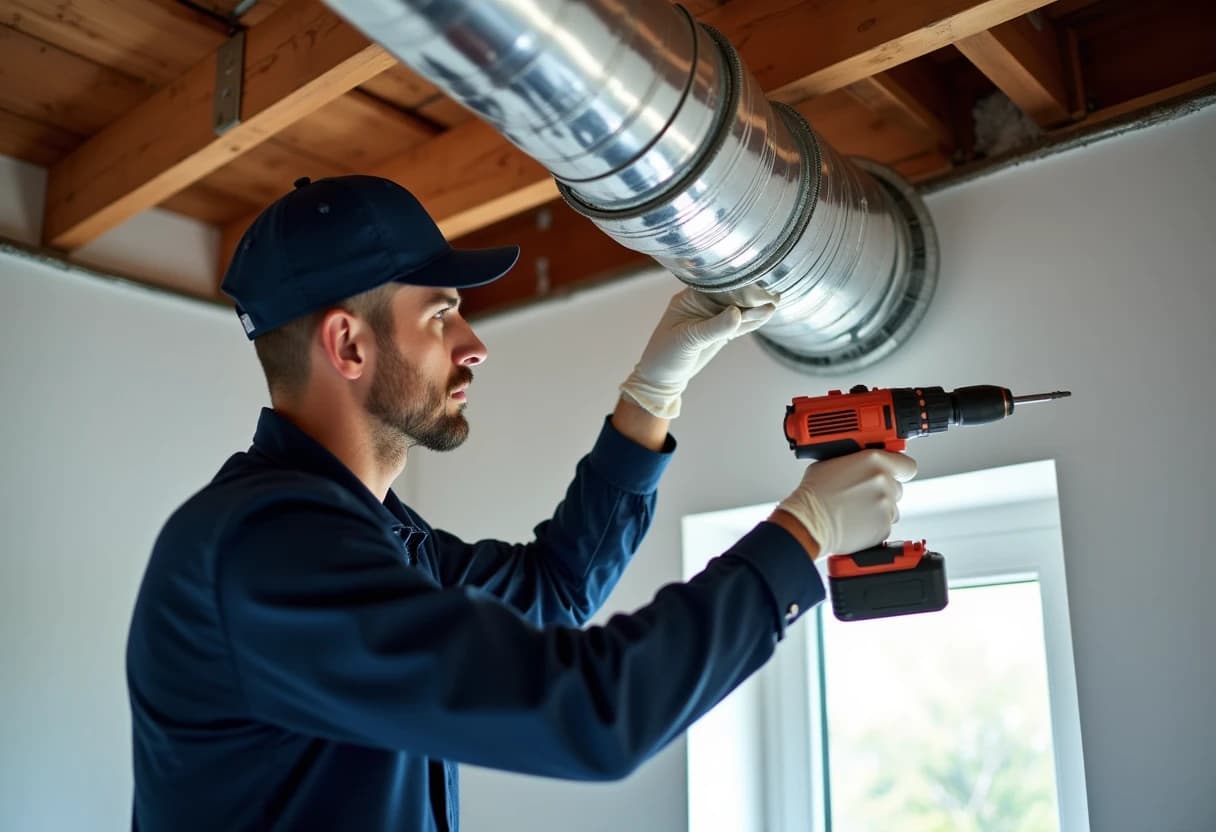
Homeowners in Sharon call us for dryer vent installation at three moments: when a new laundry location needs its first vent, when a home inspection or appliance installer condemns the existing setup, and when years of blockages and repairs make clear the old route will never work. In all three cases the job is the same discipline: route planning against the code's 35-foot equivalent-length budget, 4-inch smooth rigid metal duct, clamped and taped joints with no screws in the airstream, insulation where the run crosses unheated space, and a termination — side wall, rim joist or roof — that keeps out weather and wildlife. Flat quotes, one-day installs, and a system your annual cleaning will keep healthy for decades.
Why Dryer Vent Installation & Rerouting Matters for Sharon Homes
Materials are the second decision that determines everything after. Vinyl accordion hose — still present behind thousands of local dryers — is a fire hazard the industry disowned decades ago: it melts, kinks and packs with lint. Foil flex crushes at a touch and corrugates the airflow into turbulence that drops fibers at every ridge. Even where flex is tolerated, it is only as a short transition at the appliance, never concealed, never as the run. Smooth-interior rigid metal duct is the code's answer and ours: lint slides across it instead of catching, rotary cleaning brushes glide through it at full effectiveness, it cannot kink or sag into condensation bellies when properly supported, and it is noncombustible. Joints matter equally — fitted in the direction of airflow, secured with clamps or external fasteners and sealed with UL-listed foil tape, because a screw tip inside the duct becomes a lint anchor that seeds the next blockage. Full flex-to-rigid replacement is among our most common installations, and its effects are permanent: slower lint accumulation, faster cleanings, better drying, lower risk.
Basement laundries dominate Sharon's housing stock, and they are where thoughtful venting matters most. Sharon's housing ranges from early-1900s homes around Post Office Square and summer-cottage conversions near Lake Massapoag to large mid-century and 1980s-2000s colonials set into the town's heavily wooded lots. The lake-area cottages that became year-round homes often carry pieced-together heating systems, while the bigger colonials run long duct networks across multiple zones. A below-grade dryer must exhaust up and out — through the rim joist above the foundation, most often — and every foot of that run crosses cold space where moist exhaust wants to condense. Sharon is one of the most wooded towns we serve, and the tree canopy around Moose Hill and Lake Massapoag delivers intense spring pollen and autumn leaf-mold loads that end up in return ducts. Lakeside homes add summer humidity to the mix, a combination that makes regular duct cleaning noticeably improve allergy seasons here. Our basement installations handle both problems by design: the shortest legal route to a rim-joist or high-wall termination, continuous slope so any condensate drains outward, and insulation on duct crossing unheated space. The result is a basement laundry that stays dry, and a vent that stays clear between annual cleanings.
Our Dryer Vent Installation & Rerouting Process in Sharon
1Site Assessment & Route Planning
Every installation begins with the route. We assess the laundry location, measure candidate paths to the exterior, and score each against the code's 35-foot equivalent-length budget — deducting for every elbow — and against your home's structure: framing, foundation type, finished spaces, and where a termination can legally and sensibly exit. You get options with trade-offs explained, and a flat price for the route you choose.
2Demolition of Non-Compliant Venting
Old venting comes out carefully, not destructively: we protect finishes, keep openings minimal, and document conditions as we find them. What we uncover often explains years of symptoms — a crushed flex section behind a wall, a joint that separated a decade ago, a cavity lined with escaped lint. Photos go in your record.
3Cut & Flash the Exterior Penetration
Penetrations are where amateur installs leak — water into sheathing, air into cavities. Ours are built like window details: sized to the hood, flashed to shed water over the cladding, sealed with quality exterior sealant, and finished so the termination looks intentional on the facade. On masonry we drill and anchor; we never improvise attachment.
4Install Rigid Metal Duct on the Planned Route
Where the route crosses unheated space — a cold basement, garage bay, attic run — we insulate the duct so exhaust stays above its dew point until it exits, which is the difference between a dry duct and a condensation problem in a Massachusetts winter. Concealed sections are completed and verified before any finishes close them in.
5Mount the Termination Hood & Damper
Where pests are a known pressure — and in Greater Boston they are — we fit guard designs engineered for dryer exhaust: excluding birds and rodents without restricting airflow or trapping lint. We also note the hood in your service record so future cleanings include damper checks, keeping the one wear-prone component watched for the system's life.
6Connect the Appliance & Seal the System
At the dryer, we install a short UL-listed semi-rigid aluminum transition duct — the only place flexible material belongs — clamped at both ends and routed so it keeps full diameter when the machine is pushed to its working position. We mark the safe setback so the connector is never crushed by a future shove against the wall.
7Test, Verify & Document the Installation
Before we leave: work areas vacuumed with HEPA equipment, penetration debris removed, the dryer set and leveled, and a walkthrough of the finished system — where it runs, how the damper should look during a cycle, and when the first annual cleaning is due. A correctly built vent needs almost nothing from you; we make sure you know the little it does.
Benefits of Professional Dryer Vent Installation & Rerouting in Sharon
Moisture Managed, Structure Protected
Every load pushes about a gallon of water vapor through the vent, and an engineered system delivers all of it outdoors: continuous slope drains any condensate to the termination, insulation keeps exhaust above its dew point across cold spaces, and sealed joints leave nothing to drip. Your framing, insulation and finishes stay dry, load after load, year after year.
Fire-Safe by Design, Not by Vigilance
A code-compliant installation attacks fire risk structurally: smooth rigid metal that lint slides across instead of catching on, a run short enough that exhaust velocity carries fibers all the way out, joints without screw tips to snag them, and a termination that cannot mat over. The system accumulates fuel slowly by design — safety that does not depend on anyone remembering anything.
A Laundry Located Where You Actually Want It
For renovations, early vent planning is leverage: consulted while walls are open, we can route a short, straight, fully concealed run that would be expensive or impossible after drywall. A ten-minute conversation at framing stage regularly saves homeowners hundreds of dollars and a compromised route.
Permanently Lower Energy Costs
Sealed rigid duct also stops the hidden energy leaks of bad systems: conditioned air escaping through gapped joints, winter infiltration through failed dampers, and the heating-season cost of a laundry room with a permanent 4-inch draft. A tight system with a tight damper closes all of it.
Code Compliance That Closes Every Question
The finished system meets the IRC's dryer exhaust provisions line by line: 4-inch smooth rigid metal, equivalent length within the 35-foot budget, no fasteners in the airstream, damper-equipped unscreened termination. For home sales, that removes a standard inspection flag; for permits and condo approvals, our documentation answers the questions before they are asked.
Decades of Service From a One-Day Job
The one-day timeline is real for most installations: assessment and route confirmation, demolition of old venting, penetration, duct assembly, termination, connection and commissioning typically fit a single visit. Complex reroutes through finished space may take a second day. Either way, laundry is back in service the same evening.
Signs Your Sharon Home Needs Dryer Vent Installation & Rerouting
Blockages and Repairs Keep Recurring
If your vent needs cleaning twice a year, blocks anyway, and has accumulated a history of repairs, the route itself is the problem — too long, too bent, wrong materials, or condensation-prone by design. At some point serial maintenance costs more than the reroute that ends it. We will do that math with you honestly; often the crossover is closer than expected.
The Run Is Overlong or Elbow-Heavy
Count the route: if your duct wanders more than roughly 25 linear feet, or turns more than three corners, it is likely past the code's 35-foot equivalent-length budget once elbows are deducted — typically five feet per 90-degree bend. Beyond the budget, the dryer physically cannot keep lint moving to the outlet, and chronic clogging is built in.
Your Vent Is Flexible Plastic or Foil Duct
Look behind and beyond your dryer: if the exhaust path is white vinyl or shiny foil accordion hose — especially if it disappears into a wall or ceiling that way — the system needs replacement, not another cleaning. Flex materials trap lint in every corrugation, crush at a touch, and in vinyl's case can melt. Codes and manufacturers rejected them long ago.
Chronic Condensation the Route Guarantees
Some vents condense because of damage; others condense because of design — long uninsulated passages through cold basements, garages or attics where exhaust cannot stay above its dew point, or bellied routes with no slope to drain. When repair visits keep treating water in the same duct, the route is the diagnosis, and rerouting or rebuilt insulation and slope is the cure.
Inspection, Insurance or Association Requirements
Appliance warranties add quiet pressure: manufacturers condition coverage on adequate exhaust, and a warranty claim on a dryer connected to a non-compliant vent can be denied on that basis. If you are buying a premium machine, the few hundred dollars of proper venting is also warranty insurance.
A New Laundry Location Needs Its First Vent
Moving laundry upstairs, finishing a basement, building an in-law suite or converting a condo all create the same requirement: a new exhaust route, designed before the walls close if at all possible. Vent routing decided at the framing stage is shorter, cheaper and cleaner than the same route retrofitted through finished surfaces months later.
Dryer Vent Installation & Rerouting Cost in Sharon, MA
Multi-family and condo installation pricing carries a few specifics worth knowing up front. Roof terminations — common for interior condo laundries — sit toward the top of the range for the flashing and access work, typically $650 to $900 for the full installation. Association requirements add process rather than much cost: we provide written scopes for board approval and certificates of insurance at no charge, and our documentation is built to satisfy trustee and management-company review. The meaningful savings lever is coordination: when a triple-decker owner or association books multiple units in one mobilization, shared setup, staging and travel drop per-unit pricing by 20 to 30 percent, and the building ends up with one consistent, compliant system instead of three eras of improvisation. For laundry-relocation projects inside renovations, timing is the lever: venting roughed in while walls are open routinely costs $200 to $400 less than the identical route built after finishes, which is why we encourage a planning call at the framing stage — free advice that saves real money.
Want the full pricing picture? See our complete Boston-area cost guide or call (617) 390-7145 for an exact flat quote for your Sharon home.
Local Knowledge: Sharon, Norfolk County
Serving Sharon means knowing Sharon. Sharon's housing ranges from early-1900s homes around Post Office Square and summer-cottage conversions near Lake Massapoag to large mid-century and 1980s-2000s colonials set into the town's heavily wooded lots. The lake-area cottages that became year-round homes often carry pieced-together heating systems, while the bigger colonials run long duct networks across multiple zones. Sharon is one of the most wooded towns we serve, and the tree canopy around Moose Hill and Lake Massapoag delivers intense spring pollen and autumn leaf-mold loads that end up in return ducts. Lakeside homes add summer humidity to the mix, a combination that makes regular duct cleaning noticeably improve allergy seasons here. Those conditions shape how we work here: which brush heads come off the truck, how we protect finishes in older interiors, and what we expect to find when the camera goes into a 02067 duct system. Our crews are in and around Sharon nearly every week — often for neighbors of past customers — so scheduling is fast and our arrival windows hold.
The Best Time of Year in Sharon
Renovation season drives our installation rhythm as much as weather does. Greater Boston remodels from spring through fall — basements finished, laundries moved upstairs, triple-deckers converted to condos — and every one of those projects needs dryer exhaust designed rather than improvised. The economics of timing are stark: venting planned at framing stage routes shorter, conceals cleaner and costs $200 to $400 less than the same run retrofitted after drywall. We take planning calls from homeowners and contractors all season, often walking a route in fifteen minutes that saves the project real money and the homeowner a decade of compromise. If your project touches the laundry — or could move it somewhere better — the cheapest vent you will ever build is the one designed before the walls close.
Why Choose Boston Air Duct Cleaners
Choosing a duct cleaner is really a trust decision — you are letting a crew work inside the system that feeds air to your family. We make that decision easy: a local West Newton company with insured, uniformed technicians, transparent flat-rate quotes, NADCA-standard equipment and methods, and photographic proof of the finished work. No door-to-door sales, no bait-and-switch coupons, no invented 'mold emergencies.' Just honest mechanical cleaning done properly the first time, backed by a written guarantee.
Serving Sharon and Surrounding Communities
Beyond Sharon, our crews cover the surrounding communities daily — including Canton, Stoughton, Foxborough, Easton, Walpole, Norwood. Because routes cluster geographically, booking alongside a neighboring appointment often unlocks same-day service and combined-visit savings. Wherever you are in Norfolk County, the same flat-rate pricing, insured technicians and photo-documented process applies.