
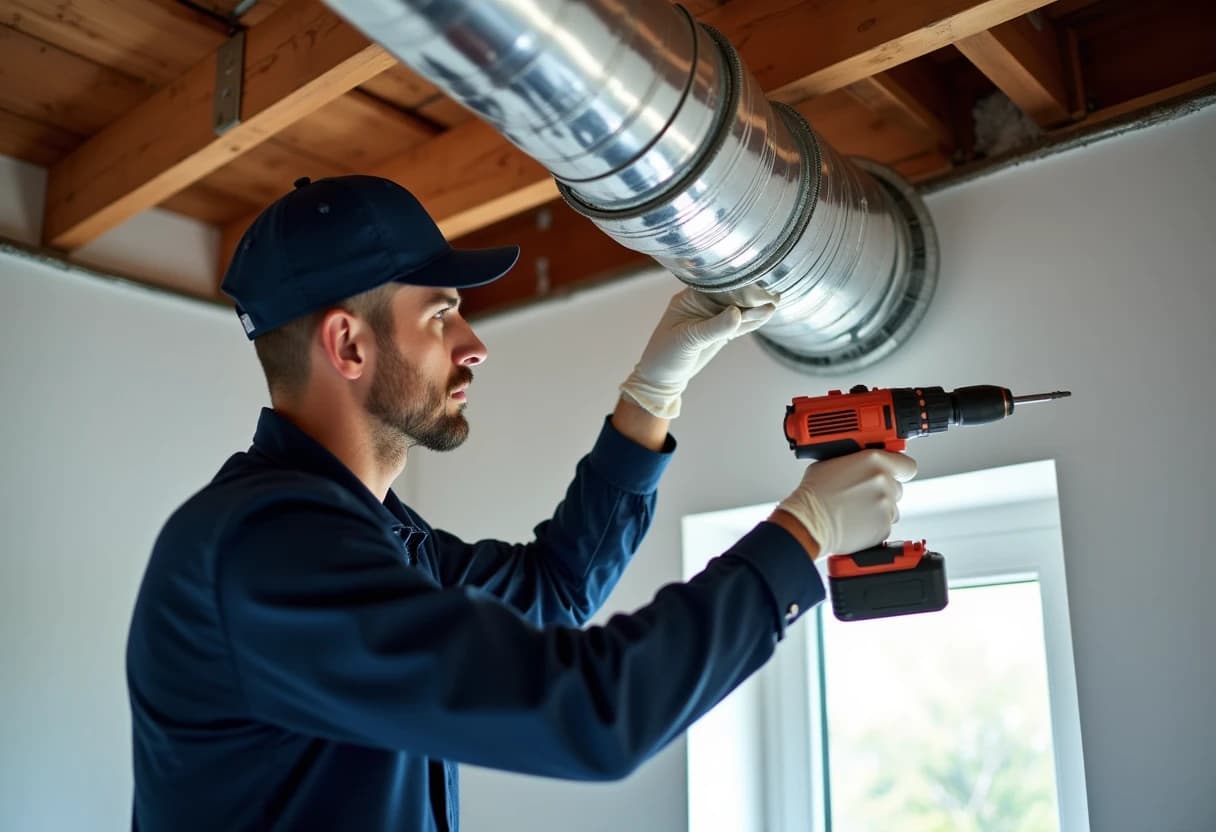
Some dryer vents cannot be cleaned or repaired into safety — they were never right to begin with. Runs assembled from vinyl or foil flex duct, routes that wander fifty feet through a basement, dryers venting into crawlspaces or garages, laundry areas with no vent at all: these call for installation, not maintenance. Our Easton crews design and build code-compliant dryer exhaust systems from scratch — 4-inch smooth rigid metal duct, the shortest practical route to outdoors, joints without airstream-piercing screws, and a proper damper-equipped termination through the side wall, roof or rim joist. Priced flat from $300 to $900, finished in a day, and built to outlast the dryer itself.
Why Dryer Vent Installation & Rerouting Matters for Easton Homes
Materials are the second decision that determines everything after. Vinyl accordion hose — still present behind thousands of local dryers — is a fire hazard the industry disowned decades ago: it melts, kinks and packs with lint. Foil flex crushes at a touch and corrugates the airflow into turbulence that drops fibers at every ridge. Even where flex is tolerated, it is only as a short transition at the appliance, never concealed, never as the run. Smooth-interior rigid metal duct is the code's answer and ours: lint slides across it instead of catching, rotary cleaning brushes glide through it at full effectiveness, it cannot kink or sag into condensation bellies when properly supported, and it is noncombustible. Joints matter equally — fitted in the direction of airflow, secured with clamps or external fasteners and sealed with UL-listed foil tape, because a screw tip inside the duct becomes a lint anchor that seeds the next blockage. Full flex-to-rigid replacement is among our most common installations, and its effects are permanent: slower lint accumulation, faster cleanings, better drying, lower risk.
From the triple-deckers near Oakes Ames Memorial Hall to the singles and capes out toward Stonehill College, Easton presents every dryer venting challenge in the catalog: interior laundry rooms far from exterior walls, below-grade basements where the only exit is the rim joist, and condo layouts that force roof terminations. North Easton village is a nationally significant landscape of H.H. Richardson buildings and Ames-era worker housing, including the converted Ames Shovel Works lofts, while South Easton and Eastondale carry the town's postwar capes and its 1980s-2000s colonial subdivisions. The shovel-works and other mill conversions rely on modern ducted systems threaded through 19th-century stone and timber structures. We have built vents through all of it. Easton's historic mill-condo conversions around Shovel Shop Pond give us distinctive jobs where new ductwork meets 150-year-old masonry and moisture behaves unpredictably. Wetlands around Borderland State Park and the Hockomock Swamp also push summer humidity higher than residents expect from an inland town. Because our shop is about 27 miles away in West Newton, site visits and installs schedule quickly — and most Easton installations are complete, verified and cleaned up within a single day.
Our Dryer Vent Installation & Rerouting Process in Easton
1Site Assessment & Route Planning
Every installation begins with the route. We assess the laundry location, measure candidate paths to the exterior, and score each against the code's 35-foot equivalent-length budget — deducting for every elbow — and against your home's structure: framing, foundation type, finished spaces, and where a termination can legally and sensibly exit. You get options with trade-offs explained, and a flat price for the route you choose.
2Demolition of Non-Compliant Venting
Replacement jobs start with removing what failed: vinyl and foil flex pulled from cavities and joist bays, abandoned duct capped or extracted, screened hoods and window inserts taken out, and improvised terminations into attics or crawlspaces closed off. We vacuum the lint these systems have shed along their routes — hidden accumulation that should not stay in the structure.
3Cut & Flash the Exterior Penetration
Penetrations are where amateur installs leak — water into sheathing, air into cavities. Ours are built like window details: sized to the hood, flashed to shed water over the cladding, sealed with quality exterior sealant, and finished so the termination looks intentional on the facade. On masonry we drill and anchor; we never improvise attachment.
4Install Rigid Metal Duct on the Planned Route
Support and slope are built in as we go: hangers and strapping at proper intervals so no section can sag into a condensation belly, and a continuous pitch toward the termination so any moisture that does condense drains outdoors instead of pooling. These details are invisible when the job is done and decisive for how the system ages.
5Mount the Termination Hood & Damper
Where pests are a known pressure — and in Greater Boston they are — we fit guard designs engineered for dryer exhaust: excluding birds and rodents without restricting airflow or trapping lint. We also note the hood in your service record so future cleanings include damper checks, keeping the one wear-prone component watched for the system's life.
6Connect the Appliance & Seal the System
At the dryer, we install a short UL-listed semi-rigid aluminum transition duct — the only place flexible material belongs — clamped at both ends and routed so it keeps full diameter when the machine is pushed to its working position. We mark the safe setback so the connector is never crushed by a future shove against the wall.
7Test, Verify & Document the Installation
You receive complete documentation: photos of the route (including concealed sections before they closed), the materials used, the equivalent-length math, and the finished termination. For permitted work, condo approvals or home sales, this record answers every question an inspector, board or buyer will ask about what is behind the walls.
Benefits of Professional Dryer Vent Installation & Rerouting in Easton
Moisture Managed, Structure Protected
Moisture protection extends to the envelope itself: our flashed, sealed penetrations keep wind-driven rain out of walls and roofs for the long term. An installation is only as good as its weakest detail, and the exterior detail is the one that faces forty years of nor'easters. We build it like it will.
Permanently Lower Energy Costs
The efficiency also shows up in maintenance economics: smooth, short, sealed runs need only quick annual cleanings, while flex mazes generate blockage-level service calls and appliance repairs. Over ten years, the well-installed vent is the cheaper vent by a wide margin, before counting a single kilowatt-hour.
Code Compliance That Closes Every Question
Compliance has practical teeth in transactions: dryer venting is among the most commonly flagged items in Massachusetts home inspections, and an improvised system becomes a negotiation item or a closing repair. A documented compliant installation converts that liability into a selling point — visible evidence of a well-maintained house.
Dramatically Faster Drying
Shortening a wandering 40-foot run to a direct 12-foot route transforms drying performance: full airflow means each cycle actually exhausts the gallon of moisture a load releases, so sensor dryers stop running overtime and heavy loads finish in one pass. Customers routinely describe post-installation performance as having bought a new machine.
A Laundry Located Where You Actually Want It
For renovations, early vent planning is leverage: consulted while walls are open, we can route a short, straight, fully concealed run that would be expensive or impossible after drywall. A ten-minute conversation at framing stage regularly saves homeowners hundreds of dollars and a compromised route.
Decades of Service From a One-Day Job
Because we also clean and repair dryer vents across Greater Boston, we install with the next twenty years of maintenance in mind — routes our own brushes can traverse, access preserved where it matters, baselines recorded for future verification. We build systems we expect to service ourselves, and it shows in the choices.
Signs Your Easton Home Needs Dryer Vent Installation & Rerouting
Inspection, Insurance or Association Requirements
Condo associations across Greater Boston have tightened dryer vent requirements after regional fire losses, and some now mandate compliant installation on unit turnover or renovation. If your building has issued requirements, we handle the full sequence: scope for board approval, insured installation, and per-unit documentation for the association's records.
Your Vent Is Flexible Plastic or Foil Duct
A quick self-check: press gently on the visible duct. Rigid metal does not give; flex crumples. If any concealed portion of your run is flex, assume the hidden sections are in worse shape than the visible ones — they always are — and price the replacement before the blockage schedule prices it for you.
Chronic Condensation the Route Guarantees
Watch the laundry itself: loads that come out damp-smelling, a duct that drips after cycles, rust tracks under joints. Chronic internal moisture is rotting the system from the inside while it feeds blockages. The permanent fix is a route engineered for New England winters, not another season of drip trays and patches.
Blockages and Repairs Keep Recurring
If your vent needs cleaning twice a year, blocks anyway, and has accumulated a history of repairs, the route itself is the problem — too long, too bent, wrong materials, or condensation-prone by design. At some point serial maintenance costs more than the reroute that ends it. We will do that math with you honestly; often the crossover is closer than expected.
The Run Is Overlong or Elbow-Heavy
Basement laundries venting to a far wall are the classic offenders — installed where the first hole was easiest, not where the route was shortest. Our assessment often finds a rim-joist or near-wall exit that cuts the run by half or more. Ask for the measurement; the equivalent-length math takes ten minutes and settles the question.
A New Laundry Location Needs Its First Vent
New dryer purchases trigger the question too: installers deliver the machine but rarely build ductwork, and a new appliance connected to no vent — or a condemned one — sits unusable. If your delivery is scheduled, get the vent designed and installed ahead of it, so the first load runs the day the dryer arrives.
Dryer Vent Installation & Rerouting Cost in Easton, MA
Understanding the cost drivers helps you compare quotes intelligently. Distance and elbows set the duct budget — both in dollars and in the code's 35-foot equivalent-length allowance — so the shortest workable route is cheapest twice over. The penetration is the next driver: hole-sawing clapboard is quick; core-drilling stone foundation or flashing a roof cap takes equipment and time. Access is third: exposed basement routes install fast, while runs concealed through finished walls and ceilings involve careful openings and coordination on restoration. Termination choice matters modestly — quality wall hoods, rim-joist hoods and dryer-rated roof caps span roughly $30 to $150 in parts — but skimping there is false economy, since the damper is the system's one wear component. Beware quotes that reach a low number with flex duct, screened hoods or screwed joints: each is a code violation that converts your installation savings into years of accelerated lint accumulation and future service calls. The correct comparison is rigid-to-rigid, and on that basis our pricing is consistently competitive across Eastern Massachusetts.
Want the full pricing picture? See our complete Boston-area cost guide or call (617) 390-7145 for an exact flat quote for your Easton home.
Local Knowledge: Easton, Bristol County
Every town's ductwork tells the story of its housing. North Easton village is a nationally significant landscape of H.H. Richardson buildings and Ames-era worker housing, including the converted Ames Shovel Works lofts, while South Easton and Eastondale carry the town's postwar capes and its 1980s-2000s colonial subdivisions. The shovel-works and other mill conversions rely on modern ducted systems threaded through 19th-century stone and timber structures. Easton's historic mill-condo conversions around Shovel Shop Pond give us distinctive jobs where new ductwork meets 150-year-old masonry and moisture behaves unpredictably. Wetlands around Borderland State Park and the Hockomock Swamp also push summer humidity higher than residents expect from an inland town. We plan Easton jobs around those realities, from equipment selection to time on site, and it shows in the results. If you live near Oakes Ames Memorial Hall or anywhere across Easton's 02356 area, we have almost certainly cleaned a system like yours before — and we can tell you exactly what to expect before we arrive.
The Best Time of Year in Easton
There is a right season for dryer vent installation in Massachusetts, and it is earlier than most homeowners think. Exterior penetrations, flashing and sealant all prefer dry, above-freezing weather, and roof terminations essentially require it — which makes late spring through fall the natural construction window. Demand tells the same story from the other side: our installation calendar fills through fall as households discover failing vents during the first heavy-laundry weeks, and winter installs, while entirely doable for wall and rim-joist routes, involve weather scheduling around the exterior work. The strategic move is the one our repeat customers make: assess in summer, install in early fall, and enter the heating season — when the dryer works hardest and the house seals tightest — on a fresh, verified, code-compliant system.
Why Choose Boston Air Duct Cleaners
Choosing a duct cleaner is really a trust decision — you are letting a crew work inside the system that feeds air to your family. We make that decision easy: a local West Newton company with insured, uniformed technicians, transparent flat-rate quotes, NADCA-standard equipment and methods, and photographic proof of the finished work. No door-to-door sales, no bait-and-switch coupons, no invented 'mold emergencies.' Just honest mechanical cleaning done properly the first time, backed by a written guarantee.
Serving Easton and Surrounding Communities
Beyond Easton, our crews cover the surrounding communities daily — including Stoughton, Sharon, Mansfield, Brockton, Foxborough, Avon. Because routes cluster geographically, booking alongside a neighboring appointment often unlocks same-day service and combined-visit savings. Wherever you are in Bristol County, the same flat-rate pricing, insured technicians and photo-documented process applies.