
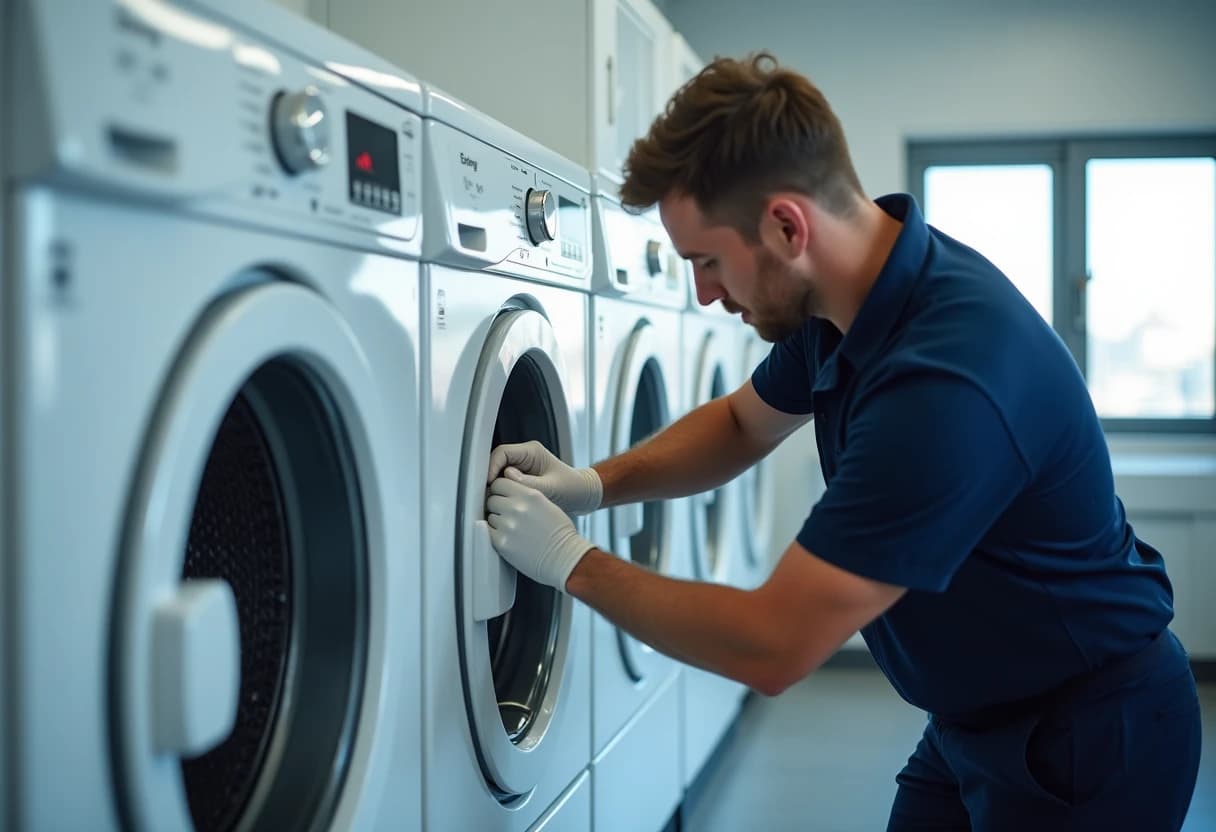
The call we never want to get from Randolph is the one after the fire. Dryer fires are overwhelmingly preventable — lint-clogged venting is the leading cause, per FEMA and NFPA — and in multi-family buildings a single unit's blocked vent endangers every neighbor sharing the structure. That is why insurers, and increasingly master-policy underwriters, ask associations for documented vent maintenance. Our program gives Randolph buildings the complete answer: scheduled whole-building cleanings with resident coordination handled by us, mechanical end-to-end cleaning of every vent and shared riser, immediate flagging of hazards like foil accordion transition ducts and crushed runs, and a unit-by-unit report formatted for board minutes and insurance files. Most buildings are completed in one to three days.
Why Commercial & Multi-Unit Dryer Vent Cleaning Matters for Randolph Homes
Residents cannot solve this problem individually, which is why it belongs to the building. A tenant or condo owner can clear their lint screen and perhaps the first few feet of transition hose — but the duct in the wall, the vertical riser shared with three neighbors, the forty-foot ceiling run to the far wall, and the termination flap four stories up are all beyond any resident's reach, tools and authority. Meanwhile every load every household dries adds lint to those shared paths. This is the classic common-element maintenance problem: individually invisible, collectively dangerous, and cheap to fix at building scale. A coordinated whole-building cleaning turns dozens of separate impossibilities into one efficient project — our coordinator handles notices and access scheduling, crews clear multiple units per hour once mobilized, no-access units are documented and revisited, and the building ends the week with every run verified clear. Boards that institutionalize it annually spend a modest per-door amount; buildings that leave it to residents are, in practice, leaving it to no one.
Randolph property managers call us for three reasons more than any other: an insurance renewal questionnaire asking about vent maintenance, a resident complaint about two-cycle dry times, or a neighboring building's fire making the local news. Randolph built out fast in the 1950s and 60s, so the dominant stock is modest capes, ranches and split-levels on tidy lots, with older Victorians clustered near Crawford Square and Stetson Hall. Most of these post-war homes came with forced-air furnaces from day one, which means original sheet-metal ductwork that is now sixty-plus years old and often has never been professionally cleaned. Because so much of Randolph's housing shares the same 1950s-60s construction vintage, we routinely find duct systems that have accumulated a half-century of dust, pet dander and renovation debris. Homes backing up to the Blue Hills Reservation side of town also pull in heavy seasonal pollen that settles deep in supply runs. All three end the same way — a coordinated building-wide cleaning with per-unit documentation. We handle resident scheduling and notices, clean every run with rotary brush and vacuum extraction, service the shared risers individual residents cannot reach, and deliver the report that closes the file. Most Randolph buildings complete in a single visit of one to three days.
Our Commercial & Multi-Unit Dryer Vent Cleaning Process in Randolph
1Building Walkthrough & Per-Unit Proposal
Every building project starts with a walkthrough: we identify how each unit vents — individual wall runs, shared vertical risers, common trunk lines — locate terminations on walls and roofs, note access requirements, and inspect representative runs. The proposal that follows prices the building flat, per unit, with riser and common-duct service itemized, so boards approve a known number.
2Resident Coordination & Scheduling
For occupied buildings, logistics decide whether a project succeeds. Ours run on a simple system: management distributes our notice template with dates; we sequence units floor by floor to keep crews moving; a coordinator handles reschedules and lockouts as they arise; and the final report distinguishes cleaned, no-access and exception units explicitly, because an insurer reading it will want exactly that distinction.
3Dryer-Side Service: Transition Duct & Connection
Each unit visit starts at the machine: lint screen housing vacuumed, dryer pulled and the fire-load of lint behind it removed, transition duct inspected against IRC M1502 requirements — smooth interior, proper material, no screws projecting into the airstream, no excessive length or crushing. Deficiencies are photographed for the unit's report line, and simple corrections are completed during the same visit with owner approval.
4Mechanical Cleaning of the Full Vent Run
Compressed-air whips and rotary brushes work the duct from the unit connection toward the termination, mechanically stripping the lint mat that blowers and leaf-blower shortcuts merely compact. Every elbow — each one worth 5 feet of equivalent length under code math, and each one a lint trap in practice — gets deliberate attention. Extracted lint is bagged per unit, which residents find quietly persuasive.
5Shared Risers, Common Trunks & Booster Fans
High-rise and mid-rise venting is a system, not a bundle of individual runs. Our crews clean shared risers top-down from roof terminations with weighted rotary lines, verify each unit's takeoff where it joins the common duct, and confirm draft through the full stack afterward. Central exhaust fans and pressure-relief dampers serving laundry stacks are cleaned and checked in the same mobilization.
6Termination Service & Exterior Verification
Every vent ends at a termination, and terminations fail constantly: flaps stuck open to pests or frozen shut with lint, screens added by well-meaning painters (code prohibits them — they trap lint), caps crushed or painted over, bird and rodent nests in the hood. We clear and verify every termination, on walls or roofs, with ladder and roof access included in the project scope.
7Airflow Verification & Building Compliance Report
Each cleaned run gets a functional verification — airflow at the termination with the dryer running, or anemometer readings where equipment access allows — so the report records outcomes, not just activity. The building deliverable lists every unit: cleaned and verified, no-access, or exception, with photos of hazards and itemized repair recommendations. Boards file it; insurers accept it; renewals cite it.
Benefits of Professional Commercial & Multi-Unit Dryer Vent Cleaning in Randolph
Volume Pricing That Beats Unit-by-Unit Service
Coordinated projects are simply more efficient: one mobilization, sequenced access, crews completing multiple units per hour, shared risers cleaned once for everyone above them. We pass that efficiency through as per-unit volume pricing scaled to building size, which is why an annual program typically costs an association less per door than one emergency service call.
Directly Reduced Fire Risk, Building-Wide
Fire prevention in shared-wall housing is collective by nature: one blocked vent endangers the neighbors, and no resident can clean the common risers. A coordinated cleaning is the only mechanism that actually resets the whole building's risk — every run, every riser, every termination verified clear on the same dated report.
Shorter Dry Times & Lower Utility Costs
A lint-restricted vent forces dryers to run longer per load — frequently twice as long — and in buildings with common laundry or owner-paid utilities, that waste lands directly on the operating budget. Restored airflow returns machines to single-cycle drying, and laundromats often see the gas savings alone repay the cleaning within months.
Longer Dryer Life & Fewer Appliance Failures
Thermal fuse failures, the classic 'dryer runs but no heat' complaint, are overwhelmingly a venting symptom — the fuse did its job against trapped heat. Buildings on an annual cleaning program see this entire complaint category shrink, which residents experience as reliable machines and managers experience as a quieter work-order queue.
Hazard Discovery Before It Costs You
Every exception we flag is a future incident pre-empted: the crushed run behind a renovated wall, the riser takeoff installed backwards, the termination flap frozen shut that made one unit's dryer exhaust into the building. Boards receive these findings prioritized and priced, converting unknown risks into a manageable repair list.
Insurance & Liability Documentation That Holds Up
Boards carry a duty to maintain common elements, and in most governing documents the vent path beyond the unit wall qualifies. A dated, unit-by-unit report demonstrates that duty discharged — and the annual repetition of it demonstrates a program, which is what diligence actually looks like to a carrier or a court.
Signs Your Randolph Home Needs Commercial & Multi-Unit Dryer Vent Cleaning
Burning Smells, Hot Laundry Areas or Tripped Thermal Fuses
A hot, linty smell during dryer operation is the machine overheating against restricted exhaust — the exact precondition of a lint fire. Treat it as urgent in any building: the affected unit's run needs immediate inspection, and one unit's condition in a shared-riser building is a reasonable proxy for its neighbors'.
Insurance Questionnaires or Post-Incident Requirements
Post-incident requirements are the hard version of the sign: a fire or near-miss anywhere in the building, an adjuster's inquiry, or a fire-department visit that noted lint at terminations. At that point documentation is being demanded rather than recommended. The same program that would have prevented the scrutiny now becomes its resolution — start it either way.
No One Can Say When Vents Were Last Cleaned
New management contracts and board turnovers routinely surface this gap: dryer vents appear in no budget, no vendor list and no maintenance log. It is among the first items worth correcting, because it combines genuine fire risk with an insurer-facing documentation hole — and because the first cleaning doubles as a building-wide inspection.
High-Duty Operations: Laundromats & Common Laundry Rooms
Shared laundry rooms in apartment and condo buildings combine commercial duty with residential oversight — machines run all day, but no one owns the maintenance. Booster fans cake with lint and stall, common trunks load up, and the room runs hot. If your building's laundry room fits that description, it is the building's single most overdue vent.
Foil Accordion Ducts or Improvised Vent Runs in Units
Walk any older building's units and you will find them: shiny foil accordion transitions sagging behind dryers, trapping lint in every corrugation. Manufacturers prohibit them and the IRC's requirements for smooth-interior duct exist because they burn. Each one found is a unit-level hazard flag — and a building-wide survey usually finds many.
Lint Visible at Terminations or on the Building Exterior
Walk the building perimeter and look at every vent hood: visible lint at the flap, caps that no longer close, vegetation fuzzy with fibers below the outlet. These external tells are free inspection data, and they reliably indicate runs overdue for mechanical cleaning — plus terminations that need damper service while the crew is there.
Commercial & Multi-Unit Dryer Vent Cleaning Cost in Randolph, MA
Three questions frame every building quote: How many units, and how does each vent? What common-element ductwork exists — risers, trunks, boosters, laundry-room manifolds? And what does access require — resident scheduling only, or ladder, lift and roof work? A six-unit triple-decker pair with individual wall vents might quote near $300–$600 total. A 40-unit garden complex typically lands in the $1,600–$3,000 range. A high-rise with shared risers is quoted as units plus riser service, often phased across budget years. What associations should refuse to pay: per-unit teaser rates that exclude the dryer pull, the transition duct or the termination (the three most failure-prone segments), 'discovery' surcharges invented mid-project, and any proposal without per-unit completion reporting — because in multi-unit work, undocumented cleaning fails at half its job.
Want the full pricing picture? See our complete Boston-area cost guide or call (617) 390-7145 for an exact flat quote for your Randolph home.
Local Knowledge: Randolph, Norfolk County
Every town's ductwork tells the story of its housing. Randolph built out fast in the 1950s and 60s, so the dominant stock is modest capes, ranches and split-levels on tidy lots, with older Victorians clustered near Crawford Square and Stetson Hall. Most of these post-war homes came with forced-air furnaces from day one, which means original sheet-metal ductwork that is now sixty-plus years old and often has never been professionally cleaned. Because so much of Randolph's housing shares the same 1950s-60s construction vintage, we routinely find duct systems that have accumulated a half-century of dust, pet dander and renovation debris. Homes backing up to the Blue Hills Reservation side of town also pull in heavy seasonal pollen that settles deep in supply runs. We plan Randolph jobs around those realities, from equipment selection to time on site, and it shows in the results. If you live near Norroway Pond or anywhere across Randolph's 02368 area, we have almost certainly cleaned a system like yours before — and we can tell you exactly what to expect before we arrive.
The Best Time of Year in Randolph
Termination freeze-up is the distinctly New England failure mode. Dryer exhaust is warm and humid; when it meets a February termination, moisture condenses and freezes on the flap and hood, and a cap already propped partway open by lint accumulation becomes an ice-and-lint blockage that can seal a vent entirely. Residents notice two-cycle drying; the duct experiences trapped heat. Buildings with north-facing terminations, roof caps and long uninsulated runs through cold cavities are most vulnerable — and long cold runs also condense moisture internally, matting lint into dense plugs that only mechanical brushing removes. A pre-winter cleaning and damper service is the prevention; mid-winter, we triage frozen-vent calls across Norfolk County weekly, and the buildings calling are overwhelmingly the ones without a fall program.
Why Choose Boston Air Duct Cleaners
We built this company around the jobs other duct cleaners do badly: the 130-year-old Victorian with panned-joist returns, the Randolph condo with a 60-foot dryer run to the roof, the post-renovation house full of drywall dust. Our crews see Greater Boston's hardest systems every week, and the experience shows in the details — floor protection on the way in, sealed registers during the work, HEPA-vacuumed work areas on the way out, and imagery that proves the ducts are actually clean. Call (617) 390-7145 and judge the difference from the first conversation.
Serving Randolph and Surrounding Communities
We serve every community around Randolph as well: Quincy, Braintree, Holbrook, Avon, Canton, Stoughton all fall inside our regular service routes. If you have a second property, a rental, or family nearby, ask about multi-home scheduling — grouped appointments on the same route are our most requested discount.