
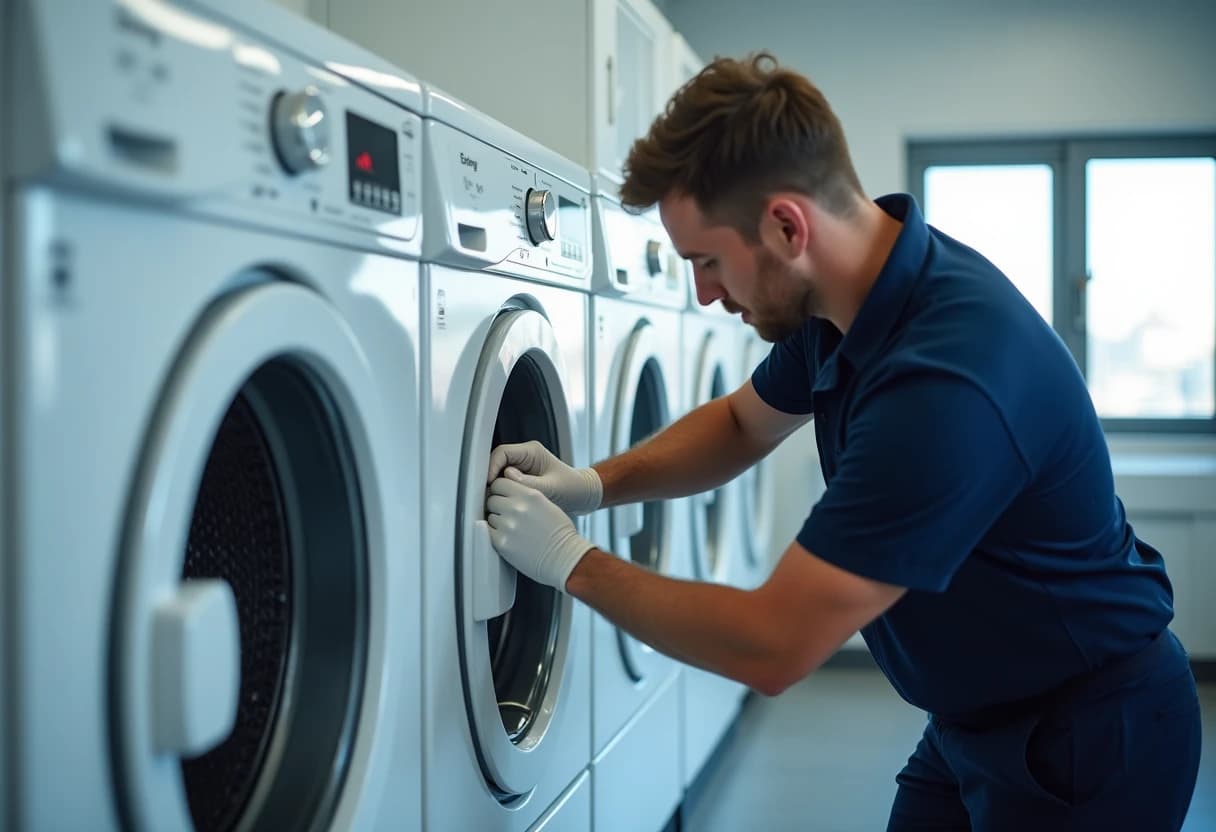
Laundromats and shared laundry rooms push dryer venting harder than any residential setting: commercial dryers cycling all day, multiple machines manifolded into common ducts, and lint production measured in pounds per week. A clogged vent in this environment does not just risk fire — it lengthens dry times, drives up gas and electric costs, trips high-limit switches and burns out machines. Our commercial dryer vent service covers Holbrook laundromats, coin-op rooms in apartment buildings, salons, gyms and any business that dries in volume: full mechanical cleaning of each duct run and common manifold, termination and damper service, before-and-after airflow verification, and maintenance intervals matched to your machine duty cycle rather than a generic calendar.
Why Commercial & Multi-Unit Dryer Vent Cleaning Matters for Holbrook Homes
The fire math of multi-unit buildings is unforgiving. FEMA estimates about 2,900 residential clothes dryer fires per year, causing deaths, injuries and roughly $35 million in property loss — and the leading factor, cited in around a third of these fires, is failure to clean. A single-family dryer fire endangers one household; the same fire in a triple-decker, garden apartment or high-rise endangers dozens, spreads through shared walls and chases, and lands on the association's master policy. Every dryer in your building produces lint with every load, and every foot of vent duct collects it — narrowing airflow, extending dry times, and raising temperatures inside the duct until the day lint, heat and airflow restriction intersect. Professional cleaning resets every run in the building to clear, and the documentation resets your liability posture: when an insurer, an attorney or a fire marshal asks about vent maintenance, a dated per-unit report is the difference between diligence and exposure. No board wants to explain a preventable fire; a maintenance program means never having to.
Fire safety in Holbrook multi-unit housing is a shared-wall problem: one clogged vent endangers every neighbor. Holbrook's older homes often combine original basement trunk ducts with newer add-on branches, and that patchwork is where we find the heaviest dust buildup and air leakage in town. Smaller lot sizes also mean dryer vents frequently terminate close to grade, where they clog with debris and become nesting spots for birds. Holbrook is a compact, working-class town of small capes, ranches and older two-family homes, much of it built in the early-to-mid 20th century when the town's shoe factories were still running. Lots are modest and homes sit close together, and many of the older houses have had forced-air heat and central air added piecemeal over the years, leaving mixed-vintage duct systems with plenty of leaky transitions. Those conditions are precisely why FEMA's dryer-fire statistics — about 2,900 a year nationally, led by failure to clean — should read as a maintenance schedule rather than trivia. Our crews serve Holbrook buildings with the same program associations in Randolph and Avon rely on: whole-building mechanical cleaning, shared riser service, hazard flagging, airflow verification, and per-unit compliance documentation delivered to the board within days of completion.
Our Commercial & Multi-Unit Dryer Vent Cleaning Process in Holbrook
1Building Walkthrough & Per-Unit Proposal
We scope before we quote: unit count and layout, vent configurations and lengths, termination locations and access (ladder, lift or roof), laundry room and common-area equipment, and any known problem units. Associations receive a fixed proposal with volume per-unit pricing, a project schedule with resident notice templates, and the reporting format agreed in advance so the board knows exactly what deliverable closes the project.
2Resident Coordination & Scheduling
We treat resident experience as part of the deliverable: clear advance notices, tight arrival windows, uniformed technicians who protect floors and finish each unit in roughly 20 to 40 minutes, and a same-day completion log to management. Units we cannot access are documented — not silently skipped — and a make-up window is scheduled so the building report ends with every unit accounted for.
3Dryer-Side Service: Transition Duct & Connection
In each unit we pull the dryer, clean behind and beneath it — a major hidden lint reservoir — and service the transition duct between machine and wall. Foil accordion transitions, which manufacturers prohibit and which trap lint in every corrugation, are flagged and can be replaced on the spot with code-appropriate material. The connection is reseated and secured without airstream-penetrating screws, per code.
4Mechanical Cleaning of the Full Vent Run
The in-wall duct is cleaned end to end with rotary brush systems driven through the full run while a high-powered vacuum captures dislodged lint — the same agitation-plus-extraction principle as NADCA duct cleaning, sized for 4-inch dryer duct. Long runs and multiple elbows get repeat passes; the pass is complete when the brush returns clean and airflow verifies.
5Shared Risers, Common Trunks & Booster Fans
Common-element ducts get common-element treatment: documented condition before and after, cleaning with equipment sized for vertical and long-trunk work, and function checks on the mechanical components — booster fans, backdraft dampers, rooftop exhaust terminations — that keep a shared system moving air. For associations, this is the portion of the project that most clearly discharges the board's maintenance duty, and we document it accordingly.
6Termination Service & Exterior Verification
We finish each run where the air does: at the outside wall or roof. The termination is cleaned, its flap or damper exercised and verified, screens and nests removed, and the exhaust confirmed to discharge outdoors — not into an attic, soffit or crawlspace, a dangerous and surprisingly common Massachusetts finding. Interior-terminating vents are documented as the priority hazards they are.
7Airflow Verification & Building Compliance Report
Each cleaned run gets a functional verification — airflow at the termination with the dryer running, or anemometer readings where equipment access allows — so the report records outcomes, not just activity. The building deliverable lists every unit: cleaned and verified, no-access, or exception, with photos of hazards and itemized repair recommendations. Boards file it; insurers accept it; renewals cite it.
Benefits of Professional Commercial & Multi-Unit Dryer Vent Cleaning in Holbrook
Longer Dryer Life & Fewer Appliance Failures
In buildings where management owns the machines — common laundry rooms, included-appliance rentals, laundromats — vent restriction is a direct capital cost: premature element, fuse and motor failures across the fleet. Regular vent service is fleet maintenance, and operators who adopt it consistently report fewer service calls and longer replacement cycles.
Shorter Dry Times & Lower Utility Costs
Every minute of extra runtime is heat pushed against a clogged duct: wasted energy, elevated temperatures, and accelerated wear. Post-cleaning, residents notice loads finishing in one cycle again — the most tangible everyday benefit of the program and the one that quiets the steady trickle of 'my dryer is broken' maintenance tickets.
Directly Reduced Fire Risk, Building-Wide
Lint-clogged venting is the leading factor in the roughly 2,900 US dryer fires FEMA counts each year, and multi-unit buildings multiply the exposure by their unit count. Whole-building cleaning removes the fuel and restores the airflow that keeps duct temperatures in design range — addressing the top cause of a genuinely common fire, in every unit at once.
A Program, Not a Project
The real deliverable is the recurring cycle: annual (or duty-matched) cleanings calendared in advance, consistent per-unit pricing locked for program clients, the same report format every year so building condition trends are visible, and reminders that arrive before renewal questionnaires do. Boards approve it once; it protects the building indefinitely.
Volume Pricing That Beats Unit-by-Unit Service
A single-home dryer vent cleaning in Greater Boston runs $150–$250; on a coordinated building project, per-unit pricing drops steeply — often to a fraction of retail — because mobilization, travel and setup are shared across dozens of units. The building gets professional service in every unit for less than residents could ever arrange individually.
Hazard Discovery Before It Costs You
Every exception we flag is a future incident pre-empted: the crushed run behind a renovated wall, the riser takeoff installed backwards, the termination flap frozen shut that made one unit's dryer exhaust into the building. Boards receive these findings prioritized and priced, converting unknown risks into a manageable repair list.
Signs Your Holbrook Home Needs Commercial & Multi-Unit Dryer Vent Cleaning
Insurance Questionnaires or Post-Incident Requirements
When the master-policy renewal asks 'When were dryer vents last professionally cleaned?', the underwriting message is explicit: this risk is on their radar, and undocumented buildings price accordingly. A completed building-wide cleaning with per-unit reporting answers the question directly — and answering it before renewal season is markedly cheaper than answering it after a nonrenewal notice.
Lint Visible at Terminations or on the Building Exterior
Walk the building perimeter and look at every vent hood: visible lint at the flap, caps that no longer close, vegetation fuzzy with fibers below the outlet. These external tells are free inspection data, and they reliably indicate runs overdue for mechanical cleaning — plus terminations that need damper service while the crew is there.
No One Can Say When Vents Were Last Cleaned
New management contracts and board turnovers routinely surface this gap: dryer vents appear in no budget, no vendor list and no maintenance log. It is among the first items worth correcting, because it combines genuine fire risk with an insurer-facing documentation hole — and because the first cleaning doubles as a building-wide inspection.
Foil Accordion Ducts or Improvised Vent Runs in Units
Walk any older building's units and you will find them: shiny foil accordion transitions sagging behind dryers, trapping lint in every corrugation. Manufacturers prohibit them and the IRC's requirements for smooth-interior duct exist because they burn. Each one found is a unit-level hazard flag — and a building-wide survey usually finds many.
Dryers Taking Two or More Cycles Per Load
Residents report it as an appliance problem — 'the dryer is getting old' — but two-cycle drying is a venting symptom far more often than a machine failure. Before replacing dryers or fielding another season of complaints, verify the exhaust path; in multi-unit buildings a pattern of slow-dry complaints maps reliably onto clogged runs and risers.
Burning Smells, Hot Laundry Areas or Tripped Thermal Fuses
A hot, linty smell during dryer operation is the machine overheating against restricted exhaust — the exact precondition of a lint fire. Treat it as urgent in any building: the affected unit's run needs immediate inspection, and one unit's condition in a shared-riser building is a reasonable proxy for its neighbors'.
Commercial & Multi-Unit Dryer Vent Cleaning Cost in Holbrook, MA
Multi-unit dryer vent cleaning in Greater Boston is priced per building, and the per-unit economics are the story: while a single-home service runs $150–$250, coordinated building projects typically price between $40 and $90 per unit depending on scale and complexity, with whole-building totals commonly landing between $300 for a small multi-family and $3,000 or more for larger properties. The honest drivers are unit count (bigger buildings earn lower per-unit rates), vent configuration (short individual wall runs price lowest; long improvised runs and shared vertical risers add equipment and time), termination access (ground-floor wall caps versus roof work or lift access), and machine handling (pulling and resetting each dryer versus laundry-room fleets). Shared risers, common trunks and booster fans are itemized separately as common-element service. Every proposal is flat and written after a walkthrough — the board approves a number, not an estimate.
Want the full pricing picture? See our complete Boston-area cost guide or call (617) 390-7145 for an exact flat quote for your Holbrook home.
Local Knowledge: Holbrook, Norfolk County
What makes Holbrook different? Holbrook is a compact, working-class town of small capes, ranches and older two-family homes, much of it built in the early-to-mid 20th century when the town's shoe factories were still running. Lots are modest and homes sit close together, and many of the older houses have had forced-air heat and central air added piecemeal over the years, leaving mixed-vintage duct systems with plenty of leaky transitions. Holbrook's older homes often combine original basement trunk ducts with newer add-on branches, and that patchwork is where we find the heaviest dust buildup and air leakage in town. Smaller lot sizes also mean dryer vents frequently terminate close to grade, where they clog with debris and become nesting spots for birds. For duct and dryer vent systems, those local factors translate into specific, predictable problems — and predictable problems are the ones we solve fastest. Call (617) 390-7145, tell us your street and home style, and we will quote the job accurately the first time, usually in under five minutes.
The Best Time of Year in Holbrook
Termination freeze-up is the distinctly New England failure mode. Dryer exhaust is warm and humid; when it meets a February termination, moisture condenses and freezes on the flap and hood, and a cap already propped partway open by lint accumulation becomes an ice-and-lint blockage that can seal a vent entirely. Residents notice two-cycle drying; the duct experiences trapped heat. Buildings with north-facing terminations, roof caps and long uninsulated runs through cold cavities are most vulnerable — and long cold runs also condense moisture internally, matting lint into dense plugs that only mechanical brushing removes. A pre-winter cleaning and damper service is the prevention; mid-winter, we triage frozen-vent calls across Norfolk County weekly, and the buildings calling are overwhelmingly the ones without a fall program.
Why Choose Boston Air Duct Cleaners
Boston Air Duct Cleaners is a local, owner-operated company based at 1121 Washington St in West Newton — not a national franchise dispatching subcontractors. Every crew is our own: background-checked, factory-trained on commercial negative-pressure equipment, and fully insured. We quote flat prices before work begins, document every job with before-and-after photos, and follow NADCA-standard source-removal methods on every system we touch. That is why so much of our work comes from repeat customers, property managers and word-of-mouth referrals across Norfolk County.
Serving Holbrook and Surrounding Communities
Beyond Holbrook, our crews cover the surrounding communities daily — including Randolph, Avon, Braintree, Abington, Weymouth, Brockton. Because routes cluster geographically, booking alongside a neighboring appointment often unlocks same-day service and combined-visit savings. Wherever you are in Norfolk County, the same flat-rate pricing, insured technicians and photo-documented process applies.