
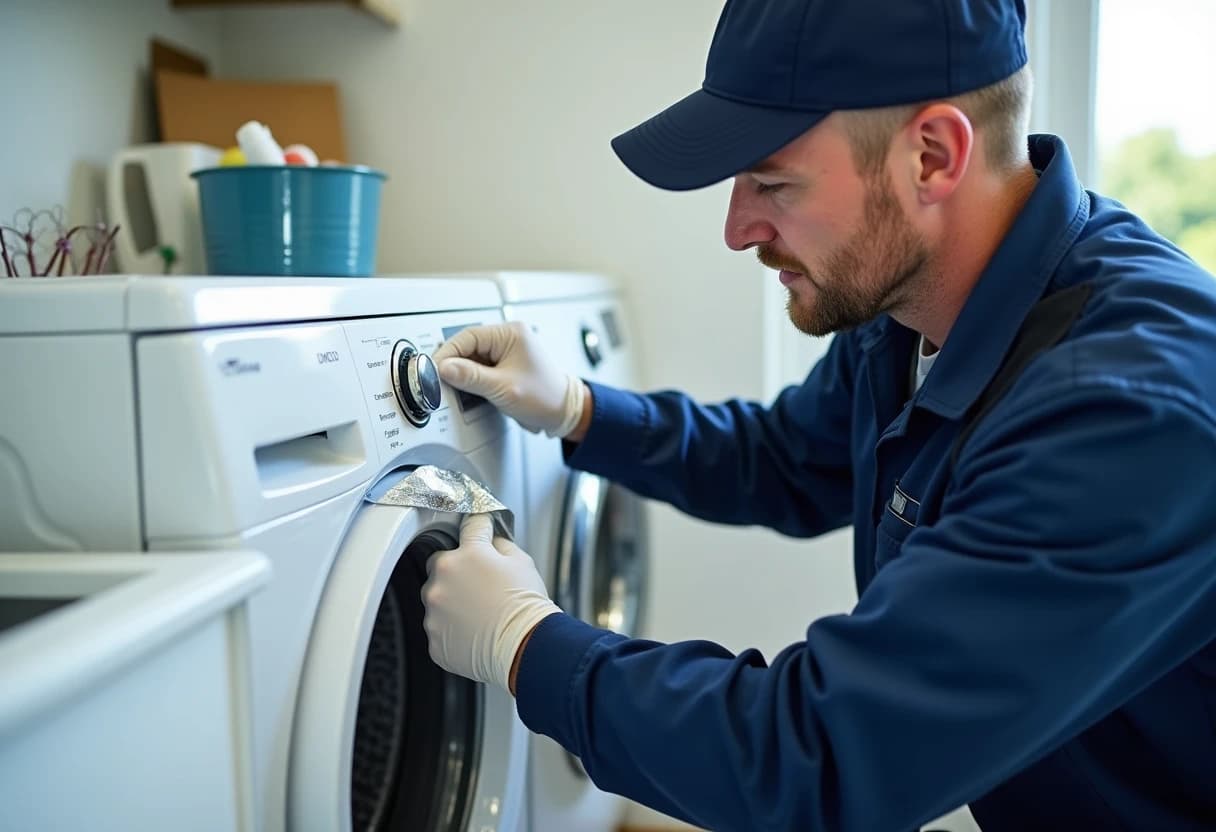
Homeowners in Peabody usually discover a broken dryer vent through a symptom that seems unrelated: a water stain on the ceiling under the laundry, lint appearing in the basement, a mildew smell in one wall, or an energy bill that crept up as the dryer strained. Our repair service finds the failure and fixes it for good — with 4-inch smooth rigid metal duct, joints fitted and clamped without airstream-piercing screws, seams sealed with UL-listed foil tape, and a new exterior hood where the old damper has failed. We are local, insured, and we photograph every repair so you can see exactly what was wrong and exactly what made it right.
Why Dryer Vent Repair Matters for Peabody Homes
A damaged dryer vent fails on three fronts at once, and all three get worse with every load. Safety first: a disconnection or breach releases lint — one of the most flammable materials in a home — into wall cavities, ceilings and basements, where it accumulates near framing with no way to remove it, while the restriction at the damage point drives up exhaust temperatures exactly the way fire investigators describe in the roughly 2,900 US dryer fires each year. Moisture second: every load pushes about a gallon of water vapor through the vent, and a leak delivers it into building materials instead of outdoors — wet insulation, mold-friendly wall cavities, stained ceilings, rotted subfloor around the laundry. Performance third: crushed and separated ducts strangle airflow, stretching drying times and energy bills while overheating the appliance. Cleaning cannot fix any of this; the duct itself is broken. A proper repair — rigid metal, sealed joints, verified airflow — resolves all three failure modes in a single visit, usually for $150 to $450.
A surprising share of our Peabody repair calls begin with a water stain. Peabody's downtown wards hold tight streets of leather-industry-era two-families and workers' cottages from the early 1900s, while West Peabody is a sea of 1950s-70s ranches, splits and Colonials built during the city's postwar boom. The West Peabody tracts were among the region's early adopters of forced-air heat, which means original ductwork in many homes is now sixty-plus years old. Newer condo complexes near the Northshore Mall corridor round out the stock. A ceiling mark below a second-floor laundry, peeling paint behind a basement dryer, a mildew odor in one wall — homeowners call a painter or a plumber before anyone thinks of the dryer vent, yet a leaking or condensing vent is the cause remarkably often. Peabody's postwar ranches carry some of the oldest original ductwork we open up anywhere on the North Shore, often with decades of compacted dust behind supply registers. Downtown's converted tannery-era buildings and two-families add their own mix of aging shared chases and hard-to-reach dryer runs. Our diagnostic visit settles it quickly: we trace the duct path, test airflow at both ends, and either confirm the vent as the culprit and quote the repair flat, or rule it out so you can chase the real source with confidence.
Our Dryer Vent Repair Process in Peabody
1Diagnose the Full Exhaust Path
Your technician maps the vent's routing, materials and condition: transition hose state, joint integrity, crush points, sag, corrosion, termination function. Where the run is concealed, airflow measurements and inspection tools tell us what the walls hide. You get a photographed diagnosis and a flat repair quote before any work begins.
2Protect the Area & Open Access
Access is half of dryer vent repair in older homes. We come prepared for ceiling-hung basement runs, duct concealed above suspended ceilings, and sections buried in soffits. Our aim is always the least invasive route to a proper repair — and clear communication before anything is opened.
3Reconnect & Properly Fasten Separated Joints
Where lint and moisture have escaped into a cavity through a long-standing disconnection, we vacuum accessible accumulation with HEPA equipment and document conditions with photos. Removing that hidden fuel load matters as much as the reconnection itself — and the photos give you a record for insurance or future renovation planning.
4Replace Crushed, Corroded or Non-Compliant Sections
Vinyl and foil accordion duct found anywhere in the run is removed on sight and replaced: rigid metal for the concealed run, a short UL-listed semi-rigid aluminum connector at the appliance. The smooth interior of proper duct resists lint accumulation dramatically better than corrugations — the repair also makes every future cleaning faster and more effective.
5Cure Condensation: Slope, Seal & Insulate
Moisture-damaged components are replaced as part of the cure: corroded duct sections, rusted clamps, sodden insulation. We also check the termination damper, since a flap frozen or stuck partly shut is a common hidden cause of the backpressure that drives moist exhaust out through joints in the first place.
6Repair or Replace the Exterior Hood & Damper
Where pests have entered through a failed damper, we remove nesting material from the duct, clean the affected section, and install a termination with pest protection that does not restrict airflow. If the old hood was painted shut — common on older multi-family buildings — we free or replace it and note the repaint risk for the future.
7Replace the Transition Duct & Reset the Dryer
Gas dryers are reconnected with the gas line unstrained and checked, electric dryers with cords properly routed clear of the hot duct. We level the machine, confirm the drum turns clean, and run a full test cycle — because a repair is not done until the system works as a system.
8Verify Airflow & Document the Repair
The proof is at the hood: with the dryer running, the damper should stand fully open under a strong, steady exhaust stream. We verify it together, compare against the pre-repair condition, and confirm no leakage remains at any repaired joint. Then the work area is cleaned, the dryer set, and the laundry room returned to service.
Benefits of Professional Dryer Vent Repair in Peabody
A Serious Fire Hazard, Eliminated
Lint inside a wall cavity cannot be cleaned on any schedule; the only fix is stopping the leak that puts it there. Repairing disconnections and sealing joints confines lint to the duct, where annual cleaning can manage it. That containment is the difference between a maintainable system and a slowly growing hazard you cannot see.
Lower Energy and Repair Bills
A failed exterior damper is a hole in your heated envelope all winter — a 4-inch duct delivering January directly to your laundry room. Replacing it with a tight-closing hood pays for itself in heating savings and comfort, entirely apart from what it does for the dryer.
Decades of Reliable Service From One Repair
Done with rigid metal, mechanical fastening and a quality termination, a dryer vent repair is not a patch — it is infrastructure. Properly installed rigid duct routinely outlasts the dryers connected to it, needing only annual cleaning. The failure-prone materials and joints that caused your problem simply are not there anymore.
Pest Entry Points Closed
Pest damage rarely stays at the hood: rodents that enter a duct chew insulation and nest against warm sections deep in the run. Closing the entry point promptly is far cheaper than the extended cleaning and repair an established rodent presence demands — one more reason failing dampers deserve fast attention.
Moisture Out of Your Walls and Ceilings
In New England's freeze-thaw climate, moisture in building assemblies does compounding damage each winter. Sealing a leaking dryer vent removes one of the few moisture sources that operates year-round, indoors, by the gallon. Building scientists put exhaust integrity high on the envelope checklist for exactly this reason.
Code Compliance & Inspection-Ready Documentation
Dryer venting is a standard flag on Massachusetts home inspections: vinyl flex, taped joints, screened hoods and overlong runs all appear in reports and complicate sales. Our repairs bring the system to current code — rigid metal, compliant joints, proper termination — with photo documentation that answers inspector and buyer questions before they are asked.
Signs Your Peabody Home Needs Dryer Vent Repair
Slow Drying That Cleaning Didn't Fix
The symptom pattern is diagnostic: strong heat in the drum with weak or absent airflow at the exterior hood means exhaust is going somewhere else. That somewhere is the failure point. It is a fifteen-minute find for a technician with airflow instruments and knowledge of how these runs are routed in local housing.
Lint Appearing Where It Shouldn't
Check the floor and framing along the vent's path, especially in basements where runs hang exposed: a dusting of gray fiber below any joint is a positive test for leakage there. The joint may look intact from below while a gap on top sheds lint and moisture into the cavity above it.
A Home Inspection or Appliance Tech Flagged the Vent
When an appliance technician condemns your vent while servicing the dryer, believe them: they have just measured the backpressure your machine fights on every load. Repairing the duct protects the repair they made — a new heating element or thermal fuse installed against a failed vent will simply fail again.
Exterior Damper Broken, Stuck or Missing
Look at the hood outside: a damper flap hanging loose, rusted stiff, cracked off, painted shut or missing entirely is a failed termination. Stuck open, it drains heat and admits pests all winter; stuck shut, it blocks the vent completely. Either way the fix is a proper replacement hood — one of the fastest, most cost-effective repairs on our list.
Musty or Mildew Smell in the Laundry Area
EPA guidance on mold is unambiguous: control the moisture and you control the growth. In laundry areas the dryer vent is a prime suspect moisture source, and a $150 to $450 repair is dramatically cheaper than the remediation an ignored leak can eventually require.
Water Stains, Drips or Peeling Paint Near the Vent Path
Rust streaks on duct exteriors, corroded clamps and white mineral tracks at joints are the slow-motion version of the same evidence: repeated internal condensation escaping over months. Left alone it rusts through the duct wall; caught early, the fix is sealing and insulation rather than replacement.
Dryer Vent Repair Cost in Peabody, MA
Repair versus replace is the judgment call at the heart of this service, and our rule is simple: repair when the underlying system is sound, replace when it is not. A rigid metal run with one separated joint, one crushed section, or a failed hood is worth repairing — the fix restores a fundamentally good system for $150 to $450. A run made entirely of accordion flex, a duct routed far beyond code's 35-foot equivalent length with no path to compliance, or a system so corroded that each repair reveals the next failure is not worth patching — full replacement or rerouting (our dryer vent installation service, typically $300 to $900) serves you better and often costs less than serial repairs would. We price both options when the call is close and give you our recommendation with reasons. Either way, the visit ends with a verified, documented exhaust path — and an honest answer about how long it should last.
Want the full pricing picture? See our complete Boston-area cost guide or call (617) 390-7145 for an exact flat quote for your Peabody home.
Local Knowledge: Peabody, Essex County
What makes Peabody different? Peabody's downtown wards hold tight streets of leather-industry-era two-families and workers' cottages from the early 1900s, while West Peabody is a sea of 1950s-70s ranches, splits and Colonials built during the city's postwar boom. The West Peabody tracts were among the region's early adopters of forced-air heat, which means original ductwork in many homes is now sixty-plus years old. Newer condo complexes near the Northshore Mall corridor round out the stock. Peabody's postwar ranches carry some of the oldest original ductwork we open up anywhere on the North Shore, often with decades of compacted dust behind supply registers. Downtown's converted tannery-era buildings and two-families add their own mix of aging shared chases and hard-to-reach dryer runs. For duct and dryer vent systems, those local factors translate into specific, predictable problems — and predictable problems are the ones we solve fastest. Call (617) 390-7145, tell us your street and home style, and we will quote the job accurately the first time, usually in under five minutes.
The Best Time of Year in Peabody
Winter exposes dryer vent damage that hides all year. Joints that leak slightly in summer drip visibly when exhaust moisture condenses hard against freezing duct; marginal dampers ice shut; snow buries grade-level hoods; and the season's heavy laundry loads push maximum moisture through every weak point. Massachusetts repair calls spike from December through February for exactly these reasons — and because a blocked or leaking vent in a sealed-up winter house sends its moisture and, for gas dryers, combustion byproducts into air that will not be refreshed until spring. If your vent showed symptoms last winter, repairing it in fall is the calm, scheduled alternative to an emergency call during a January cold snap with a full laundry basket waiting.
Why Choose Boston Air Duct Cleaners
Homeowners across Essex County choose Boston Air Duct Cleaners for three reasons. First, honesty: our inspection camera tells you whether your system actually needs cleaning — and sometimes the answer is no. Second, capability: truck-grade negative-air machines, rotary brush systems and HEPA filtration handle everything from antique gravity-furnace conversions to brand-new high-velocity systems. Third, accountability: flat quoted pricing, before-and-after photos, insured technicians, and a real local office you can call at (617) 390-7145. That combination is rarer in this industry than it should be.
Serving Peabody and Surrounding Communities
Peabody sits in the heart of our service area, and neighboring Salem, Danvers, Lynnfield, Lynn, Beverly, Middleton appointments share the same routes. That density is why our response times in this part of Essex County are among our fastest — and why you will see our trucks in the area week after week.