
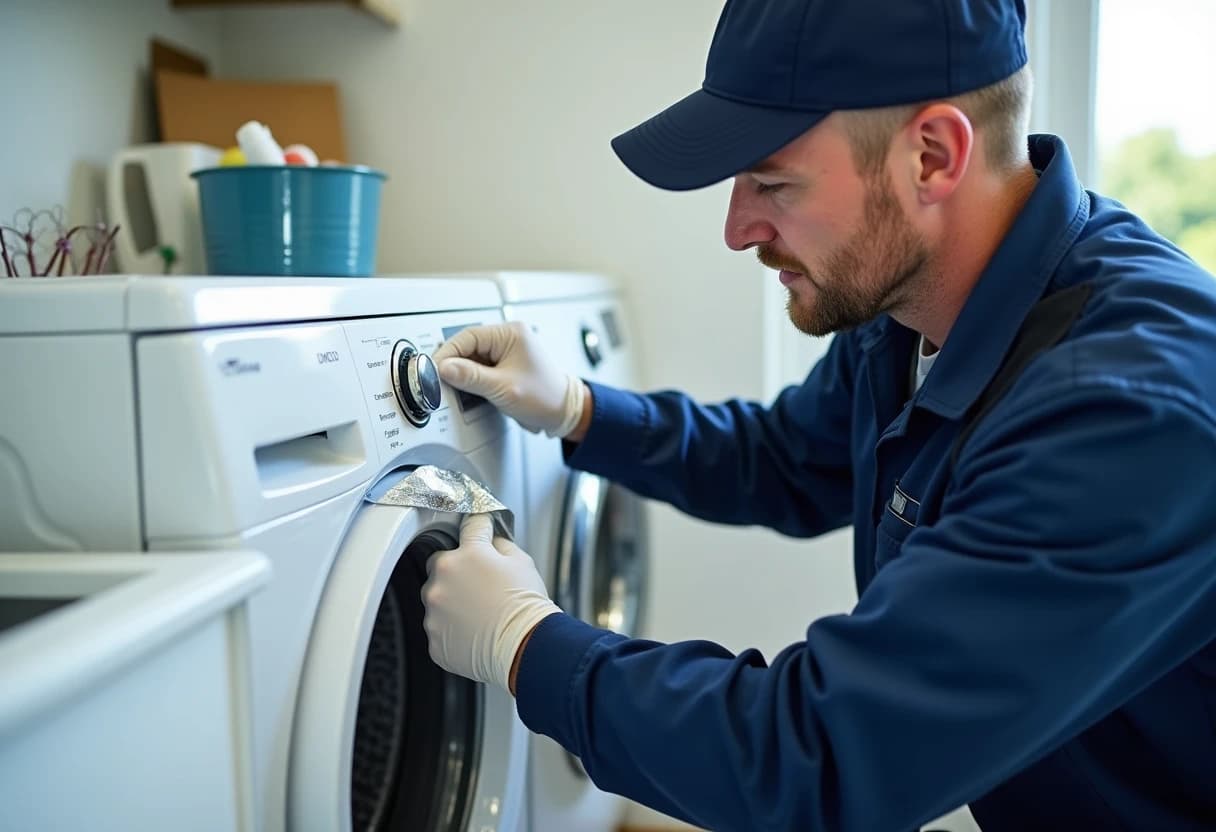
That flattened foil hose behind your dryer is doing more damage than it looks. Crushed transition ducts are the most common dryer vent failure we find in Lynnfield homes — the machine gets pushed back against the wall, the accordion hose collapses to a fraction of its diameter, and the dryer spends years straining against a pinched exhaust while lint packs the kink. We replace these hazards with semi-rigid aluminum connectors and repair everything downstream too: separated joints, sagging runs, holes rusted through duct walls, and exterior hoods that no longer close against weather and pests. Done right, with the materials the code requires, a repaired vent runs trouble-free for decades.
Why Dryer Vent Repair Matters for Lynnfield Homes
Condensation problems deserve their own diagnosis, because they mimic other failures and defeat simple cleaning. The physics: dryer exhaust leaves the drum warm and nearly saturated with moisture. If the duct passes through a cold basement, garage, crawlspace or attic — as most retrofitted Massachusetts laundry runs do — the exhaust cools below its dew point and water condenses inside the duct. The consequences cascade: condensate soaks passing lint into heavy mats that block the line; pooled water corrodes galvanized duct from the inside until pinholes leak onto ceilings; water drains backward through joints and drips behind the dryer; and in the worst winter cases, condensate freezes at the termination and seals the vent entirely. The repairs are specific and effective: restore continuous slope so water drains outward, seal the joints it has been escaping through, insulate the cold duct sections, shorten or reroute runs where the design is hopeless, and replace corroded segments. Guessing at it wastes money; our inspection identifies which combination your vent actually needs.
A surprising share of our Lynnfield repair calls begin with a water stain. Lynnfield is largely a mid-century town of ranches, split-levels and Colonials built in the 1950s through 1970s, sprinkled with antique homes near the Common and upscale new construction around MarketStreet. The mid-century homes typically run original or once-replaced forced-air systems, and their long single-story duct runs collect decades of settled dust in low horizontal sections. A ceiling mark below a second-floor laundry, peeling paint behind a basement dryer, a mildew odor in one wall — homeowners call a painter or a plumber before anyone thinks of the dryer vent, yet a leaking or condensing vent is the cause remarkably often. Homes around Pillings Pond and the Reedy Meadow wetlands sit on damp, low-lying ground where basements and crawlspace ducts pick up humidity all summer. Combined with heavy spring pine pollen from the town's mature tree canopy, Lynnfield systems benefit noticeably from regular cleaning and filtration upgrades. Our diagnostic visit settles it quickly: we trace the duct path, test airflow at both ends, and either confirm the vent as the culprit and quote the repair flat, or rule it out so you can chase the real source with confidence.
Our Dryer Vent Repair Process in Lynnfield
1Diagnose the Full Exhaust Path
Repair starts with finding every failure, not just the obvious one. We trace the duct from the dryer's outlet to the exterior termination, inspecting each accessible section and joint, and test airflow at both ends with the dryer running. Weak exterior flow with strong drum heat means the exhaust is escaping en route — and we find where.
2Protect the Area & Open Access
Access is half of dryer vent repair in older homes. We come prepared for ceiling-hung basement runs, duct concealed above suspended ceilings, and sections buried in soffits. Our aim is always the least invasive route to a proper repair — and clear communication before anything is opened.
3Reconnect & Properly Fasten Separated Joints
Where lint and moisture have escaped into a cavity through a long-standing disconnection, we vacuum accessible accumulation with HEPA equipment and document conditions with photos. Removing that hidden fuel load matters as much as the reconnection itself — and the photos give you a record for insurance or future renovation planning.
4Replace Crushed, Corroded or Non-Compliant Sections
Vinyl and foil accordion duct found anywhere in the run is removed on sight and replaced: rigid metal for the concealed run, a short UL-listed semi-rigid aluminum connector at the appliance. The smooth interior of proper duct resists lint accumulation dramatically better than corrugations — the repair also makes every future cleaning faster and more effective.
5Cure Condensation: Slope, Seal & Insulate
Where a run's routing makes condensation inevitable — long passages through cold space, low points that cannot be drained — we say so plainly and price the better fix: shortening or rerouting the run, which we quote as a separate option. Honest diagnosis beats a repair that treats symptoms the routing will simply recreate.
6Repair or Replace the Exterior Hood & Damper
Where pests have entered through a failed damper, we remove nesting material from the duct, clean the affected section, and install a termination with pest protection that does not restrict airflow. If the old hood was painted shut — common on older multi-family buildings — we free or replace it and note the repaint risk for the future.
7Replace the Transition Duct & Reset the Dryer
Gas dryers are reconnected with the gas line unstrained and checked, electric dryers with cords properly routed clear of the hot duct. We level the machine, confirm the drum turns clean, and run a full test cycle — because a repair is not done until the system works as a system.
8Verify Airflow & Document the Repair
Finally we log the service and recommend a cleaning schedule for the repaired system — typically annual. A repaired vent with smooth rigid duct and a proper termination accumulates lint far more slowly than the failed system it replaced, and the documentation we leave shows exactly what is now behind your walls.
Benefits of Professional Dryer Vent Repair in Lynnfield
Restored Drying Performance
Because the leak or crush also lets conditioned air escape or exhaust recirculate, repairs frequently improve more than laundry: cold-air infiltration through a stuck-open damper ends, and the laundry room stops swinging between sauna and icebox with the seasons.
A Serious Fire Hazard, Eliminated
A breached or restricted dryer vent combines the two ingredients of the roughly 2,900 annual US dryer fires: accumulating lint and rising exhaust temperatures. Repair removes both — the escape points that seed wall cavities with fuel, and the crush points and blockages that overheat the system. It is fire prevention with a wrench, and it lasts for decades.
Lower Energy and Repair Bills
A failed exterior damper is a hole in your heated envelope all winter — a 4-inch duct delivering January directly to your laundry room. Replacing it with a tight-closing hood pays for itself in heating savings and comfort, entirely apart from what it does for the dryer.
Pest Entry Points Closed
We remove existing nesting material as part of termination repair and clean the affected duct section, because a nest is both a blockage and a sanitation issue in an airstream that passes your clothing. The new hood's pest protection is chosen to exclude animals without the lint-trapping mesh that code prohibits.
Code Compliance & Inspection-Ready Documentation
Dryer venting is a standard flag on Massachusetts home inspections: vinyl flex, taped joints, screened hoods and overlong runs all appear in reports and complicate sales. Our repairs bring the system to current code — rigid metal, compliant joints, proper termination — with photo documentation that answers inspector and buyer questions before they are asked.
Decades of Reliable Service From One Repair
We stand behind the work: repairs are documented, photographed and guaranteed, and because we also clean vents, we see our own repairs again on annual visits — a feedback loop that keeps our standards honest. The repair you buy is one we expect to inspect ourselves for years.
Signs Your Lynnfield Home Needs Dryer Vent Repair
Slow Drying That Cleaning Didn't Fix
A dryer that dries poorly immediately after being moved, after appliance delivery, or after renovation work near the laundry almost certainly has a crushed transition or a disturbed joint — the timing is the clue. These are among the quickest, least expensive repairs we make, often at the bottom of the $150 to $450 range.
Exterior Damper Broken, Stuck or Missing
Look at the hood outside: a damper flap hanging loose, rusted stiff, cracked off, painted shut or missing entirely is a failed termination. Stuck open, it drains heat and admits pests all winter; stuck shut, it blocks the vent completely. Either way the fix is a proper replacement hood — one of the fastest, most cost-effective repairs on our list.
A Home Inspection or Appliance Tech Flagged the Vent
Inspection reports flag dryer venting constantly in Massachusetts: vinyl flex, taped or screwed joints, screened hoods, overlong concealed runs. Take the flag seriously — inspectors see the aftermath of ignored vents — and bring us the report. We translate findings into a flat-priced repair scope and documentation that closes the issue for buyers, sellers and insurers.
Musty or Mildew Smell in the Laundry Area
EPA guidance on mold is unambiguous: control the moisture and you control the growth. In laundry areas the dryer vent is a prime suspect moisture source, and a $150 to $450 repair is dramatically cheaper than the remediation an ignored leak can eventually require.
Lint Appearing Where It Shouldn't
Check the floor and framing along the vent's path, especially in basements where runs hang exposed: a dusting of gray fiber below any joint is a positive test for leakage there. The joint may look intact from below while a gap on top sheds lint and moisture into the cavity above it.
Visibly Damaged, Kinked or Sagging Duct
Trust your eyes: a transition hose flattened behind the dryer, a dented or crushed section in the basement, duct sagging between supports into a low belly, or a run held together with fabric duct tape are all failures in progress. Each restricts airflow, collects lint and moisture, and worsens with time. Photograph what you see and call — the quote is quick.
Dryer Vent Repair Cost in Lynnfield, MA
Compare the repair cost against what the failure costs to keep. A leaking vent delivers roughly a gallon of water per load into your building assemblies — and chronic wall moisture matures into mold remediation and drywall work that starts around $1,500 and climbs steeply. A crushed or blocked duct overworks the dryer into $150 to $400 appliance repairs (thermal fuses, elements, switches) that recur until the vent is fixed, while adding $10 to $20 a month in energy waste. A failed damper leaks heated air all winter and invites nest blockages every spring. And every one of these failures raises fire risk in a system that already accounts for about 2,900 US home fires a year. Against that ledger, $150 to $450 for a permanent, code-compliant repair is one of the clearest-value maintenance purchases in the home. Most customers who see the diagnostic photos do not need convincing; the duct makes the argument itself.
Want the full pricing picture? See our complete Boston-area cost guide or call (617) 390-7145 for an exact flat quote for your Lynnfield home.
Local Knowledge: Lynnfield, Essex County
What makes Lynnfield different? Lynnfield is largely a mid-century town of ranches, split-levels and Colonials built in the 1950s through 1970s, sprinkled with antique homes near the Common and upscale new construction around MarketStreet. The mid-century homes typically run original or once-replaced forced-air systems, and their long single-story duct runs collect decades of settled dust in low horizontal sections. Homes around Pillings Pond and the Reedy Meadow wetlands sit on damp, low-lying ground where basements and crawlspace ducts pick up humidity all summer. Combined with heavy spring pine pollen from the town's mature tree canopy, Lynnfield systems benefit noticeably from regular cleaning and filtration upgrades. For duct and dryer vent systems, those local factors translate into specific, predictable problems — and predictable problems are the ones we solve fastest. Call (617) 390-7145, tell us your street and home style, and we will quote the job accurately the first time, usually in under five minutes.
The Best Time of Year in Lynnfield
The freeze-thaw cycle is uniquely hard on the exterior components of New England dryer vents. Damper hinges and springs work loose as metal expands and contracts; caulk joints between hood and siding crack open, letting wind-driven rain into the wall; and ice forming in the hood from condensing exhaust bends flaps out of true a little more each season. Coastal and near-coastal homes add salt corrosion, which seizes hinges and eats galvanized steel years ahead of schedule. This is why we treat termination inspection as part of every service call: the hood fails gradually, then suddenly, and replacing it during a routine visit costs a fraction of the cascade — drafts, pests, blockage — that a failed one begins.
Why Choose Boston Air Duct Cleaners
As a West Newton-based company, we treat Lynnfield like the neighborhood it is — because for us, it is. Our reputation lives or dies on local referrals, so every job gets the full process: complete system cleaning under negative pressure, mechanical agitation of every run, blower compartment service, and a documented walkthrough before we leave. We are licensed and insured, our estimates are free and flat, and our schedule holds same-day slots for urgent calls. One visit and you will understand why neighbors keep our magnet on the fridge.
Serving Lynnfield and Surrounding Communities
We serve every community around Lynnfield as well: Wakefield, Peabody, North Reading, Reading, Saugus, Middleton all fall inside our regular service routes. If you have a second property, a rental, or family nearby, ask about multi-home scheduling — grouped appointments on the same route are our most requested discount.