
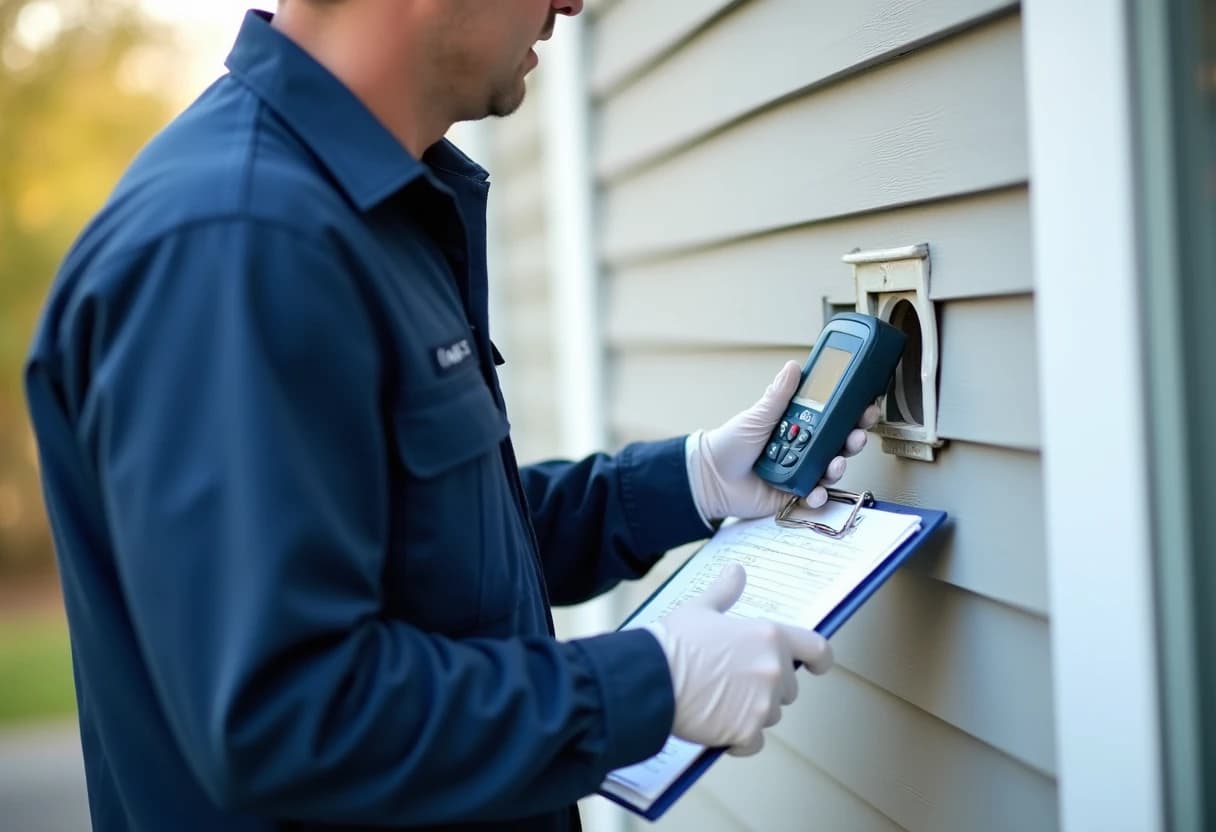
A dryer vent inspection is the fastest, cheapest way to answer a question every homeowner should be able to answer: is my dryer exhaust safe? Our Norfolk technicians measure airflow at the termination with a calibrated anemometer, run an inspection camera the full length of the duct, examine the exterior hood and damper, assess the lint load inside the run, and check the installation against the residential code rules that govern dryer ducts. You leave with a written safety report — photos, measurements and a clear verdict — instead of a guess. If the vent is clean and compliant, we tell you so and you are done for the year. If it needs work, you will know exactly what and why before spending a dollar on cleaning or repairs.
Why Dryer Vent Inspection & Safety Check Matters for Norfolk Homes
The dryer vent is the only exhaust duct in your home that moves flammable material by design. Every load sheds lint; the trap catches most of it, and the rest travels the duct — where some fraction sticks at every elbow, joint, screw tip and rough surface along the way. Whether that accumulation is trivial or dangerous depends on the duct's length, geometry, material and history, which is exactly what an inspection evaluates. The residential code (IRC M1502) exists because these variables matter: it specifies smooth rigid metal duct, limits runs to 35 feet of equivalent length with deductions for every elbow, and prohibits screws that protrude into the airstream because each protruding tip becomes a lint anchor. Many Massachusetts homes — especially older ones retrofitted with laundry in basements or upper floors — violate one or more of these rules, often invisibly inside walls. A camera inspection is the only practical way to find out, and a written report is the only way to prove the vent's condition to an insurer, a buyer or a condo board.
Buying or selling in Norfolk? The dryer vent is the gap in almost every home inspection. Norfolk is overwhelmingly a town of 1980s-through-2000s Colonial subdivisions carved out of former woodland and farmland, with only a thin layer of older homes around Town Hill. Nearly every house runs forced-air heat with central air, and the larger builds carry two systems - one in the basement, one in the attic - doubling the ductwork that needs attention. Attic air handlers over long flex-duct runs are the norm in the newer neighborhoods. General inspectors note the dryer's presence and move on; they do not camera the duct, measure the exhaust, or verify the hidden run complies with code — yet vent condition is a genuine safety and cost item, especially in older properties near Norfolk Town Common where laundry was retrofitted long after construction. Norfolk's wooded subdivisions back onto wetlands around Stony Brook, so seasonal pollen and damp shoulder-season air both work their way into duct systems here. With most homes built in the same few decades, we often find twenty-plus years of accumulated dust in systems that have never once been cleaned. We provide pre-listing and pre-purchase dryer vent inspections across Norfolk County with fast written reports that slot straight into a disclosure package or an inspection-response negotiation. Sellers use them to remove doubt; buyers use them to avoid inheriting someone else's fire risk.
Our Dryer Vent Inspection & Safety Check Process in Norfolk
1Interview & Visual Assessment
First, context: your answers about drying performance and service history frame the inspection, and a walk of the laundry area frames the system. We identify the duct material, count visible elbows, locate where the run enters the structure, and note anything — crushing, kinks, tape-only joints — that already tells part of the story.
2Airflow Measurement at the Termination
The single most telling test takes two minutes: dryer on, anemometer at the hood. Exhaust volume tells us how much of the dryer's rated airflow actually survives the trip through the duct. We record the reading in your report so future inspections can track the trend — a slow year-over-year decline is the earliest possible warning of developing blockage.
3Full-Length Camera Inspection
This is the step no flashlight can replace: a camera pass of the complete exhaust run, wall cavities and ceiling sections included. You can watch live as it travels. Lint depth, joint condition, duct material transitions and any obstructions are recorded, and representative frames go into your written report as evidence for every finding.
4Termination Hood & Damper Check
We check the exit as carefully as the run. A damper that will not open steals airflow; one that will not close invites cold air, moisture and animals. We also flag code and safety issues here: mesh screens that catch lint, terminations too close to openings or grade, and hoods damaged by weather or renovation work.
5Lint-Load Assessment & Fire-Risk Scoring
Combining the camera footage and airflow numbers, we score the system's lint load: how much fuel the duct is carrying and how fast it is accumulating based on household laundry volume. This converts raw findings into a clear risk statement — fine for now, clean this season, or clean immediately — with the evidence attached.
6Code-Compliance Review
Many Massachusetts dryer runs predate modern code or were improvised during renovations, so this review frequently finds the root cause behind chronic lint problems: an over-length run, an accordion foil transition, a screened termination collecting lint like a filter. Identifying the violation matters because cleaning a non-compliant duct treats the symptom on a schedule; correcting it treats the cause once.
7Written Safety Report & Recommendations
The visit ends with documentation, not a verbal shrug. Your report states plainly whether the vent passed, what was found where, and what — if anything — we recommend, with flat-rate pricing for any corrective work so you can decide on your own schedule. No findings are invented to sell a cleaning; the photos speak for themselves.
Benefits of Professional Dryer Vent Inspection & Safety Check in Norfolk
Protection From Moisture & Carbon Monoxide
Gas dryer owners get an extra layer of safety from inspection: the same duct carrying lint and moisture carries combustion exhaust. Verified airflow and a tight, intact run mean carbon monoxide leaves the house completely — a check that takes minutes and covers a risk most homeowners never consider.
Hidden Code Violations Exposed
Many chronic lint problems are really installation problems: the duct violates length, material or fastening rules and will clog on schedule forever until corrected. The compliance review identifies the root cause, so you can stop paying to clean a duct that was built to fail.
Lower Drying Costs & Longer Appliance Life
The economics are simple: restricted airflow taxes every single load, and the tax grows as the restriction does. Measurement catches the problem when it is small. Customers consistently report faster drying and lower utility bills after acting on inspection findings — savings that repeat weekly, every laundry day.
Real-Estate & Insurance Documentation
Buyers increasingly ask about dryer vents because their inspectors increasingly flag them. A pre-listing inspection removes the issue from the table before it appears; a pre-purchase inspection prices it before you own it. Agents across Greater Boston refer us for exactly this reason.
A Written Report You Can Actually Use
Documentation has quiet value that compounds. After a kitchen fire two streets over, your insurer asks about dryer maintenance — you have a dated report. A buyer's inspector flags the vent — you produce this year's inspection and the issue evaporates. The paper trail costs nothing extra; it comes standard.
No Unnecessary Cleanings
The $79 inspection frequently saves the $200 cleaning. When airflow measures strong and the camera shows light accumulation, we say so in writing and leave. Customers who used to buy blind annual cleanings routinely discover their actual interval is longer — and their total maintenance spend drops accordingly.
Signs Your Norfolk Home Needs Dryer Vent Inspection & Safety Check
Clothes Take More Than One Cycle
Two cycles to dry a normal load is the classic symptom of a restricted vent. The dryer produces the same heat as always — the moisture simply has nowhere to go, so it recirculates through the drum. An inspection will measure exactly how much airflow the duct is stealing.
Burning or Musty Smells During Operation
A hot, singed odor while the dryer runs can mean lint is contacting the heating element or accumulating somewhere hot — the most urgent warning sign a vent can give. Stop using the dryer and book an inspection immediately; this is the symptom that precedes actual ignition events.
You Cannot Remember the Last Service
If the vent has no service history you can name, assume it has never been inspected — most have not. NFPA guidance is simple: dryer exhaust should be checked at least annually. The first inspection establishes your baseline; every year after tracks the trend.
Recent Renovation, New Dryer or New Home
Just bought the house? Your home inspector almost certainly did not camera the dryer duct or measure its airflow — general inspections do not include it. Given that lint fires are among the most common preventable house fires, a dedicated vent inspection belongs on every new-owner checklist.
No Visible Exhaust at the Outside Hood
Lint visibly beard-ing around the exterior hood, a damper wedged with debris, or a termination that was painted or caulked over during exterior work — all common findings, all easily missed from ground level, and all fully documented during the exterior portion of our inspection.
The Dryer or Laundry Room Feels Hot
A dryer cabinet that is hot to the touch, or a laundry room that turns into a sauna mid-cycle, means exhaust heat is staying in the house instead of leaving through the duct. That trapped heat is the same heat that ignites lint. It warrants a measurement promptly.
Dryer Vent Inspection & Safety Check Cost in Norfolk, MA
A standalone dryer vent inspection in Greater Boston runs $79 to $149, with most single-family homes landing near the middle. The variables are access and complexity: a first-floor laundry with a short run to a reachable exterior hood sits at the low end, while roof terminations, multi-story runs, stacked or hard-to-move appliances, and long concealed ducts requiring extended camera work move the price up. Multi-unit buildings are quoted per unit with volume discounts for associations and property managers booking a full building. What the fee always includes: anemometer airflow measurement, full-length camera inspection, exterior hood and damper evaluation, lint-load scoring, code-compliance review, and the written photographic report. What it never includes: pressure to buy anything. If cleaning or repair is warranted, you receive a flat-rate quote alongside the findings — and if we perform the cleaning during the same visit, the inspection fee is credited toward it, which is how most customers who need work choose to proceed.
Want the full pricing picture? See our complete Boston-area cost guide or call (617) 390-7145 for an exact flat quote for your Norfolk home.
Local Knowledge: Norfolk, Norfolk County
Serving Norfolk means knowing Norfolk. Norfolk is overwhelmingly a town of 1980s-through-2000s Colonial subdivisions carved out of former woodland and farmland, with only a thin layer of older homes around Town Hill. Nearly every house runs forced-air heat with central air, and the larger builds carry two systems - one in the basement, one in the attic - doubling the ductwork that needs attention. Attic air handlers over long flex-duct runs are the norm in the newer neighborhoods. Norfolk's wooded subdivisions back onto wetlands around Stony Brook, so seasonal pollen and damp shoulder-season air both work their way into duct systems here. With most homes built in the same few decades, we often find twenty-plus years of accumulated dust in systems that have never once been cleaned. Those conditions shape how we work here: which brush heads come off the truck, how we protect finishes in older interiors, and what we expect to find when the camera goes into a 02056 duct system. Our crews are in and around Norfolk nearly every week — often for neighbors of past customers — so scheduling is fast and our arrival windows hold.
The Best Time of Year in Norfolk
Spring earns its own place on the inspection calendar because of what moves into vents between March and June: nesting birds. Starlings and house sparrows treat an uncapped or damaged dryer termination as prime real estate, and a nest turns a healthy vent into a near-total blockage within days. Our spring inspections put extra attention on the termination — damper integrity, hood condition, evidence of nesting activity — and catch bird problems before eggs complicate a humane removal. Spring is also when winter's damage surfaces: hoods cracked by ice, dampers stiffened by corrosion, joints loosened by months of freeze-thaw movement in the structure.
Why Choose Boston Air Duct Cleaners
Boston Air Duct Cleaners is a local, owner-operated company based at 1121 Washington St in West Newton — not a national franchise dispatching subcontractors. Every crew is our own: background-checked, factory-trained on commercial negative-pressure equipment, and fully insured. We quote flat prices before work begins, document every job with before-and-after photos, and follow NADCA-standard source-removal methods on every system we touch. That is why so much of our work comes from repeat customers, property managers and word-of-mouth referrals across Norfolk County.
Serving Norfolk and Surrounding Communities
Beyond Norfolk, our crews cover the surrounding communities daily — including Millis, Medfield, Franklin, Wrentham, Medway, Walpole. Because routes cluster geographically, booking alongside a neighboring appointment often unlocks same-day service and combined-visit savings. Wherever you are in Norfolk County, the same flat-rate pricing, insured technicians and photo-documented process applies.