
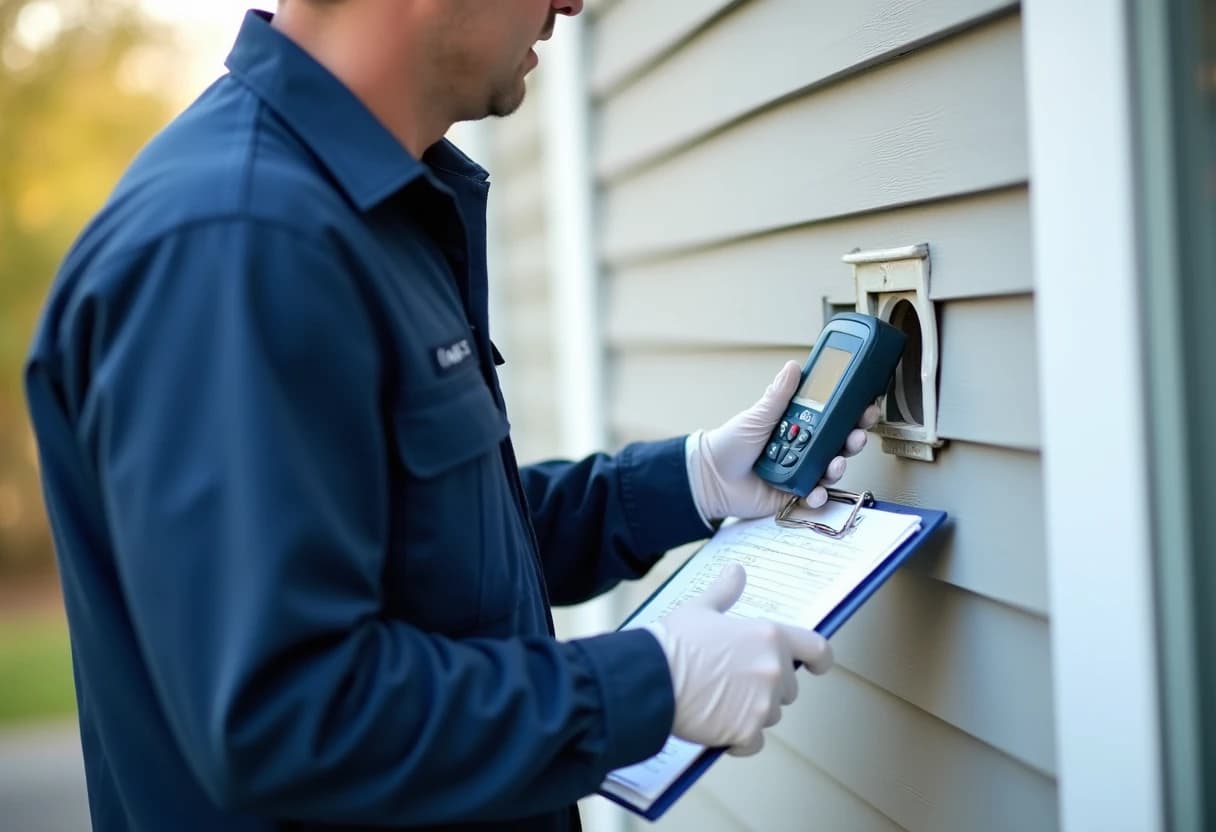
A dryer vent inspection is the fastest, cheapest way to answer a question every homeowner should be able to answer: is my dryer exhaust safe? Our Millis technicians measure airflow at the termination with a calibrated anemometer, run an inspection camera the full length of the duct, examine the exterior hood and damper, assess the lint load inside the run, and check the installation against the residential code rules that govern dryer ducts. You leave with a written safety report — photos, measurements and a clear verdict — instead of a guess. If the vent is clean and compliant, we tell you so and you are done for the year. If it needs work, you will know exactly what and why before spending a dollar on cleaning or repairs.
Why Dryer Vent Inspection & Safety Check Matters for Millis Homes
Dryer fires are among the most preventable house fires in America, and the statistics are stubbornly consistent: FEMA and NFPA data attribute roughly 2,900 residential clothes dryer fires per year to U.S. homes, causing deaths, injuries and tens of millions of dollars in property loss — with lint the leading ignition source and failure to clean the leading contributing factor. What makes these fires preventable is that the hazard builds slowly and measurably. Lint accumulates in the duct, airflow drops, drying times stretch, the dryer cabinet runs hotter, and eventually a heating element or a spark meets a fuel supply that has been growing for years. An annual inspection interrupts that chain at the first link. Airflow measurement detects restriction long before it becomes dangerous; camera imaging shows exactly where lint is packing and whether the duct itself — crushed sections, separated joints, an accordion foil transition — is contributing. For less than the cost of a dinner out, you convert an invisible risk into a documented, managed one.
Condo and multi-family living shapes dryer safety in Millis more than most owners realize. Millis mixes a small nineteenth-century village center with waves of postwar capes and ranches, followed by 1980s-to-2000s Colonial subdivisions off Orchard and Village Streets. Most of the postwar homes have had central air added onto aging furnace ductwork, creating mismatched systems where new equipment pushes air through fifty-year-old sheet metal. Slab-on-grade ranches here often run ducts through attics, where summer heat stresses every joint. In triple-deckers and converted buildings, dryer ducts often run long distances through shared walls and ceilings to reach an outside face, and the termination may be three stories up where nobody has looked at it in years. Low-lying stretches of Millis near the Charles River and Bogastow Brook keep basements damp for much of the year, and moisture migrating into basement duct runs is the top issue we see locally. Homes near the town's working farms also pull in more field dust and pollen than owners realize. Association boards across Norfolk County increasingly require documented dryer vent verification for exactly this reason — one unit's neglected duct is every unit's fire risk. Our inspection reports are formatted for board and property-manager submission: photos, airflow numbers, code notes and a dated finding for each unit, delivered after a single visit.
Our Dryer Vent Inspection & Safety Check Process in Millis
1Interview & Visual Assessment
First, context: your answers about drying performance and service history frame the inspection, and a walk of the laundry area frames the system. We identify the duct material, count visible elbows, locate where the run enters the structure, and note anything — crushing, kinks, tape-only joints — that already tells part of the story.
2Airflow Measurement at the Termination
The single most telling test takes two minutes: dryer on, anemometer at the hood. Exhaust volume tells us how much of the dryer's rated airflow actually survives the trip through the duct. We record the reading in your report so future inspections can track the trend — a slow year-over-year decline is the earliest possible warning of developing blockage.
3Full-Length Camera Inspection
This is the step no flashlight can replace: a camera pass of the complete exhaust run, wall cavities and ceiling sections included. You can watch live as it travels. Lint depth, joint condition, duct material transitions and any obstructions are recorded, and representative frames go into your written report as evidence for every finding.
4Termination Hood & Damper Check
Outside, we evaluate the termination: does the damper open fully under dryer airflow and close cleanly at rest? Is the hood intact, sealed to the wall, and free of lint beards, paint-overs or screening that traps lint? A surprising share of vent failures live entirely at this last twelve inches of the system.
5Lint-Load Assessment & Fire-Risk Scoring
Not all lint findings are equal. A light, even film is normal; wet, matted accumulation at a low point signals condensation problems; heavy packing at elbows signals a duct working beyond its geometry. We grade what the camera found against how your household uses the dryer, so the recommendation matches your actual risk.
6Code-Compliance Review
Many Massachusetts dryer runs predate modern code or were improvised during renovations, so this review frequently finds the root cause behind chronic lint problems: an over-length run, an accordion foil transition, a screened termination collecting lint like a filter. Identifying the violation matters because cleaning a non-compliant duct treats the symptom on a schedule; correcting it treats the cause once.
7Written Safety Report & Recommendations
The visit ends with documentation, not a verbal shrug. Your report states plainly whether the vent passed, what was found where, and what — if anything — we recommend, with flat-rate pricing for any corrective work so you can decide on your own schedule. No findings are invented to sell a cleaning; the photos speak for themselves.
Benefits of Professional Dryer Vent Inspection & Safety Check in Millis
Fire Risk Caught Before It Matters
Lint fires do not announce themselves; they accumulate. An inspection converts that slow, invisible buildup into a number and a photograph you can act on. Homeowners who inspect annually essentially never experience a vent-related fire, because the fuel never gets the chance to reach a dangerous load.
Lower Drying Costs & Longer Appliance Life
A restricted vent makes every load take longer, and longer cycles cost real money in electricity or gas — often hundreds of dollars a year in heavy-laundry households. Inspection catches restriction at the stage where a single cleaning restores one-cycle drying and normal operating costs.
Hidden Code Violations Exposed
Many chronic lint problems are really installation problems: the duct violates length, material or fastening rules and will clog on schedule forever until corrected. The compliance review identifies the root cause, so you can stop paying to clean a duct that was built to fail.
A Written Report You Can Actually Use
The report is the product: dated, photographed, measured. Homeowners file it with insurance records, sellers attach it to disclosures, landlords and condo boards accept it as compliance documentation, and buyers use it to negotiate or verify. A verbal 'looks fine' from a handyman does none of those jobs.
Protection From Moisture & Carbon Monoxide
Every load of laundry evaporates roughly a gallon of water, and all of it must exit through this one duct. Joints that separated inside a ceiling deliver that gallon into your structure instead. The camera pass finds hidden leaks that no exterior symptom would reveal until damage was done.
No Unnecessary Cleanings
The $79 inspection frequently saves the $200 cleaning. When airflow measures strong and the camera shows light accumulation, we say so in writing and leave. Customers who used to buy blind annual cleanings routinely discover their actual interval is longer — and their total maintenance spend drops accordingly.
Signs Your Millis Home Needs Dryer Vent Inspection & Safety Check
Insurance, Condo or Sale Requirements
Multi-family buildings across Massachusetts are adding periodic dryer vent verification to bylaws after highly publicized lint fires in stacked-laundry buildings. If a notice has landed in your mailbox, we handle single units and whole buildings, with per-unit documentation the board can file.
Clothes Take More Than One Cycle
Drying time is the vent's report card. Loads that once took 45 minutes now taking 80 means delivered airflow has fallen substantially — and every extra minute is money and heat stress. If your laundry routine has quietly stretched over the past year, the duct is asking for an inspection.
The Dryer or Laundry Room Feels Hot
A dryer cabinet that is hot to the touch, or a laundry room that turns into a sauna mid-cycle, means exhaust heat is staying in the house instead of leaving through the duct. That trapped heat is the same heat that ignites lint. It warrants a measurement promptly.
Burning or Musty Smells During Operation
Musty smells on 'clean' laundry point to moisture lingering in the duct — often a low spot where condensation pools and lint mats into a damp plug. Beyond the odor, wet lint accumulations restrict flow badly and hide mold. The camera finds the low spot; the fix follows from there.
No Visible Exhaust at the Outside Hood
The outdoor hood is the one part of the system you can check yourself, and a weak or absent exhaust stream there is diagnostic. But the hood cannot tell you where the problem lives — the duct, the damper or the dryer. The anemometer and camera answer that in one visit.
You Cannot Remember the Last Service
Dryer vents fail on a schedule set by laundry volume, duct length and installation quality — variables you cannot assess from the laundry room. Annual inspection is the standing recommendation of fire-safety agencies precisely because no visible cue reliably announces when a vent crosses from fine to dangerous.
Dryer Vent Inspection & Safety Check Cost in Millis, MA
It helps to price the inspection against what it prevents. A restricted vent adds 20 to 40 minutes to every load; at Massachusetts electricity rates, heavy-laundry households can burn through several hundred dollars a year in wasted drying energy alone — several times the inspection fee. A thermal fuse or high-limit failure from chronic overheating means an appliance repair visit starting around $150 plus parts. A moisture leak inside a wall from a separated joint means drywall, paint and possibly mold remediation. And a lint fire, even a small contained one, means smoke damage, insurance claims and premiums that never quite come back down. Against that menu, $79–$149 once a year with a written report is the least expensive line item in home fire safety. We keep the price deliberately low because inspection is how responsible vent maintenance should start — measurement first, then only the work the measurements justify.
Want the full pricing picture? See our complete Boston-area cost guide or call (617) 390-7145 for an exact flat quote for your Millis home.
Local Knowledge: Millis, Norfolk County
Every town's ductwork tells the story of its housing. Millis mixes a small nineteenth-century village center with waves of postwar capes and ranches, followed by 1980s-to-2000s Colonial subdivisions off Orchard and Village Streets. Most of the postwar homes have had central air added onto aging furnace ductwork, creating mismatched systems where new equipment pushes air through fifty-year-old sheet metal. Slab-on-grade ranches here often run ducts through attics, where summer heat stresses every joint. Low-lying stretches of Millis near the Charles River and Bogastow Brook keep basements damp for much of the year, and moisture migrating into basement duct runs is the top issue we see locally. Homes near the town's working farms also pull in more field dust and pollen than owners realize. We plan Millis jobs around those realities, from equipment selection to time on site, and it shows in the results. If you live near Oak Grove Farm or anywhere across Millis's 02054 area, we have almost certainly cleaned a system like yours before — and we can tell you exactly what to expect before we arrive.
The Best Time of Year in Millis
Spring earns its own place on the inspection calendar because of what moves into vents between March and June: nesting birds. Starlings and house sparrows treat an uncapped or damaged dryer termination as prime real estate, and a nest turns a healthy vent into a near-total blockage within days. Our spring inspections put extra attention on the termination — damper integrity, hood condition, evidence of nesting activity — and catch bird problems before eggs complicate a humane removal. Spring is also when winter's damage surfaces: hoods cracked by ice, dampers stiffened by corrosion, joints loosened by months of freeze-thaw movement in the structure.
Why Choose Boston Air Duct Cleaners
What separates us from the coupon crowd is simple: we do the whole job, we prove it, and we charge what we quoted. Our technicians clean supplies, returns, trunks and blower compartments on every visit — never a cosmetic vent wipe. Photo documentation comes standard, pricing is flat and confirmed up front, and our trucks carry true commercial vacuum equipment, not rented shop-vacs. Based in West Newton and serving Millis year-round, we answer our own phone at (617) 390-7145 and stand behind every cleaning with a satisfaction guarantee.
Serving Millis and Surrounding Communities
Beyond Millis, our crews cover the surrounding communities daily — including Medway, Medfield, Norfolk, Sherborn, Holliston, Franklin. Because routes cluster geographically, booking alongside a neighboring appointment often unlocks same-day service and combined-visit savings. Wherever you are in Norfolk County, the same flat-rate pricing, insured technicians and photo-documented process applies.