
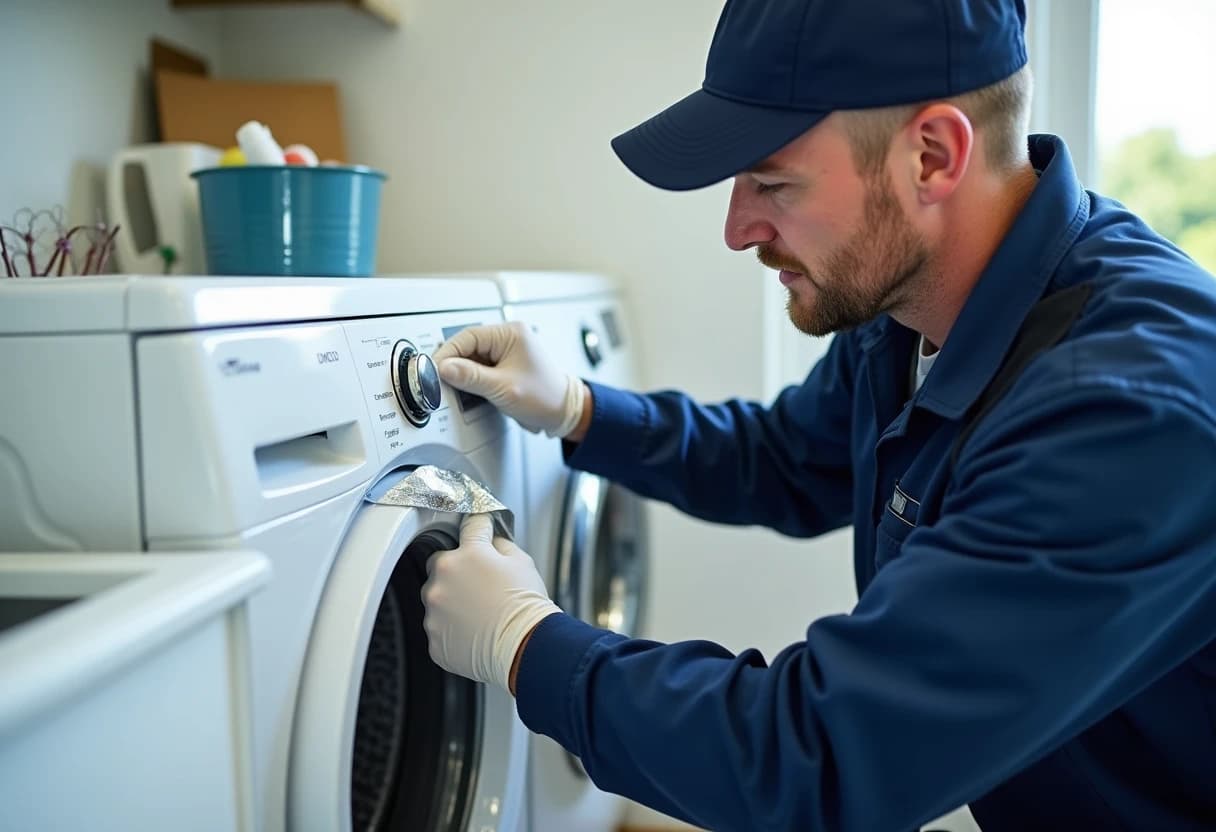
That flattened foil hose behind your dryer is doing more damage than it looks. Crushed transition ducts are the most common dryer vent failure we find in Norfolk homes — the machine gets pushed back against the wall, the accordion hose collapses to a fraction of its diameter, and the dryer spends years straining against a pinched exhaust while lint packs the kink. We replace these hazards with semi-rigid aluminum connectors and repair everything downstream too: separated joints, sagging runs, holes rusted through duct walls, and exterior hoods that no longer close against weather and pests. Done right, with the materials the code requires, a repaired vent runs trouble-free for decades.
Why Dryer Vent Repair Matters for Norfolk Homes
Disconnected dryer ducts are far more common than homeowners imagine, because the connections were never robust to begin with. Many vents were assembled with duct tape (which bakes brittle and lets go within a few years of hot exhaust cycles), or with screws driven through the duct wall (which the code prohibits precisely because the protruding tips snag lint until vibration and weight work the joint apart). Add the shove of every appliance delivery, the settling of old framing, and renovation work that jostles concealed runs, and joints quietly separate inside walls and ceilings all over Greater Boston. The dryer keeps running; the exhaust simply goes into the house. We find these failures with airflow testing and inspection — a dryer producing strong drum heat but weak exterior airflow is venting somewhere it should not — then rejoin the duct with proper fittings, clamps and UL-listed foil tape. If lint has been accumulating in the cavity, we document it and vacuum what is accessible, because that hidden pile is a fuel load your home does not need.
A surprising share of our Norfolk repair calls begin with a water stain. Norfolk is overwhelmingly a town of 1980s-through-2000s Colonial subdivisions carved out of former woodland and farmland, with only a thin layer of older homes around Town Hill. Nearly every house runs forced-air heat with central air, and the larger builds carry two systems - one in the basement, one in the attic - doubling the ductwork that needs attention. Attic air handlers over long flex-duct runs are the norm in the newer neighborhoods. A ceiling mark below a second-floor laundry, peeling paint behind a basement dryer, a mildew odor in one wall — homeowners call a painter or a plumber before anyone thinks of the dryer vent, yet a leaking or condensing vent is the cause remarkably often. Norfolk's wooded subdivisions back onto wetlands around Stony Brook, so seasonal pollen and damp shoulder-season air both work their way into duct systems here. With most homes built in the same few decades, we often find twenty-plus years of accumulated dust in systems that have never once been cleaned. Our diagnostic visit settles it quickly: we trace the duct path, test airflow at both ends, and either confirm the vent as the culprit and quote the repair flat, or rule it out so you can chase the real source with confidence.
Our Dryer Vent Repair Process in Norfolk
1Diagnose the Full Exhaust Path
We treat symptoms as evidence: lint in the basement points to a specific joint; a ceiling stain maps to a specific duct section; condensation drips tell us where the run crosses cold space. Correlating symptoms with the physical path usually pinpoints the failure within minutes — and rules out the failures you do not have.
2Protect the Area & Open Access
Laundry areas are tight, finished spaces, and we work in them accordingly: drop cloths, boot covers, and careful handling of the appliance and its gas or electrical connections. Gas dryers get particular care around the flexible connector — we never strain a gas line to reach a duct.
3Reconnect & Properly Fasten Separated Joints
We do not just push a failed joint back together; we rebuild it so it cannot fail the same way. That means cleaning mating surfaces, correcting the misalignment or unsupported weight that pulled the joint apart, adding hangers or strapping where the run lacked support, and sealing the finished connection against both air and moisture leakage.
4Replace Crushed, Corroded or Non-Compliant Sections
Replacement is also the moment to correct design faults we find: a kink where two sections meet at a bad angle becomes a pair of smooth elbows; an unsupported span gets hangers; an oversized or undersized segment is brought back to uniform 4-inch diameter so airflow stops tumbling at transitions. We fix what failed and what made it fail.
5Cure Condensation: Slope, Seal & Insulate
Where a run's routing makes condensation inevitable — long passages through cold space, low points that cannot be drained — we say so plainly and price the better fix: shortening or rerouting the run, which we quote as a separate option. Honest diagnosis beats a repair that treats symptoms the routing will simply recreate.
6Repair or Replace the Exterior Hood & Damper
The new hood is sealed to the wall correctly: fastened to siding or masonry, flashed and caulked so wind-driven rain stays out of the wall assembly, with the duct connection sealed inside. On brick and stone, we drill and anchor rather than improvise; on clapboard, we integrate with the siding plane. The termination should outlast the roof.
7Replace the Transition Duct & Reset the Dryer
The appliance connection is rebuilt to spec: a UL-listed semi-rigid aluminum transition duct, as short and straight as the layout allows, secured with clamps at both ends. We position the dryer so the connector keeps its full diameter — not crushed against the wall — and mark the safe distance so future pushes do not recreate the old kink.
8Verify Airflow & Document the Repair
The proof is at the hood: with the dryer running, the damper should stand fully open under a strong, steady exhaust stream. We verify it together, compare against the pre-repair condition, and confirm no leakage remains at any repaired joint. Then the work area is cleaned, the dryer set, and the laundry room returned to service.
Benefits of Professional Dryer Vent Repair in Norfolk
Moisture Out of Your Walls and Ceilings
Condensation repairs — slope, sealing, insulation — end the drip-and-pool cycle that rusts ducts from the inside and stains ceilings from above. Laundry areas dry out, winter window condensation eases, and the musty smell that clung to the wall behind the dryer leaves with the moisture feeding it.
Restored Drying Performance
A crushed or separated duct throttles airflow just like a lint clog, and no amount of cleaning fixes it. Repair restores the full 4-inch path, and drying performance returns immediately — one-cycle loads, accurate sensor-dry behavior, and a machine that stops straining against backpressure it was never designed to fight.
A Serious Fire Hazard, Eliminated
A breached or restricted dryer vent combines the two ingredients of the roughly 2,900 annual US dryer fires: accumulating lint and rising exhaust temperatures. Repair removes both — the escape points that seed wall cavities with fuel, and the crush points and blockages that overheat the system. It is fire prevention with a wrench, and it lasts for decades.
Decades of Reliable Service From One Repair
Done with rigid metal, mechanical fastening and a quality termination, a dryer vent repair is not a patch — it is infrastructure. Properly installed rigid duct routinely outlasts the dryers connected to it, needing only annual cleaning. The failure-prone materials and joints that caused your problem simply are not there anymore.
Code Compliance & Inspection-Ready Documentation
For condo owners, documented code-compliant repair satisfies association requirements and insurance due diligence in one visit. We provide written scopes for board approval beforehand and completion records with photos afterward — paperwork that matters when a shared building's fire safety is the subject.
Lower Energy and Repair Bills
A dryer fighting a damaged vent runs longer per load and hotter per minute — both metered directly on your utility bill, often $10 to $20 a month for a busy household. Repair returns cycles to design length. The savings recur every laundry day, quietly repaying the one-time repair cost within the first year or two.
Signs Your Norfolk Home Needs Dryer Vent Repair
Water Stains, Drips or Peeling Paint Near the Vent Path
A ceiling stain below a second-floor laundry, paint bubbling behind the dryer, or drips from a basement duct joint all point to exhaust moisture escaping or condensing in the run. Each load adds another gallon of vapor to the problem. Repair — sealing, sloping, insulating or replacing the affected section — stops the source; cosmetic fixes without it just repaint the symptom.
A Home Inspection or Appliance Tech Flagged the Vent
When an appliance technician condemns your vent while servicing the dryer, believe them: they have just measured the backpressure your machine fights on every load. Repairing the duct protects the repair they made — a new heating element or thermal fuse installed against a failed vent will simply fail again.
Visibly Damaged, Kinked or Sagging Duct
Sag matters more than it looks: a bellied section pools condensate, which soaks lint into a mat, which adds weight, which deepens the sag. The cycle ends in a blocked or rusted-through low point. Adding proper support and restoring slope while the duct is still sound is a small repair that prevents a large one.
Musty or Mildew Smell in the Laundry Area
A persistent damp smell around the laundry — or in one adjacent wall or ceiling — often means exhaust moisture has been feeding hidden mildew via a leak or chronic condensation. The odor is the nose's report on a moisture problem the eyes cannot see. A vent-path inspection locates the escape point, and repair dries up its food supply.
Slow Drying That Cleaning Didn't Fix
If a vent cleaning did not restore drying performance, the airflow restriction is structural: a crushed section, a collapsed inner liner, a separated joint dumping exhaust short of the hood, or a damper that cannot open. The next step is diagnosis, not another cleaning — we trace the path, find the mechanical fault, and quote its repair flat.
Lint Appearing Where It Shouldn't
Lint drifting from a basement ceiling, gathering on joists, puffing from a wall register or collecting behind the dryer means exhaust is escaping the duct before the termination. Lint marks the leak like dye in water — follow it and you find the separated joint or breach. This is a repair call, not a cleaning call, and it should not wait.
Dryer Vent Repair Cost in Norfolk, MA
Repair versus replace is the judgment call at the heart of this service, and our rule is simple: repair when the underlying system is sound, replace when it is not. A rigid metal run with one separated joint, one crushed section, or a failed hood is worth repairing — the fix restores a fundamentally good system for $150 to $450. A run made entirely of accordion flex, a duct routed far beyond code's 35-foot equivalent length with no path to compliance, or a system so corroded that each repair reveals the next failure is not worth patching — full replacement or rerouting (our dryer vent installation service, typically $300 to $900) serves you better and often costs less than serial repairs would. We price both options when the call is close and give you our recommendation with reasons. Either way, the visit ends with a verified, documented exhaust path — and an honest answer about how long it should last.
Want the full pricing picture? See our complete Boston-area cost guide or call (617) 390-7145 for an exact flat quote for your Norfolk home.
Local Knowledge: Norfolk, Norfolk County
Serving Norfolk means knowing Norfolk. Norfolk is overwhelmingly a town of 1980s-through-2000s Colonial subdivisions carved out of former woodland and farmland, with only a thin layer of older homes around Town Hill. Nearly every house runs forced-air heat with central air, and the larger builds carry two systems - one in the basement, one in the attic - doubling the ductwork that needs attention. Attic air handlers over long flex-duct runs are the norm in the newer neighborhoods. Norfolk's wooded subdivisions back onto wetlands around Stony Brook, so seasonal pollen and damp shoulder-season air both work their way into duct systems here. With most homes built in the same few decades, we often find twenty-plus years of accumulated dust in systems that have never once been cleaned. Those conditions shape how we work here: which brush heads come off the truck, how we protect finishes in older interiors, and what we expect to find when the camera goes into a 02056 duct system. Our crews are in and around Norfolk nearly every week — often for neighbors of past customers — so scheduling is fast and our arrival windows hold.
The Best Time of Year in Norfolk
Spring is nesting season, and a dryer vent with a compromised damper is prime real estate: warm, dry, sheltered, and lined with soft lint. Birds, squirrels and mice move in between March and June, and by summer the nest has become a full blockage — often discovered when drying times collapse or a burning smell appears. The seasonal logic favors acting early: repair a failing damper in late winter and the nest never happens; wait, and the spring repair includes nest removal, duct cleaning and sanitizing on top of the hood replacement. If you heard scratching or chirping near the laundry last spring, put the termination inspection on this year's calendar before the wildlife does.
Why Choose Boston Air Duct Cleaners
We built this company around the jobs other duct cleaners do badly: the 130-year-old Victorian with panned-joist returns, the Norfolk condo with a 60-foot dryer run to the roof, the post-renovation house full of drywall dust. Our crews see Greater Boston's hardest systems every week, and the experience shows in the details — floor protection on the way in, sealed registers during the work, HEPA-vacuumed work areas on the way out, and imagery that proves the ducts are actually clean. Call (617) 390-7145 and judge the difference from the first conversation.
Serving Norfolk and Surrounding Communities
We serve every community around Norfolk as well: Millis, Medfield, Franklin, Wrentham, Medway, Walpole all fall inside our regular service routes. If you have a second property, a rental, or family nearby, ask about multi-home scheduling — grouped appointments on the same route are our most requested discount.