
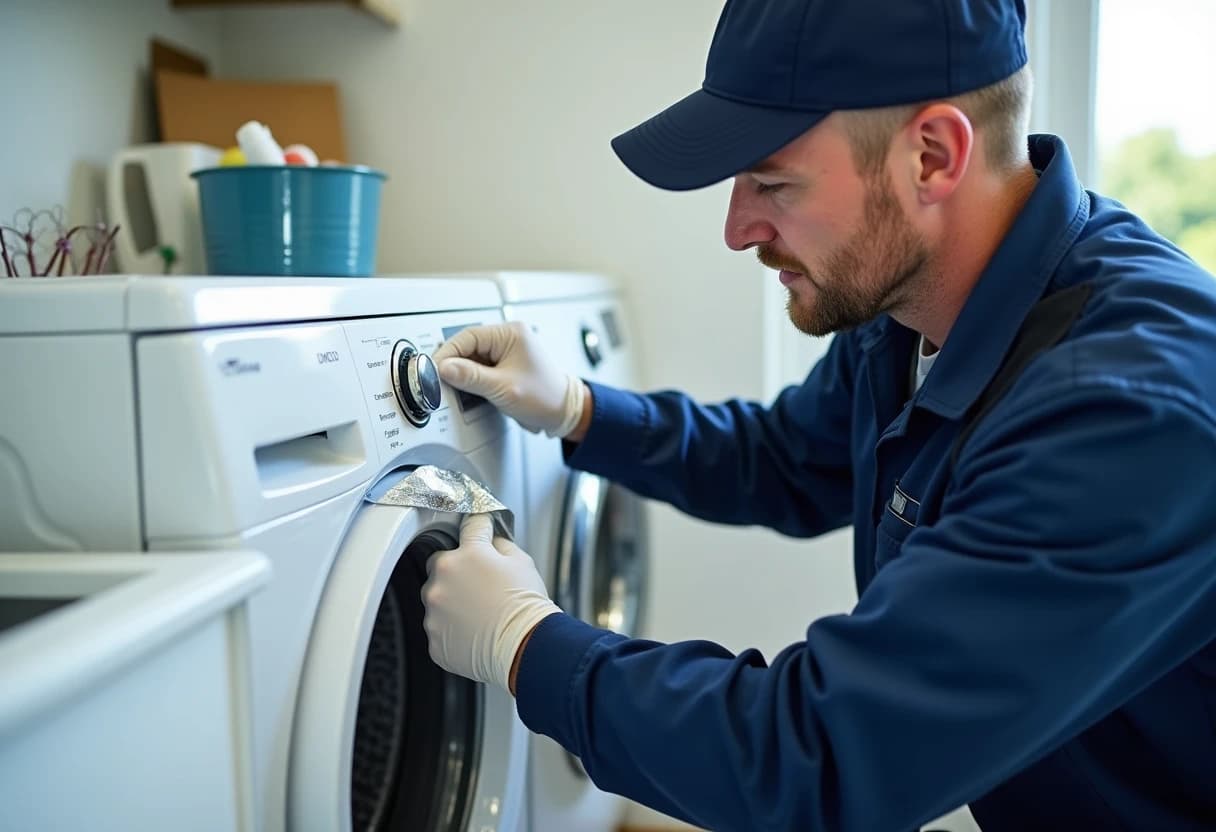
Dryer exhaust is hot, humid, lint-laden air, and every foot of duct it travels through must be intact and sealed. A single disconnected joint dumps a gallon of moisture per load into a wall cavity or ceiling — along with a steady supply of highly flammable lint. We repair dryer vents throughout Marblehead: reconnecting and properly securing separated ducts, replacing damaged runs and non-compliant flex materials with smooth rigid metal, curing chronic condensation problems, and replacing broken exterior hoods and bird-guard dampers. Repairs are quoted flat after diagnosis, typically $150 to $450, and every job ends with an airflow verification and photos of the completed work.
Why Dryer Vent Repair Matters for Marblehead Homes
There is also a timing argument: dryer vent damage compounds, and early repair is dramatically cheaper than late repair. A loose joint today is a separated joint next year — and a wall cavity full of lint and moisture the year after, when the fix has grown from a $150 reconnection into drywall opening, cavity cleaning, and possibly mold remediation. A crushed transition hose today is a strained heating element and blown thermal fuse next winter, adding an appliance repair bill to the vent repair that was needed anyway. A failing damper today is a nest blockage by spring. This is why we treat inspection as the heart of the service: our technicians walk the entire exhaust path, test airflow at both ends, and give you a photographed, prioritized picture of what is failing and what it costs to fix now versus later. Most Marblehead repairs land between $150 and $450 and finish in a single visit — a modest price for closing off the expensive futures.
Winters around Marblehead are hard on dryer vents in ways warmer regions never see. Surrounded by harbor on one side and open Atlantic on the other, Marblehead homes battle salt-laden humidity year-round, and we routinely replace seized, corroded vent hoods on homes near the causeway. In Old Town's centuries-old basements, stone foundations wick moisture that finds its way into any duct run passing through. Exhaust moisture condenses and freezes in duct sections crossing cold basements and exterior walls, dampers ice shut, and snow buries grade-level hoods. Marblehead's Old Town holds one of the largest concentrations of pre-Revolutionary homes in America - narrow gambrels and Georgians on winding lanes - while Clifton and the Neck add Victorian summer estates and mid-century family homes. Retrofitting ductwork into these antique frames produces tight chases, flexible duct and high-velocity mini-duct systems that demand careful, gentle cleaning methods. Those homes often route vents through the coldest parts of the structure, which is why our Marblehead condensation repairs so often involve insulating and re-sloping duct in unheated space. We fix the winter failure and the design weakness behind it, so the same problem does not return with the next cold snap.
Our Dryer Vent Repair Process in Marblehead
1Diagnose the Full Exhaust Path
Your technician maps the vent's routing, materials and condition: transition hose state, joint integrity, crush points, sag, corrosion, termination function. Where the run is concealed, airflow measurements and inspection tools tell us what the walls hide. You get a photographed diagnosis and a flat repair quote before any work begins.
2Protect the Area & Open Access
Laundry areas are tight, finished spaces, and we work in them accordingly: drop cloths, boot covers, and careful handling of the appliance and its gas or electrical connections. Gas dryers get particular care around the flexible connector — we never strain a gas line to reach a duct.
3Reconnect & Properly Fasten Separated Joints
Where lint and moisture have escaped into a cavity through a long-standing disconnection, we vacuum accessible accumulation with HEPA equipment and document conditions with photos. Removing that hidden fuel load matters as much as the reconnection itself — and the photos give you a record for insurance or future renovation planning.
4Replace Crushed, Corroded or Non-Compliant Sections
Vinyl and foil accordion duct found anywhere in the run is removed on sight and replaced: rigid metal for the concealed run, a short UL-listed semi-rigid aluminum connector at the appliance. The smooth interior of proper duct resists lint accumulation dramatically better than corrugations — the repair also makes every future cleaning faster and more effective.
5Cure Condensation: Slope, Seal & Insulate
Condensation repairs follow the water. We restore continuous slope toward the termination so condensate drains out instead of pooling; seal the joints it has been leaking through with foil tape rated for the duty; and insulate duct sections crossing unheated basements, garages, attics and exterior wall bays so exhaust stays above its dew point until it exits.
6Repair or Replace the Exterior Hood & Damper
The new hood is sealed to the wall correctly: fastened to siding or masonry, flashed and caulked so wind-driven rain stays out of the wall assembly, with the duct connection sealed inside. On brick and stone, we drill and anchor rather than improvise; on clapboard, we integrate with the siding plane. The termination should outlast the roof.
7Replace the Transition Duct & Reset the Dryer
The appliance connection is rebuilt to spec: a UL-listed semi-rigid aluminum transition duct, as short and straight as the layout allows, secured with clamps at both ends. We position the dryer so the connector keeps its full diameter — not crushed against the wall — and mark the safe distance so future pushes do not recreate the old kink.
8Verify Airflow & Document the Repair
Finally we log the service and recommend a cleaning schedule for the repaired system — typically annual. A repaired vent with smooth rigid duct and a proper termination accumulates lint far more slowly than the failed system it replaced, and the documentation we leave shows exactly what is now behind your walls.
Benefits of Professional Dryer Vent Repair in Marblehead
Decades of Reliable Service From One Repair
Repairs also make every future cleaning better: smooth interiors let rotary brushes work at full effectiveness, sealed joints keep the vacuum's suction where it belongs, and a free-swinging damper lets technicians verify airflow honestly. You are not just fixing today's failure — you are buying easier maintenance forever.
A Serious Fire Hazard, Eliminated
Lint inside a wall cavity cannot be cleaned on any schedule; the only fix is stopping the leak that puts it there. Repairing disconnections and sealing joints confines lint to the duct, where annual cleaning can manage it. That containment is the difference between a maintainable system and a slowly growing hazard you cannot see.
Restored Drying Performance
Customers are often startled by the change: a vent we repaired after years of gradual crushing gives them back the dryer they bought. If your drying times worsened after an appliance delivery, a renovation, or a move of the machine — events that crush transitions and separate joints — repair, not replacement, is very likely the answer.
Moisture Out of Your Walls and Ceilings
In New England's freeze-thaw climate, moisture in building assemblies does compounding damage each winter. Sealing a leaking dryer vent removes one of the few moisture sources that operates year-round, indoors, by the gallon. Building scientists put exhaust integrity high on the envelope checklist for exactly this reason.
Code Compliance & Inspection-Ready Documentation
Compliance is not paperwork for its own sake; each code provision encodes a failure the industry learned about the hard way. Smooth interiors resist lint. Clamped joints survive heat. Unscreened dampers do not mat over. A to-code vent is simply a vent engineered not to fail the common ways.
Lower Energy and Repair Bills
A failed exterior damper is a hole in your heated envelope all winter — a 4-inch duct delivering January directly to your laundry room. Replacing it with a tight-closing hood pays for itself in heating savings and comfort, entirely apart from what it does for the dryer.
Signs Your Marblehead Home Needs Dryer Vent Repair
Visibly Damaged, Kinked or Sagging Duct
Trust your eyes: a transition hose flattened behind the dryer, a dented or crushed section in the basement, duct sagging between supports into a low belly, or a run held together with fabric duct tape are all failures in progress. Each restricts airflow, collects lint and moisture, and worsens with time. Photograph what you see and call — the quote is quick.
Lint Appearing Where It Shouldn't
Lint drifting from a basement ceiling, gathering on joists, puffing from a wall register or collecting behind the dryer means exhaust is escaping the duct before the termination. Lint marks the leak like dye in water — follow it and you find the separated joint or breach. This is a repair call, not a cleaning call, and it should not wait.
Water Stains, Drips or Peeling Paint Near the Vent Path
A ceiling stain below a second-floor laundry, paint bubbling behind the dryer, or drips from a basement duct joint all point to exhaust moisture escaping or condensing in the run. Each load adds another gallon of vapor to the problem. Repair — sealing, sloping, insulating or replacing the affected section — stops the source; cosmetic fixes without it just repaint the symptom.
A Home Inspection or Appliance Tech Flagged the Vent
When an appliance technician condemns your vent while servicing the dryer, believe them: they have just measured the backpressure your machine fights on every load. Repairing the duct protects the repair they made — a new heating element or thermal fuse installed against a failed vent will simply fail again.
Slow Drying That Cleaning Didn't Fix
If a vent cleaning did not restore drying performance, the airflow restriction is structural: a crushed section, a collapsed inner liner, a separated joint dumping exhaust short of the hood, or a damper that cannot open. The next step is diagnosis, not another cleaning — we trace the path, find the mechanical fault, and quote its repair flat.
Exterior Damper Broken, Stuck or Missing
Evidence of animals — chirping in the duct, nesting material at the hood, droppings near the vent line — means the termination has already failed as a barrier. We remove the nest, clean the affected duct, and install a hood with real pest protection. Spring is nesting season; the repair is best made before it.
Dryer Vent Repair Cost in Marblehead, MA
Compare the repair cost against what the failure costs to keep. A leaking vent delivers roughly a gallon of water per load into your building assemblies — and chronic wall moisture matures into mold remediation and drywall work that starts around $1,500 and climbs steeply. A crushed or blocked duct overworks the dryer into $150 to $400 appliance repairs (thermal fuses, elements, switches) that recur until the vent is fixed, while adding $10 to $20 a month in energy waste. A failed damper leaks heated air all winter and invites nest blockages every spring. And every one of these failures raises fire risk in a system that already accounts for about 2,900 US home fires a year. Against that ledger, $150 to $450 for a permanent, code-compliant repair is one of the clearest-value maintenance purchases in the home. Most customers who see the diagnostic photos do not need convincing; the duct makes the argument itself.
Want the full pricing picture? See our complete Boston-area cost guide or call (617) 390-7145 for an exact flat quote for your Marblehead home.
Local Knowledge: Marblehead, Essex County
Serving Marblehead means knowing Marblehead. Marblehead's Old Town holds one of the largest concentrations of pre-Revolutionary homes in America - narrow gambrels and Georgians on winding lanes - while Clifton and the Neck add Victorian summer estates and mid-century family homes. Retrofitting ductwork into these antique frames produces tight chases, flexible duct and high-velocity mini-duct systems that demand careful, gentle cleaning methods. Surrounded by harbor on one side and open Atlantic on the other, Marblehead homes battle salt-laden humidity year-round, and we routinely replace seized, corroded vent hoods on homes near the causeway. In Old Town's centuries-old basements, stone foundations wick moisture that finds its way into any duct run passing through. Those conditions shape how we work here: which brush heads come off the truck, how we protect finishes in older interiors, and what we expect to find when the camera goes into a 01945 duct system. Our crews are in and around Marblehead nearly every week — often for neighbors of past customers — so scheduling is fast and our arrival windows hold.
The Best Time of Year in Marblehead
Winter exposes dryer vent damage that hides all year. Joints that leak slightly in summer drip visibly when exhaust moisture condenses hard against freezing duct; marginal dampers ice shut; snow buries grade-level hoods; and the season's heavy laundry loads push maximum moisture through every weak point. Massachusetts repair calls spike from December through February for exactly these reasons — and because a blocked or leaking vent in a sealed-up winter house sends its moisture and, for gas dryers, combustion byproducts into air that will not be refreshed until spring. If your vent showed symptoms last winter, repairing it in fall is the calm, scheduled alternative to an emergency call during a January cold snap with a full laundry basket waiting.
Why Choose Boston Air Duct Cleaners
As a West Newton-based company, we treat Marblehead like the neighborhood it is — because for us, it is. Our reputation lives or dies on local referrals, so every job gets the full process: complete system cleaning under negative pressure, mechanical agitation of every run, blower compartment service, and a documented walkthrough before we leave. We are licensed and insured, our estimates are free and flat, and our schedule holds same-day slots for urgent calls. One visit and you will understand why neighbors keep our magnet on the fridge.
Serving Marblehead and Surrounding Communities
Marblehead sits in the heart of our service area, and neighboring Swampscott, Salem, Lynn, Peabody, Nahant, Beverly appointments share the same routes. That density is why our response times in this part of Essex County are among our fastest — and why you will see our trucks in the area week after week.