
Dust is the quiet tax on every HVAC system in Ipswich. It collects on the blower blades and unbalances the fan; it blankets the coil and insulates it against the heat exchange it exists to perform; it lines the ducts and raises the static pressure the motor must fight every minute it runs. The system compensates the only way it can — longer cycles, higher bills, hotter-running components, earlier failures. HVAC system cleaning removes the tax. We clean ducts, plenums, blower, coil and cabinet as one job, using truck-grade negative pressure and NADCA-standard methods, and we document the transformation with photos. Customers most often report three changes within the week: stronger register airflow, faster temperature recovery, and a system suddenly quiet enough to forget.
Why HVAC System Cleaning Matters for Ipswich Homes
Whole-system cleaning is also an indoor air quality service with reach that duct-only cleaning cannot match. The dampest, most biologically active surfaces in the air path are on the equipment: the evaporator coil and drain pan stay wet through the cooling season, and their biofilm is the usual origin of musty odors and microbial circulation. The blower wheel, spinning in the airstream, sheds particulate from its buildup continuously. Cleaning the ducts while leaving those components loaded means the air still crosses contaminated surfaces on every cycle — cleaner than before, but never actually clean. Our whole-system service closes the gap: coil cleaned and treated, pan scrubbed and draining, blower detailed, cabinet HEPA-vacuumed, and only then does the duct cleaning fully pay off. For allergy and asthma households, the difference is the point; for everyone else it arrives as less dusting, neutral-smelling airflow, and the end of the burnt-dust announcement every October when the furnace fires for the first time.
The equipment serving Ipswich homes was mostly asked to do a job it was never sized for. Ipswich holds more surviving First Period houses than any other community in America, and its downtown streets are lined with 17th- and 18th-century homes where any forced-air system is by definition a careful retrofit through hand-hewn framing. Beyond the historic core, seasonal cottage colonies on Great Neck and Little Neck have largely converted to year-round living, alongside mid-century and newer homes out the Linebrook corridor. Systems extended through renovations, condo conversions and added zones run higher static pressure than their designs intended — and interior dust buildup pushes them past the margin. Between the tidal Ipswich River, the salt marshes and Crane Beach, humidity and salt air press on this town from three sides, keeping duct interiors and crawlspaces damp deep into fall. In the First Period homes downtown, retrofit duct runs snake through centuries-old cavities that accumulate dust from plaster, timber and long-settled chimneys. Whole-system cleaning recovers what the buildup took: we clean the complete duct network, then detail the blower, coil, plenums and cabinet, restoring capacity these hard-working systems cannot spare. Ipswich, Rowley and Hamilton are on our routes every week.
Our HVAC System Cleaning Process in Ipswich
1Full System Inspection & Airflow Baseline
The baseline matters because this service promises measurable results. We record starting conditions — equipment buildup, duct interiors, airflow strength at the weakest registers — so the after-photos and the final walkthrough demonstrate recovery rather than assert it. Systems with issues cleaning cannot fix, like failed dampers or crushed runs, get flagged now, in writing, before work begins.
2Protection, Sealing & Negative Pressure
We treat your home as a finished space: drop cloths, boot covers, corner guards on tight stairways, careful hose routing. With every opening sealed and the negative-air machine holding the ductwork under vacuum, loosened contamination has exactly one exit — through our filtration. Most customers are surprised the house is cleaner after a whole-system job than before it.
3Complete Duct Network Cleaning
The duct phase follows NADCA source-removal method end to end: mechanical agitation of every supply and return, trunk lines cleaned last so debris always moves toward the collection point, and appropriate tooling per duct type — aggressive brushes on rigid metal, gentler whips on flex runs and older panned returns common in Massachusetts homes.
4Blower Wheel & Motor Compartment Detailing
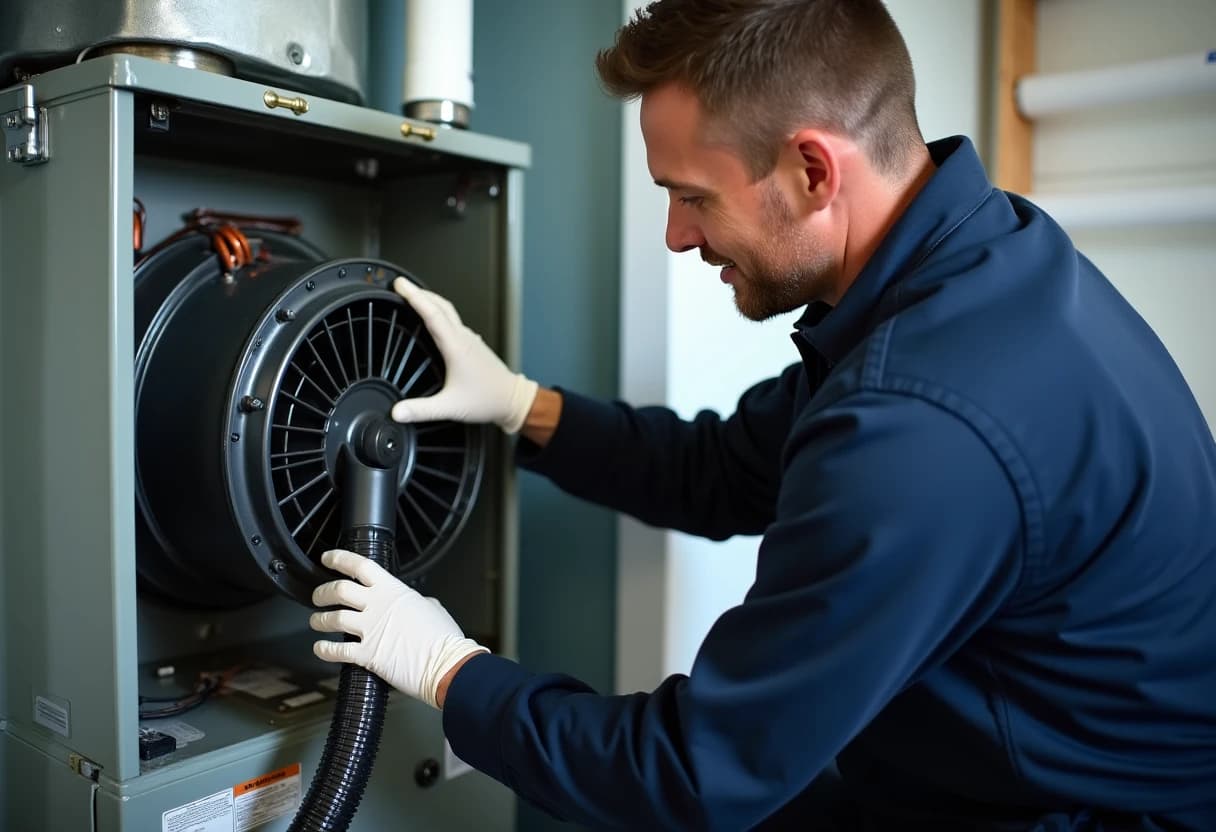
The blower assembly gets restoration-grade attention: wheel removed where design allows or detailed in place, blades cleared of the compacted felt that steals airflow, motor housing vacuumed and wiped, and the compartment HEPA-cleaned to bare metal. A clean wheel moves dramatically more air — this single component is where most of the felt recovery lives.
5Evaporator Coil Cleaning
The coil is the system's radiator and its biggest hidden airflow chokepoint — fins spaced tighter than a millimeter apart trap fine dust that filters miss, and the wet cooling-season surface glues it in place. We clean the coil face and fins with methods matched to buildup severity, restoring the heat transfer and airflow the Department of Energy identifies as central to system efficiency.
6Cabinet, Plenums & Condensate Service
The air handler cabinet and both plenums — the supply box distributing to the trunks and the return box feeding the blower — are HEPA-vacuumed and wiped to clean surfaces. The drain pan under the coil is scrubbed and the condensate line flushed clear, closing off the standing-water conditions behind musty odors and cooling-season microbial growth.
7Fresh Filter, Reassembly & Verified Results
Reassembly is checklist-driven: panels sealed properly so the blower compartment holds no bypass leaks, filter seated with no gaps, registers remounted, thermostat restored, work areas HEPA-vacuumed. Then verification — strong, clean-smelling airflow at every register, quieter operation, and photo documentation matched shot-for-shot to the pre-cleaning set.
Benefits of Professional HVAC System Cleaning in Ipswich
Cleaner Air From a Cleaner Machine
For allergy and asthma households, the whole-system approach closes the loop that duct-only cleaning leaves open. Every allergen reservoir in the air path — duct film, blower mat, coil face, cabinet drifts — is removed in one visit, and a quality filter installed at the end protects the result. It is the configuration allergists' environmental-control advice is actually pointing at.
Lower Energy Bills, Month After Month
Efficiency loss from fouling is a compounding leak: the blower draws more power to move less air, the compressor and burners run longer to deliver the same comfort, and every cycle costs more than design intended. Whole-system cleaning plugs the leak at every point at once — which is why it is the rare home service with a genuine payback period rather than just a benefit.
Years Added to Equipment Life
HVAC technicians will tell you which systems reach old age: the ones with clean airflow. Limit-switch trips, cracked exchangers and burned motors cluster in fouled systems because restriction stresses everything upstream and downstream of it. Periodic whole-system cleaning is how a homeowner buys into the long-lived cohort — and why tune-up techs are among our steadiest referral sources.
Cooling That Keeps Up in July
A blanketed evaporator coil cannot shed heat, so the AC runs longer, delivers less, and loses exactly when you need it most — the humid Massachusetts afternoons that now define our summers. Coil cleaning restores rated cooling capacity and, just as important here, dehumidification, so the house gets cool and dry instead of cool-ish and clammy.
Airflow Restored to Design Capacity
Airflow is the product your HVAC system exists to deliver, and dust taxes it at every stage — matted blower blades, blanketed coil fins, narrowed duct runs. Whole-system cleaning refunds the tax in full. The most common customer report after our visits: rooms that had not heated or cooled properly in years suddenly behave, with no equipment replaced and nothing adjusted but cleanliness.
One Visit, Complete Documentation
Bundling ducts and equipment into one appointment beats the piecemeal alternative on every axis: one mobilization cost instead of two, one afternoon of access instead of several, and no gap period where the uncleaned half recontaminates the cleaned one. The flat system price runs well below the summed cost of duct cleaning, coil service and blower work booked separately.
Signs Your Ipswich Home Needs HVAC System Cleaning
Weak Airflow at Some or All Registers
The upstairs-never-cools, back-bedroom-never-warms pattern is a delivered-airflow problem before it is anything else: the rooms farthest down the duct path feel restriction first and worst. Owners live with it for years assuming the system is undersized; more often it is suffocating. Cleaning restores the margin, and the far rooms are where the recovery shows first.
Uneven Rooms, Noisy Cycles, Dust Everywhere
Fast-returning household dust means the system is redistributing a stored reservoir — and in a fouled system, the ducts, blower and cabinet all contribute. Cleaning only the ducts leaves the equipment share circulating. If a previous duct cleaning disappointed on the dust front, the blower wheel and plenums are usually the reason, and the whole-system version is the fix.
AC Struggling, Icing, or Running Nonstop
An air conditioner that runs all afternoon without reaching setpoint on hot days is usually starved, not undersized: a fouled coil cannot shed heat and a matted blower cannot feed it enough air. If your AC 'got old' over a few seasons rather than gradually across decades, buildup is the likelier culprit — and cleaning is the cheaper test than replacement.
Visible Buildup on the Blower or Around the Air Handler
Check the filter's service history as a proxy: filters that load with dust unusually fast indicate a heavy circulating burden, and filters that were skipped for long stretches guarantee the equipment downstream absorbed the difference. Either pattern — fast-loading or long-neglected — predicts exactly what we find when the cabinet opens.
Energy Bills Creeping Up Year Over Year
If usage climbs while rates and habits hold steady, your system is paying an efficiency tax somewhere — and the air side is the usual collector. Fouled blowers and coils force longer runtimes for the same comfort, and the loss compounds annually as buildup grows. A bill trending wrong across two or three seasons is a cleaning inspection's strongest referral.
Burnt-Dust Smell at Furnace Startup
Take the smell seriously as information: it means the airstream crosses surfaces loaded enough to volatilize, and what you smell burning in October you are breathing unburnt the rest of the year. Persistent or acrid versions merit prompt inspection anyway, to rule out the electrical and overheating causes that share the odor profile.
HVAC System Cleaning Cost in Ipswich, MA
Budget by scenario. A compact single-zone system — a Cape or condo with one furnace, ten to twelve runs, accessible equipment — lands near $450 to $550. The Greater Boston median — a colonial with one or two zones, fifteen to twenty runs, a basement furnace with A-coil — runs $550 to $750. Large or complex systems — three zones, twenty-five-plus runs, attic air handlers, hydro-air setups — reach $750 to $900, occasionally beyond for multi-equipment homes quoted per system. What moves a quote within these bands is mostly labor time: coil access that requires cutting in a service panel, blower wheels that must come out for proper cleaning, and heavy fouling needing repeat agitation all add hours. What never moves a quote: things 'discovered' after work begins. Our inspection sets the scope, the scope sets the flat price, and surprises we find mid-job — a failed damper, a disconnected run — get documented and quoted separately for your decision, never folded silently into the bill.
Want the full pricing picture? See our complete Boston-area cost guide or call (617) 390-7145 for an exact flat quote for your Ipswich home.
Local Knowledge: Ipswich, Essex County
What makes Ipswich different? Ipswich holds more surviving First Period houses than any other community in America, and its downtown streets are lined with 17th- and 18th-century homes where any forced-air system is by definition a careful retrofit through hand-hewn framing. Beyond the historic core, seasonal cottage colonies on Great Neck and Little Neck have largely converted to year-round living, alongside mid-century and newer homes out the Linebrook corridor. Between the tidal Ipswich River, the salt marshes and Crane Beach, humidity and salt air press on this town from three sides, keeping duct interiors and crawlspaces damp deep into fall. In the First Period homes downtown, retrofit duct runs snake through centuries-old cavities that accumulate dust from plaster, timber and long-settled chimneys. For duct and dryer vent systems, those local factors translate into specific, predictable problems — and predictable problems are the ones we solve fastest. Call (617) 390-7145, tell us your street and home style, and we will quote the job accurately the first time, usually in under five minutes.
The Best Time of Year in Ipswich
New England's equipment stock adds a seasonal wrinkle worth naming: an enormous share of local systems are conversions and hybrids — forced-air retrofitted into homes built for radiators, hydro-air systems marrying boilers to air handlers, condo conversions threading flex duct through triple-decker framing. These systems run higher static pressure than clean-sheet designs, which means less margin for fouling: buildup that a generously ducted suburban system tolerates will noticeably choke a retrofit. The seasonal moisture cycle compounds it — humid summers make basement equipment buildup damp and sticky, long winters bake it hard — so accumulation here bonds faster and restricts sooner than national rules of thumb suggest. For conversion-era systems, we recommend the inspection interval owners of old houses already apply to everything else: regularly, and before the hard season rather than after it.
Why Choose Boston Air Duct Cleaners
What separates us from the coupon crowd is simple: we do the whole job, we prove it, and we charge what we quoted. Our technicians clean supplies, returns, trunks and blower compartments on every visit — never a cosmetic vent wipe. Photo documentation comes standard, pricing is flat and confirmed up front, and our trucks carry true commercial vacuum equipment, not rented shop-vacs. Based in West Newton and serving Ipswich year-round, we answer our own phone at (617) 390-7145 and stand behind every cleaning with a satisfaction guarantee.
Serving Ipswich and Surrounding Communities
Ipswich sits in the heart of our service area, and neighboring Rowley, Hamilton, Essex, Topsfield, Georgetown, Gloucester appointments share the same routes. That density is why our response times in this part of Essex County are among our fastest — and why you will see our trucks in the area week after week.