
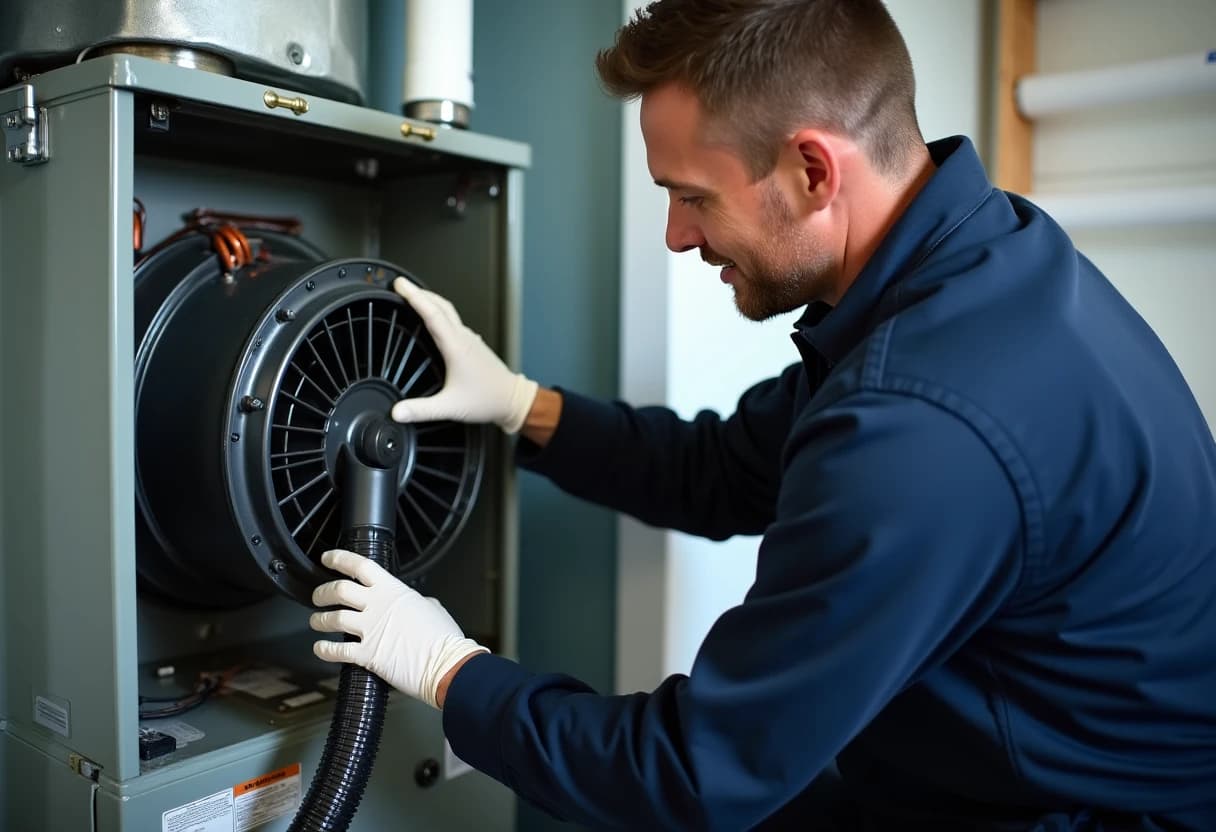
Your furnace and air conditioner were engineered around one assumption: clean airflow. Every gram of dust the system accumulates violates it — matting the blower wheel until it moves a fraction of its rated air, blanketing the evaporator coil until heat transfer chokes, and narrowing duct runs until rooms at the end of the line barely feel the system running. HVAC system cleaning reverses all of it at once. Our Georgetown technicians place the ductwork under commercial negative pressure, mechanically agitate every run, then open the equipment itself: blower assembly degreased and detailed, coil cleaned fin by fin, cabinet and plenums HEPA-vacuumed and wiped. The result is the closest thing to factory airflow your system has seen since installation day.
Why HVAC System Cleaning Matters for Georgetown Homes
The Greater Boston housing and equipment stock makes the whole-system case stronger than the national average. Local systems run brutal duty cycles — heating from October into April, cooling through increasingly hot humid summers — so accumulation rates are high and the efficiency stakes higher. Much of the equipment sits in basements that contribute their own load: fieldstone-foundation dust, humidity that makes buildup sticky and biologically active, and mechanical rooms that double as storage. The ductwork above it is frequently a palimpsest of decades — original trunks from a gravity-furnace conversion, extensions from two renovations, flexible runs from a condo conversion — with correspondingly generous interior surface area and leak points. And a striking share of local systems have simply never had the equipment side opened for cleaning at all: filters changed, burners tuned, blower and coil untouched since installation. For systems like these, the first whole-system cleaning is transformative — the photos look like restoration work — and the airflow recovery is the kind owners describe to their neighbors, which is how most of our Essex County routes filled in the first place.
Georgetown homeowners usually find us through a symptom: the upstairs that will not cool, the bills that climb every winter, the AC that runs all afternoon during a Essex County heat wave without catching up. Georgetown pairs antique center-chimney Colonials and Victorians clustered around the town common with large 1990s and 2000s Colonial subdivisions carved out of former woodland along its rural roads. The newer homes run big - often 2,500 square feet and up - with long duct runs to bonus rooms over garages that are notorious for weak airflow and dust accumulation at the far ends of the system. Many Georgetown properties sit on well water and are surrounded by woods and hayfields, so seasonal pollen and fine organic debris load up return grilles quickly here. The oversized colonials common in town also mean second-floor duct branches that have often never been cleaned since the house was built. Those symptoms almost always trace to the air side — fouled blower, blanketed coil, restricted ducts — and a whole-system cleaning resolves them together. We bring truck-grade negative pressure and NADCA-standard methods to every Georgetown job, and we leave photo proof of the recovery.
Our HVAC System Cleaning Process in Georgetown
1Full System Inspection & Airflow Baseline
We begin where the problems live: the air handler comes open first, because blower and coil condition determine half the scope. The technician documents the equipment, cameras representative duct runs, checks the condensate path, and walks you through findings with photos. The quote you approve reflects exactly what the inspection found — no mid-job discoveries priced from a flashlight.
2Protection, Sealing & Negative Pressure
We treat your home as a finished space: drop cloths, boot covers, corner guards on tight stairways, careful hose routing. With every opening sealed and the negative-air machine holding the ductwork under vacuum, loosened contamination has exactly one exit — through our filtration. Most customers are surprised the house is cleaner after a whole-system job than before it.
3Complete Duct Network Cleaning
Returns get equal billing with supplies in our sequence, because they are the dirtier side — unfiltered by design, inhaling everything the rooms produce. We clean the full return network including the drop into the air handler, which is the last unfiltered stretch before your blower and the reason freshly serviced equipment refouls when duct-only cleanings skip it.
4Blower Wheel & Motor Compartment Detailing
While the compartment is open we clean everything air touches: wheel, housing scroll, motor exterior, mounting hardware, compartment floor and walls. We also note conditions worth your HVAC tech's attention — bearing noise, capacitor age, belt wear on older units — in your report. We clean equipment; we flag, rather than sell, mechanical repairs.
5Evaporator Coil Cleaning
The coil is the system's radiator and its biggest hidden airflow chokepoint — fins spaced tighter than a millimeter apart trap fine dust that filters miss, and the wet cooling-season surface glues it in place. We clean the coil face and fins with methods matched to buildup severity, restoring the heat transfer and airflow the Department of Energy identifies as central to system efficiency.
6Cabinet, Plenums & Condensate Service
Plenums collect the heaviest drifts in many systems — every airstream in the house passes through them — and they are routinely skipped by duct-only services because access takes cabinet work. We clean both, plus the cabinet interior, the filter rack and its sealing surfaces, and the condensate path, so the equipment core matches the freshly cleaned network around it.
7Fresh Filter, Reassembly & Verified Results
The job ends with your system running and your questions answered. We review maintenance guidance — filter change intervals for your specific system, the case for pairing future cleanings with tune-ups, any conditions we flagged for your HVAC tech — and log your service date. Whole-system cleanings hold three to five years in typical homes; we will remind you when an inspection is actually due, not before.
Benefits of Professional HVAC System Cleaning in Georgetown
Lower Energy Bills, Month After Month
Six-plus months of heating and an increasingly serious cooling season give Massachusetts systems some of the longest annual runtimes in the country — so every point of recovered efficiency is multiplied across more operating hours than almost anywhere else. The same cleaning that is a modest comfort upgrade in a mild climate is a measurable utility-budget event here.
One Visit, Complete Documentation
You receive the complete photo record — every duct run, the blower before and after, the coil face, the plenums — plus written notes on system condition. That file has compounding value: it informs your HVAC tech's next tune-up, supports home-sale disclosures with evidence instead of assertions, and establishes the maintenance baseline future service gets measured against.
Quieter Operation, Fewer Odors
An unbalanced, matted blower wheel hums, drones and vibrates its way through every cycle — noise most owners attribute to age. Cleaning rebalances the assembly and clears the restrictions that make air whistle through starved returns, and the system drops to the background again. Many customers say the new quiet is the benefit they notice most.
Years Added to Equipment Life
Heat is the enemy of mechanical equipment, and dirt manufactures heat: insulated coils, blanketed motors, restricted exchangers all run hotter than design. Every degree accelerates wear on windings, bearings, igniters and boards. A clean air side is thermal relief for the whole machine — the difference, over a decade, between a system that retires on schedule and one that fails in a January cold snap.
Cleaner Air From a Cleaner Machine
Whole-system cleaning is the complete version of the air-quality upgrade: the duct reservoir removed and the equipment surfaces — wet coil, biofilmed pan, shedding blower — cleaned behind it. Air crossing clean components picks up nothing on its way to your rooms, which is why households report less dust, neutral-smelling airflow and easier breathing within days.
Airflow Restored to Design Capacity
The felt difference has a mechanical explanation: a fouled system fights elevated static pressure and degraded fan performance simultaneously, and the losses multiply. Removing both restores the delivered-air volume the ductwork was engineered around — which is why post-cleaning systems reach setpoint faster, cycle less, and finally push meaningful air to the far registers upstairs.
Signs Your Georgetown Home Needs HVAC System Cleaning
Burnt-Dust Smell at Furnace Startup
Households plan around this smell — open windows for the October first-fire, guests warned, sensitive noses out of the house. That workaround treats a cleanable condition as a fact of life. A system cleaned end to end starts the heating season without announcement, because there is nothing on the exchanger or in the plenums left to burn off.
Visible Buildup on the Blower or Around the Air Handler
Dust drifts inside the furnace cabinet, gray fuzz on the coil face, buildup ringing the filter rack — the equipment shows its condition to anyone who opens a panel. HVAC techs doing tune-ups see it constantly and mention it constantly; if yours suggested the blower and coil need cleaning, that is a professional reading a gauge, not an upsell.
Weak Airflow at Some or All Registers
The upstairs-never-cools, back-bedroom-never-warms pattern is a delivered-airflow problem before it is anything else: the rooms farthest down the duct path feel restriction first and worst. Owners live with it for years assuming the system is undersized; more often it is suffocating. Cleaning restores the margin, and the far rooms are where the recovery shows first.
No Record of the System Ever Being Cleaned
New homeowners inherit the air side as-is, with no line item on any disclosure covering blower mats and coil blankets. If your purchase included a system of unknown cleaning history — which is to say, almost any purchase — a baseline whole-system cleaning tells you what you own, documents it, and starts the maintenance clock from a known-clean state.
AC Struggling, Icing, or Running Nonstop
Watch for the humidity tell: a struggling AC that leaves the house cool but clammy is failing at dehumidification, which a blanketed coil surrenders first. In a Massachusetts July, moisture removal is half the job. If the air feels damp at setpoint, the coil face deserves a look before the thermostat takes any more blame.
Energy Bills Creeping Up Year Over Year
Compare this January's usage to the same month three years back, weather-adjusted even roughly. Steady growth without a rate change means the system works harder for the same heat — the signature of accumulating restriction. Cleaning recovers what buildup took; if the bills do not respond, the inspection will have flagged the mechanical issue that is actually responsible.
HVAC System Cleaning Cost in Georgetown, MA
Budget by scenario. A compact single-zone system — a Cape or condo with one furnace, ten to twelve runs, accessible equipment — lands near $450 to $550. The Greater Boston median — a colonial with one or two zones, fifteen to twenty runs, a basement furnace with A-coil — runs $550 to $750. Large or complex systems — three zones, twenty-five-plus runs, attic air handlers, hydro-air setups — reach $750 to $900, occasionally beyond for multi-equipment homes quoted per system. What moves a quote within these bands is mostly labor time: coil access that requires cutting in a service panel, blower wheels that must come out for proper cleaning, and heavy fouling needing repeat agitation all add hours. What never moves a quote: things 'discovered' after work begins. Our inspection sets the scope, the scope sets the flat price, and surprises we find mid-job — a failed damper, a disconnected run — get documented and quoted separately for your decision, never folded silently into the bill.
Want the full pricing picture? See our complete Boston-area cost guide or call (617) 390-7145 for an exact flat quote for your Georgetown home.
Local Knowledge: Georgetown, Essex County
Serving Georgetown means knowing Georgetown. Georgetown pairs antique center-chimney Colonials and Victorians clustered around the town common with large 1990s and 2000s Colonial subdivisions carved out of former woodland along its rural roads. The newer homes run big - often 2,500 square feet and up - with long duct runs to bonus rooms over garages that are notorious for weak airflow and dust accumulation at the far ends of the system. Many Georgetown properties sit on well water and are surrounded by woods and hayfields, so seasonal pollen and fine organic debris load up return grilles quickly here. The oversized colonials common in town also mean second-floor duct branches that have often never been cleaned since the house was built. Those conditions shape how we work here: which brush heads come off the truck, how we protect finishes in older interiors, and what we expect to find when the camera goes into a 01833 duct system. Our crews are in and around Georgetown nearly every week — often for neighbors of past customers — so scheduling is fast and our arrival windows hold.
The Best Time of Year in Georgetown
Summer is when fouled systems get exposed. A coil blanketed in dust cannot shed heat on a 92-degree afternoon, a matted blower cannot feed it enough air, and the compound effect shows up as the classic July complaint: an AC running continuously, a house stuck four degrees above setpoint, and the humidity — the half of cooling Massachusetts actually needs — barely touched. Icing is the acute version, and it clusters in heat waves precisely because that is when starved coils run coldest longest. A late-spring whole-system cleaning is the prevention: full coil capacity, restored airflow, drains cleared before condensate season. The systems we clean in May do not appear on our emergency-symptom calls in July — that is the pattern, year after year.
Why Choose Boston Air Duct Cleaners
We built this company around the jobs other duct cleaners do badly: the 130-year-old Victorian with panned-joist returns, the Georgetown condo with a 60-foot dryer run to the roof, the post-renovation house full of drywall dust. Our crews see Greater Boston's hardest systems every week, and the experience shows in the details — floor protection on the way in, sealed registers during the work, HEPA-vacuumed work areas on the way out, and imagery that proves the ducts are actually clean. Call (617) 390-7145 and judge the difference from the first conversation.
Serving Georgetown and Surrounding Communities
Georgetown sits in the heart of our service area, and neighboring Rowley, Topsfield, North Andover, Ipswich, Middleton, Andover appointments share the same routes. That density is why our response times in this part of Essex County are among our fastest — and why you will see our trucks in the area week after week.