
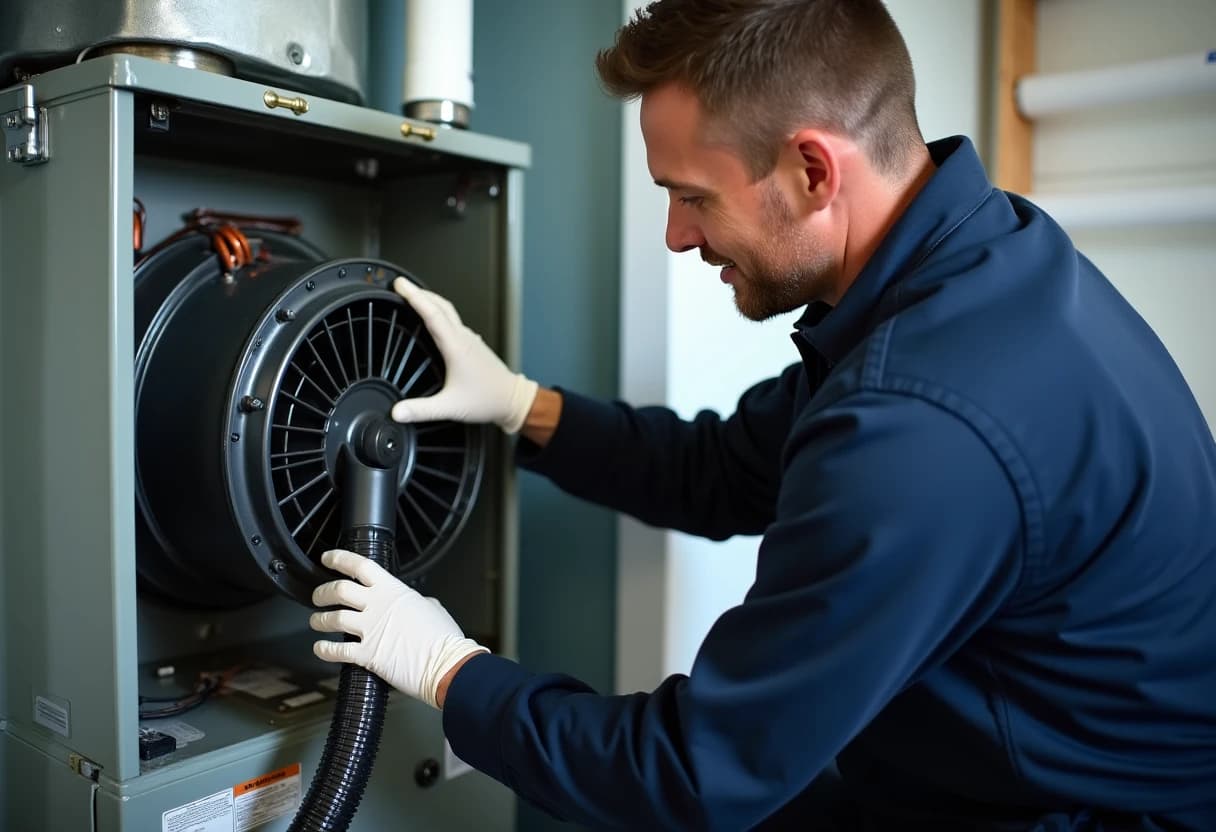
HVAC system cleaning is duct cleaning finished properly: the complete air side of your heating and cooling system — every supply and return run, the main trunks, the supply and return plenums, the blower wheel and housing, the evaporator coil and the air handler cabinet — cleaned in one coordinated visit. The distinction matters because the components work as one circuit: air that passes through a dust-caked blower and a fouled coil recontaminates clean ducts within months, and dirty ducts re-foul a freshly serviced blower just as fast. Our Winthrop crews clean the circuit end to end under HEPA-filtered negative pressure, following NADCA source-removal standards, and verify the result with before-and-after imaging. One visit, whole system, and the airflow difference is measurable at every register.
Why HVAC System Cleaning Matters for Winthrop Homes
Efficiency loss from a dirty air side is not folklore; it is measurable physics with a utility-bill signature. A dust-matted blower wheel loses blade profile and moving capacity, so the motor works harder to deliver less air. A fouled evaporator coil cannot exchange heat — the Department of Energy identifies dirty coils as a leading cause of degraded AC efficiency — so compressors run longer to move the same BTUs. Elevated duct static pressure from interior buildup compounds both. Stack the losses and a neglected system can consume meaningfully more energy than a clean one while delivering worse comfort, which in Massachusetts — where electricity prices run among the highest in the continental US and heating seasons stretch six months — converts to real money every single month. Whole-system cleaning recovers that capacity at once. Customers with visibly fouled systems routinely see the difference in the next billing cycle, and the improvement recurs monthly, which is why this service so often functions as an investment with a payback period rather than an expense.
Ask anyone maintaining an older home near Fort Banks: Winthrop basements are hard on mechanical equipment. Winthrop packs Victorian-era seaside cottages, gambrel two-families and early-1900s multifamilies onto a dense peninsula where nearly every home is within a half mile of open ocean. Heating is historically boiler-based, so the forced-air and heat-pump systems now common here are almost all retrofits worked into compact framing with short, twisting duct runs. Salt air is the defining factor in Winthrop - exterior dryer vent hoods, flappers and duct terminations corrode and seize faster on this peninsula than anywhere else we service, and ocean humidity keeps interior duct surfaces damp enough to hold odors. Wind-driven sand and salt spray off Winthrop Beach also work into exterior intakes on the water-facing sides of homes. Dust and humidity from below-grade spaces load the return side continuously, and the blower and coil absorb what the filter misses — year after unopened year. Our HVAC system cleaning addresses the whole circuit at once, and in Winthrop housing stock the difference between duct-only and whole-system work is not subtle: the equipment is where the worst accumulation lives.
Our HVAC System Cleaning Process in Winthrop
1Full System Inspection & Airflow Baseline
The baseline matters because this service promises measurable results. We record starting conditions — equipment buildup, duct interiors, airflow strength at the weakest registers — so the after-photos and the final walkthrough demonstrate recovery rather than assert it. Systems with issues cleaning cannot fix, like failed dampers or crushed runs, get flagged now, in writing, before work begins.
2Protection, Sealing & Negative Pressure
The system becomes a closed circuit before anything gets agitated: sealed openings, depressurized trunks, HEPA-filtered collection. This setup is what separates source removal from dust redistribution, and it protects the equipment work too — debris loosened in the ducts flows to the vacuum rather than settling into the freshly opened blower compartment downstream.
3Complete Duct Network Cleaning
Returns get equal billing with supplies in our sequence, because they are the dirtier side — unfiltered by design, inhaling everything the rooms produce. We clean the full return network including the drop into the air handler, which is the last unfiltered stretch before your blower and the reason freshly serviced equipment refouls when duct-only cleanings skip it.
4Blower Wheel & Motor Compartment Detailing
The blower assembly gets restoration-grade attention: wheel removed where design allows or detailed in place, blades cleared of the compacted felt that steals airflow, motor housing vacuumed and wiped, and the compartment HEPA-cleaned to bare metal. A clean wheel moves dramatically more air — this single component is where most of the felt recovery lives.
5Evaporator Coil Cleaning
The coil is the system's radiator and its biggest hidden airflow chokepoint — fins spaced tighter than a millimeter apart trap fine dust that filters miss, and the wet cooling-season surface glues it in place. We clean the coil face and fins with methods matched to buildup severity, restoring the heat transfer and airflow the Department of Energy identifies as central to system efficiency.
6Cabinet, Plenums & Condensate Service
Plenums collect the heaviest drifts in many systems — every airstream in the house passes through them — and they are routinely skipped by duct-only services because access takes cabinet work. We clean both, plus the cabinet interior, the filter rack and its sealing surfaces, and the condensate path, so the equipment core matches the freshly cleaned network around it.
7Fresh Filter, Reassembly & Verified Results
We close the system with a fresh filter — quality pleated media, or your preferred spec — reinstall every register, and run the system live. The walkthrough covers register-by-register airflow against the morning's baseline, the complete before-and-after photo set, and written notes on anything worth watching. You see the recovery, not just an invoice describing it.
Benefits of Professional HVAC System Cleaning in Winthrop
Years Added to Equipment Life
The failure modes that kill furnaces and condensers early — overheated blower motors, stress-cycled heat exchangers, iced coils, overworked compressors — all begin with restricted, dirty airflow. Whole-system cleaning removes the root cause, letting every component run at the temperatures and loads it was engineered for. Against five-figure Massachusetts replacement costs, it is the cheapest longevity insurance available.
Cooling That Keeps Up in July
A blanketed evaporator coil cannot shed heat, so the AC runs longer, delivers less, and loses exactly when you need it most — the humid Massachusetts afternoons that now define our summers. Coil cleaning restores rated cooling capacity and, just as important here, dehumidification, so the house gets cool and dry instead of cool-ish and clammy.
Cleaner Air From a Cleaner Machine
Whole-system cleaning is the complete version of the air-quality upgrade: the duct reservoir removed and the equipment surfaces — wet coil, biofilmed pan, shedding blower — cleaned behind it. Air crossing clean components picks up nothing on its way to your rooms, which is why households report less dust, neutral-smelling airflow and easier breathing within days.
Quieter Operation, Fewer Odors
The burnt-dust smell of October's first furnace cycle is the equipment announcing its buildup — accumulation on the exchanger and in the plenums cooking off at first heat. A system cleaned before the season starts silent and neutral instead. Likewise the musty cooling-season note from a biofilmed coil and pan: cleaned and treated, the wet section stops perfuming the house.
One Visit, Complete Documentation
You receive the complete photo record — every duct run, the blower before and after, the coil face, the plenums — plus written notes on system condition. That file has compounding value: it informs your HVAC tech's next tune-up, supports home-sale disclosures with evidence instead of assertions, and establishes the maintenance baseline future service gets measured against.
Lower Energy Bills, Month After Month
A clean air side moves more air per watt and exchanges more heat per cycle — the Department of Energy points to dirty coils and blowers as core efficiency drains, and Massachusetts energy prices make the recovery unusually valuable here. Customers with visibly fouled systems routinely see the difference in the next bill, and the savings recur every month the system runs.
Signs Your Winthrop Home Needs HVAC System Cleaning
Uneven Rooms, Noisy Cycles, Dust Everywhere
The classic trio of a fouled air side: rooms that heat and cool unevenly, a system that has grown audibly louder over the years, and dust that returns to surfaces within days of cleaning. Each has other possible causes; together they point one direction. A single whole-system cleaning typically improves all three at once, which is itself diagnostic.
Weak Airflow at Some or All Registers
Weak flow paired with a system that sounds like it is working hard — motor droning, air whistling at returns — is restriction announcing itself twice. The fan is fighting elevated static pressure and losing. Filters get checked first, and should be; when a fresh filter does not restore the registers, the buildup is deeper in the circuit and needs mechanical removal.
AC Struggling, Icing, or Running Nonstop
Watch for the humidity tell: a struggling AC that leaves the house cool but clammy is failing at dehumidification, which a blanketed coil surrenders first. In a Massachusetts July, moisture removal is half the job. If the air feels damp at setpoint, the coil face deserves a look before the thermostat takes any more blame.
Visible Buildup on the Blower or Around the Air Handler
Dust drifts inside the furnace cabinet, gray fuzz on the coil face, buildup ringing the filter rack — the equipment shows its condition to anyone who opens a panel. HVAC techs doing tune-ups see it constantly and mention it constantly; if yours suggested the blower and coil need cleaning, that is a professional reading a gauge, not an upsell.
No Record of the System Ever Being Cleaned
Filters changed, burners tuned, blower and coil never once opened: that is the maintenance biography of most residential systems, and it means decades of accumulation on the components that matter most. If you cannot name the year the equipment side was cleaned, it has not been — and the first whole-system service will be the dramatic one.
Energy Bills Creeping Up Year Over Year
If usage climbs while rates and habits hold steady, your system is paying an efficiency tax somewhere — and the air side is the usual collector. Fouled blowers and coils force longer runtimes for the same comfort, and the loss compounds annually as buildup grows. A bill trending wrong across two or three seasons is a cleaning inspection's strongest referral.
HVAC System Cleaning Cost in Winthrop, MA
Timing and bundling move the price meaningfully. Pairing whole-system cleaning with your annual furnace tune-up is the highest-value configuration — the services are complementary, not redundant: the tune-up tech handles combustion, controls and mechanical health; we handle the air side the tune-up scope skips. Booked in the same season, each service makes the other's results better and longer-lasting, and cleaning first means your tech tunes a system breathing properly. Shoulder seasons price best: late spring and late summer bookings avoid the October tune-up crush and the July AC panic, and our calendars hold genuine availability. Bundle economics apply across our services too — adding dryer vent cleaning to a whole-system visit is our most popular pairing, priced well below the standalone sum, and sanitizing treatment adds $75 to $200 when equipment or odor conditions warrant it. Finally, maintenance cadence is the quiet discount: systems on a three-to-five-year cleaning cycle stay in light-buildup territory, where jobs run faster and quote lower — the cheapest whole-system cleaning is the one that never lets the system get truly dirty.
Want the full pricing picture? See our complete Boston-area cost guide or call (617) 390-7145 for an exact flat quote for your Winthrop home.
Local Knowledge: Winthrop, Suffolk County
What makes Winthrop different? Winthrop packs Victorian-era seaside cottages, gambrel two-families and early-1900s multifamilies onto a dense peninsula where nearly every home is within a half mile of open ocean. Heating is historically boiler-based, so the forced-air and heat-pump systems now common here are almost all retrofits worked into compact framing with short, twisting duct runs. Salt air is the defining factor in Winthrop - exterior dryer vent hoods, flappers and duct terminations corrode and seize faster on this peninsula than anywhere else we service, and ocean humidity keeps interior duct surfaces damp enough to hold odors. Wind-driven sand and salt spray off Winthrop Beach also work into exterior intakes on the water-facing sides of homes. For duct and dryer vent systems, those local factors translate into specific, predictable problems — and predictable problems are the ones we solve fastest. Call (617) 390-7145, tell us your street and home style, and we will quote the job accurately the first time, usually in under five minutes.
The Best Time of Year in Winthrop
New England's equipment stock adds a seasonal wrinkle worth naming: an enormous share of local systems are conversions and hybrids — forced-air retrofitted into homes built for radiators, hydro-air systems marrying boilers to air handlers, condo conversions threading flex duct through triple-decker framing. These systems run higher static pressure than clean-sheet designs, which means less margin for fouling: buildup that a generously ducted suburban system tolerates will noticeably choke a retrofit. The seasonal moisture cycle compounds it — humid summers make basement equipment buildup damp and sticky, long winters bake it hard — so accumulation here bonds faster and restricts sooner than national rules of thumb suggest. For conversion-era systems, we recommend the inspection interval owners of old houses already apply to everything else: regularly, and before the hard season rather than after it.
Why Choose Boston Air Duct Cleaners
Homeowners across Suffolk County choose Boston Air Duct Cleaners for three reasons. First, honesty: our inspection camera tells you whether your system actually needs cleaning — and sometimes the answer is no. Second, capability: truck-grade negative-air machines, rotary brush systems and HEPA filtration handle everything from antique gravity-furnace conversions to brand-new high-velocity systems. Third, accountability: flat quoted pricing, before-and-after photos, insured technicians, and a real local office you can call at (617) 390-7145. That combination is rarer in this industry than it should be.
Serving Winthrop and Surrounding Communities
We serve every community around Winthrop as well: East Boston, Revere, Chelsea, Boston, Everett, Lynn all fall inside our regular service routes. If you have a second property, a rental, or family nearby, ask about multi-home scheduling — grouped appointments on the same route are our most requested discount.