
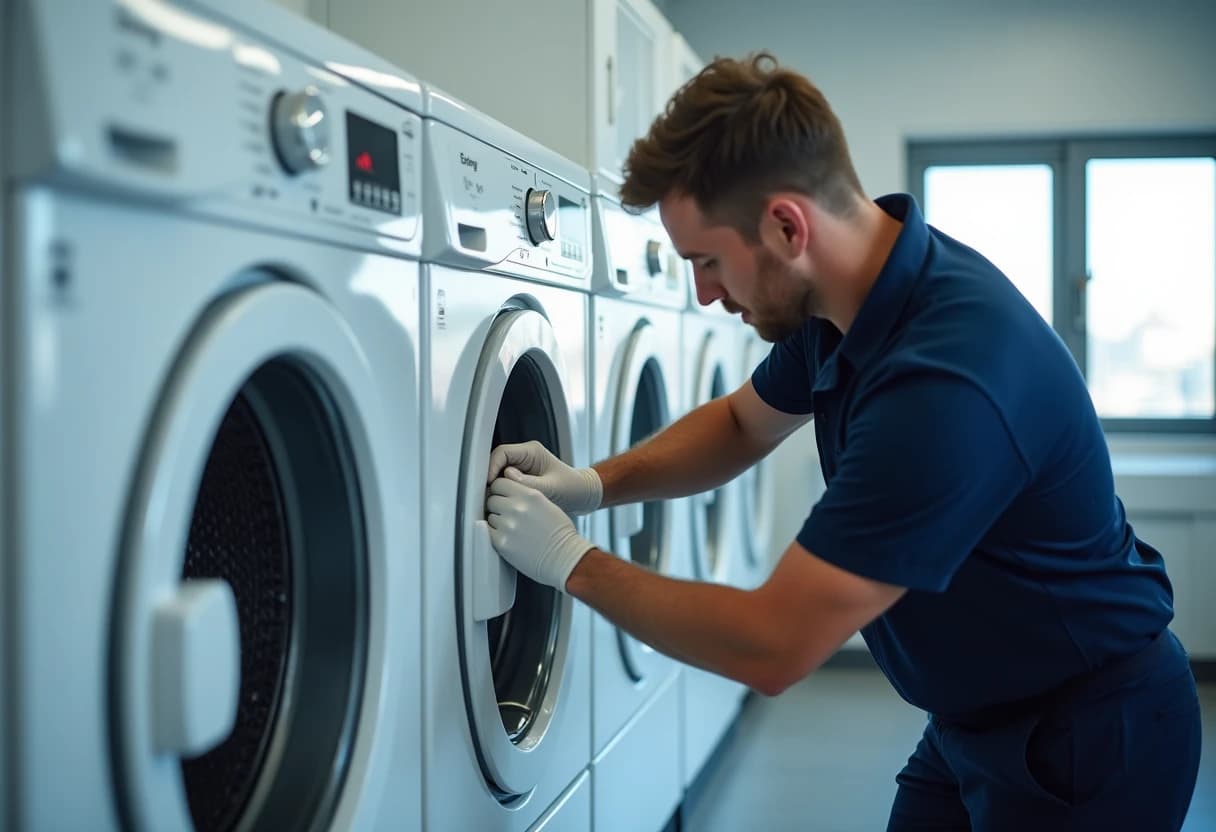
Lint is the most flammable substance most buildings produce daily, and dryer vents concentrate it precisely where heat lives. The National Fire Protection Association's data is blunt: failure to clean is the leading factor in home clothes dryer fires, and multi-family buildings carry the compounded exposure of many dryers behind one set of walls. Our Upton commercial program serves condominiums, apartment buildings, townhome HOAs, senior housing and laundromats with full-building vent cleaning: every run brushed and vacuumed end to end, terminations and dampers cleared and checked, hazardous transition ducts flagged, and airflow measured after cleaning. Boards get one flat proposal, residents get minimal disruption, and everyone gets the report that proves it happened.
Why Commercial & Multi-Unit Dryer Vent Cleaning Matters for Upton Homes
Residents cannot solve this problem individually, which is why it belongs to the building. A tenant or condo owner can clear their lint screen and perhaps the first few feet of transition hose — but the duct in the wall, the vertical riser shared with three neighbors, the forty-foot ceiling run to the far wall, and the termination flap four stories up are all beyond any resident's reach, tools and authority. Meanwhile every load every household dries adds lint to those shared paths. This is the classic common-element maintenance problem: individually invisible, collectively dangerous, and cheap to fix at building scale. A coordinated whole-building cleaning turns dozens of separate impossibilities into one efficient project — our coordinator handles notices and access scheduling, crews clear multiple units per hour once mobilized, no-access units are documented and revisited, and the building ends the week with every run verified clear. Boards that institutionalize it annually spend a modest per-door amount; buildings that leave it to residents are, in practice, leaving it to no one.
Multi-unit housing defines Upton, and its dryer venting shows the accumulated improvisation of decades. Upton pairs a small core of 18th- and 19th-century farmhouses and capes around the common with wave after wave of colonial subdivisions built from the 1980s through the 2010s on former farm and woodlot land. The newer homes almost all run propane- or oil-fired forced hot air with full ductwork, while many of the antiques carry retrofit systems squeezed into old timber framing. In buildings like these, vents were often added long after construction — routed through basements, snaked to whatever wall was nearest, extended during renovations — and many have never been professionally cleaned since installation. Upton's newer cul-de-sac colonials were often occupied straight off the construction site, and we regularly pull drywall dust and sawdust out of systems that have never been cleaned since the builder left. The town's wooded, well-and-septic lots also mean plenty of basement humidity feeding into returns, so moisture staining inside trunk lines is a common find here. Our crews work Upton buildings regularly and carry what its stock demands: rotary systems for long improvised runs, ladder and roof access for upper-floor terminations, and the patience for buildings where every unit's vent tells a different story. Boards get one proposal, one project, one per-unit report.
Our Commercial & Multi-Unit Dryer Vent Cleaning Process in Upton
1Building Walkthrough & Per-Unit Proposal
Every building project starts with a walkthrough: we identify how each unit vents — individual wall runs, shared vertical risers, common trunk lines — locate terminations on walls and roofs, note access requirements, and inspect representative runs. The proposal that follows prices the building flat, per unit, with riser and common-duct service itemized, so boards approve a known number.
2Resident Coordination & Scheduling
We treat resident experience as part of the deliverable: clear advance notices, tight arrival windows, uniformed technicians who protect floors and finish each unit in roughly 20 to 40 minutes, and a same-day completion log to management. Units we cannot access are documented — not silently skipped — and a make-up window is scheduled so the building report ends with every unit accounted for.
3Dryer-Side Service: Transition Duct & Connection
In each unit we pull the dryer, clean behind and beneath it — a major hidden lint reservoir — and service the transition duct between machine and wall. Foil accordion transitions, which manufacturers prohibit and which trap lint in every corrugation, are flagged and can be replaced on the spot with code-appropriate material. The connection is reseated and secured without airstream-penetrating screws, per code.
4Mechanical Cleaning of the Full Vent Run
The in-wall duct is cleaned end to end with rotary brush systems driven through the full run while a high-powered vacuum captures dislodged lint — the same agitation-plus-extraction principle as NADCA duct cleaning, sized for 4-inch dryer duct. Long runs and multiple elbows get repeat passes; the pass is complete when the brush returns clean and airflow verifies.
5Shared Risers, Common Trunks & Booster Fans
Stacked buildings route multiple dryers into shared vertical risers, and these common elements are where multi-unit lint risk concentrates — no resident can clean them, and every household loads them. We service risers from terminations and access points with vertical-run equipment, clean common horizontal trunks and basement manifolds, and service inline booster fans, whose blades cake with lint and quietly fail.
6Termination Service & Exterior Verification
Exterior work is where multi-unit projects earn their price: terminations three stories up that no resident has ever seen, roof caps buried under winter ice damage, wall hoods behind shrubs. Each one is cleared of lint and debris, checked for damper function so it seals when idle and opens fully under flow, and photographed for the report. Damaged or non-compliant caps are flagged with replacement pricing.
7Airflow Verification & Building Compliance Report
Each cleaned run gets a functional verification — airflow at the termination with the dryer running, or anemometer readings where equipment access allows — so the report records outcomes, not just activity. The building deliverable lists every unit: cleaned and verified, no-access, or exception, with photos of hazards and itemized repair recommendations. Boards file it; insurers accept it; renewals cite it.
Benefits of Professional Commercial & Multi-Unit Dryer Vent Cleaning in Upton
Longer Dryer Life & Fewer Appliance Failures
Dryers venting against a clogged duct cook themselves: heating elements cycle against trapped heat, thermostats and thermal fuses trip and fail, motors run hot and die early. Clear venting is the cheapest appliance-life extension available — a point every appliance manufacturer's manual makes, and every burned-out element invoice repeats.
Hazard Discovery Before It Costs You
Every exception we flag is a future incident pre-empted: the crushed run behind a renovated wall, the riser takeoff installed backwards, the termination flap frozen shut that made one unit's dryer exhaust into the building. Boards receive these findings prioritized and priced, converting unknown risks into a manageable repair list.
Volume Pricing That Beats Unit-by-Unit Service
Coordinated projects are simply more efficient: one mobilization, sequenced access, crews completing multiple units per hour, shared risers cleaned once for everyone above them. We pass that efficiency through as per-unit volume pricing scaled to building size, which is why an annual program typically costs an association less per door than one emergency service call.
Insurance & Liability Documentation That Holds Up
Documentation converts maintenance into protection. The same cleaning, undocumented, protects the building physically but leaves the association exposed on paper. Our reports close that gap: scope, method, dates, per-unit outcomes and photographic evidence, delivered in a format managers file once and retrieve in minutes when the renewal questionnaire arrives.
Directly Reduced Fire Risk, Building-Wide
Fire prevention in shared-wall housing is collective by nature: one blocked vent endangers the neighbors, and no resident can clean the common risers. A coordinated cleaning is the only mechanism that actually resets the whole building's risk — every run, every riser, every termination verified clear on the same dated report.
Shorter Dry Times & Lower Utility Costs
Utility waste from restricted venting is invisible but continuous, accruing on every load in every unit. Cleaning removes the restriction building-wide at once, which is why managers of buildings with house-paid gas or electric can often see the program's effect in the utility data — a rare maintenance item with a measurable meter-level return.
Signs Your Upton Home Needs Commercial & Multi-Unit Dryer Vent Cleaning
Insurance Questionnaires or Post-Incident Requirements
Post-incident requirements are the hard version of the sign: a fire or near-miss anywhere in the building, an adjuster's inquiry, or a fire-department visit that noted lint at terminations. At that point documentation is being demanded rather than recommended. The same program that would have prevented the scrutiny now becomes its resolution — start it either way.
Dryers Taking Two or More Cycles Per Load
Residents report it as an appliance problem — 'the dryer is getting old' — but two-cycle drying is a venting symptom far more often than a machine failure. Before replacing dryers or fielding another season of complaints, verify the exhaust path; in multi-unit buildings a pattern of slow-dry complaints maps reliably onto clogged runs and risers.
Lint Visible at Terminations or on the Building Exterior
Terminations that never fully close — propped open by lint mats — do double damage: they confirm heavy internal accumulation, and they hold an open door for pests, drafts and winter freeze-up. Any visible lint at an exterior outlet justifies putting a camera and a brush through that run promptly.
No One Can Say When Vents Were Last Cleaned
New management contracts and board turnovers routinely surface this gap: dryer vents appear in no budget, no vendor list and no maintenance log. It is among the first items worth correcting, because it combines genuine fire risk with an insurer-facing documentation hole — and because the first cleaning doubles as a building-wide inspection.
High-Duty Operations: Laundromats & Common Laundry Rooms
Watch the operational metrics: creeping gas consumption per load, customer complaints about damp clothes, machines cycling on high-limit switches. Each is restricted exhaust translated into operating cost. Duty-matched vent cleaning restores throughput and typically pays for itself in energy and uptime before its fire-safety value is even priced in.
Foil Accordion Ducts or Improvised Vent Runs in Units
If your association has never inspected what connects residents' dryers to the walls, assume nonconformance: transition duct is resident-installed, unregulated in practice, and frequently the worst link in the chain. Our unit visits document and correct these connections — the cheap fix that removes the most flammable segment of the entire vent path.
Commercial & Multi-Unit Dryer Vent Cleaning Cost in Upton, MA
Why volume pricing works in the association's favor: the expensive parts of vent cleaning are mobilization and setup, and a building project pays for them once across dozens of units. Crews sequenced through an access schedule complete multiple units per hour, so a 24-unit building might complete in a day at a per-door price no resident could obtain individually. Complexity moves the number: buildings where every unit vents a short run to its own wall cap sit at the low end near $40–$60 per unit; mid-rises with stacked risers, roof terminations and long ceiling runs price toward $70–$90 plus itemized riser service; and buildings needing hazard remediation — foil transition replacements (typically $45–$85 per unit installed), termination cap replacements, disconnected-run repairs — receive those items priced separately for board approval, never folded silently into the cleaning invoice.
Want the full pricing picture? See our complete Boston-area cost guide or call (617) 390-7145 for an exact flat quote for your Upton home.
Local Knowledge: Upton, Worcester County
Every town's ductwork tells the story of its housing. Upton pairs a small core of 18th- and 19th-century farmhouses and capes around the common with wave after wave of colonial subdivisions built from the 1980s through the 2010s on former farm and woodlot land. The newer homes almost all run propane- or oil-fired forced hot air with full ductwork, while many of the antiques carry retrofit systems squeezed into old timber framing. Upton's newer cul-de-sac colonials were often occupied straight off the construction site, and we regularly pull drywall dust and sawdust out of systems that have never been cleaned since the builder left. The town's wooded, well-and-septic lots also mean plenty of basement humidity feeding into returns, so moisture staining inside trunk lines is a common find here. We plan Upton jobs around those realities, from equipment selection to time on site, and it shows in the results. If you live near Upton Heritage Park or anywhere across Upton's 01568 area, we have almost certainly cleaned a system like yours before — and we can tell you exactly what to expect before we arrive.
The Best Time of Year in Upton
Budget season is the other calendar that matters. Condo boards and HOAs typically set budgets in fall for January fiscal years, and management companies batch portfolio maintenance into spring and fall windows — so the associations that get the best scheduling are the ones whose proposals are in hand before the budget meeting, not after the insurance renewal letter. Our walkthroughs and written building proposals are free and typically delivered within a week, which makes September the ideal month to price a program for board approval, October through November the prime execution window, and spring the natural slot for portfolio managers batching multiple properties. Insurance renewal dates deserve the same planning: a completed compliance report dated before the questionnaire arrives reads as a program; one dated after reads as a scramble. We calendar program buildings so the report always predates the renewal.
Why Choose Boston Air Duct Cleaners
As a West Newton-based company, we treat Upton like the neighborhood it is — because for us, it is. Our reputation lives or dies on local referrals, so every job gets the full process: complete system cleaning under negative pressure, mechanical agitation of every run, blower compartment service, and a documented walkthrough before we leave. We are licensed and insured, our estimates are free and flat, and our schedule holds same-day slots for urgent calls. One visit and you will understand why neighbors keep our magnet on the fridge.
Serving Upton and Surrounding Communities
Beyond Upton, our crews cover the surrounding communities daily — including Mendon, Milford, Hopkinton, Westborough, Holliston, Northborough. Because routes cluster geographically, booking alongside a neighboring appointment often unlocks same-day service and combined-visit savings. Wherever you are in Worcester County, the same flat-rate pricing, insured technicians and photo-documented process applies.