
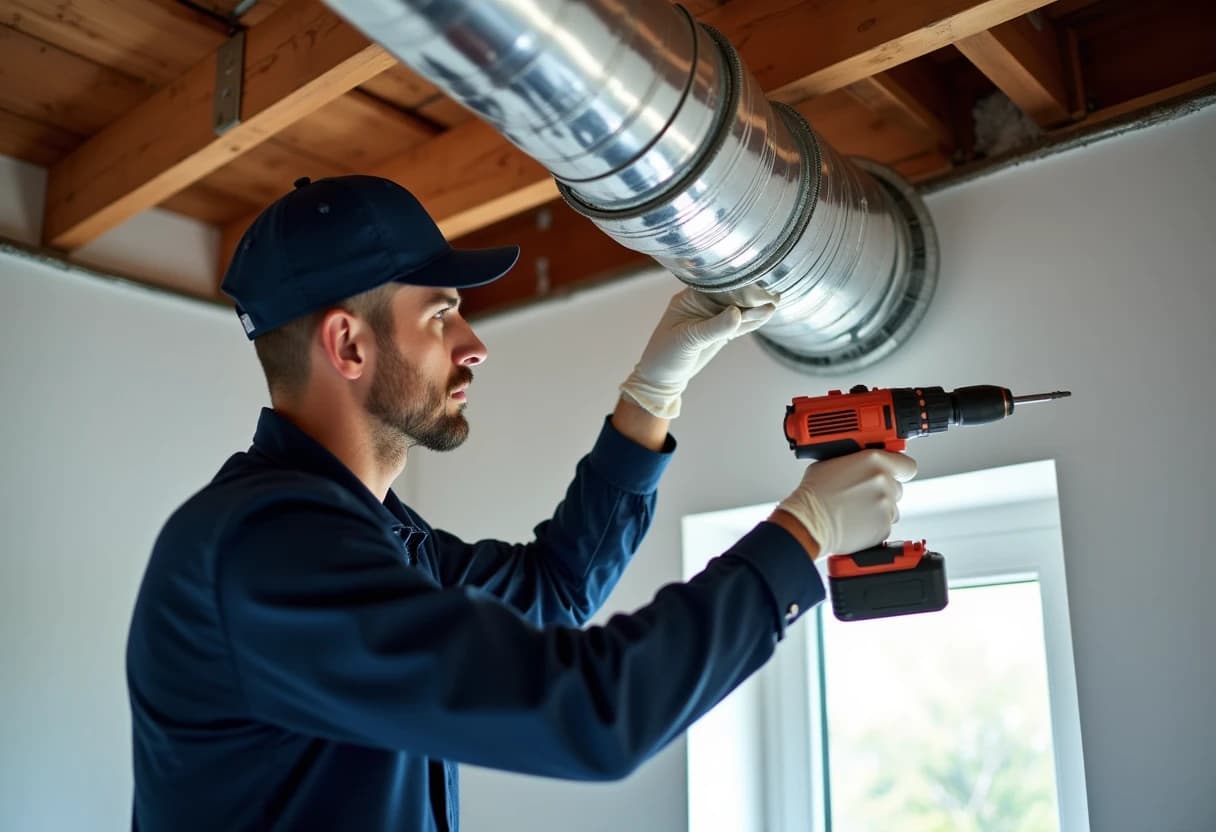
Moving your laundry to a better spot? Finishing a basement? Buying a home whose inspection flagged the venting? Those are the moments to get the dryer exhaust right permanently. We install and reroute dryer vents throughout Upton: planning the shortest code-legal path from the appliance to outdoors, cutting clean penetrations through clapboard, brick or rim joist, hanging rigid metal duct with proper support and slope, and finishing with a quality hood whose damper seals against New England weather. A correctly built vent needs nothing but an annual cleaning for decades — and it dries clothes the way the appliance manual promised.
Why Dryer Vent Installation & Rerouting Matters for Upton Homes
Dryer vent installation is where fire safety is actually decided. The roughly 2,900 US home dryer fires each year cluster around the same installation faults: flexible plastic or foil duct that traps lint in its corrugations, overlong runs the dryer cannot clear, screws through joints snagging fibers in the airstream, and terminations that clog or were never outdoors at all. The IRC's dryer exhaust provisions — 4-inch smooth rigid metal, 35-foot maximum equivalent length with elbow deductions, no protruding fasteners, damper-equipped unscreened termination — are the distilled corrections to those fault patterns. A vent built to that standard resists lint accumulation by design, keeps exhaust velocity high enough to carry fibers all the way out, and gives annual cleaning a smooth, brushable path to maintain. A vent built casually does the opposite, banking a little more fuel every load. Installation is a few hundred dollars once; the system it creates determines your laundry's risk profile for the life of the house. That asymmetry is the entire argument for doing it right.
Condo and multi-family installation around Kiwanis Beach is its own discipline, and Upton associations know the stakes: one bad vent in a shared structure is everyone's fire risk. Upton pairs a small core of 18th- and 19th-century farmhouses and capes around the common with wave after wave of colonial subdivisions built from the 1980s through the 2010s on former farm and woodlot land. The newer homes almost all run propane- or oil-fired forced hot air with full ductwork, while many of the antiques carry retrofit systems squeezed into old timber framing. We manage the full process — written scopes for board approval, certificates of insurance, penetrations planned with the building envelope and neighboring units in mind, and per-unit documentation on completion. Upton's newer cul-de-sac colonials were often occupied straight off the construction site, and we regularly pull drywall dust and sawdust out of systems that have never been cleaned since the builder left. The town's wooded, well-and-septic lots also mean plenty of basement humidity feeding into returns, so moisture staining inside trunk lines is a common find here. For triple-deckers and small associations we can rough in venting for multiple units in one mobilization, which cuts per-unit cost substantially and gives the building one consistent, compliant system.
Our Dryer Vent Installation & Rerouting Process in Upton
1Site Assessment & Route Planning
The technician maps what exists and what is possible: where the dryer sits (or will sit), which walls are exterior, what the framing and foundation allow, and where obstacles — plumbing, wiring, ductwork, finished ceilings — constrain the path. Shortest is best: fewer feet and fewer elbows mean faster drying and slower lint accumulation for the life of the system.
2Demolition of Non-Compliant Venting
Old venting comes out carefully, not destructively: we protect finishes, keep openings minimal, and document conditions as we find them. What we uncover often explains years of symptoms — a crushed flex section behind a wall, a joint that separated a decade ago, a cavity lined with escaped lint. Photos go in your record.
3Cut & Flash the Exterior Penetration
The exterior opening is cut precisely for the termination: hole saw through clapboard and sheathing, core drill through brick, block or stone, or a framed opening at the rim joist. We locate it to respect required clearances from grade, openings and inside corners, then flash and seal it so wind-driven New England rain stays out of the wall assembly permanently.
4Install Rigid Metal Duct on the Planned Route
Where the route crosses unheated space — a cold basement, garage bay, attic run — we insulate the duct so exhaust stays above its dew point until it exits, which is the difference between a dry duct and a condensation problem in a Massachusetts winter. Concealed sections are completed and verified before any finishes close them in.
5Mount the Termination Hood & Damper
Termination choice is matched to the route: low-profile wall hoods for clapboard and shingle, masonry-mounted hoods for brick, rim-joist hoods for basement exits, and dedicated dryer roof caps — never plumbing-style caps — for vertical runs. Each is chosen for damper quality, because the damper is the moving part that determines how the termination survives New England weather.
6Connect the Appliance & Seal the System
Gas dryers are handled with the care the fuel demands: the flexible gas connector unstrained, the machine leveled and positioned, and the connection checked before operation. Electric units get cords routed clear of the duct. The appliance end is where good systems get ruined by casual reconnection, so we finish it to the same standard as the concealed run.
7Test, Verify & Document the Installation
You receive complete documentation: photos of the route (including concealed sections before they closed), the materials used, the equivalent-length math, and the finished termination. For permitted work, condo approvals or home sales, this record answers every question an inspector, board or buyer will ask about what is behind the walls.
Benefits of Professional Dryer Vent Installation & Rerouting in Upton
Fire-Safe by Design, Not by Vigilance
The safety margin compounds with maintenance: rigid duct is fully brushable, so every annual cleaning actually reaches every surface — something no cleaning can honestly claim on a corrugated flex run threaded through cavities. You are not just starting cleaner; you are cleanable, permanently.
Permanently Lower Energy Costs
A dryer that finishes in one cycle instead of two uses half the energy per load — a difference worth $10 to $20 a month to a busy household, recurring for the life of the system. Few building improvements have a payback mechanism this direct: the installation cost is fixed once, and the savings arrive with every laundry day after.
Moisture Managed, Structure Protected
Moisture protection extends to the envelope itself: our flashed, sealed penetrations keep wind-driven rain out of walls and roofs for the long term. An installation is only as good as its weakest detail, and the exterior detail is the one that faces forty years of nor'easters. We build it like it will.
Code Compliance That Closes Every Question
Insurers and condo associations increasingly ask about dryer venting after regional fire losses, and 'professionally installed to code, with photos' is the answer that ends the conversation. We provide certificates of insurance for association work and per-unit records for multi-family buildings as standard practice.
A Laundry Located Where You Actually Want It
For renovations, early vent planning is leverage: consulted while walls are open, we can route a short, straight, fully concealed run that would be expensive or impossible after drywall. A ten-minute conversation at framing stage regularly saves homeowners hundreds of dollars and a compromised route.
Dramatically Faster Drying
Shortening a wandering 40-foot run to a direct 12-foot route transforms drying performance: full airflow means each cycle actually exhausts the gallon of moisture a load releases, so sensor dryers stop running overtime and heavy loads finish in one pass. Customers routinely describe post-installation performance as having bought a new machine.
Signs Your Upton Home Needs Dryer Vent Installation & Rerouting
The Run Is Overlong or Elbow-Heavy
Basement laundries venting to a far wall are the classic offenders — installed where the first hole was easiest, not where the route was shortest. Our assessment often finds a rim-joist or near-wall exit that cuts the run by half or more. Ask for the measurement; the equivalent-length math takes ten minutes and settles the question.
The Dryer Vents Indoors — Anywhere
A vent that ends in an attic, crawlspace, garage, ceiling cavity or bucket-style indoor 'lint trap' is an urgent installation call. Every load pumps a gallon of moisture and a charge of fine lint into the structure or living space — feeding mold, soaking insulation, and accumulating fuel where no one will ever clean it. This setup should not run another season.
Inspection, Insurance or Association Requirements
Massachusetts home inspections flag improvised dryer venting constantly — flex runs, screened hoods, indoor terminations, overlong routes — and the flag follows the transaction: buyers demand fixes, sellers concede credits. A documented compliant installation clears the item permanently, whether you are listing this spring or just retiring a known liability.
Chronic Condensation the Route Guarantees
Winter tells the truth about marginal routes: dripping joints, frost at the termination, ice sealing the damper, damp lint clogs by February. If your vent has a cold-weather personality, its path crosses too much unheated space unprotected. We rebuild such runs with insulation and continuous outward slope — or shorten them past the problem entirely.
A New Laundry Location Needs Its First Vent
Renovation is the moment of maximum leverage: we consult with homeowners and contractors while framing is open, position the laundry within the length budget, and rough in the run for pennies on the retrofit dollar. If your project touches the laundry's walls or ceiling, call before drywall — future you will be grateful.
Your Vent Is Flexible Plastic or Foil Duct
Look behind and beyond your dryer: if the exhaust path is white vinyl or shiny foil accordion hose — especially if it disappears into a wall or ceiling that way — the system needs replacement, not another cleaning. Flex materials trap lint in every corrugation, crush at a touch, and in vinyl's case can melt. Codes and manufacturers rejected them long ago.
Dryer Vent Installation & Rerouting Cost in Upton, MA
Understanding the cost drivers helps you compare quotes intelligently. Distance and elbows set the duct budget — both in dollars and in the code's 35-foot equivalent-length allowance — so the shortest workable route is cheapest twice over. The penetration is the next driver: hole-sawing clapboard is quick; core-drilling stone foundation or flashing a roof cap takes equipment and time. Access is third: exposed basement routes install fast, while runs concealed through finished walls and ceilings involve careful openings and coordination on restoration. Termination choice matters modestly — quality wall hoods, rim-joist hoods and dryer-rated roof caps span roughly $30 to $150 in parts — but skimping there is false economy, since the damper is the system's one wear component. Beware quotes that reach a low number with flex duct, screened hoods or screwed joints: each is a code violation that converts your installation savings into years of accelerated lint accumulation and future service calls. The correct comparison is rigid-to-rigid, and on that basis our pricing is consistently competitive across Eastern Massachusetts.
Want the full pricing picture? See our complete Boston-area cost guide or call (617) 390-7145 for an exact flat quote for your Upton home.
Local Knowledge: Upton, Worcester County
What makes Upton different? Upton pairs a small core of 18th- and 19th-century farmhouses and capes around the common with wave after wave of colonial subdivisions built from the 1980s through the 2010s on former farm and woodlot land. The newer homes almost all run propane- or oil-fired forced hot air with full ductwork, while many of the antiques carry retrofit systems squeezed into old timber framing. Upton's newer cul-de-sac colonials were often occupied straight off the construction site, and we regularly pull drywall dust and sawdust out of systems that have never been cleaned since the builder left. The town's wooded, well-and-septic lots also mean plenty of basement humidity feeding into returns, so moisture staining inside trunk lines is a common find here. For duct and dryer vent systems, those local factors translate into specific, predictable problems — and predictable problems are the ones we solve fastest. Call (617) 390-7145, tell us your street and home style, and we will quote the job accurately the first time, usually in under five minutes.
The Best Time of Year in Upton
New England's building stock gives installation a seasonal maintenance logic too. Coastal and near-coastal homes lose termination hardware to salt corrosion years ahead of inland schedules, making hood quality and periodic inspection part of the design conversation. Freeze-thaw cycles work on every exterior penetration, which is why our flashing details are built to roofing standards rather than caulk-and-hope. And the region's centuries-old walls — balloon framing, stone foundations, triple wythe brick — reward installers who have opened them before and punish those improvising on the day. We schedule the weather-sensitive stages around the forecast, stock the fittings old construction demands, and build every system for the specific abuse a Massachusetts year delivers: forty inches of snow, ninety-degree dew-point weeks, and the two hundred laundry days in between.
Why Choose Boston Air Duct Cleaners
Homeowners across Worcester County choose Boston Air Duct Cleaners for three reasons. First, honesty: our inspection camera tells you whether your system actually needs cleaning — and sometimes the answer is no. Second, capability: truck-grade negative-air machines, rotary brush systems and HEPA filtration handle everything from antique gravity-furnace conversions to brand-new high-velocity systems. Third, accountability: flat quoted pricing, before-and-after photos, insured technicians, and a real local office you can call at (617) 390-7145. That combination is rarer in this industry than it should be.
Serving Upton and Surrounding Communities
We serve every community around Upton as well: Mendon, Milford, Hopkinton, Westborough, Holliston, Northborough all fall inside our regular service routes. If you have a second property, a rental, or family nearby, ask about multi-home scheduling — grouped appointments on the same route are our most requested discount.