
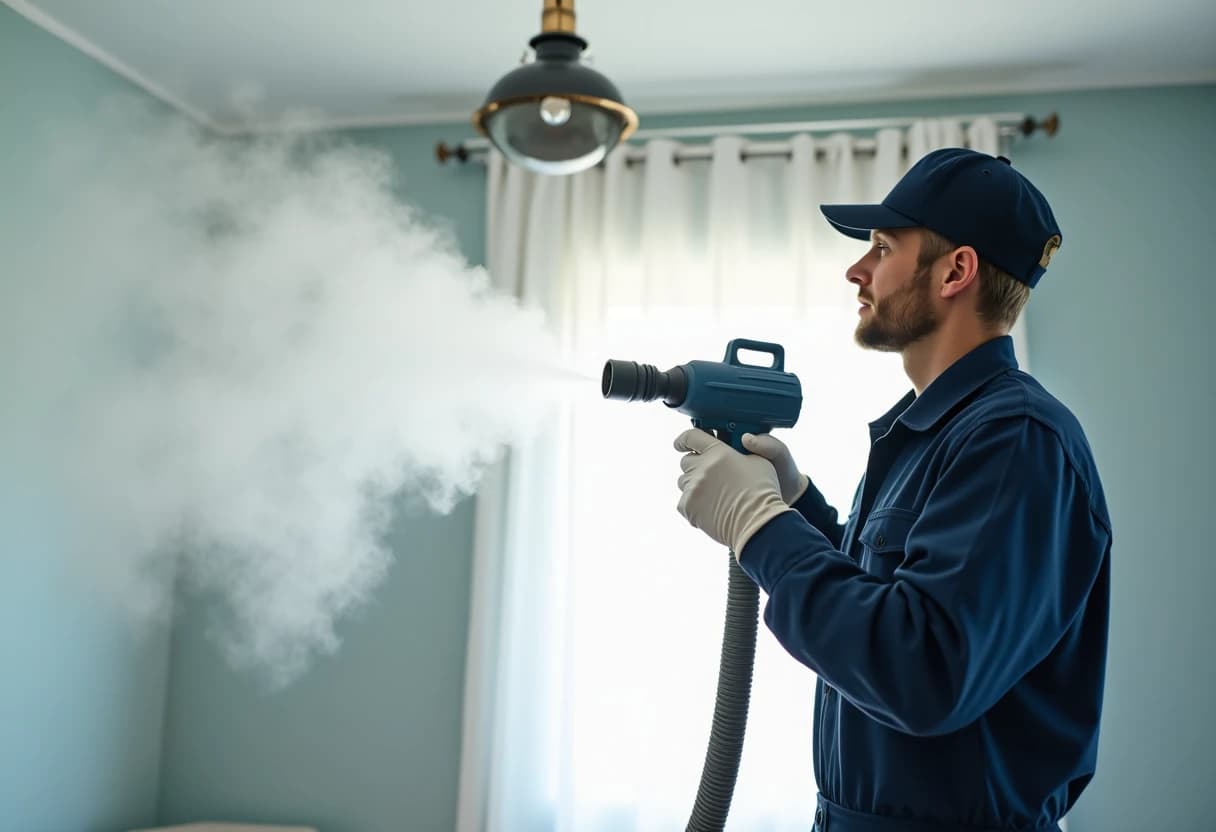
The EPA's guidance on duct treatments is specific: chemical biocides should be applied only after mechanical cleaning, and only products registered for use in HVAC systems belong in your air path. That is exactly how we sanitize ducts in Roxbury. First the system is cleaned to bare surfaces under negative pressure; then an EPA-registered antimicrobial is atomized through the supply and return network at label rates, treating the seams, joints and textures no brush can fully reach. The treatment kills odor-causing bacteria, neutralizes microbial residue and inhibits regrowth — and because it lands on clean metal rather than a dust blanket, it actually works. We will also tell you plainly when your system does not need it.
Why Air Duct Sanitizing & Deodorizing Matters for Roxbury Homes
The value calculation for sanitizing is straightforward when you price the alternatives homeowners actually try first. A year of premium candles, plug-ins and sprays costs several hundred dollars and masks the problem. Ozone generators are marketed aggressively for odor work, but the EPA warns that ozone at safe concentrations does not effectively remove indoor odor sources and at effective concentrations is a lung irritant — and ozone does nothing about the residue that regenerates the smell. Replacing carpets and repainting rooms runs thousands and fails when the odor source is upstream in the air system, re-scenting the new surfaces within months. Against those options, a $250 to $500 professional treatment that neutralizes the actual source — applied once, lasting years — is the economical path, not the indulgent one. Bundled with duct cleaning it is cheaper still, since the system is already sealed, accessed and under negative pressure. That bundle is our most-requested package in odor situations, and the one with the highest review-to-job ratio of anything we sell.
The housing stock around Roxbury gives duct odors unusual staying power. Roxbury holds some of Boston's most historic housing, from 1800s mansard Victorians and brick rowhouses on Fort Hill to triple-deckers around Grove Hall, alongside a significant share of mid-century apartment buildings and a current wave of new mixed-income development near Nubian Square. Heating systems span every era - steam radiators, gravity furnace conversions, modern gas forced air and brand-new heat pump systems in the infill buildings. Many of the grand old houses have been re-divided multiple times, leaving layered, partially abandoned ductwork. Many of these systems include long trunk runs, joint-heavy older metal and returns that have never once been opened — surface area that has absorbed generations of household life. Roxbury families deal with some of the city's highest asthma rates, a legacy of older housing stock and busy corridors like Melnea Cass Boulevard and Blue Hill Avenue, which makes clean ductwork a genuine health measure here rather than a luxury. We find that the neighborhood's multi-generational homes, where grandparents and grandkids share the same air, are among the most rewarding places we work. A masking spray has no chance against that reservoir. Our approach — mechanical source removal first, then EPA-registered antimicrobial fogging through the full air path — is built for systems with this much history, and we bring it to Roxbury, Dorchester and Jamaica Plain weekly.
Our Air Duct Sanitizing & Deodorizing Process in Roxbury
1Odor Assessment & Honest Qualification
We qualify the job before we book the fog. Odors that ride the airflow, spike at cycle start, or track the seasons implicate the system; odors independent of airflow usually do not. The assessment separates the two, checks for the moisture or contamination that sometimes underlies duct smells, and produces a flat written quote for exactly the work your situation supports.
2Source-Removal Cleaning First
EPA guidance is explicit that treatments belong on cleaned surfaces only, and our sequence honors it: full source-removal cleaning before any product is introduced. This is the honest-versus-theater divide in duct sanitizing. Fog through dirty ducts and the smell returns in weeks as bacteria recolonize the untouched film; clean first and the treatment bonds to bare metal, where it can actually work.
3Product Selection & Preparation
Preparation is checklist work that determines results: product selected for your specific odor profile, dilution mixed to label specification, fogging equipment matched to your system's size so droplet distribution covers the full duct network. We also plan the airflow path — which registers stay open, how the blower assists — so the treatment reaches the far end of every run, not just the trunks.
4Whole-System Antimicrobial Fogging
With the system freshly cleaned, the EPA-registered fog does its work at the surface level: contact-killing the bacteria that metabolize duct residue into odor, neutralizing the residual film chemically, and leaving an inhibiting layer that suppresses microbial regrowth. The application follows label contact times precisely — this is regulated chemistry applied to specification, not a scented mist waved through the vents.
5Coil, Drain Pan & Blower Treatment
The dampest components carry the strongest biology, so the air handler wet section gets direct treatment: evaporator coil surfaces, the drain pan and its trap, and the blower wheel and housing. Musty odors disproportionately originate here — a slimy pan or biofilmed coil can perfume an entire house — and treating the ducts while skipping the equipment leaves the source in place.
6Deodorizing Pass for Stubborn Odors
Antimicrobial treatment handles biological odors, but some smells are chemical: tar and nicotine films, cooking-oil residue, fire smoke. For those, we deploy counteractants that chemically neutralize the odor compounds themselves. The distinction matters — treating a smoke house with antimicrobial alone leaves the tar film broadcasting — and diagnosing which chemistry your odor needs is exactly what the initial assessment is for.
7System Airing, Verification & Walkthrough
We leave the system running clean and documented: registers remounted, a fresh filter installed on request, treatment records in your file, and honest guidance on what to expect — a faint clean-neutral note for a day or two as the treatment cures, then nothing. If the odor you hired us to kill ever returns in the following months, you call, we come back. That simple.
Benefits of Professional Air Duct Sanitizing & Deodorizing in Roxbury
Smoke Ghosts Finally Evicted
If a home smelled of cigarettes at the showing and still does after renovation, the air system is the unrenovated room. Smoke rode the returns for years, coating the full duct network with residue no one ever addresses. Treating that network is routinely the missing piece that finally clears a smoker's house — and the step savvy buyers now negotiate into the purchase.
Musty Summer Smell Broken for Good
That damp blast at AC start-up is bacteria metabolizing humid duct film — a cycle that returns every muggy stretch and worsens annually. Sanitizing removes the film and leaves treated surfaces the biology cannot recolonize, so the next humid week produces silence from the registers. For many Massachusetts households this is the first summer without the smell in a decade.
Small Add-On Cost, Outsized Payoff
Bundled with duct cleaning, sanitizing adds roughly $75 to $200 to the visit — the system is already sealed, accessed and under negative pressure, so you pay for chemistry and application time, not a second mobilization. Against the hundreds homeowners spend annually on masking products that fix nothing, the one-time source treatment is the plainly economical choice.
Odors Neutralized at the Source, Not Masked
The failure of masking is chemical: fragrance molecules and odor molecules coexist, so the nose gets both — that sickly candle-over-dog note every guest recognizes. Neutralization is different chemistry entirely: the odor compounds are broken down or bound, and the bacteria regenerating them are killed. Once the source stops producing, nothing needs covering, and the difference is unmistakable at the front door.
Pet Odor Elimination That Actually Holds
The cruel mechanics of pet odor: residents go nose-blind while every guest detects it instantly. If you have wondered whether your house 'smells like dog,' the ducts are almost certainly broadcasting more than you can perceive. Sanitizing after source-removal cleaning resets the broadcast to zero — and unlike surface remedies, it stays reset, because the reservoir itself is gone.
Microbial Load Reduced System-Wide
Beyond odor, the treatment is a sanitizing pass over the one surface network your household's air touches continuously. EPA-registered antimicrobials kill odor bacteria and mold spores resident in the duct film and inhibit their regrowth — meaningful for households with allergy sufferers, young children, elderly members or anyone for whom airborne biology is more than an abstraction.
Signs Your Roxbury Home Needs Air Duct Sanitizing & Deodorizing
Pets Present or Past
Allergy dynamics compound the odor case: duct-borne dander affects sensitive visitors and family members even when the smell is subtle. A treated system cuts both the odor and the circulating allergen load, which is why families expecting a new baby, hosting an allergic relative, or rehoming after a pet's passing all book this same service.
Smoke History in the Home
The classic frustration: a fully renovated home that still exhales cigarettes on the first hot day. The renovation never entered the ductwork, where smoke residue coats every run the returns fed for years. If your renovation checklist did not include the air system, the smell has a protected reservoir — and an easy explanation for its persistence.
Guests Notice a Smell You No Longer Can
Nose-blindness is real and universal: constant exposure deletes a smell from your perception while every visitor gets it full strength at the door. If a candid friend, a relative or a real estate agent has mentioned a pet, smoke or musty note you cannot detect, believe them — and suspect the ducts, because whole-house odors are almost always airflow-distributed.
Musty Blast When the Heat or AC Starts
A damp, sour or dirty-sock note in the first minutes of a cycle, fading as the system runs, points to microbial activity on the coil, in the drain pan or along the duct film. It is most common in cooling season and after humid stretches. The pattern is diagnostic — and it is exactly what cleaning plus antimicrobial treatment eliminates.
Odors Return No Matter How Much You Clean
Count what you have already tried: shampooed carpets, washed walls, new air filters, open windows, every candle in the store. When that entire arsenal fails against a smell, you are not fighting a surface — you are fighting a reservoir with a fan attached. Treating the reservoir is the move that finally works.
After Pests, Mold or Water in the System
Post-mold-remediation, treating the cleaned duct surfaces inhibits recolonization while moisture corrections take effect — standard best practice, and typically specified in remediation protocols. If your home had mold work done and the ducts were cleaned but never treated, that gap is worth closing before the next humid season tests it.
Air Duct Sanitizing & Deodorizing Cost in Roxbury, MA
Compare the cost against what duct-borne odors actually extract from households. Masking products — candles, plug-ins, sprays — run $200 to $500 annually for a committed household and resolve nothing. Consumer ozone generators cost $100 to $400, carry EPA warnings, and leave the odor source intact. Carpet replacement motivated by a smell that turns out to be duct-borne runs $2,000 to $6,000 and fails on arrival, since the system re-scents new fibers within months. Repainting for smoke odor without treating the ducts: $3,000 to $8,000, same outcome. Against that landscape, $250 to $500 for professional source treatment — or $75 to $200 added to a cleaning you may need anyway — is not the premium option; it is the only option priced against the actual problem. For sellers the math sharpens further: listing agents consistently report that odor-flagged homes show worse and negotiate weaker, with concessions that dwarf the treatment cost by an order of magnitude. Fresh-smelling is the cheapest staging money can buy.
Want the full pricing picture? See our complete Boston-area cost guide or call (617) 390-7145 for an exact flat quote for your Roxbury home.
Local Knowledge: Roxbury, Suffolk County
Serving Roxbury means knowing Roxbury. Roxbury holds some of Boston's most historic housing, from 1800s mansard Victorians and brick rowhouses on Fort Hill to triple-deckers around Grove Hall, alongside a significant share of mid-century apartment buildings and a current wave of new mixed-income development near Nubian Square. Heating systems span every era - steam radiators, gravity furnace conversions, modern gas forced air and brand-new heat pump systems in the infill buildings. Many of the grand old houses have been re-divided multiple times, leaving layered, partially abandoned ductwork. Roxbury families deal with some of the city's highest asthma rates, a legacy of older housing stock and busy corridors like Melnea Cass Boulevard and Blue Hill Avenue, which makes clean ductwork a genuine health measure here rather than a luxury. We find that the neighborhood's multi-generational homes, where grandparents and grandkids share the same air, are among the most rewarding places we work. Those conditions shape how we work here: which brush heads come off the truck, how we protect finishes in older interiors, and what we expect to find when the camera goes into a 02119 duct system. Our crews are in and around Roxbury nearly every week — often for neighbors of past customers — so scheduling is fast and our arrival windows hold.
The Best Time of Year in Roxbury
Summer humidity is the engine of Greater Boston's duct-odor cycle. When dew points camp in the high 60s, moisture condenses on every cool surface in the air path — coil, pan, basement trunk lines — and the organic film absorbs it like a sponge. Bacteria respond within days, and their metabolism is the musty smell that arrives with every cooling cycle from July onward. Coastal and near-coastal homes get an extended version, with marine air keeping duct-adjacent spaces damp well into fall. Sanitizing breaks the biological half of the cycle; pairing it with the moisture-side fixes — insulating sweating runs, managing basement humidity, keeping condensate lines clear — breaks the whole loop, and the pairing is what turns a yearly complaint into a solved problem.
Why Choose Boston Air Duct Cleaners
Choosing a duct cleaner is really a trust decision — you are letting a crew work inside the system that feeds air to your family. We make that decision easy: a local West Newton company with insured, uniformed technicians, transparent flat-rate quotes, NADCA-standard equipment and methods, and photographic proof of the finished work. No door-to-door sales, no bait-and-switch coupons, no invented 'mold emergencies.' Just honest mechanical cleaning done properly the first time, backed by a written guarantee.
Serving Roxbury and Surrounding Communities
We serve every community around Roxbury as well: Dorchester, Jamaica Plain, South End, Boston, Roslindale, Brookline all fall inside our regular service routes. If you have a second property, a rental, or family nearby, ask about multi-home scheduling — grouped appointments on the same route are our most requested discount.