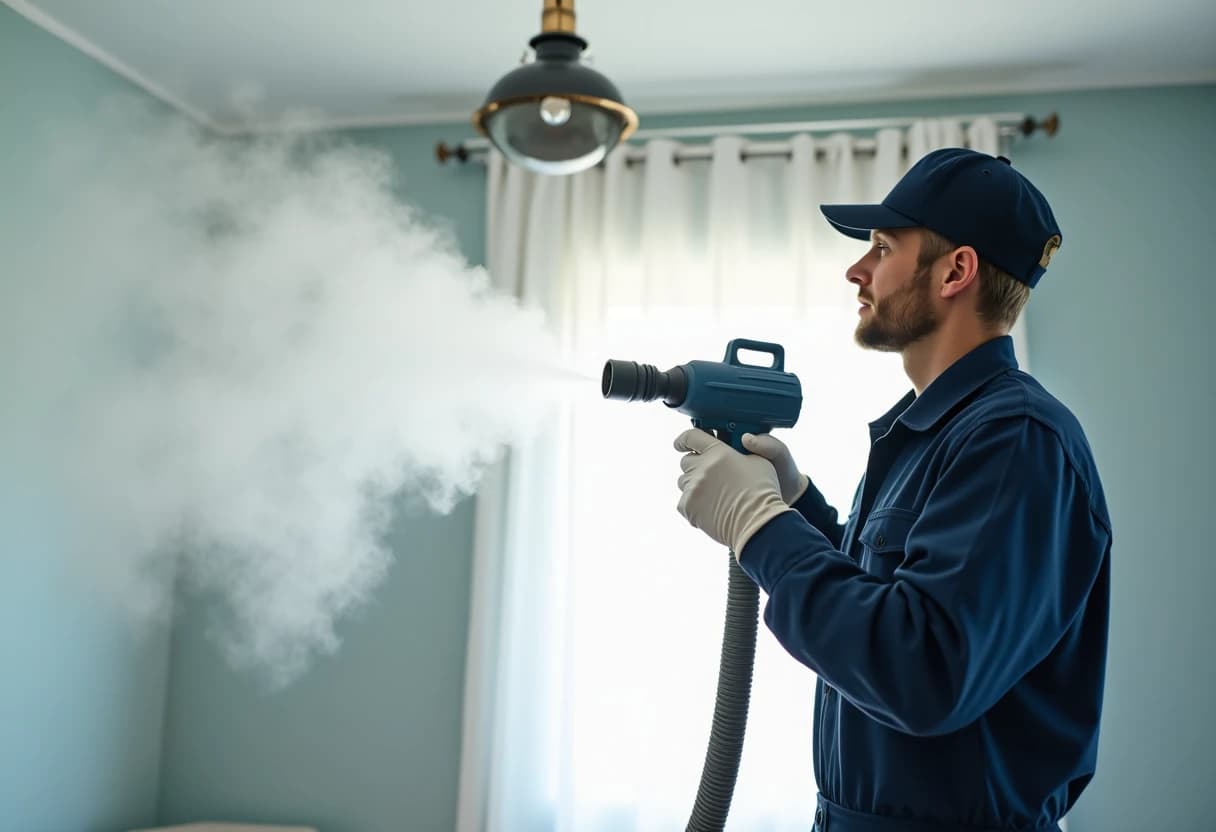
There is an honest version of duct sanitizing and a dishonest one, and the difference is sequence. Fogging chemicals through dirty ducts — the discount version — is theater: no product penetrates a mat of dust and biofilm, so the smell returns within weeks. The effective version treats sanitizing as step two of two: mechanical source-removal cleaning first, so surfaces are bare; then an EPA-registered, HVAC-labeled antimicrobial applied under airflow so coverage is complete. That is the only version we sell in Dorchester. Applied correctly, one treatment neutralizes pet, smoke and musty odors at their source, sanitizes the full air path, and keeps the system smelling neutral for years rather than days.
Why Air Duct Sanitizing & Deodorizing Matters for Dorchester Homes
Odors that ride the airflow defeat every surface-level remedy because the HVAC system out-circulates them all. A home's air passes through the duct network several times an hour; if that network holds odor-saturated residue, every pass re-scents every room. This is why the dog smell survives shampooing the carpets, why the smoke ghost outlives three coats of paint, and why the musty note returns each summer no matter what happens in the basement. Candles, plug-ins and sprays add fragrance on top of the odor — the olfactory equivalent of painting over rust. Source treatment is the only durable fix: remove the odor-holding film mechanically, then neutralize what remains chemically with an EPA-registered antimicrobial designed for HVAC application. Homes treated this way do not smell like lavender or 'clean linen' afterward. They smell like nothing — which, as anyone who has fought a persistent house odor knows, is the entire goal. The difference walking in the front door is immediate, and it is the single most commented-on result in our customer reviews.
The housing stock around Dorchester gives duct odors unusual staying power. Dorchester is Boston's largest neighborhood and the heartland of the classic New England triple-decker, with block after block of 1890s-1920s three-family homes joined by Victorian singles around Ashmont Hill and Melville Park and brick mill conversions at Lower Mills. Triple-deckers were built for stove and radiator heat, so their forced-air systems are almost always retrofits - basement furnaces feeding first floors easily while upper units depend on long vertical chases that accumulate dust at every joint. Three stacked households also mean three dryers, often venting through improvised routes. Many of these systems include long trunk runs, joint-heavy older metal and returns that have never once been opened — surface area that has absorbed generations of household life. Nobody who works on Dorchester triple-deckers is surprised by what comes out of the ducts: a century of coal soot, plaster dust and lint layered in shared chases. We also see a steady stream of dryer vent hazards here, from basement dryers vented into crawlspaces to third-floor units pushing lint through thirty feet of pipe. The Baker Chocolate Factory condos at Lower Mills bring their own mill-conversion duct quirks. A masking spray has no chance against that reservoir. Our approach — mechanical source removal first, then EPA-registered antimicrobial fogging through the full air path — is built for systems with this much history, and we bring it to Dorchester, South Boston and Roxbury weekly.
Our Air Duct Sanitizing & Deodorizing Process in Dorchester
1Odor Assessment & Honest Qualification
First we determine whether sanitizing will actually fix your problem. The technician traces the odor's behavior — does it arrive with airflow, vary by season, concentrate at certain registers — inspects the duct interiors and air handler, and checks for moisture. If the source is your ducts, we quote the treatment flat. If it is not, we say so and point you at the real source.
2Source-Removal Cleaning First
EPA guidance is explicit that treatments belong on cleaned surfaces only, and our sequence honors it: full source-removal cleaning before any product is introduced. This is the honest-versus-theater divide in duct sanitizing. Fog through dirty ducts and the smell returns in weeks as bacteria recolonize the untouched film; clean first and the treatment bonds to bare metal, where it can actually work.
3Product Selection & Preparation
We match the chemistry to the problem: an EPA-registered antimicrobial labeled for HVAC use as the base treatment, with odor-counteractant chemistry added for smoke, pet or severe musty situations. You see the product names and safety data sheets before application — never a vague 'proprietary treatment' — and we review re-entry timing, typically just a few hours, with you up front.
4Whole-System Antimicrobial Fogging
With the system freshly cleaned, the EPA-registered fog does its work at the surface level: contact-killing the bacteria that metabolize duct residue into odor, neutralizing the residual film chemically, and leaving an inhibiting layer that suppresses microbial regrowth. The application follows label contact times precisely — this is regulated chemistry applied to specification, not a scented mist waved through the vents.
5Coil, Drain Pan & Blower Treatment
The dampest components carry the strongest biology, so the air handler wet section gets direct treatment: evaporator coil surfaces, the drain pan and its trap, and the blower wheel and housing. Musty odors disproportionately originate here — a slimy pan or biofilmed coil can perfume an entire house — and treating the ducts while skipping the equipment leaves the source in place.
6Deodorizing Pass for Stubborn Odors
Antimicrobial treatment handles biological odors, but some smells are chemical: tar and nicotine films, cooking-oil residue, fire smoke. For those, we deploy counteractants that chemically neutralize the odor compounds themselves. The distinction matters — treating a smoke house with antimicrobial alone leaves the tar film broadcasting — and diagnosing which chemistry your odor needs is exactly what the initial assessment is for.
7System Airing, Verification & Walkthrough
We leave the system running clean and documented: registers remounted, a fresh filter installed on request, treatment records in your file, and honest guidance on what to expect — a faint clean-neutral note for a day or two as the treatment cures, then nothing. If the odor you hired us to kill ever returns in the following months, you call, we come back. That simple.
Benefits of Professional Air Duct Sanitizing & Deodorizing in Dorchester
A True Reset for Newly Purchased Homes
The previous owners' pets, kitchen, tobacco and habits are archived in your duct film, replaying on every cycle. Cleaning plus sanitizing erases the archive — mechanically stripping the residue, then neutralizing the biology — so the house starts smelling like yours from day one. It is the single most-requested reason for this service, and the reviews it generates say 'finally smells like our home.'
Odors Neutralized at the Source, Not Masked
Homeowners who have fought a duct-borne smell describe the same arc: sprays, candles, filters, ozone gadgets, shampooed carpets — hundreds of dollars of masking, months of frustration, smell intact. Source treatment ends the arc in one visit because it is aimed at the right target. The register air itself comes out neutral, so the rooms finally stay that way.
Microbial Load Reduced System-Wide
Ducts are a microbial habitat by design — dark, textured, dust-fed and periodically damp. Sanitizing knocks the resident population down to baseline and leaves an inhibiting residue that slows recolonization for years. It is not sterility, and no honest company promises that; it is a substantially cleaner biological starting point for all the air you breathe at home.
Small Add-On Cost, Outsized Payoff
Bundled with duct cleaning, sanitizing adds roughly $75 to $200 to the visit — the system is already sealed, accessed and under negative pressure, so you pay for chemistry and application time, not a second mobilization. Against the hundreds homeowners spend annually on masking products that fix nothing, the one-time source treatment is the plainly economical choice.
Pet Odor Elimination That Actually Holds
Dander is airborne, the return ducts inhale it continuously, and years of accumulation turn the duct film into a dander reservoir with whole-house reach — which is why the pet smell survives every carpet shampoo. Removing the reservoir and neutralizing the residue takes the system out of the equation, and most households report the smell simply gone, permanently, after one treatment.
Musty Summer Smell Broken for Good
The musty cycle is self-reinforcing: each humid season's growth adds residue that feeds the next season's growth. Breaking it requires actually removing the substrate, which is what the cleaning-plus-treatment pairing does. Homeowners who assumed the smell was 'just what old houses do' discover it was just what untreated ducts do — old houses smell fine with a neutral air path.
Signs Your Dorchester Home Needs Air Duct Sanitizing & Deodorizing
You Just Bought the Home
An unknown air system is a reasonable default for sanitizing: you cannot see the duct film's history, and whatever the previous owners' household deposited — pets, smoke, cooking, dampness — is now on replay in your air. Between closing and move-in is the ideal window: empty rooms, open access, and a fresh biological baseline before your family breathes the system daily.
Guests Notice a Smell You No Longer Can
The cruelest version arrives during a home sale: buyers and agents smell in thirty seconds what you have not smelled in years, and it costs you at the negotiating table either way. Pre-listing duct sanitizing addresses the odor you cannot perceive at its distribution point — which is why experienced listing agents put it on the prep checklist.
Smoke History in the Home
After a kitchen fire, wildfire smoke event or nearby structure fire, ducts inhale smoke even when flames never touched the house, and the system re-releases the odor long after surfaces are cleaned. Restoration protocols increasingly include duct treatment as standard; if yours did not, the lingering smell is telling you what was skipped.
Pets Present or Past
Allergy dynamics compound the odor case: duct-borne dander affects sensitive visitors and family members even when the smell is subtle. A treated system cuts both the odor and the circulating allergen load, which is why families expecting a new baby, hosting an allergic relative, or rehoming after a pet's passing all book this same service.
Odors Return No Matter How Much You Clean
Count what you have already tried: shampooed carpets, washed walls, new air filters, open windows, every candle in the store. When that entire arsenal fails against a smell, you are not fighting a surface — you are fighting a reservoir with a fan attached. Treating the reservoir is the move that finally works.
Musty Blast When the Heat or AC Starts
Cycle-start odor means the smell is being generated inside the system and flushed out with the first air movement. Intermittent mustiness responds fully to sanitizing; a strong, constant or worsening version can indicate active mold colonization, which our inspection distinguishes — a difference that matters, since mold removal involves containment protocols and different pricing.
Air Duct Sanitizing & Deodorizing Cost in Dorchester, MA
Air duct sanitizing in Greater Boston runs $250 to $500 as a standalone service, and $75 to $200 when bundled with duct cleaning — the bundle discount reflects that the system is already sealed, accessed and under negative pressure, so the marginal cost is chemistry and application time rather than a second full mobilization. Within those ranges, price tracks system size (number of runs and zones determines product volume and fogging time), the odor profile (straightforward musty or pet situations need the antimicrobial pass alone, while smoke and severe cases add counteractant treatment), and how much wet-section work the coil, drain pan and blower need. One structural note on honest pricing: because effective sanitizing requires clean surfaces, a standalone quote for a system with dirty ducts must include cleaning — which is why legitimate standalone pricing converges toward the bundle anyway. A company happy to fog your uncleaned ducts for $149 is selling you a scented failure; the EPA's guidance that biocides follow mechanical cleaning is not a formality, it is why the treatment works at all.
Want the full pricing picture? See our complete Boston-area cost guide or call (617) 390-7145 for an exact flat quote for your Dorchester home.
Local Knowledge: Dorchester, Suffolk County
Every town's ductwork tells the story of its housing. Dorchester is Boston's largest neighborhood and the heartland of the classic New England triple-decker, with block after block of 1890s-1920s three-family homes joined by Victorian singles around Ashmont Hill and Melville Park and brick mill conversions at Lower Mills. Triple-deckers were built for stove and radiator heat, so their forced-air systems are almost always retrofits - basement furnaces feeding first floors easily while upper units depend on long vertical chases that accumulate dust at every joint. Three stacked households also mean three dryers, often venting through improvised routes. Nobody who works on Dorchester triple-deckers is surprised by what comes out of the ducts: a century of coal soot, plaster dust and lint layered in shared chases. We also see a steady stream of dryer vent hazards here, from basement dryers vented into crawlspaces to third-floor units pushing lint through thirty feet of pipe. The Baker Chocolate Factory condos at Lower Mills bring their own mill-conversion duct quirks. We plan Dorchester jobs around those realities, from equipment selection to time on site, and it shows in the results. If you live near Dorchester Avenue or anywhere across Dorchester's 02122 area, we have almost certainly cleaned a system like yours before — and we can tell you exactly what to expect before we arrive.
The Best Time of Year in Dorchester
The first furnace start of October is New England's annual duct-odor reveal. Summer's humidity left the system's film damp and biologically active; the first heating cycles bake it, and the house fills with a musty-dusty note that is equal parts burnt accumulation and volatilized microbial residue. Households that smelled nothing all summer suddenly field questions at the door. If last October's first fires announced themselves this way, book cleaning and sanitizing in September — the treatment lands on the year's heaviest odor load, and the heating season opens with clean, neutral startup cycles instead. Fall slots fill fastest for exactly this reason; the smart calendar position is ahead of the rush, not inside it.
Why Choose Boston Air Duct Cleaners
As a West Newton-based company, we treat Dorchester like the neighborhood it is — because for us, it is. Our reputation lives or dies on local referrals, so every job gets the full process: complete system cleaning under negative pressure, mechanical agitation of every run, blower compartment service, and a documented walkthrough before we leave. We are licensed and insured, our estimates are free and flat, and our schedule holds same-day slots for urgent calls. One visit and you will understand why neighbors keep our magnet on the fridge.
Serving Dorchester and Surrounding Communities
We serve every community around Dorchester as well: South Boston, Roxbury, Milton, Quincy, Jamaica Plain, Boston all fall inside our regular service routes. If you have a second property, a rental, or family nearby, ask about multi-home scheduling — grouped appointments on the same route are our most requested discount.