
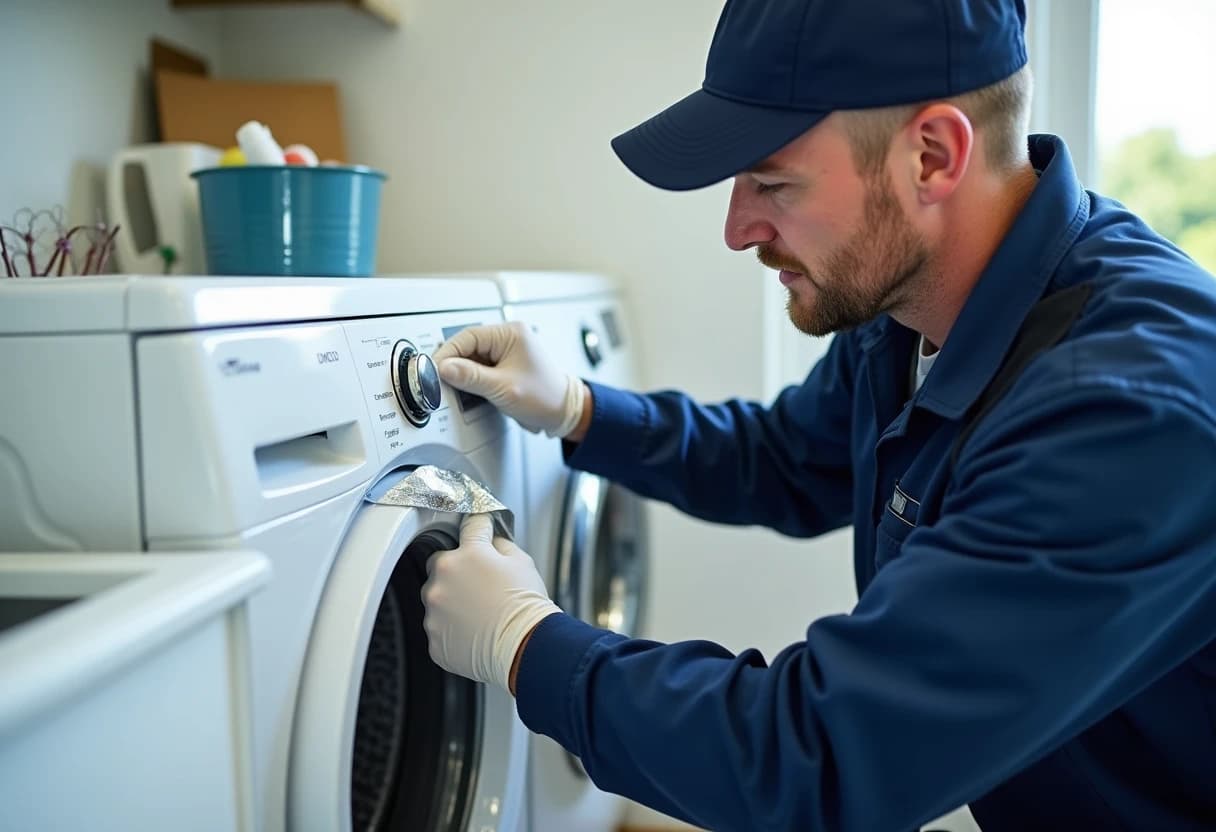
That flattened foil hose behind your dryer is doing more damage than it looks. Crushed transition ducts are the most common dryer vent failure we find in Franklin homes — the machine gets pushed back against the wall, the accordion hose collapses to a fraction of its diameter, and the dryer spends years straining against a pinched exhaust while lint packs the kink. We replace these hazards with semi-rigid aluminum connectors and repair everything downstream too: separated joints, sagging runs, holes rusted through duct walls, and exterior hoods that no longer close against weather and pests. Done right, with the materials the code requires, a repaired vent runs trouble-free for decades.
Why Dryer Vent Repair Matters for Franklin Homes
A damaged dryer vent fails on three fronts at once, and all three get worse with every load. Safety first: a disconnection or breach releases lint — one of the most flammable materials in a home — into wall cavities, ceilings and basements, where it accumulates near framing with no way to remove it, while the restriction at the damage point drives up exhaust temperatures exactly the way fire investigators describe in the roughly 2,900 US dryer fires each year. Moisture second: every load pushes about a gallon of water vapor through the vent, and a leak delivers it into building materials instead of outdoors — wet insulation, mold-friendly wall cavities, stained ceilings, rotted subfloor around the laundry. Performance third: crushed and separated ducts strangle airflow, stretching drying times and energy bills while overheating the appliance. Cleaning cannot fix any of this; the duct itself is broken. A proper repair — rigid metal, sealed joints, verified airflow — resolves all three failure modes in a single visit, usually for $150 to $450.
Dryer vent damage in Franklin is largely a story about the buildings. Franklin grew explosively in the 1980s and 1990s, so its housing stock leans heavily toward Colonial-style subdivision homes on cul-de-sacs, joined by newer townhouse and condo developments near the two commuter rail stations. Nearly all of it was built with central forced-air systems, and many of those builder-grade duct installations used flex duct and panned joist returns that collect dust far faster than rigid metal trunk lines. Laundry hookups in homes like these were added long after construction, so vents thread through old framing, hug cold foundation walls and rely on joints assembled in cramped, concealed spaces — precisely the conditions that produce separations, crush points and condensation. Franklin's homes are young by Massachusetts standards, but thirty-year-old builder-grade ductwork is exactly the age where seams loosen and blower compartments fill with construction debris that was never cleaned out. Add the finished basements that are almost standard here and you get plenty of below-grade humidity feeding musty supply-air odors. Our repair crews work in Franklin weekly and arrive equipped for its housing stock: rigid metal duct and fittings in the sizes older runs need, insulation for cold-space sections, and the patience concealed ductwork demands.
Our Dryer Vent Repair Process in Franklin
1Diagnose the Full Exhaust Path
We treat symptoms as evidence: lint in the basement points to a specific joint; a ceiling stain maps to a specific duct section; condensation drips tell us where the run crosses cold space. Correlating symptoms with the physical path usually pinpoints the failure within minutes — and rules out the failures you do not have.
2Protect the Area & Open Access
Laundry areas are tight, finished spaces, and we work in them accordingly: drop cloths, boot covers, and careful handling of the appliance and its gas or electrical connections. Gas dryers get particular care around the flexible connector — we never strain a gas line to reach a duct.
3Reconnect & Properly Fasten Separated Joints
We do not just push a failed joint back together; we rebuild it so it cannot fail the same way. That means cleaning mating surfaces, correcting the misalignment or unsupported weight that pulled the joint apart, adding hangers or strapping where the run lacked support, and sealing the finished connection against both air and moisture leakage.
4Replace Crushed, Corroded or Non-Compliant Sections
Vinyl and foil accordion duct found anywhere in the run is removed on sight and replaced: rigid metal for the concealed run, a short UL-listed semi-rigid aluminum connector at the appliance. The smooth interior of proper duct resists lint accumulation dramatically better than corrugations — the repair also makes every future cleaning faster and more effective.
5Cure Condensation: Slope, Seal & Insulate
Condensation repairs follow the water. We restore continuous slope toward the termination so condensate drains out instead of pooling; seal the joints it has been leaking through with foil tape rated for the duty; and insulate duct sections crossing unheated basements, garages, attics and exterior wall bays so exhaust stays above its dew point until it exits.
6Repair or Replace the Exterior Hood & Damper
The new hood is sealed to the wall correctly: fastened to siding or masonry, flashed and caulked so wind-driven rain stays out of the wall assembly, with the duct connection sealed inside. On brick and stone, we drill and anchor rather than improvise; on clapboard, we integrate with the siding plane. The termination should outlast the roof.
7Replace the Transition Duct & Reset the Dryer
The appliance connection is rebuilt to spec: a UL-listed semi-rigid aluminum transition duct, as short and straight as the layout allows, secured with clamps at both ends. We position the dryer so the connector keeps its full diameter — not crushed against the wall — and mark the safe distance so future pushes do not recreate the old kink.
8Verify Airflow & Document the Repair
You receive photo documentation of the failures found and the repairs made — valuable for insurance files, condo associations, home sales and your own records. We also note the condition of everything we did not repair, so you have an honest picture of the vent's remaining lifespan and its next likely maintenance date.
Benefits of Professional Dryer Vent Repair in Franklin
A Serious Fire Hazard, Eliminated
A breached or restricted dryer vent combines the two ingredients of the roughly 2,900 annual US dryer fires: accumulating lint and rising exhaust temperatures. Repair removes both — the escape points that seed wall cavities with fuel, and the crush points and blockages that overheat the system. It is fire prevention with a wrench, and it lasts for decades.
Lower Energy and Repair Bills
A dryer fighting a damaged vent runs longer per load and hotter per minute — both metered directly on your utility bill, often $10 to $20 a month for a busy household. Repair returns cycles to design length. The savings recur every laundry day, quietly repaying the one-time repair cost within the first year or two.
Restored Drying Performance
A crushed or separated duct throttles airflow just like a lint clog, and no amount of cleaning fixes it. Repair restores the full 4-inch path, and drying performance returns immediately — one-cycle loads, accurate sensor-dry behavior, and a machine that stops straining against backpressure it was never designed to fight.
Pest Entry Points Closed
A dryer vent with a failed damper is an open, warm, sheltered 4-inch doorway — irresistible to birds, squirrels and mice, whose nests then block the duct and whose presence contaminates it. Repairing the termination closes the doorway with a damper and guard designed for dryer exhaust, ending the nest-remove-repeat cycle for good.
Decades of Reliable Service From One Repair
We stand behind the work: repairs are documented, photographed and guaranteed, and because we also clean vents, we see our own repairs again on annual visits — a feedback loop that keeps our standards honest. The repair you buy is one we expect to inspect ourselves for years.
Moisture Out of Your Walls and Ceilings
In New England's freeze-thaw climate, moisture in building assemblies does compounding damage each winter. Sealing a leaking dryer vent removes one of the few moisture sources that operates year-round, indoors, by the gallon. Building scientists put exhaust integrity high on the envelope checklist for exactly this reason.
Signs Your Franklin Home Needs Dryer Vent Repair
Slow Drying That Cleaning Didn't Fix
If a vent cleaning did not restore drying performance, the airflow restriction is structural: a crushed section, a collapsed inner liner, a separated joint dumping exhaust short of the hood, or a damper that cannot open. The next step is diagnosis, not another cleaning — we trace the path, find the mechanical fault, and quote its repair flat.
Lint Appearing Where It Shouldn't
Lint drifting from a basement ceiling, gathering on joists, puffing from a wall register or collecting behind the dryer means exhaust is escaping the duct before the termination. Lint marks the leak like dye in water — follow it and you find the separated joint or breach. This is a repair call, not a cleaning call, and it should not wait.
Musty or Mildew Smell in the Laundry Area
EPA guidance on mold is unambiguous: control the moisture and you control the growth. In laundry areas the dryer vent is a prime suspect moisture source, and a $150 to $450 repair is dramatically cheaper than the remediation an ignored leak can eventually require.
Visibly Damaged, Kinked or Sagging Duct
Trust your eyes: a transition hose flattened behind the dryer, a dented or crushed section in the basement, duct sagging between supports into a low belly, or a run held together with fabric duct tape are all failures in progress. Each restricts airflow, collects lint and moisture, and worsens with time. Photograph what you see and call — the quote is quick.
Water Stains, Drips or Peeling Paint Near the Vent Path
A ceiling stain below a second-floor laundry, paint bubbling behind the dryer, or drips from a basement duct joint all point to exhaust moisture escaping or condensing in the run. Each load adds another gallon of vapor to the problem. Repair — sealing, sloping, insulating or replacing the affected section — stops the source; cosmetic fixes without it just repaint the symptom.
Exterior Damper Broken, Stuck or Missing
Cold drafts in the laundry room trace to the damper more often than to windows: a flap that no longer closes turns the duct into a 4-inch outside-air inlet. If the laundry area runs noticeably colder in winter than adjacent rooms, put the hood on your inspection list — the heating-season savings from a tight new damper are immediate.
Dryer Vent Repair Cost in Franklin, MA
It helps to know what drives repair pricing, because the failure type matters more than the home's size. Accessibility is the biggest factor: a joint hanging exposed in a basement is a fast fix, while the same failure above a finished ceiling involves careful access and restoration planning. Materials are second: quality rigid metal duct, UL-listed connectors, foil tape and a solid termination hood carry real parts costs — roughly $30 to $120 of most invoices — but they are why the repair lasts decades. Scope is third: many vents present multiple failures at once (a crushed transition and a failed damper and a leaking joint), and bundling them into one visit is significantly cheaper than three separate calls. What does not drive our pricing: drama. We quote from the diagnosis, show you the photos, and price the fix flat. Massachusetts homeowners have seen enough scare-based selling around dryer fires; the facts are alarming enough without embellishment, and the honest repair is usually a few hundred dollars.
Want the full pricing picture? See our complete Boston-area cost guide or call (617) 390-7145 for an exact flat quote for your Franklin home.
Local Knowledge: Franklin, Norfolk County
Every town's ductwork tells the story of its housing. Franklin grew explosively in the 1980s and 1990s, so its housing stock leans heavily toward Colonial-style subdivision homes on cul-de-sacs, joined by newer townhouse and condo developments near the two commuter rail stations. Nearly all of it was built with central forced-air systems, and many of those builder-grade duct installations used flex duct and panned joist returns that collect dust far faster than rigid metal trunk lines. Franklin's homes are young by Massachusetts standards, but thirty-year-old builder-grade ductwork is exactly the age where seams loosen and blower compartments fill with construction debris that was never cleaned out. Add the finished basements that are almost standard here and you get plenty of below-grade humidity feeding musty supply-air odors. We plan Franklin jobs around those realities, from equipment selection to time on site, and it shows in the results. If you live near DelCarte Recreation Area or anywhere across Franklin's 02038 area, we have almost certainly cleaned a system like yours before — and we can tell you exactly what to expect before we arrive.
The Best Time of Year in Franklin
Spring is nesting season, and a dryer vent with a compromised damper is prime real estate: warm, dry, sheltered, and lined with soft lint. Birds, squirrels and mice move in between March and June, and by summer the nest has become a full blockage — often discovered when drying times collapse or a burning smell appears. The seasonal logic favors acting early: repair a failing damper in late winter and the nest never happens; wait, and the spring repair includes nest removal, duct cleaning and sanitizing on top of the hood replacement. If you heard scratching or chirping near the laundry last spring, put the termination inspection on this year's calendar before the wildlife does.
Why Choose Boston Air Duct Cleaners
Homeowners across Norfolk County choose Boston Air Duct Cleaners for three reasons. First, honesty: our inspection camera tells you whether your system actually needs cleaning — and sometimes the answer is no. Second, capability: truck-grade negative-air machines, rotary brush systems and HEPA filtration handle everything from antique gravity-furnace conversions to brand-new high-velocity systems. Third, accountability: flat quoted pricing, before-and-after photos, insured technicians, and a real local office you can call at (617) 390-7145. That combination is rarer in this industry than it should be.
Serving Franklin and Surrounding Communities
We serve every community around Franklin as well: Bellingham, Medway, Norfolk, Wrentham, Milford, Plainville all fall inside our regular service routes. If you have a second property, a rental, or family nearby, ask about multi-home scheduling — grouped appointments on the same route are our most requested discount.