
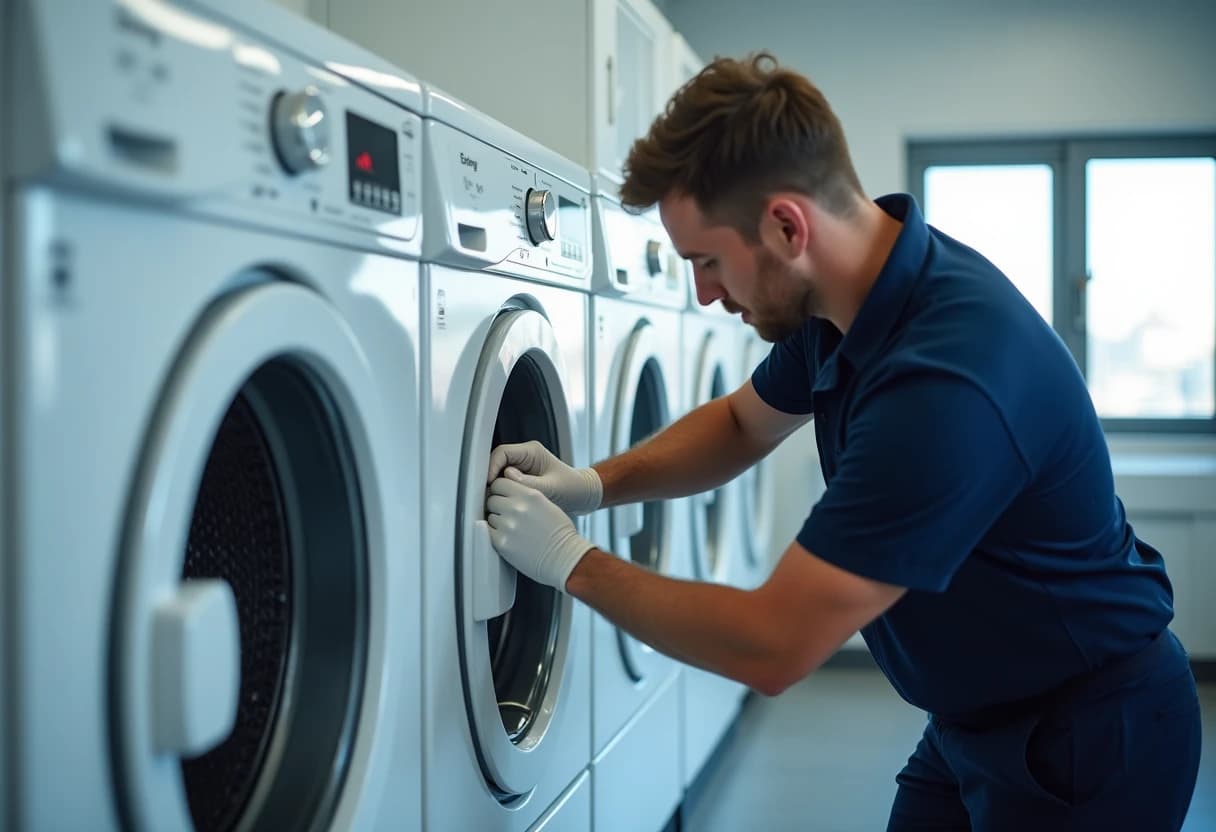
Laundromats and shared laundry rooms push dryer venting harder than any residential setting: commercial dryers cycling all day, multiple machines manifolded into common ducts, and lint production measured in pounds per week. A clogged vent in this environment does not just risk fire — it lengthens dry times, drives up gas and electric costs, trips high-limit switches and burns out machines. Our commercial dryer vent service covers Needham laundromats, coin-op rooms in apartment buildings, salons, gyms and any business that dries in volume: full mechanical cleaning of each duct run and common manifold, termination and damper service, before-and-after airflow verification, and maintenance intervals matched to your machine duty cycle rather than a generic calendar.
Why Commercial & Multi-Unit Dryer Vent Cleaning Matters for Needham Homes
Insurance is increasingly the driver that gets this work scheduled. Master-policy underwriters for condominium associations and apartment owners have tightened attention on dryer venting because the loss data justifies it: lint fires are frequent, preventable and well-documented. Renewal questionnaires now routinely ask when vents were last professionally cleaned; some carriers request the report itself, and after a claim, the absence of maintenance records becomes part of the story an adjuster writes. Massachusetts associations have an added legal dimension — boards carry a duty to maintain common elements, and in many governing documents the vent duct beyond the unit's wall is exactly that. A documented cleaning program is inexpensive armor: dated per-unit reports, condition exceptions logged and disclosed to owners, hazards like prohibited transition ducts flagged in writing, and a recurring schedule that demonstrates ongoing diligence rather than a one-time response. We format our reporting for precisely these audiences — boards, managers, carriers and counsel — because in multi-unit work the paperwork is not an accessory to the service. It is half the service.
Whether it is a triple-decker near Needham Heights, a mid-rise condominium off Olin College of Engineering, or garden apartments elsewhere in Needham, the venting problems rhyme: lint-loaded runs, blocked or screened terminations, transition ducts that should have been replaced years ago. Needham has one of Greater Boston's most aggressive teardown markets: streets of 1920s Colonials and 1950s capes are steadily being replaced by 4,000-square-foot new builds with multi-zone forced-air systems. The surviving older homes typically carry retrofit ductwork wedged into radiator-era framing, while the new construction ships with long flex-duct runs through conditioned attics. That mix means we see both fifty-year-old dust loads and brand-new systems full of construction debris. Because Needham rebuilds itself house by house, post-construction duct cleaning is practically a local specialty for us - new systems here routinely contain sawdust, drywall grit and packaging debris from day one. Sitting just over the Charles from our Newton shop, Needham also gets some of our quickest arrival windows. As a local company based 6 miles away in West Newton, we have cleaned building-wide across Norfolk County for associations, HOAs and management portfolios — with volume pricing per unit, crews that respect residents' homes, and reporting standardized so multi-building managers can compare properties at a glance.
Our Commercial & Multi-Unit Dryer Vent Cleaning Process in Needham
1Building Walkthrough & Per-Unit Proposal
First we learn your building's venting anatomy, because no two multi-unit buildings vent alike. Stacked risers, basement manifolds, improvised renovation-era runs and individual wall vents each demand different equipment and time. The walkthrough maps it, a camera check of representative runs establishes condition honestly, and your written proposal reflects the actual building — not a per-vent teaser that grows on site.
2Resident Coordination & Scheduling
For occupied buildings, logistics decide whether a project succeeds. Ours run on a simple system: management distributes our notice template with dates; we sequence units floor by floor to keep crews moving; a coordinator handles reschedules and lockouts as they arise; and the final report distinguishes cleaned, no-access and exception units explicitly, because an insurer reading it will want exactly that distinction.
3Dryer-Side Service: Transition Duct & Connection
In each unit we pull the dryer, clean behind and beneath it — a major hidden lint reservoir — and service the transition duct between machine and wall. Foil accordion transitions, which manufacturers prohibit and which trap lint in every corrugation, are flagged and can be replaced on the spot with code-appropriate material. The connection is reseated and secured without airstream-penetrating screws, per code.
4Mechanical Cleaning of the Full Vent Run
The in-wall duct is cleaned end to end with rotary brush systems driven through the full run while a high-powered vacuum captures dislodged lint — the same agitation-plus-extraction principle as NADCA duct cleaning, sized for 4-inch dryer duct. Long runs and multiple elbows get repeat passes; the pass is complete when the brush returns clean and airflow verifies.
5Shared Risers, Common Trunks & Booster Fans
Stacked buildings route multiple dryers into shared vertical risers, and these common elements are where multi-unit lint risk concentrates — no resident can clean them, and every household loads them. We service risers from terminations and access points with vertical-run equipment, clean common horizontal trunks and basement manifolds, and service inline booster fans, whose blades cake with lint and quietly fail.
6Termination Service & Exterior Verification
Exterior work is where multi-unit projects earn their price: terminations three stories up that no resident has ever seen, roof caps buried under winter ice damage, wall hoods behind shrubs. Each one is cleared of lint and debris, checked for damper function so it seals when idle and opens fully under flow, and photographed for the report. Damaged or non-compliant caps are flagged with replacement pricing.
7Airflow Verification & Building Compliance Report
The project closes with documentation built for its real audiences. Management receives a unit-by-unit log with service dates and technician notes; the board receives a summary with building-level findings — riser condition, termination issues, prohibited transition ducts by unit — and prioritized recommendations; and the insurance-ready certificate states scope, method and completion date. Next year's cycle is calendared before we leave.
Benefits of Professional Commercial & Multi-Unit Dryer Vent Cleaning in Needham
Volume Pricing That Beats Unit-by-Unit Service
Left to individual residents, vent cleaning happens rarely, unevenly and at retail prices — and the shared ducts never get cleaned at all. Building-wide service inverts every part of that: complete coverage, common elements included, standardized quality, one invoice, and a per-unit rate that makes the line item easy to defend at budget time.
Insurance & Liability Documentation That Holds Up
Documentation converts maintenance into protection. The same cleaning, undocumented, protects the building physically but leaves the association exposed on paper. Our reports close that gap: scope, method, dates, per-unit outcomes and photographic evidence, delivered in a format managers file once and retrieve in minutes when the renewal questionnaire arrives.
Directly Reduced Fire Risk, Building-Wide
The comparison that matters is cost per risk retired. For a modest per-door price, an association eliminates its most preventable fire hazard for the year — one whose national loss statistics, per NFPA and FEMA, are driven precisely by the maintenance being skipped. Few line items in a reserve study buy comparable protection per dollar.
Hazard Discovery Before It Costs You
The inspection value of a building-wide project rivals the cleaning value. Our unit-by-unit documentation regularly surfaces conditions associations did not know they had — moisture damage from leaking ducts, code violations from old renovations, pest entry at damaged terminations — while they are still inexpensive line items rather than insurance claims.
Shorter Dry Times & Lower Utility Costs
Utility waste from restricted venting is invisible but continuous, accruing on every load in every unit. Cleaning removes the restriction building-wide at once, which is why managers of buildings with house-paid gas or electric can often see the program's effect in the utility data — a rare maintenance item with a measurable meter-level return.
Longer Dryer Life & Fewer Appliance Failures
In buildings where management owns the machines — common laundry rooms, included-appliance rentals, laundromats — vent restriction is a direct capital cost: premature element, fuse and motor failures across the fleet. Regular vent service is fleet maintenance, and operators who adopt it consistently report fewer service calls and longer replacement cycles.
Signs Your Needham Home Needs Commercial & Multi-Unit Dryer Vent Cleaning
No One Can Say When Vents Were Last Cleaned
If the answer is not in the maintenance file, the answer is effectively never — and lint has been accumulating in every run and riser since installation or the last renovation. A building-wide baseline cleaning with per-unit documentation starts the clock properly and gives the association its first real picture of vent condition.
Lint Visible at Terminations or on the Building Exterior
Terminations that never fully close — propped open by lint mats — do double damage: they confirm heavy internal accumulation, and they hold an open door for pests, drafts and winter freeze-up. Any visible lint at an exterior outlet justifies putting a camera and a brush through that run promptly.
Foil Accordion Ducts or Improvised Vent Runs in Units
Walk any older building's units and you will find them: shiny foil accordion transitions sagging behind dryers, trapping lint in every corrugation. Manufacturers prohibit them and the IRC's requirements for smooth-interior duct exist because they burn. Each one found is a unit-level hazard flag — and a building-wide survey usually finds many.
Burning Smells, Hot Laundry Areas or Tripped Thermal Fuses
A hot, linty smell during dryer operation is the machine overheating against restricted exhaust — the exact precondition of a lint fire. Treat it as urgent in any building: the affected unit's run needs immediate inspection, and one unit's condition in a shared-riser building is a reasonable proxy for its neighbors'.
High-Duty Operations: Laundromats & Common Laundry Rooms
Watch the operational metrics: creeping gas consumption per load, customer complaints about damp clothes, machines cycling on high-limit switches. Each is restricted exhaust translated into operating cost. Duty-matched vent cleaning restores throughput and typically pays for itself in energy and uptime before its fire-safety value is even priced in.
Dryers Taking Two or More Cycles Per Load
Residents report it as an appliance problem — 'the dryer is getting old' — but two-cycle drying is a venting symptom far more often than a machine failure. Before replacing dryers or fielding another season of complaints, verify the exhaust path; in multi-unit buildings a pattern of slow-dry complaints maps reliably onto clogged runs and risers.
Commercial & Multi-Unit Dryer Vent Cleaning Cost in Needham, MA
Why volume pricing works in the association's favor: the expensive parts of vent cleaning are mobilization and setup, and a building project pays for them once across dozens of units. Crews sequenced through an access schedule complete multiple units per hour, so a 24-unit building might complete in a day at a per-door price no resident could obtain individually. Complexity moves the number: buildings where every unit vents a short run to its own wall cap sit at the low end near $40–$60 per unit; mid-rises with stacked risers, roof terminations and long ceiling runs price toward $70–$90 plus itemized riser service; and buildings needing hazard remediation — foil transition replacements (typically $45–$85 per unit installed), termination cap replacements, disconnected-run repairs — receive those items priced separately for board approval, never folded silently into the cleaning invoice.
Want the full pricing picture? See our complete Boston-area cost guide or call (617) 390-7145 for an exact flat quote for your Needham home.
Local Knowledge: Needham, Norfolk County
Every town's ductwork tells the story of its housing. Needham has one of Greater Boston's most aggressive teardown markets: streets of 1920s Colonials and 1950s capes are steadily being replaced by 4,000-square-foot new builds with multi-zone forced-air systems. The surviving older homes typically carry retrofit ductwork wedged into radiator-era framing, while the new construction ships with long flex-duct runs through conditioned attics. That mix means we see both fifty-year-old dust loads and brand-new systems full of construction debris. Because Needham rebuilds itself house by house, post-construction duct cleaning is practically a local specialty for us - new systems here routinely contain sawdust, drywall grit and packaging debris from day one. Sitting just over the Charles from our Newton shop, Needham also gets some of our quickest arrival windows. We plan Needham jobs around those realities, from equipment selection to time on site, and it shows in the results. If you live near Needham Heights or anywhere across Needham's 02492 area, we have almost certainly cleaned a system like yours before — and we can tell you exactly what to expect before we arrive.
The Best Time of Year in Needham
Winter is dryer-fire season in New England, and the mechanics are seasonal in every direction. Cold months mean heavier laundry — flannels, fleeces, blankets — that sheds more lint per load; closed-up buildings mean any exhaust leak or interior-terminating vent dumps moisture where it condenses; and frozen or lint-jammed termination flaps restrict airflow exactly when dryers work hardest. Fire departments nationally see dryer-fire incidence peak in winter, and Massachusetts buildings fit the pattern. Fall is therefore the smart season for building-wide cleaning: every run cleared and every damper verified before the heavy-laundry months, and the project completed while roof and ladder access is still comfortable. Associations that anchor their annual cycle to September and October get the protection when it matters most — and beat the scheduling rush.
Why Choose Boston Air Duct Cleaners
Homeowners across Norfolk County choose Boston Air Duct Cleaners for three reasons. First, honesty: our inspection camera tells you whether your system actually needs cleaning — and sometimes the answer is no. Second, capability: truck-grade negative-air machines, rotary brush systems and HEPA filtration handle everything from antique gravity-furnace conversions to brand-new high-velocity systems. Third, accountability: flat quoted pricing, before-and-after photos, insured technicians, and a real local office you can call at (617) 390-7145. That combination is rarer in this industry than it should be.
Serving Needham and Surrounding Communities
We serve every community around Needham as well: Newton, Wellesley, Dedham, Dover, Westwood, Brookline all fall inside our regular service routes. If you have a second property, a rental, or family nearby, ask about multi-home scheduling — grouped appointments on the same route are our most requested discount.