
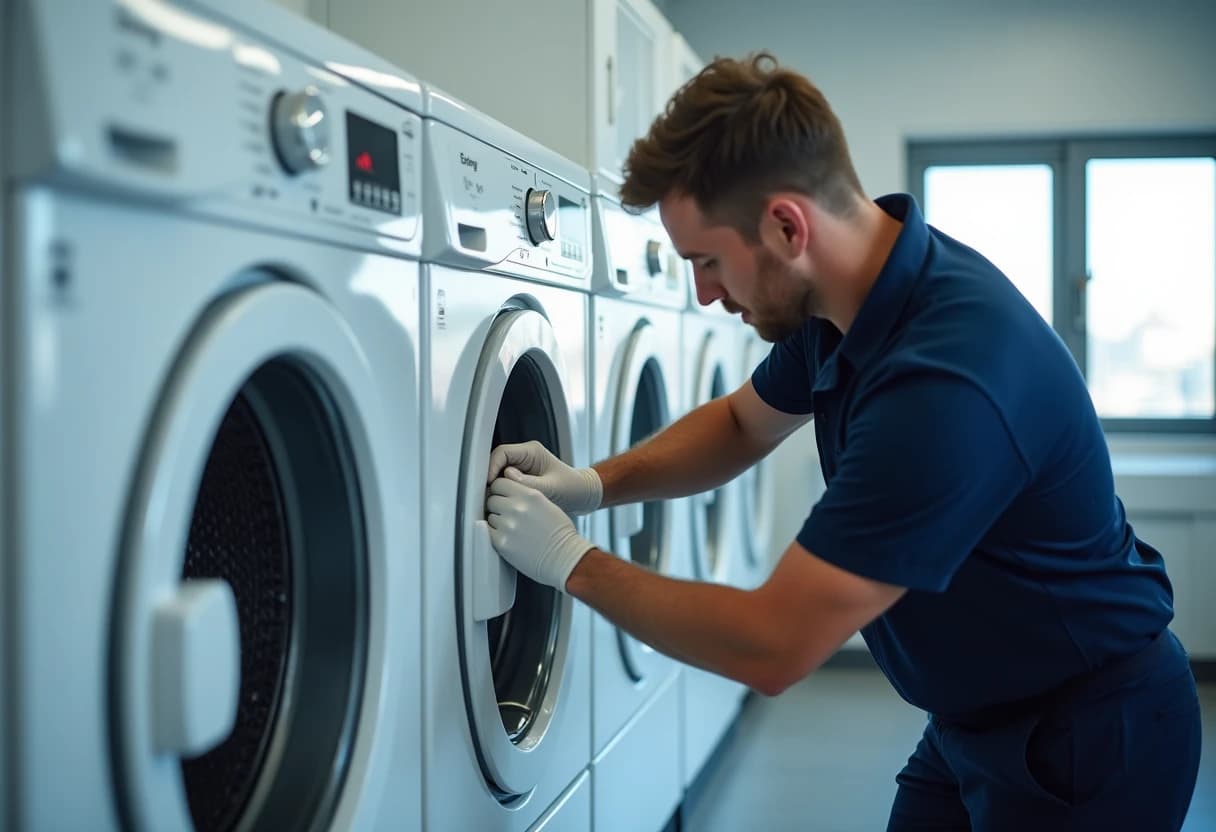
Multi-unit dryer vent cleaning is a logistics problem as much as a technical one, and we have built our commercial program around both. One project coordinator schedules the building; residents get clear notice windows; crews move unit by unit with rotary brush systems and high-powered vacuums, cleaning each vent from the dryer connection to the exterior termination; and shared risers and common trunk lines are cleaned from roof or wall terminations with equipment sized for vertical runs. Brookline associations and management companies get per-unit volume pricing that drops steeply below single-home rates, a completion report listing every unit's condition, and a documented answer to the question insurers increasingly ask: when were the dryer vents last professionally cleaned?
Why Commercial & Multi-Unit Dryer Vent Cleaning Matters for Brookline Homes
Multi-family buildings accumulate venting problems single homes never see. Stacked units in mid-rise and high-rise construction often share vertical risers — one common duct serving multiple dryers — where lint from every household compounds and where no individual resident can clean even if they try. Long horizontal runs snake through ceiling plenums to reach an outside wall, exceeding the code intent of the IRC's 35-foot equivalent-length limit once elbows are deducted. Renovations leave behind crushed flex duct, illegal screw-joined sections that snag lint, and foil accordion transitions that both the code and every dryer manufacturer warn against. Terminations get painted shut, screened over (another code violation — screens trap lint), or blocked by bird nests three stories up where nobody looks. Our crews see all of it weekly, and the whole-building service is designed for it: equipment for vertical risers and roof terminations, unit-by-unit condition documentation, and honest flagging of the hazards that cleaning alone cannot fix, priced separately for board approval. You cannot manage what has never been inspected — and most buildings have never been inspected.
Multi-unit housing defines Brookline, and its dryer venting shows the accumulated improvisation of decades. Brookline layers grand brick apartment blocks and condo buildings around Coolidge Corner and Washington Square over streets of substantial Victorians, Tudors and colonials, with estate-scale homes in Chestnut Hill and South Brookline. Almost everything predates central air, so the town is a showcase of retrofit solutions - high-velocity mini-duct systems, condo fan-coil risers and attic air handlers snaked through slate-roofed third floors. In buildings like these, vents were often added long after construction — routed through basements, snaked to whatever wall was nearest, extended during renovations — and many have never been professionally cleaned since installation. Brookline is minutes from our West Newton shop, and its pre-war condo buildings are steady work for us: shared ventilation shafts and decades-old fan-coil systems accumulate dust that no individual unit owner ever sees. Strict historic-district rules mean exterior vent terminations are often undersized or hidden, and we know the compliant ways to keep them functional. Our crews work Brookline buildings regularly and carry what its stock demands: rotary systems for long improvised runs, ladder and roof access for upper-floor terminations, and the patience for buildings where every unit's vent tells a different story. Boards get one proposal, one project, one per-unit report.
Our Commercial & Multi-Unit Dryer Vent Cleaning Process in Brookline
1Building Walkthrough & Per-Unit Proposal
We scope before we quote: unit count and layout, vent configurations and lengths, termination locations and access (ladder, lift or roof), laundry room and common-area equipment, and any known problem units. Associations receive a fixed proposal with volume per-unit pricing, a project schedule with resident notice templates, and the reporting format agreed in advance so the board knows exactly what deliverable closes the project.
2Resident Coordination & Scheduling
For occupied buildings, logistics decide whether a project succeeds. Ours run on a simple system: management distributes our notice template with dates; we sequence units floor by floor to keep crews moving; a coordinator handles reschedules and lockouts as they arise; and the final report distinguishes cleaned, no-access and exception units explicitly, because an insurer reading it will want exactly that distinction.
3Dryer-Side Service: Transition Duct & Connection
The first feet of the vent path fail most often: crushed transition hoses behind the dryer, lint packed at the wall connection, and prohibited foil accordion duct that sags into lint-collecting bellies. We service this section in every unit — machine pulled, area vacuumed, transition cleaned or replacement offered, connection remade properly — because a clean wall duct fed through a clogged transition solves nothing.
4Mechanical Cleaning of the Full Vent Run
The in-wall duct is cleaned end to end with rotary brush systems driven through the full run while a high-powered vacuum captures dislodged lint — the same agitation-plus-extraction principle as NADCA duct cleaning, sized for 4-inch dryer duct. Long runs and multiple elbows get repeat passes; the pass is complete when the brush returns clean and airflow verifies.
5Shared Risers, Common Trunks & Booster Fans
Stacked buildings route multiple dryers into shared vertical risers, and these common elements are where multi-unit lint risk concentrates — no resident can clean them, and every household loads them. We service risers from terminations and access points with vertical-run equipment, clean common horizontal trunks and basement manifolds, and service inline booster fans, whose blades cake with lint and quietly fail.
6Termination Service & Exterior Verification
We finish each run where the air does: at the outside wall or roof. The termination is cleaned, its flap or damper exercised and verified, screens and nests removed, and the exhaust confirmed to discharge outdoors — not into an attic, soffit or crawlspace, a dangerous and surprisingly common Massachusetts finding. Interior-terminating vents are documented as the priority hazards they are.
7Airflow Verification & Building Compliance Report
Each cleaned run gets a functional verification — airflow at the termination with the dryer running, or anemometer readings where equipment access allows — so the report records outcomes, not just activity. The building deliverable lists every unit: cleaned and verified, no-access, or exception, with photos of hazards and itemized repair recommendations. Boards file it; insurers accept it; renewals cite it.
Benefits of Professional Commercial & Multi-Unit Dryer Vent Cleaning in Brookline
Insurance & Liability Documentation That Holds Up
Documentation converts maintenance into protection. The same cleaning, undocumented, protects the building physically but leaves the association exposed on paper. Our reports close that gap: scope, method, dates, per-unit outcomes and photographic evidence, delivered in a format managers file once and retrieve in minutes when the renewal questionnaire arrives.
Shorter Dry Times & Lower Utility Costs
A lint-restricted vent forces dryers to run longer per load — frequently twice as long — and in buildings with common laundry or owner-paid utilities, that waste lands directly on the operating budget. Restored airflow returns machines to single-cycle drying, and laundromats often see the gas savings alone repay the cleaning within months.
Hazard Discovery Before It Costs You
Every exception we flag is a future incident pre-empted: the crushed run behind a renovated wall, the riser takeoff installed backwards, the termination flap frozen shut that made one unit's dryer exhaust into the building. Boards receive these findings prioritized and priced, converting unknown risks into a manageable repair list.
Longer Dryer Life & Fewer Appliance Failures
In buildings where management owns the machines — common laundry rooms, included-appliance rentals, laundromats — vent restriction is a direct capital cost: premature element, fuse and motor failures across the fleet. Regular vent service is fleet maintenance, and operators who adopt it consistently report fewer service calls and longer replacement cycles.
Volume Pricing That Beats Unit-by-Unit Service
Left to individual residents, vent cleaning happens rarely, unevenly and at retail prices — and the shared ducts never get cleaned at all. Building-wide service inverts every part of that: complete coverage, common elements included, standardized quality, one invoice, and a per-unit rate that makes the line item easy to defend at budget time.
A Program, Not a Project
Buildings on our maintenance program stop managing this risk and start merely reviewing it: we track the interval, propose dates, coordinate residents, execute, and deliver the report to the same folder every cycle. For management companies, the program scales across portfolios with standardized reporting — one decision covering every property's most preventable hazard.
Signs Your Brookline Home Needs Commercial & Multi-Unit Dryer Vent Cleaning
Dryers Taking Two or More Cycles Per Load
The test is simple: a healthy dryer with clear venting dries a standard load in one cycle. Track your building's work orders — clusters of slow-dry, no-heat and thermal-fuse tickets are the venting system asking for service, and each ticket represents a unit running its dryer at elevated temperature against a restricted duct.
Lint Visible at Terminations or on the Building Exterior
Terminations that never fully close — propped open by lint mats — do double damage: they confirm heavy internal accumulation, and they hold an open door for pests, drafts and winter freeze-up. Any visible lint at an exterior outlet justifies putting a camera and a brush through that run promptly.
Insurance Questionnaires or Post-Incident Requirements
Carriers writing habitational risk in Massachusetts have tightened on dryer venting because loss data justifies it. Boards seeing new questionnaire language, inspection requirements or premium credits tied to vent maintenance should read the market signal: this is now standard due diligence for multi-unit buildings, and the documented program is what compliance looks like.
High-Duty Operations: Laundromats & Common Laundry Rooms
Watch the operational metrics: creeping gas consumption per load, customer complaints about damp clothes, machines cycling on high-limit switches. Each is restricted exhaust translated into operating cost. Duty-matched vent cleaning restores throughput and typically pays for itself in energy and uptime before its fire-safety value is even priced in.
No One Can Say When Vents Were Last Cleaned
New management contracts and board turnovers routinely surface this gap: dryer vents appear in no budget, no vendor list and no maintenance log. It is among the first items worth correcting, because it combines genuine fire risk with an insurer-facing documentation hole — and because the first cleaning doubles as a building-wide inspection.
Burning Smells, Hot Laundry Areas or Tripped Thermal Fuses
Laundry rooms that run noticeably hot and humid indicate exhaust air staying in the building — restricted ducts, failed boosters or leaking joints. Beyond discomfort, that moisture feeds mold in shared spaces and the heat stresses every machine in the room. Both symptoms resolve when the common venting actually moves its design airflow.
Commercial & Multi-Unit Dryer Vent Cleaning Cost in Brookline, MA
Why volume pricing works in the association's favor: the expensive parts of vent cleaning are mobilization and setup, and a building project pays for them once across dozens of units. Crews sequenced through an access schedule complete multiple units per hour, so a 24-unit building might complete in a day at a per-door price no resident could obtain individually. Complexity moves the number: buildings where every unit vents a short run to its own wall cap sit at the low end near $40–$60 per unit; mid-rises with stacked risers, roof terminations and long ceiling runs price toward $70–$90 plus itemized riser service; and buildings needing hazard remediation — foil transition replacements (typically $45–$85 per unit installed), termination cap replacements, disconnected-run repairs — receive those items priced separately for board approval, never folded silently into the cleaning invoice.
Want the full pricing picture? See our complete Boston-area cost guide or call (617) 390-7145 for an exact flat quote for your Brookline home.
Local Knowledge: Brookline, Norfolk County
Every town's ductwork tells the story of its housing. Brookline layers grand brick apartment blocks and condo buildings around Coolidge Corner and Washington Square over streets of substantial Victorians, Tudors and colonials, with estate-scale homes in Chestnut Hill and South Brookline. Almost everything predates central air, so the town is a showcase of retrofit solutions - high-velocity mini-duct systems, condo fan-coil risers and attic air handlers snaked through slate-roofed third floors. Brookline is minutes from our West Newton shop, and its pre-war condo buildings are steady work for us: shared ventilation shafts and decades-old fan-coil systems accumulate dust that no individual unit owner ever sees. Strict historic-district rules mean exterior vent terminations are often undersized or hidden, and we know the compliant ways to keep them functional. We plan Brookline jobs around those realities, from equipment selection to time on site, and it shows in the results. If you live near Brookline Village or anywhere across Brookline's 02445 area, we have almost certainly cleaned a system like yours before — and we can tell you exactly what to expect before we arrive.
The Best Time of Year in Brookline
Termination freeze-up is the distinctly New England failure mode. Dryer exhaust is warm and humid; when it meets a February termination, moisture condenses and freezes on the flap and hood, and a cap already propped partway open by lint accumulation becomes an ice-and-lint blockage that can seal a vent entirely. Residents notice two-cycle drying; the duct experiences trapped heat. Buildings with north-facing terminations, roof caps and long uninsulated runs through cold cavities are most vulnerable — and long cold runs also condense moisture internally, matting lint into dense plugs that only mechanical brushing removes. A pre-winter cleaning and damper service is the prevention; mid-winter, we triage frozen-vent calls across Norfolk County weekly, and the buildings calling are overwhelmingly the ones without a fall program.
Why Choose Boston Air Duct Cleaners
As a West Newton-based company, we treat Brookline like the neighborhood it is — because for us, it is. Our reputation lives or dies on local referrals, so every job gets the full process: complete system cleaning under negative pressure, mechanical agitation of every run, blower compartment service, and a documented walkthrough before we leave. We are licensed and insured, our estimates are free and flat, and our schedule holds same-day slots for urgent calls. One visit and you will understand why neighbors keep our magnet on the fridge.
Serving Brookline and Surrounding Communities
We serve every community around Brookline as well: Newton, Jamaica Plain, Brighton, Allston, West Roxbury, Back Bay all fall inside our regular service routes. If you have a second property, a rental, or family nearby, ask about multi-home scheduling — grouped appointments on the same route are our most requested discount.