
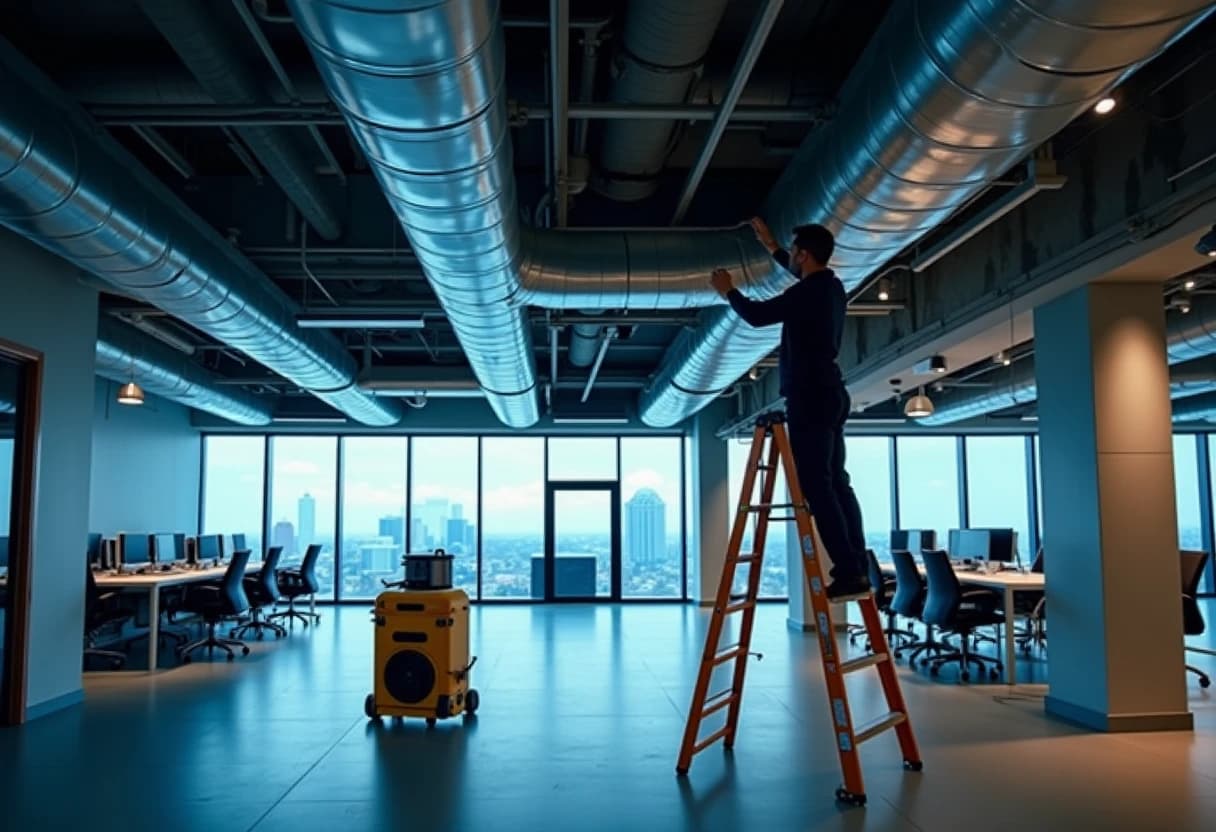
When employees complain about stuffy air, tenants file IAQ tickets, or customers notice dust streaming from ceiling diffusers, the ductwork is usually the culprit — and in commercial buildings it is measured in thousands of square feet of hidden sheet metal. Boston Air Duct Cleaners provides full source-removal duct cleaning for commercial properties in Littleton: supply and return trunks, branch runs, VAV and fan-powered boxes, rooftop unit interiors, and the diffusers and grilles your occupants actually see. Our crews are experienced with roof access, ceiling plenum returns, and the long horizontal trunk runs typical of office and retail construction. Every project includes pre- and post-cleaning photo documentation, after-hours or phased scheduling, and a certificate of insurance issued to your property before work begins.
Why Commercial Air Duct Cleaning Matters for Littleton Homes
Commercial ductwork works harder than residential ductwork and gets dirtier faster. A typical office system runs ten to twelve hours a day, moving air for dozens of occupants who each shed skin cells, clothing fibers and tracked-in street dust; retail and restaurant systems add door-traffic grit, paper dust and cooking aerosols on top. Ceiling plenum returns — standard in commercial construction — inhale everything above the ceiling tiles: fireproofing fibers, construction debris left from every past fit-out, and decades of settled dust. All of it recirculates through the space every operating hour. The consequences show up three ways. Occupants complain: headaches, irritated eyes, allergy flare-ups and the persistent 'stale office' smell that no janitorial contract fixes. Equipment suffers: fouled coils, blower wheels and filters drive up energy consumption and shorten the life of rooftop units that cost five figures to replace. And liability accumulates: documented IAQ maintenance is increasingly what insurers, tenants' counsel and health inspectors ask to see. A professional source-removal cleaning addresses all three at once, and the written report is often as valuable as the cleaning itself.
Littleton businesses call us for three commercial scenarios more than any other: post-fit-out cleanings after renovation dust invades the ductwork, odor and stale-air complaints in older buildings, and documentation requirements from insurers or medical tenants. Littleton mixes 18th- and 19th-century farmhouses around the Common with big waves of split-levels, garrisons and Colonials from the 1960s through the 1990s, plus newer cul-de-sac subdivisions near I-495. Most of the post-war stock was built with forced-air heat from day one, so ducts here are original equipment that has often gone thirty or forty years without a deep cleaning. Littleton's apple orchards, hayfields and heavily wooded lots mean seasonal pollen and field dust load up return ducts faster than homeowners expect. Homes drawing on well water and wooded septic lots also tend to run humid basements, and we frequently find musty odors traced to duct runs passing through those spaces. We bring the full commercial setup to every Littleton project — portable and truck-mounted HEPA negative-air machines, rotary brush and air-whip agitation, coil cleaning capability for rooftop and interior units — because commercial trunk lines and VAV systems demand more than residential equipment can deliver. Every project ends with a written completion report, and most are executed entirely outside your business hours.
Our Commercial Air Duct Cleaning Process in Littleton
1Site Walk, System Mapping & Flat Quote
Commercial projects start with a site walk or a review of your mechanical drawings. We identify every air handler and rooftop unit, trace the zones they serve, count diffusers and returns, note access constraints — ceiling heights, tenant hours, roof access — and inspect representative duct sections with a camera. You receive a flat, written quote with a proposed schedule before anything is booked.
2Certificates of Insurance & Scheduling Around Your Operations
Before work begins, your property receives our certificate of insurance with the endorsements commercial buildings require, plus W-9 and vendor paperwork for property management onboarding. Then we build the schedule around you: overnight for retail and restaurants, weekends for offices, phased floor-by-floor for occupied multi-tenant buildings, school-vacation weeks for education clients. Your business hours are never the cost of clean ducts.
3Containment & Protection of Finished Spaces
Retail merchandise, exam rooms, server closets, commercial kitchens — commercial spaces contain things that must not get dusty, and our protection plan is written into every project scope. Sensitive areas are draped or excluded and sequenced appropriately, negative pressure ensures loosened debris travels into HEPA collection rather than the space, and each night's work area is inspected and restored before the crew leaves.
4Negative Pressure on Each Zone
Negative pressure is the backbone of NADCA-standard cleaning, and commercial ductwork tests it: hundred-foot trunk runs, multiple branch takeoffs, VAV boxes and plenum returns all between the debris and the vacuum. We establish collection points strategically along the mains, verify draw at the far ends of each run, and only then begin agitation — ensuring every loosened particle has a clear path out of the building.
5Mechanical Agitation of Trunks, Branches & Terminal Units
This is the labor the price reflects. Every supply branch from diffuser to trunk, every return path including plenum-connected grilles, and every accessible terminal unit gets individual mechanical agitation — not just a blast of air from one end. Stubborn accumulation gets repeat passes until inspection imaging shows clean metal. Access panels are installed where the system lacks them, per NADCA standards, and sealed properly afterward.
6Air Handler, Rooftop Unit & Coil Cleaning
Rooftop units live a hard life above Massachusetts weather, and their interiors show it — wet-matted dust, corroded pans, biofilm on coil faces. Our crews are equipped and insured for roof work, and RTU interior cleaning is a routine scope item: blower and cabinet cleaning, drain pan service, coil cleaning where warranted, and photographs of everything so your facilities file shows unit condition, not just duct condition.
7Verification, Restoration & Completion Report
The last step is a walkthrough with your facilities contact or property manager: systems running, airflow verified at representative diffusers, documentation reviewed page by page. Everything we observed inside your system goes in writing, including items outside our scope that deserve your HVAC contractor's attention. We then log your property for the maintenance interval you choose, so recurring cleanings arrive as calendar items, not emergencies.
Benefits of Professional Commercial Air Duct Cleaning in Littleton
One Vendor for Whole Portfolios
Recurring commercial clients get priority scheduling, locked maintenance-interval pricing and proactive reminders when each property comes due. For managers, that converts duct cleaning from a reactive scramble — usually triggered by a tenant complaint — into a quiet line item that renews itself, with documentation accumulating in each property's file automatically.
Fewer IAQ Complaints, Happier Tenants & Staff
Occupants judge a building by how it feels to breathe in, and no janitorial contract reaches the ductwork. A documented duct cleaning gives property managers a concrete, visible answer to IAQ concerns: here is what was in the system, here is the clean result, here is the maintenance schedule going forward. Complaints become conversations you can close.
Zero Disruption to Business Operations
Overnight, weekend and phased scheduling are the default for our commercial work, not a premium add-on. Retail spaces are cleaned between close and open; offices over weekends; multi-tenant buildings floor by floor with each area restored before occupants return. The only evidence of the project your customers ever see is cleaner air.
Extended Rooftop Unit & Equipment Life
Replacing a commercial rooftop unit in Massachusetts runs well into five figures with crane time, curb adapters and controls. Dust is the primary aging accelerant — insulating coils, overheating motors, unbalancing blowers. Keeping the air path clean lets equipment run at design conditions, deferring the largest capital expenses on a building's mechanical schedule.
Lower Energy Costs Across Long Operating Hours
Static pressure is a tax on every fan in your building. Dust on blower blades, mats on coil faces and debris in trunk lines all force motors to work harder for less delivered air. Removing that resistance shortens run times, reduces demand peaks, and eases strain on compressors and motors — savings that recur every month the building operates.
Documentation for Insurance, Leases & Compliance
Commercial leases, accreditation standards and insurance carriers are steadily adding IAQ maintenance language, and 'we changed the filters' does not satisfy it. A NADCA-standard cleaning with dated photo documentation does. Property managers file our reports the way they file fire-system inspections: proof of diligence, ready before anyone asks for it.
Signs Your Littleton Home Needs Commercial Air Duct Cleaning
Dust Streaking on Diffusers, Grilles & Ceiling Tiles
Janitorial crews wiping the same diffusers every month are documenting the problem, not fixing it. Persistent re-soiling of terminals means the duct interiors upstream are shedding continuously. After a proper source-removal cleaning, terminal surfaces stay clean for years instead of weeks — an easy before-and-after your maintenance log will show.
Tenant or Employee Air Quality Complaints
Recurring complaints about stuffy air, odors, headaches or allergy symptoms that filter changes never resolve point upstream — into the duct network that filters never touch. When multiple occupants in zones served by the same unit report symptoms, the distribution system is the common denominator and the first place a camera should look.
Odors That Return Every Operating Day
A building that smells stale at opening, musty after humid stretches, or faintly of last year's kitchen operations is broadcasting from its ductwork. Odor molecules bind to the organic dust film inside ducts and re-release with every operating hour. No cleaning contract or air freshener reaches the source; source removal takes it out of the building.
No Service History Anyone Can Find
If neither the maintenance file nor the longest-tenured employee can name when the ducts were last cleaned, they almost certainly never have been. Commercial systems accumulate contamination continuously across every tenancy; a camera inspection settles the question in an hour and costs little, and we quote cleaning only when the imaging justifies it.
Water Intrusion, Mold Findings or Pest Evidence
Droppings, nesting material or insect debris in ceiling plenums and duct runs contaminate the airstream serving every occupant downstream. Pest remediation that stops at traps and exclusion leaves the duct-borne residue circulating. Include the ductwork in the cleanup scope and document it — it is the part occupants are actually breathing.
Rising Energy Bills or Weak Airflow in Certain Zones
Track runtime: systems compensating for fouled air paths cycle longer to reach setpoint, and long operating hours multiply the waste. If your building automation or utility data shows creeping consumption alongside comfort complaints, air-side fouling is the first hypothesis worth testing — and the cheapest one to fix.
Commercial Air Duct Cleaning Cost in Littleton, MA
Beware the two failure modes of commercial duct-cleaning pricing. The first is the residential coupon crew quoting a commercial building at house prices: they arrive with one portable vacuum, wipe the diffusers, skip the returns, boxes and units entirely, and leave no documentation — money spent for nothing but a false sense of maintenance. The second is the restoration-industry bid at two to three times market, justified by equipment lists rather than scope. The defensible middle for Eastern Massachusetts commercial work runs roughly $0.15–$0.50 per square foot or $500–$5,000 per typical project, executed by an insured crew with commercial negative-air equipment, and concluded with photographic before-and-after documentation. Get the scope in writing — every system, every zone, terminal units included, report included — and any bid becomes comparable. Ours arrives that way by default, usually within two business days of the site walk.
Want the full pricing picture? See our complete Boston-area cost guide or call (617) 390-7145 for an exact flat quote for your Littleton home.
Local Knowledge: Littleton, Middlesex County
What makes Littleton different? Littleton mixes 18th- and 19th-century farmhouses around the Common with big waves of split-levels, garrisons and Colonials from the 1960s through the 1990s, plus newer cul-de-sac subdivisions near I-495. Most of the post-war stock was built with forced-air heat from day one, so ducts here are original equipment that has often gone thirty or forty years without a deep cleaning. Littleton's apple orchards, hayfields and heavily wooded lots mean seasonal pollen and field dust load up return ducts faster than homeowners expect. Homes drawing on well water and wooded septic lots also tend to run humid basements, and we frequently find musty odors traced to duct runs passing through those spaces. For duct and dryer vent systems, those local factors translate into specific, predictable problems — and predictable problems are the ones we solve fastest. Call (617) 390-7145, tell us your street and home style, and we will quote the job accurately the first time, usually in under five minutes.
The Best Time of Year in Littleton
Summer humidity is the biological threat to commercial systems. Cooling coils and condensate pans run wet for months, ceiling plenums in older buildings track outdoor humidity, and the organic dust film inside ducts absorbs moisture and becomes a growth medium — which is why musty-odor and 'dirty sock' complaints spike in August across Middlesex County. Buildings with marginal condensate drainage or oversized equipment that short-cycles are most vulnerable. A pre-summer cleaning removes the organic substrate growth needs; a post-summer inspection catches whatever a wet season started before winter runtime distributes it. Restaurants and gyms — high-moisture, high-odor operations — benefit from the tightest intervals of any building type we serve.
Why Choose Boston Air Duct Cleaners
Homeowners across Middlesex County choose Boston Air Duct Cleaners for three reasons. First, honesty: our inspection camera tells you whether your system actually needs cleaning — and sometimes the answer is no. Second, capability: truck-grade negative-air machines, rotary brush systems and HEPA filtration handle everything from antique gravity-furnace conversions to brand-new high-velocity systems. Third, accountability: flat quoted pricing, before-and-after photos, insured technicians, and a real local office you can call at (617) 390-7145. That combination is rarer in this industry than it should be.
Serving Littleton and Surrounding Communities
We serve every community around Littleton as well: Acton, Boxborough, Chelmsford, Carlisle, Concord, Bolton all fall inside our regular service routes. If you have a second property, a rental, or family nearby, ask about multi-home scheduling — grouped appointments on the same route are our most requested discount.