
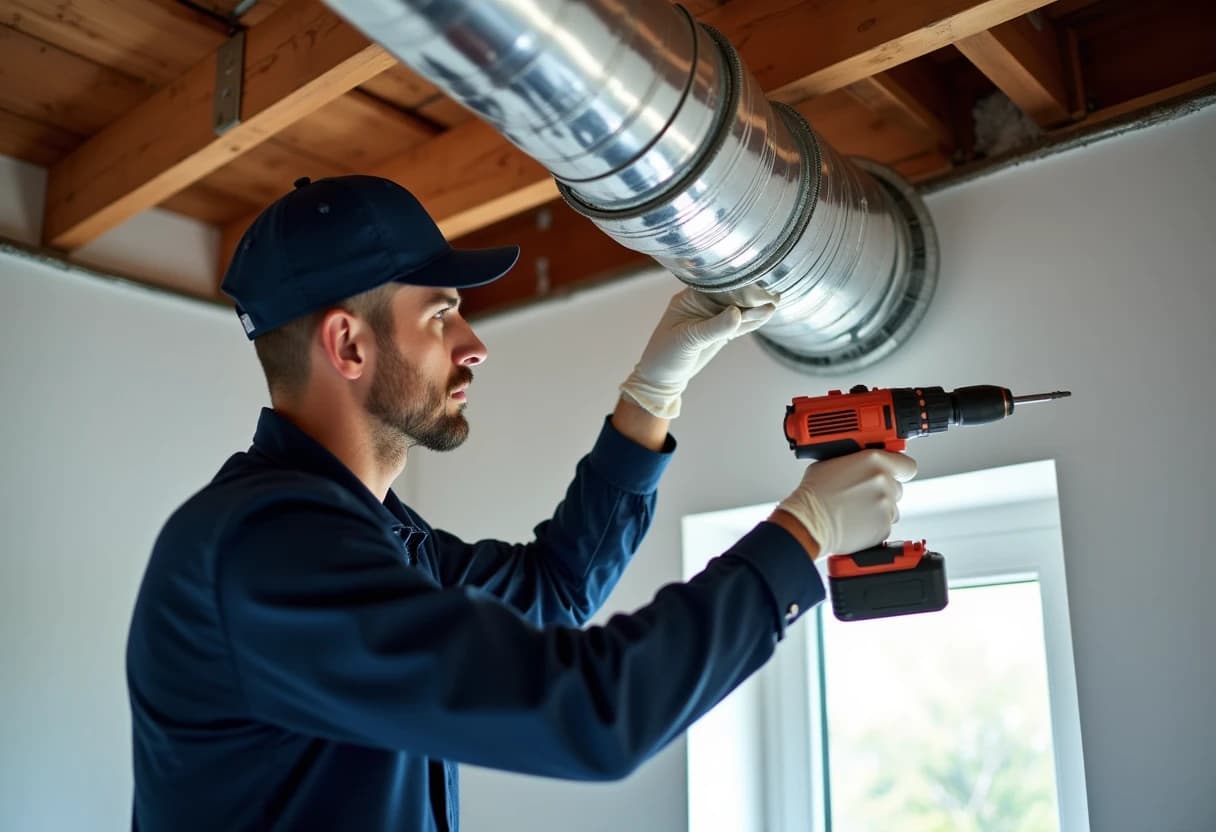
Some dryer vents cannot be cleaned or repaired into safety — they were never right to begin with. Runs assembled from vinyl or foil flex duct, routes that wander fifty feet through a basement, dryers venting into crawlspaces or garages, laundry areas with no vent at all: these call for installation, not maintenance. Our Littleton crews design and build code-compliant dryer exhaust systems from scratch — 4-inch smooth rigid metal duct, the shortest practical route to outdoors, joints without airstream-piercing screws, and a proper damper-equipped termination through the side wall, roof or rim joist. Priced flat from $300 to $900, finished in a day, and built to outlast the dryer itself.
Why Dryer Vent Installation & Rerouting Matters for Littleton Homes
Length is the invisible constraint most existing vents violate. A dryer is a modest blower pushing moist, fiber-laden air, and its reach is finite: the code's 35-foot equivalent-length budget shrinks fast when elbows are counted — a typical deduction of five feet per 90-degree bend and two and a half per 45 means a run with four corners has spent twenty feet of budget before its first straight section. Exceed the limit and physics takes over: airflow velocity drops below what carries lint, fibers settle in the duct, moisture condenses instead of exiting, and the system clogs on a schedule no cleaning interval can economically match. This is precisely the condition of countless Greater Boston vents, installed when the laundry moved but routed around, rather than through, whatever stood in the way. Rerouting solves it at the root. Our crews measure the true equivalent length, find the shortest legal path — often through a rim joist or closer wall the original installer ignored — and rebuild. Customers whose dryers limped for years routinely describe the result as getting a new appliance.
From the triple-deckers near Nagog Hill Orchards to the singles and capes out toward Long Lake, Littleton presents every dryer venting challenge in the catalog: interior laundry rooms far from exterior walls, below-grade basements where the only exit is the rim joist, and condo layouts that force roof terminations. Littleton mixes 18th- and 19th-century farmhouses around the Common with big waves of split-levels, garrisons and Colonials from the 1960s through the 1990s, plus newer cul-de-sac subdivisions near I-495. Most of the post-war stock was built with forced-air heat from day one, so ducts here are original equipment that has often gone thirty or forty years without a deep cleaning. We have built vents through all of it. Littleton's apple orchards, hayfields and heavily wooded lots mean seasonal pollen and field dust load up return ducts faster than homeowners expect. Homes drawing on well water and wooded septic lots also tend to run humid basements, and we frequently find musty odors traced to duct runs passing through those spaces. Because our shop is about 25 miles away in West Newton, site visits and installs schedule quickly — and most Littleton installations are complete, verified and cleaned up within a single day.
Our Dryer Vent Installation & Rerouting Process in Littleton
1Site Assessment & Route Planning
The technician maps what exists and what is possible: where the dryer sits (or will sit), which walls are exterior, what the framing and foundation allow, and where obstacles — plumbing, wiring, ductwork, finished ceilings — constrain the path. Shortest is best: fewer feet and fewer elbows mean faster drying and slower lint accumulation for the life of the system.
2Demolition of Non-Compliant Venting
Where the old route will be reused, we strip it to sound structure; where it is abandoned, we seal the redundant penetrations properly — foam and blocking inside, patched and flashed outside — so the old path does not remain as an air leak or pest entry. Clean removal is part of the installation, not an extra.
3Cut & Flash the Exterior Penetration
Roof terminations get roofing-grade treatment: shingles lifted and re-laid over proper flashing, a cap rated for dryer exhaust with a working damper, and sealant appropriate to the roofing material. We schedule roof penetrations for dry weather and verify water-tightness before leaving — a roof leak is not an acceptable side effect of a laundry upgrade.
4Install Rigid Metal Duct on the Planned Route
Where the route crosses unheated space — a cold basement, garage bay, attic run — we insulate the duct so exhaust stays above its dew point until it exits, which is the difference between a dry duct and a condensation problem in a Massachusetts winter. Concealed sections are completed and verified before any finishes close them in.
5Mount the Termination Hood & Damper
Termination choice is matched to the route: low-profile wall hoods for clapboard and shingle, masonry-mounted hoods for brick, rim-joist hoods for basement exits, and dedicated dryer roof caps — never plumbing-style caps — for vertical runs. Each is chosen for damper quality, because the damper is the moving part that determines how the termination survives New England weather.
6Connect the Appliance & Seal the System
Gas dryers are handled with the care the fuel demands: the flexible gas connector unstrained, the machine leveled and positioned, and the connection checked before operation. Electric units get cords routed clear of the duct. The appliance end is where good systems get ruined by casual reconnection, so we finish it to the same standard as the concealed run.
7Test, Verify & Document the Installation
Before we leave: work areas vacuumed with HEPA equipment, penetration debris removed, the dryer set and leveled, and a walkthrough of the finished system — where it runs, how the damper should look during a cycle, and when the first annual cleaning is due. A correctly built vent needs almost nothing from you; we make sure you know the little it does.
Benefits of Professional Dryer Vent Installation & Rerouting in Littleton
Fire-Safe by Design, Not by Vigilance
The safety margin compounds with maintenance: rigid duct is fully brushable, so every annual cleaning actually reaches every surface — something no cleaning can honestly claim on a corrugated flex run threaded through cavities. You are not just starting cleaner; you are cleanable, permanently.
A Laundry Located Where You Actually Want It
Proper vent design frees the floor plan: a second-floor laundry, a kitchen-adjacent closet, a finished-basement corner all become viable when the exhaust route is engineered rather than improvised. We tell you honestly which locations work within the length budget — and often find compliant routes that make the layout you wanted possible.
Dramatically Faster Drying
New high-efficiency dryers are especially sensitive to backpressure, and manufacturers condition warranties on adequate venting. Installing the vent right protects the appliance investment and lets its efficiency ratings actually materialize — a heat-pump or sensor dryer on a choked vent never performs to its label.
Decades of Service From a One-Day Job
Rigid metal duct, properly supported and sealed, is lifetime infrastructure: it does not kink, sag, melt or degrade, and it routinely outlasts several dryers. After installation day, the system's entire maintenance schedule is an annual cleaning and an occasional glance at the damper. Most homeowners never think about it again — which is the point.
Permanently Lower Energy Costs
A dryer that finishes in one cycle instead of two uses half the energy per load — a difference worth $10 to $20 a month to a busy household, recurring for the life of the system. Few building improvements have a payback mechanism this direct: the installation cost is fixed once, and the savings arrive with every laundry day after.
Moisture Managed, Structure Protected
For basement laundries — the Massachusetts default — proper installation is the difference between a dry basement and a damp one. Vents that dump into crawlspaces, leak at joints or condense in cold runs feed exactly the humidity and mold problems New England basements already fight; a correct rim-joist installation removes the dryer from that fight entirely.
Signs Your Littleton Home Needs Dryer Vent Installation & Rerouting
The Dryer Vents Indoors — Anywhere
Window inserts and condensation boxes marketed as 'indoor dryer vents' are not a solution for a standard vented dryer in a Massachusetts home; they are humidity machines. If one is in service in your laundry, a proper exterior route almost certainly exists — our assessment will find the shortest one and price it flat.
Inspection, Insurance or Association Requirements
Appliance warranties add quiet pressure: manufacturers condition coverage on adequate exhaust, and a warranty claim on a dryer connected to a non-compliant vent can be denied on that basis. If you are buying a premium machine, the few hundred dollars of proper venting is also warranty insurance.
The Run Is Overlong or Elbow-Heavy
Count the route: if your duct wanders more than roughly 25 linear feet, or turns more than three corners, it is likely past the code's 35-foot equivalent-length budget once elbows are deducted — typically five feet per 90-degree bend. Beyond the budget, the dryer physically cannot keep lint moving to the outlet, and chronic clogging is built in.
Your Vent Is Flexible Plastic or Foil Duct
A quick self-check: press gently on the visible duct. Rigid metal does not give; flex crumples. If any concealed portion of your run is flex, assume the hidden sections are in worse shape than the visible ones — they always are — and price the replacement before the blockage schedule prices it for you.
Blockages and Repairs Keep Recurring
Recurring appliance failures tell the same story from the other end: thermal fuses, heating elements and high-limit switches that fail repeatedly are a dryer protesting a duct it cannot push through. Each repair buys months. A rerouted, rigid, code-length run buys decades — and usually costs less than three appliance service calls.
A New Laundry Location Needs Its First Vent
New dryer purchases trigger the question too: installers deliver the machine but rarely build ductwork, and a new appliance connected to no vent — or a condemned one — sits unusable. If your delivery is scheduled, get the vent designed and installed ahead of it, so the first load runs the day the dryer arrives.
Dryer Vent Installation & Rerouting Cost in Littleton, MA
Dryer vent installation in Greater Boston typically runs $300 to $900, and the price is mostly the route. At the low end, $300 to $450: a straightforward side-wall or rim-joist installation with a short run — dryer near an exterior wall, one clean penetration, minimal duct. Mid-range, $450 to $650: longer routes with several elbows, full flex-to-rigid replacement along an existing path, insulation over unheated space, or masonry penetrations through brick or block foundation. The top of the range, $650 to $900: reroutes through finished space with access openings, roof terminations with proper flashing, relocations that move the laundry's exhaust across the floor plan, and multi-story routes in triple-deckers and condos. Every quote is flat and follows a site assessment — we measure the route, do the equivalent-length math, and price the specific design you approve. Materials are included: rigid metal duct, listed transition connector, clamps and foil tape, insulation where needed, and a quality damper-equipped termination hood.
Want the full pricing picture? See our complete Boston-area cost guide or call (617) 390-7145 for an exact flat quote for your Littleton home.
Local Knowledge: Littleton, Middlesex County
Serving Littleton means knowing Littleton. Littleton mixes 18th- and 19th-century farmhouses around the Common with big waves of split-levels, garrisons and Colonials from the 1960s through the 1990s, plus newer cul-de-sac subdivisions near I-495. Most of the post-war stock was built with forced-air heat from day one, so ducts here are original equipment that has often gone thirty or forty years without a deep cleaning. Littleton's apple orchards, hayfields and heavily wooded lots mean seasonal pollen and field dust load up return ducts faster than homeowners expect. Homes drawing on well water and wooded septic lots also tend to run humid basements, and we frequently find musty odors traced to duct runs passing through those spaces. Those conditions shape how we work here: which brush heads come off the truck, how we protect finishes in older interiors, and what we expect to find when the camera goes into a 01460 duct system. Our crews are in and around Littleton nearly every week — often for neighbors of past customers — so scheduling is fast and our arrival windows hold.
The Best Time of Year in Littleton
Renovation season drives our installation rhythm as much as weather does. Greater Boston remodels from spring through fall — basements finished, laundries moved upstairs, triple-deckers converted to condos — and every one of those projects needs dryer exhaust designed rather than improvised. The economics of timing are stark: venting planned at framing stage routes shorter, conceals cleaner and costs $200 to $400 less than the same run retrofitted after drywall. We take planning calls from homeowners and contractors all season, often walking a route in fifteen minutes that saves the project real money and the homeowner a decade of compromise. If your project touches the laundry — or could move it somewhere better — the cheapest vent you will ever build is the one designed before the walls close.
Why Choose Boston Air Duct Cleaners
As a West Newton-based company, we treat Littleton like the neighborhood it is — because for us, it is. Our reputation lives or dies on local referrals, so every job gets the full process: complete system cleaning under negative pressure, mechanical agitation of every run, blower compartment service, and a documented walkthrough before we leave. We are licensed and insured, our estimates are free and flat, and our schedule holds same-day slots for urgent calls. One visit and you will understand why neighbors keep our magnet on the fridge.
Serving Littleton and Surrounding Communities
Littleton sits in the heart of our service area, and neighboring Acton, Boxborough, Chelmsford, Carlisle, Concord, Bolton appointments share the same routes. That density is why our response times in this part of Middlesex County are among our fastest — and why you will see our trucks in the area week after week.