
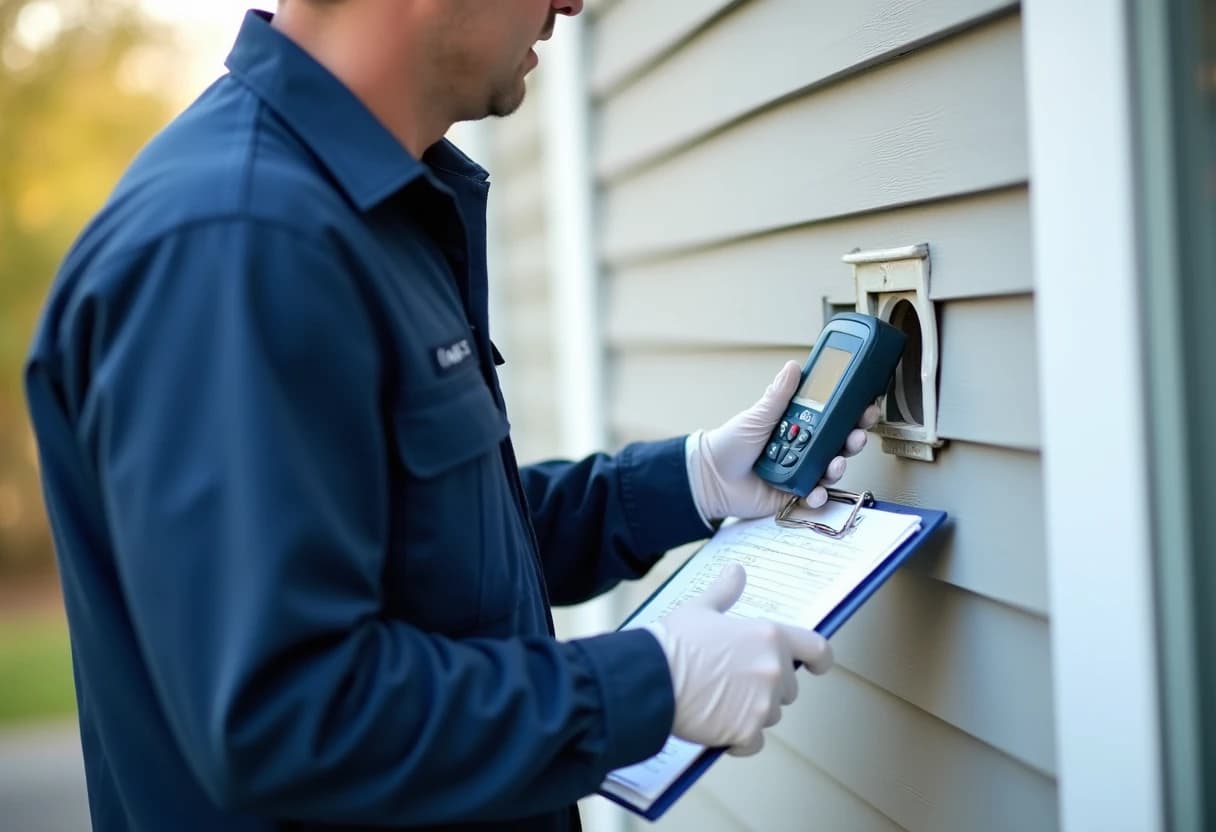
A dryer vent inspection is the fastest, cheapest way to answer a question every homeowner should be able to answer: is my dryer exhaust safe? Our Lincoln technicians measure airflow at the termination with a calibrated anemometer, run an inspection camera the full length of the duct, examine the exterior hood and damper, assess the lint load inside the run, and check the installation against the residential code rules that govern dryer ducts. You leave with a written safety report — photos, measurements and a clear verdict — instead of a guess. If the vent is clean and compliant, we tell you so and you are done for the year. If it needs work, you will know exactly what and why before spending a dollar on cleaning or repairs.
Why Dryer Vent Inspection & Safety Check Matters for Lincoln Homes
The dryer vent is the only exhaust duct in your home that moves flammable material by design. Every load sheds lint; the trap catches most of it, and the rest travels the duct — where some fraction sticks at every elbow, joint, screw tip and rough surface along the way. Whether that accumulation is trivial or dangerous depends on the duct's length, geometry, material and history, which is exactly what an inspection evaluates. The residential code (IRC M1502) exists because these variables matter: it specifies smooth rigid metal duct, limits runs to 35 feet of equivalent length with deductions for every elbow, and prohibits screws that protrude into the airstream because each protruding tip becomes a lint anchor. Many Massachusetts homes — especially older ones retrofitted with laundry in basements or upper floors — violate one or more of these rules, often invisibly inside walls. A camera inspection is the only practical way to find out, and a written report is the only way to prove the vent's condition to an insurer, a buyer or a condo board.
The Lincoln climate is quietly hard on dryer terminations. With more than a third of the town preserved as conservation land and working farms like Drumlin Farm and Codman Community Farms, Lincoln's air carries a real seasonal load of pollen, field dust and farm particulates that settles in return ducts. The flat-roofed modernist homes here also hide compact duct runs that are easy to neglect and tricky to access without experience. Wind-driven rain, coastal air and freeze-thaw cycles corrode hoods and stiffen damper flaps, and by late winter we routinely find Lincoln terminations that no longer open fully — or no longer close, inviting drafts and pests. Lincoln pairs 18th-century farmhouses and estate properties with one of the country's most significant concentrations of modernist homes, including the Gropius House and the mid-century enclaves inspired by it, all set on large conservation-minded lots. The modernist houses often use radiant slabs or unconventional duct layouts hidden in flat-roof assemblies, while the antique farmhouses carry delicate retrofit forced-air systems threaded through original timber frames. An annual inspection catches termination problems along with everything else: our checklist covers the hood, damper, exterior seal, duct interior, airflow volume, lint load and code compliance in one visit. Neighbors in Concord and Lexington book us for the same annual check, which keeps our trucks in the area and appointment windows short.
Our Dryer Vent Inspection & Safety Check Process in Lincoln
1Interview & Visual Assessment
Every inspection opens with a short conversation and a visual survey. Drying times, error codes, humidity in the laundry room and the age of the installation all steer the inspection. The technician checks the transition duct behind the dryer first — foil accordion duct and plastic flex are immediate findings, since both are recognized fire hazards.
2Airflow Measurement at the Termination
We quantify before we diagnose. An anemometer reading at the outside hood, taken while the dryer runs, measures delivered airflow against the benchmark a dryer needs to operate safely. Strong flow with a clean camera pass means a pass; weak flow tells us restriction exists and the camera's job is to find it.
3Full-Length Camera Inspection
This is the step no flashlight can replace: a camera pass of the complete exhaust run, wall cavities and ceiling sections included. You can watch live as it travels. Lint depth, joint condition, duct material transitions and any obstructions are recorded, and representative frames go into your written report as evidence for every finding.
4Termination Hood & Damper Check
The exterior hood gets a hands-on inspection — flap movement, spring tension, seal condition, evidence of pest entry, and clearance from grade and snow lines. New England weather is hard on terminations; corroded hinges and stuck dampers are among our most common findings, and both restrict airflow as effectively as a clogged duct.
5Lint-Load Assessment & Fire-Risk Scoring
We translate the inspection into a plain-English risk score. You will know approximately what percentage of the duct's cross-section remains open, where the worst accumulation sits, and how urgent intervention is. FEMA attributes roughly 2,900 dryer fires a year primarily to lint — the score tells you honestly where your vent stands relative to that risk.
6Code-Compliance Review
Code exists because dryer ducts start fires, so compliance is a safety checklist, not paperwork. The technician verifies duct material and diameter, tallies the equivalent length including elbow penalties, checks joint construction and fastening method, and confirms the termination is damper-equipped and screen-free. Each violation goes in the report with a photo and a recommended fix.
7Written Safety Report & Recommendations
Everything we measured and saw goes into a written safety report delivered the same day. Pass or fail, you have proof of the vent's condition — the document buyers ask for, insurers accept and associations require. If work is warranted, the report doubles as a precise scope, so any quote you gather is comparing the same job.
Benefits of Professional Dryer Vent Inspection & Safety Check in Lincoln
Lower Drying Costs & Longer Appliance Life
A restricted vent makes every load take longer, and longer cycles cost real money in electricity or gas — often hundreds of dollars a year in heavy-laundry households. Inspection catches restriction at the stage where a single cleaning restores one-cycle drying and normal operating costs.
Fire Risk Caught Before It Matters
You insure your house against fire for thousands a year; an inspection actively prevents the most preventable category of fire for a fraction of one premium payment. The camera and anemometer find what smoke detectors only react to — the hazard itself, while it is still just lint in a duct.
Hidden Code Violations Exposed
Many chronic lint problems are really installation problems: the duct violates length, material or fastening rules and will clog on schedule forever until corrected. The compliance review identifies the root cause, so you can stop paying to clean a duct that was built to fail.
A Written Report You Can Actually Use
Every inspection creates a baseline. Next year's airflow number is compared against this year's, which turns a single snapshot into a trend line — and trend lines catch developing problems that any single visit might reasonably pass. It is the difference between a photo and a medical history.
Protection From Moisture & Carbon Monoxide
Every load of laundry evaporates roughly a gallon of water, and all of it must exit through this one duct. Joints that separated inside a ceiling deliver that gallon into your structure instead. The camera pass finds hidden leaks that no exterior symptom would reveal until damage was done.
No Unnecessary Cleanings
Inspection-first service means you only pay for cleaning when measurement says the vent needs it. Short, efficient runs in some homes stay healthy for two or three years between cleanings; heavy-laundry households may need annual service. The instruments decide — not a calendar, and not a salesperson.
Signs Your Lincoln Home Needs Dryer Vent Inspection & Safety Check
No Visible Exhaust at the Outside Hood
Step outside while the dryer runs: you should see the damper held open by strong airflow and feel a confident stream of warm air. A flap barely moving — or not moving at all — means severe restriction or a stuck damper, and the system needs professional attention.
The Dryer or Laundry Room Feels Hot
Modern dryers protect themselves from restricted vents by cycling their high-limit switch — you experience this as a hot machine, lukewarm loads and mysteriously long cycles. The safety is working, but it was not designed for daily duty. An inspection identifies the restriction before the safety component fails.
You Cannot Remember the Last Service
New homeowners inherit the previous owners' laundry habits inside their duct. Unless the sellers produced a dated inspection report, the vent's condition is unknown — and unknown is exactly the wrong state for the home's most fire-prone duct. A move-in inspection resolves it for under $150.
Insurance, Condo or Sale Requirements
If your carrier, condo board or property manager has asked for proof of dryer vent maintenance, that is the sign — the requirement itself. Our written report is built to satisfy exactly these requests: dated, photographed, measured and signed, delivered after a single visit.
Recent Renovation, New Dryer or New Home
Renovations disturb dryer ducts constantly — runs get crushed by new framing, terminations get sided or painted over, and 'temporary' flex connections become permanent. If contractors have worked near your laundry area or exterior walls, an inspection verifies the exhaust path survived the project.
Clothes Take More Than One Cycle
When towels come out damp after a full cycle, most people blame the dryer and call an appliance tech. In our experience the appliance is usually fine — the exhaust path is not. A twenty-minute airflow measurement settles the question before you pay for a repair visit the machine never needed.
Dryer Vent Inspection & Safety Check Cost in Lincoln, MA
For real-estate and compliance uses, pricing stays in the same $79–$149 band with a few specifics. Pre-listing and pre-purchase inspections cost the same as annual ones and include transaction-ready documentation — dated report, photographs, airflow figures and code notes formatted for disclosure packages or inspection responses; rush scheduling for pending closings is usually possible within 48 hours. Condo associations and landlords booking multiple units in one visit receive per-unit pricing that steps down meaningfully with volume — a full triple-decker or small building costs far less per unit than three separate appointments. Annual-plan customers who book recurring inspections lock the current rate and receive reminder scheduling. If the inspection finds work: cleaning typically runs $129–$249 depending on the run, repairs are quoted flat from the camera findings, and nothing proceeds without your written approval. The inspection stands alone; everything beyond it is your decision made with the evidence in hand.
Want the full pricing picture? See our complete Boston-area cost guide or call (617) 390-7145 for an exact flat quote for your Lincoln home.
Local Knowledge: Lincoln, Middlesex County
What makes Lincoln different? Lincoln pairs 18th-century farmhouses and estate properties with one of the country's most significant concentrations of modernist homes, including the Gropius House and the mid-century enclaves inspired by it, all set on large conservation-minded lots. The modernist houses often use radiant slabs or unconventional duct layouts hidden in flat-roof assemblies, while the antique farmhouses carry delicate retrofit forced-air systems threaded through original timber frames. With more than a third of the town preserved as conservation land and working farms like Drumlin Farm and Codman Community Farms, Lincoln's air carries a real seasonal load of pollen, field dust and farm particulates that settles in return ducts. The flat-roofed modernist homes here also hide compact duct runs that are easy to neglect and tricky to access without experience. For duct and dryer vent systems, those local factors translate into specific, predictable problems — and predictable problems are the ones we solve fastest. Call (617) 390-7145, tell us your street and home style, and we will quote the job accurately the first time, usually in under five minutes.
The Best Time of Year in Lincoln
New England's housing stock gives dryer vents a distinctive seasonal biography. In the triple-deckers, capes and colonials that dominate Greater Boston, laundry migrated into basements and upper floors decades after construction, producing long runs through unheated spaces where every winter adds condensation cycles and every summer adds humidity. Many of these ducts also predate modern code — foil flex, excessive length, screened terminations — so seasonal stress lands on installations that were marginal to begin with. That is exactly why the annual inspection matters more here than in newer markets: the older and more improvised the run, the shorter the distance between 'fine last year' and 'hazard this year.'
Why Choose Boston Air Duct Cleaners
Homeowners across Middlesex County choose Boston Air Duct Cleaners for three reasons. First, honesty: our inspection camera tells you whether your system actually needs cleaning — and sometimes the answer is no. Second, capability: truck-grade negative-air machines, rotary brush systems and HEPA filtration handle everything from antique gravity-furnace conversions to brand-new high-velocity systems. Third, accountability: flat quoted pricing, before-and-after photos, insured technicians, and a real local office you can call at (617) 390-7145. That combination is rarer in this industry than it should be.
Serving Lincoln and Surrounding Communities
We serve every community around Lincoln as well: Concord, Lexington, Weston, Waltham, Sudbury, Wayland all fall inside our regular service routes. If you have a second property, a rental, or family nearby, ask about multi-home scheduling — grouped appointments on the same route are our most requested discount.