
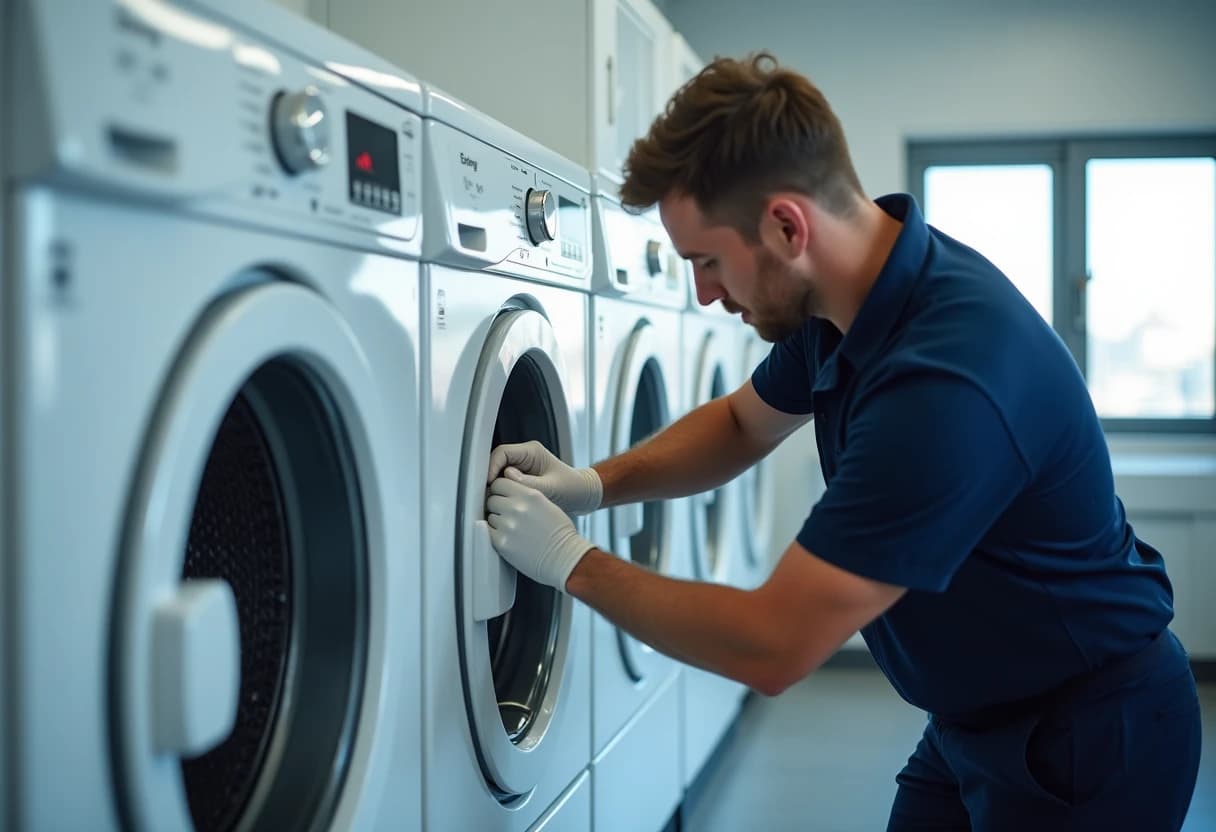
Lint is the most flammable substance most buildings produce daily, and dryer vents concentrate it precisely where heat lives. The National Fire Protection Association's data is blunt: failure to clean is the leading factor in home clothes dryer fires, and multi-family buildings carry the compounded exposure of many dryers behind one set of walls. Our Everett commercial program serves condominiums, apartment buildings, townhome HOAs, senior housing and laundromats with full-building vent cleaning: every run brushed and vacuumed end to end, terminations and dampers cleared and checked, hazardous transition ducts flagged, and airflow measured after cleaning. Boards get one flat proposal, residents get minimal disruption, and everyone gets the report that proves it happened.
Why Commercial & Multi-Unit Dryer Vent Cleaning Matters for Everett Homes
Insurance is increasingly the driver that gets this work scheduled. Master-policy underwriters for condominium associations and apartment owners have tightened attention on dryer venting because the loss data justifies it: lint fires are frequent, preventable and well-documented. Renewal questionnaires now routinely ask when vents were last professionally cleaned; some carriers request the report itself, and after a claim, the absence of maintenance records becomes part of the story an adjuster writes. Massachusetts associations have an added legal dimension — boards carry a duty to maintain common elements, and in many governing documents the vent duct beyond the unit's wall is exactly that. A documented cleaning program is inexpensive armor: dated per-unit reports, condition exceptions logged and disclosed to owners, hazards like prohibited transition ducts flagged in writing, and a recurring schedule that demonstrates ongoing diligence rather than a one-time response. We format our reporting for precisely these audiences — boards, managers, carriers and counsel — because in multi-unit work the paperwork is not an accessory to the service. It is half the service.
Everett property managers call us for three reasons more than any other: an insurance renewal questionnaire asking about vent maintenance, a resident complaint about two-cycle dry times, or a neighboring building's fire making the local news. Everett is wall-to-wall early-1900s triple-deckers and two-families on narrow lots, now punctuated by large new apartment buildings rising along lower Broadway and the Mystic waterfront near Encore. Unit-by-unit heating conversions are the norm in the older multifamilies, producing stacked, mismatched duct systems of very different ages inside a single building. Everett's industrial waterfront past and its position beside Route 16 and Route 99 traffic mean fine soot accumulates quickly in duct systems here. Landlords with multiple triple-decker units are among our steadiest Everett customers, often booking all floors of a building in one visit. All three end the same way — a coordinated building-wide cleaning with per-unit documentation. We handle resident scheduling and notices, clean every run with rotary brush and vacuum extraction, service the shared risers individual residents cannot reach, and deliver the report that closes the file. Most Everett buildings complete in a single visit of one to three days.
Our Commercial & Multi-Unit Dryer Vent Cleaning Process in Everett
1Building Walkthrough & Per-Unit Proposal
We scope before we quote: unit count and layout, vent configurations and lengths, termination locations and access (ladder, lift or roof), laundry room and common-area equipment, and any known problem units. Associations receive a fixed proposal with volume per-unit pricing, a project schedule with resident notice templates, and the reporting format agreed in advance so the board knows exactly what deliverable closes the project.
2Resident Coordination & Scheduling
Access is the hard part of multi-unit work, and we manage it for you. Our coordinator provides notice templates for management to distribute, builds a unit-by-unit schedule in efficient sequences, confirms time windows, and tracks completions and no-access units in real time. Buildings typically complete in one to three days, and residents are in their homes for minutes, not hours.
3Dryer-Side Service: Transition Duct & Connection
In each unit we pull the dryer, clean behind and beneath it — a major hidden lint reservoir — and service the transition duct between machine and wall. Foil accordion transitions, which manufacturers prohibit and which trap lint in every corrugation, are flagged and can be replaced on the spot with code-appropriate material. The connection is reseated and secured without airstream-penetrating screws, per code.
4Mechanical Cleaning of the Full Vent Run
The in-wall duct is cleaned end to end with rotary brush systems driven through the full run while a high-powered vacuum captures dislodged lint — the same agitation-plus-extraction principle as NADCA duct cleaning, sized for 4-inch dryer duct. Long runs and multiple elbows get repeat passes; the pass is complete when the brush returns clean and airflow verifies.
5Shared Risers, Common Trunks & Booster Fans
Stacked buildings route multiple dryers into shared vertical risers, and these common elements are where multi-unit lint risk concentrates — no resident can clean them, and every household loads them. We service risers from terminations and access points with vertical-run equipment, clean common horizontal trunks and basement manifolds, and service inline booster fans, whose blades cake with lint and quietly fail.
6Termination Service & Exterior Verification
We finish each run where the air does: at the outside wall or roof. The termination is cleaned, its flap or damper exercised and verified, screens and nests removed, and the exhaust confirmed to discharge outdoors — not into an attic, soffit or crawlspace, a dangerous and surprisingly common Massachusetts finding. Interior-terminating vents are documented as the priority hazards they are.
7Airflow Verification & Building Compliance Report
Each cleaned run gets a functional verification — airflow at the termination with the dryer running, or anemometer readings where equipment access allows — so the report records outcomes, not just activity. The building deliverable lists every unit: cleaned and verified, no-access, or exception, with photos of hazards and itemized repair recommendations. Boards file it; insurers accept it; renewals cite it.
Benefits of Professional Commercial & Multi-Unit Dryer Vent Cleaning in Everett
Longer Dryer Life & Fewer Appliance Failures
In buildings where management owns the machines — common laundry rooms, included-appliance rentals, laundromats — vent restriction is a direct capital cost: premature element, fuse and motor failures across the fleet. Regular vent service is fleet maintenance, and operators who adopt it consistently report fewer service calls and longer replacement cycles.
Volume Pricing That Beats Unit-by-Unit Service
A single-home dryer vent cleaning in Greater Boston runs $150–$250; on a coordinated building project, per-unit pricing drops steeply — often to a fraction of retail — because mobilization, travel and setup are shared across dozens of units. The building gets professional service in every unit for less than residents could ever arrange individually.
A Program, Not a Project
One-time cleanings decay; lint production never stops. An annual program keeps every run permanently inside its safe accumulation window, keeps documentation permanently current for insurers, and keeps the cost flat and predictable. Associations that institutionalize it typically spend less per year than their first catch-up cleaning cost — and never face a catch-up again.
Shorter Dry Times & Lower Utility Costs
Every minute of extra runtime is heat pushed against a clogged duct: wasted energy, elevated temperatures, and accelerated wear. Post-cleaning, residents notice loads finishing in one cycle again — the most tangible everyday benefit of the program and the one that quiets the steady trickle of 'my dryer is broken' maintenance tickets.
Directly Reduced Fire Risk, Building-Wide
Fire prevention in shared-wall housing is collective by nature: one blocked vent endangers the neighbors, and no resident can clean the common risers. A coordinated cleaning is the only mechanism that actually resets the whole building's risk — every run, every riser, every termination verified clear on the same dated report.
Insurance & Liability Documentation That Holds Up
Documentation converts maintenance into protection. The same cleaning, undocumented, protects the building physically but leaves the association exposed on paper. Our reports close that gap: scope, method, dates, per-unit outcomes and photographic evidence, delivered in a format managers file once and retrieve in minutes when the renewal questionnaire arrives.
Signs Your Everett Home Needs Commercial & Multi-Unit Dryer Vent Cleaning
Lint Visible at Terminations or on the Building Exterior
Lint beards on wall caps, gray fuzz on the siding below terminations, or lint scatter on the roof around stack outlets mean the ducts are so loaded they are extruding their contents. What escapes outside is the overflow; the accumulation inside the run is worse, and the affected units are drying against serious restriction.
Foil Accordion Ducts or Improvised Vent Runs in Units
Improvised venting accumulates in multi-unit buildings with every renovation and appliance swap: plastic flex hose, screw-joined sections snagging lint in the airstream (a specific code prohibition), runs far beyond the 35-foot equivalent-length intent once elbows are counted. A building-wide cleaning doubles as the survey that finally catalogs these conditions.
No One Can Say When Vents Were Last Cleaned
If the answer is not in the maintenance file, the answer is effectively never — and lint has been accumulating in every run and riser since installation or the last renovation. A building-wide baseline cleaning with per-unit documentation starts the clock properly and gives the association its first real picture of vent condition.
Insurance Questionnaires or Post-Incident Requirements
Post-incident requirements are the hard version of the sign: a fire or near-miss anywhere in the building, an adjuster's inquiry, or a fire-department visit that noted lint at terminations. At that point documentation is being demanded rather than recommended. The same program that would have prevented the scrutiny now becomes its resolution — start it either way.
Burning Smells, Hot Laundry Areas or Tripped Thermal Fuses
Thermal fuses and high-limit switches exist to interrupt exactly this failure, and their tripping is diagnostic: heat had nowhere to go. Repeated no-heat service calls on building machines are the venting system burning through safety margins. Clean the exhaust paths before the next component in that chain is the lint itself.
High-Duty Operations: Laundromats & Common Laundry Rooms
Commercial duty cycles compress the maintenance calendar: a laundromat dryer produces in weeks the lint a household machine makes in a year, loading manifolded ducts continuously. If your store has never set a cleaning interval matched to throughput, the venting is overdue by definition — quarterly service is typical for busy operations.
Commercial & Multi-Unit Dryer Vent Cleaning Cost in Everett, MA
Annual program pricing is where the economics get genuinely favorable. Buildings on our recurring schedule receive locked per-unit rates, priority booking in the spring and fall rush, and lighter-touch renewal cleanings — because a vent cleaned twelve months ago needs maintenance, not excavation, and we price the difference honestly. Most associations find the steady-state annual cost per door runs 20–30% below their first catch-up cleaning, which had years of accumulation to remove. Laundromats and common laundry rooms price by machine count and duty cycle rather than by unit: figure roughly $30–$60 per machine per visit at quarterly intervals for busy stores, with common manifolds and booster fans included in scope. Operators should weigh that against the other side of the ledger — gas waste from restricted exhaust, machine downtime, and element and fuse replacements — which for high-throughput stores routinely exceeds the cleaning cost on its own.
Want the full pricing picture? See our complete Boston-area cost guide or call (617) 390-7145 for an exact flat quote for your Everett home.
Local Knowledge: Everett, Middlesex County
Every town's ductwork tells the story of its housing. Everett is wall-to-wall early-1900s triple-deckers and two-families on narrow lots, now punctuated by large new apartment buildings rising along lower Broadway and the Mystic waterfront near Encore. Unit-by-unit heating conversions are the norm in the older multifamilies, producing stacked, mismatched duct systems of very different ages inside a single building. Everett's industrial waterfront past and its position beside Route 16 and Route 99 traffic mean fine soot accumulates quickly in duct systems here. Landlords with multiple triple-decker units are among our steadiest Everett customers, often booking all floors of a building in one visit. We plan Everett jobs around those realities, from equipment selection to time on site, and it shows in the results. If you live near Village district breweries or anywhere across Everett's 02149 area, we have almost certainly cleaned a system like yours before — and we can tell you exactly what to expect before we arrive.
The Best Time of Year in Everett
Budget season is the other calendar that matters. Condo boards and HOAs typically set budgets in fall for January fiscal years, and management companies batch portfolio maintenance into spring and fall windows — so the associations that get the best scheduling are the ones whose proposals are in hand before the budget meeting, not after the insurance renewal letter. Our walkthroughs and written building proposals are free and typically delivered within a week, which makes September the ideal month to price a program for board approval, October through November the prime execution window, and spring the natural slot for portfolio managers batching multiple properties. Insurance renewal dates deserve the same planning: a completed compliance report dated before the questionnaire arrives reads as a program; one dated after reads as a scramble. We calendar program buildings so the report always predates the renewal.
Why Choose Boston Air Duct Cleaners
Choosing a duct cleaner is really a trust decision — you are letting a crew work inside the system that feeds air to your family. We make that decision easy: a local West Newton company with insured, uniformed technicians, transparent flat-rate quotes, NADCA-standard equipment and methods, and photographic proof of the finished work. No door-to-door sales, no bait-and-switch coupons, no invented 'mold emergencies.' Just honest mechanical cleaning done properly the first time, backed by a written guarantee.
Serving Everett and Surrounding Communities
Beyond Everett, our crews cover the surrounding communities daily — including Chelsea, Malden, Medford, Somerville, Revere, Charlestown. Because routes cluster geographically, booking alongside a neighboring appointment often unlocks same-day service and combined-visit savings. Wherever you are in Middlesex County, the same flat-rate pricing, insured technicians and photo-documented process applies.