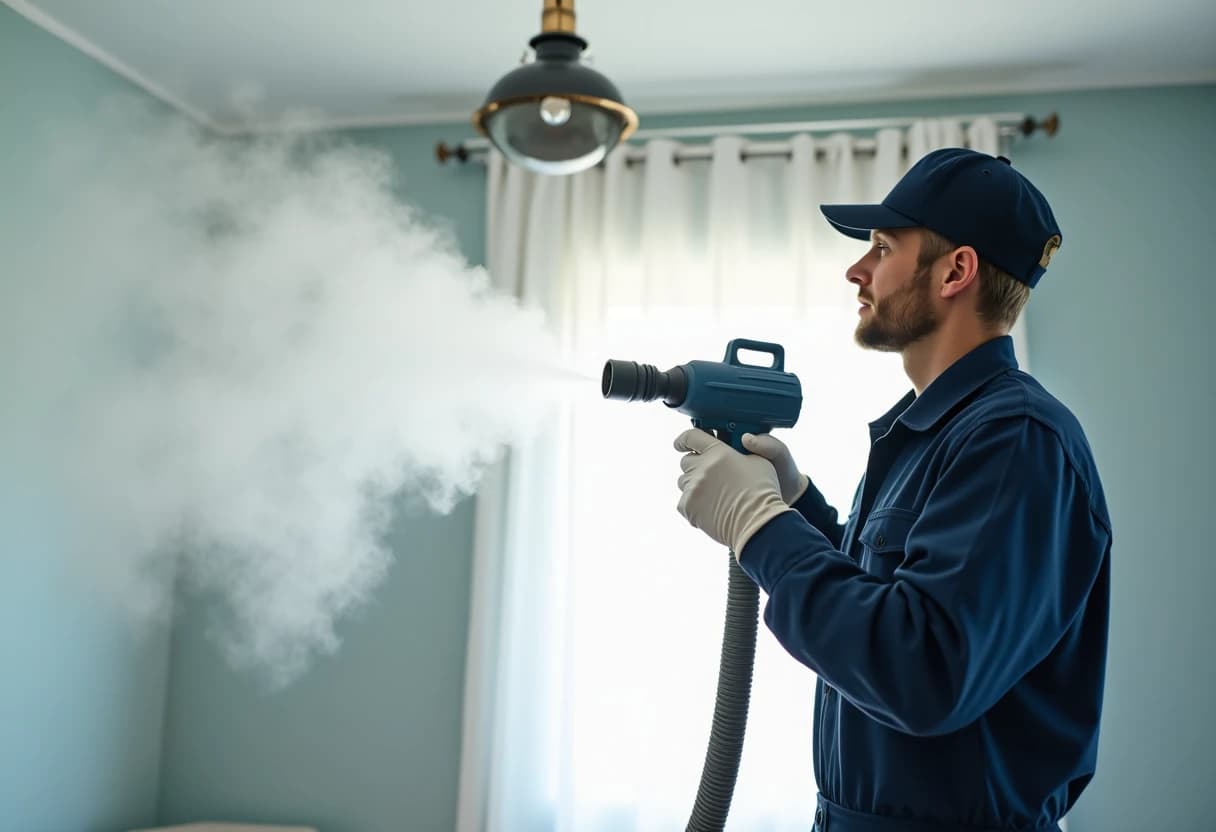
Some smells cannot be cleaned out of a house because they do not live in the house — they live in the air system. Pet odor, cigarette smoke, mustiness and that indefinable previous-owner smell bind to the organic film inside ductwork and re-release with every blower cycle, which is why they survive repainting, carpet replacement and every candle ever lit. Our Chelsea duct sanitizing and deodorizing service attacks the source: after a proper source-removal cleaning, we fog an EPA-registered antimicrobial through the entire air path, neutralizing odor-producing bacteria and residue on contact. The result is not a masking fragrance. It is a system reset to neutral, so your home finally smells like nothing at all.
Why Air Duct Sanitizing & Deodorizing Matters for Chelsea Homes
Pet households face duct odor mechanics that surface cleaning cannot beat. Dander is an aerosol: it rides the return airflow into the duct network, settles into the interior film, and accumulates for as long as the pet lives there — often across multiple pets and many years. The film becomes an odor reservoir with the system's full distribution reach, which is why the smell is strongest when the heat kicks on and why guests detect it instantly while residents have gone nose-blind. The same mechanism archives cigarette and cannabis smoke, cooking oils, and the general biological signature every household writes into its air system over time. When the home changes hands, the new owners inherit the archive. Source-removal cleaning strips the reservoir; EPA-registered fogging neutralizes the residue and the bacteria feeding on it; and the system stops broadcasting. For sellers, this pairing is one of the highest-leverage pre-listing investments available — showings live and die on the first thirty seconds of smell — and for buyers it is the cleanest possible start in a home with an unknown history.
Anyone who has spent a humid August near PORT Park knows the Chelsea basement smell — and in homes with forced-air systems, that smell rarely stays in the basement. Chelsea is one of the densest cities in Massachusetts, rebuilt largely in wood-frame triple-deckers and multifamily rows after the great fires of 1908 and 1973, now joined by modern apartment blocks in the Box District and along the waterfront. Many of the older multifamilies run separate compact forced-air or heat-pump systems per unit, with short duct runs that clog quickly in dense living conditions. Return leaks and duct runs through damp below-grade spaces pull musty air into the system, where it saturates the interior film and re-broadcasts upstairs all season. Chelsea sits beside Route 1, the Tobin Bridge and active Chelsea Creek fuel terminals, so airborne soot and diesel particulates settle into duct systems here faster than almost anywhere else we serve. Frequent cleaning makes a measurable difference for the many multi-generational households sharing tight quarters. Our cleaning-plus-sanitizing pairing removes the saturated film and neutralizes the biology behind the odor, which is why Chelsea mustiness calls are among our most satisfying jobs: the fix is genuinely complete.
Our Air Duct Sanitizing & Deodorizing Process in Chelsea
1Odor Assessment & Honest Qualification
We qualify the job before we book the fog. Odors that ride the airflow, spike at cycle start, or track the seasons implicate the system; odors independent of airflow usually do not. The assessment separates the two, checks for the moisture or contamination that sometimes underlies duct smells, and produces a flat written quote for exactly the work your situation supports.
2Source-Removal Cleaning First
EPA guidance is explicit that treatments belong on cleaned surfaces only, and our sequence honors it: full source-removal cleaning before any product is introduced. This is the honest-versus-theater divide in duct sanitizing. Fog through dirty ducts and the smell returns in weeks as bacteria recolonize the untouched film; clean first and the treatment bonds to bare metal, where it can actually work.
3Product Selection & Preparation
Only two kinds of products enter your air path: antimicrobials EPA-registered specifically for use in HVAC systems, and deodorizing counteractants formulated for duct application. No bleach, which corrodes ducts; no ozone shock treatments, which the EPA warns are ineffective at safe concentrations; no fragrance bombs that mask rather than neutralize. Dilutions follow the label exactly — that is what EPA registration means.
4Whole-System Antimicrobial Fogging
With the system freshly cleaned, the EPA-registered fog does its work at the surface level: contact-killing the bacteria that metabolize duct residue into odor, neutralizing the residual film chemically, and leaving an inhibiting layer that suppresses microbial regrowth. The application follows label contact times precisely — this is regulated chemistry applied to specification, not a scented mist waved through the vents.
5Coil, Drain Pan & Blower Treatment
The dampest components carry the strongest biology, so the air handler wet section gets direct treatment: evaporator coil surfaces, the drain pan and its trap, and the blower wheel and housing. Musty odors disproportionately originate here — a slimy pan or biofilmed coil can perfume an entire house — and treating the ducts while skipping the equipment leaves the source in place.
6Deodorizing Pass for Stubborn Odors
Smoke and heavy pet situations get a second, targeted pass with odor-counteractant chemistry — products that bind and neutralize odor molecules rather than perfume over them. Tobacco residue in particular clings aggressively to metal and re-releases for years; the counteractant pass addresses it specifically. This step is included when the assessment calls for it and skipped, with the price reflecting that, when it does not.
7System Airing, Verification & Walkthrough
We leave the system running clean and documented: registers remounted, a fresh filter installed on request, treatment records in your file, and honest guidance on what to expect — a faint clean-neutral note for a day or two as the treatment cures, then nothing. If the odor you hired us to kill ever returns in the following months, you call, we come back. That simple.
Benefits of Professional Air Duct Sanitizing & Deodorizing in Chelsea
Musty Summer Smell Broken for Good
The musty cycle is self-reinforcing: each humid season's growth adds residue that feeds the next season's growth. Breaking it requires actually removing the substrate, which is what the cleaning-plus-treatment pairing does. Homeowners who assumed the smell was 'just what old houses do' discover it was just what untreated ducts do — old houses smell fine with a neutral air path.
Smoke Ghosts Finally Evicted
If a home smelled of cigarettes at the showing and still does after renovation, the air system is the unrenovated room. Smoke rode the returns for years, coating the full duct network with residue no one ever addresses. Treating that network is routinely the missing piece that finally clears a smoker's house — and the step savvy buyers now negotiate into the purchase.
A True Reset for Newly Purchased Homes
The previous owners' pets, kitchen, tobacco and habits are archived in your duct film, replaying on every cycle. Cleaning plus sanitizing erases the archive — mechanically stripping the residue, then neutralizing the biology — so the house starts smelling like yours from day one. It is the single most-requested reason for this service, and the reviews it generates say 'finally smells like our home.'
Pet Odor Elimination That Actually Holds
Multi-pet and long-tenure pet households benefit most: the accumulation scales with animal-years, and no surface cleaning touches the duct-borne share. Post-treatment, the improvement compounds — ongoing dander still sheds, but it lands in a neutral system rather than layering onto decades of saturated film, and routine filter changes keep the new baseline for years.
Microbial Load Reduced System-Wide
After specific contamination events — pest activity in the ducts, confirmed mold, water intrusion — this benefit becomes the headline: droppings, spores and bloom residue carry genuine pathogen and allergen loads, and mechanical cleaning alone does not neutralize them. The EPA-registered treatment does, which is why sanitizing moves from optional to advised the moment contamination history enters the picture.
Small Add-On Cost, Outsized Payoff
Standalone treatments run $250 to $500; bundled with cleaning, the marginal cost drops by half or more. That pricing asymmetry is why we encourage odor-motivated customers to book the pairing — one visit, one setup, both halves of the fix. The alternative sequence, cleaning now and a separate sanitizing visit after the smell persists, costs more and delays the result.
Signs Your Chelsea Home Needs Air Duct Sanitizing & Deodorizing
Smoke History in the Home
If any era of the home's life included indoor smoking, the duct network carries the tar-and-nicotine film to prove it — and that film off-gasses for years, strongest on warm humid days when the residue softens. Paint and carpet replacement miss it entirely. Counteractant duct treatment is the step that finally clears a smoker's house.
You Just Bought the Home
An unknown air system is a reasonable default for sanitizing: you cannot see the duct film's history, and whatever the previous owners' household deposited — pets, smoke, cooking, dampness — is now on replay in your air. Between closing and move-in is the ideal window: empty rooms, open access, and a fresh biological baseline before your family breathes the system daily.
Guests Notice a Smell You No Longer Can
The cruelest version arrives during a home sale: buyers and agents smell in thirty seconds what you have not smelled in years, and it costs you at the negotiating table either way. Pre-listing duct sanitizing addresses the odor you cannot perceive at its distribution point — which is why experienced listing agents put it on the prep checklist.
After Pests, Mold or Water in the System
Water events prime duct systems for microbial bloom: damp film, warm darkness, abundant food. If your basement flooded, a pipe let go, or humidity ran uncontrolled for a season, sanitizing after cleanup suppresses the bloom before it establishes — cheaper and easier than the mold removal that established growth eventually demands.
Pets Present or Past
Allergy dynamics compound the odor case: duct-borne dander affects sensitive visitors and family members even when the smell is subtle. A treated system cuts both the odor and the circulating allergen load, which is why families expecting a new baby, hosting an allergic relative, or rehoming after a pet's passing all book this same service.
Musty Blast When the Heat or AC Starts
A damp, sour or dirty-sock note in the first minutes of a cycle, fading as the system runs, points to microbial activity on the coil, in the drain pan or along the duct film. It is most common in cooling season and after humid stretches. The pattern is diagnostic — and it is exactly what cleaning plus antimicrobial treatment eliminates.
Air Duct Sanitizing & Deodorizing Cost in Chelsea, MA
Budget by scenario. Bundled with a full cleaning — our most common configuration — sanitizing adds $75 to $200, putting the combined odor-elimination package at roughly $425 to $900 for typical single-family systems. Standalone treatment of a recently, verifiably cleaned system runs $250 to $400 for most homes, $400 to $500 for large or multi-zone systems. Smoke remediation adds $75 to $150 for the counteractant pass. What you should not pay for: 'sanitizing' quoted per vent at prices that balloon past these ranges, mandatory add-on treatments sold from scare photos, or ozone 'shock treatments' — the EPA warns ozone is ineffective against odor sources at safe concentrations and a respiratory irritant at effective ones, so it is a product we simply do not offer. Our quotes are flat, written and scoped to your actual odor situation after the assessment — and when the assessment says your system does not need sanitizing, the quote says that instead, which happens more often than the industry would like you to know.
Want the full pricing picture? See our complete Boston-area cost guide or call (617) 390-7145 for an exact flat quote for your Chelsea home.
Local Knowledge: Chelsea, Suffolk County
Serving Chelsea means knowing Chelsea. Chelsea is one of the densest cities in Massachusetts, rebuilt largely in wood-frame triple-deckers and multifamily rows after the great fires of 1908 and 1973, now joined by modern apartment blocks in the Box District and along the waterfront. Many of the older multifamilies run separate compact forced-air or heat-pump systems per unit, with short duct runs that clog quickly in dense living conditions. Chelsea sits beside Route 1, the Tobin Bridge and active Chelsea Creek fuel terminals, so airborne soot and diesel particulates settle into duct systems here faster than almost anywhere else we serve. Frequent cleaning makes a measurable difference for the many multi-generational households sharing tight quarters. Those conditions shape how we work here: which brush heads come off the truck, how we protect finishes in older interiors, and what we expect to find when the camera goes into a 02150 duct system. Our crews are in and around Chelsea nearly every week — often for neighbors of past customers — so scheduling is fast and our arrival windows hold.
The Best Time of Year in Chelsea
Winter changes the odor equation by sealing the laboratory. From November through March, Massachusetts houses close tight, ventilation drops to mechanical minimums, and the blower runs hours daily — so whatever the duct film holds is recirculated and concentrated through the very months the household spends most indoors. Pet and smoke odors that summer's open windows diluted become suddenly, embarrassingly prominent by January. This is why mid-winter odor calls are among our most urgent-sounding, and why the pre-season treatment is worth disproportionately more than the same service in April: sanitize in fall, and the five sealed months circulate neutral air; wait, and the sealed months amplify the problem while you live inside it.
Why Choose Boston Air Duct Cleaners
What separates us from the coupon crowd is simple: we do the whole job, we prove it, and we charge what we quoted. Our technicians clean supplies, returns, trunks and blower compartments on every visit — never a cosmetic vent wipe. Photo documentation comes standard, pricing is flat and confirmed up front, and our trucks carry true commercial vacuum equipment, not rented shop-vacs. Based in West Newton and serving Chelsea year-round, we answer our own phone at (617) 390-7145 and stand behind every cleaning with a satisfaction guarantee.
Serving Chelsea and Surrounding Communities
We serve every community around Chelsea as well: Everett, Revere, East Boston, Charlestown, Winthrop, Malden all fall inside our regular service routes. If you have a second property, a rental, or family nearby, ask about multi-home scheduling — grouped appointments on the same route are our most requested discount.