
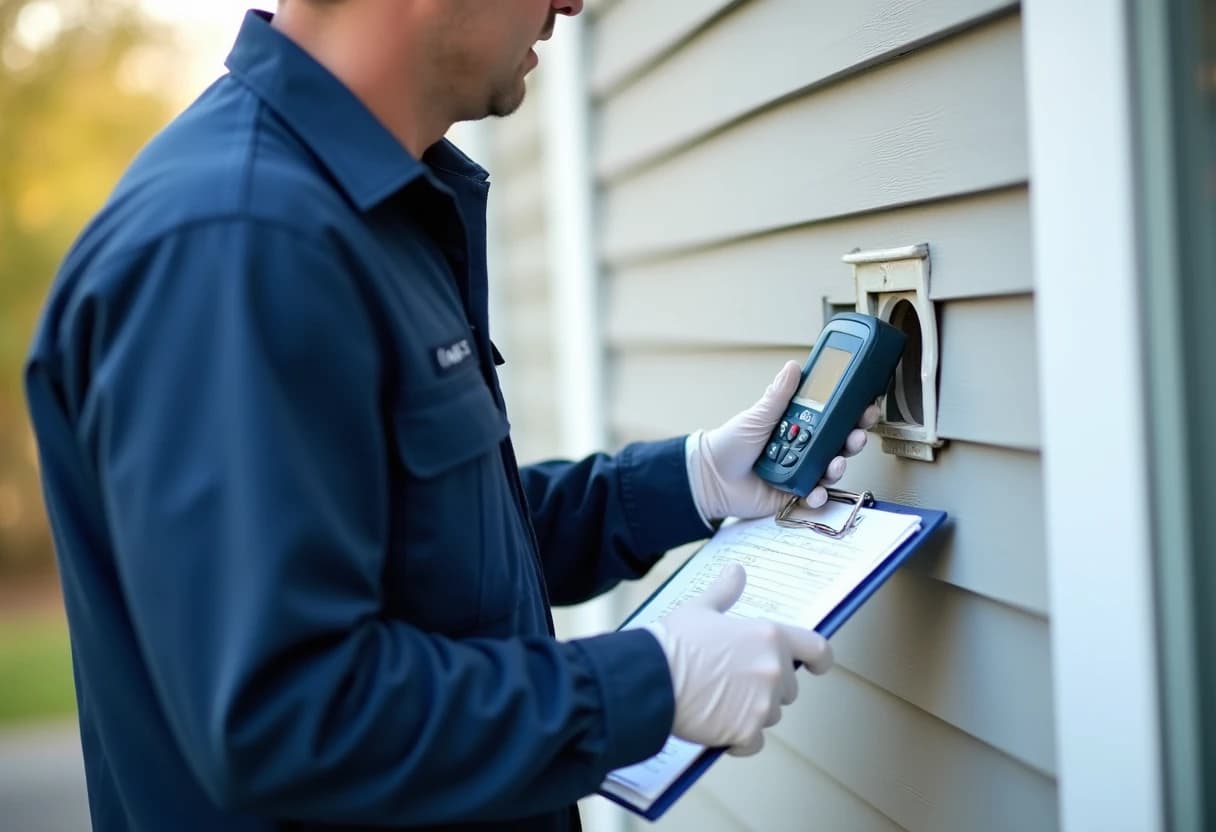
FEMA estimates around 2,900 home clothes dryer fires occur in the United States every year, and failure to clean the vent is the leading contributing factor. The trouble is that the danger is invisible: the lint that matters is not in the trap you clear after each load, it is packed inside the wall, ceiling or crawlspace duct you never see. Our Canton dryer vent inspection makes the invisible visible. A camera travels the entire exhaust run from the dryer connection to the outdoor termination, airflow is measured and compared against healthy benchmarks, and every finding is documented in a written report you can act on, file with your insurer, or hand to a home buyer.
Why Dryer Vent Inspection & Safety Check Matters for Canton Homes
The dryer vent is the only exhaust duct in your home that moves flammable material by design. Every load sheds lint; the trap catches most of it, and the rest travels the duct — where some fraction sticks at every elbow, joint, screw tip and rough surface along the way. Whether that accumulation is trivial or dangerous depends on the duct's length, geometry, material and history, which is exactly what an inspection evaluates. The residential code (IRC M1502) exists because these variables matter: it specifies smooth rigid metal duct, limits runs to 35 feet of equivalent length with deductions for every elbow, and prohibits screws that protrude into the airstream because each protruding tip becomes a lint anchor. Many Massachusetts homes — especially older ones retrofitted with laundry in basements or upper floors — violate one or more of these rules, often invisibly inside walls. A camera inspection is the only practical way to find out, and a written report is the only way to prove the vent's condition to an insurer, a buyer or a condo board.
Condo and multi-family living shapes dryer safety in Canton more than most owners realize. Canton mixes Victorian and early-1900s homes near Canton Center with large tracts of 1960s-1980s colonials and split-levels, plus a wave of newer townhouse and apartment construction around Canton Junction and the Route 138 corridor. The commuter-rail neighborhoods have seen heavy renovation, and many mid-century homes here run long basement trunk ducts that collect decades of debris. In triple-deckers and converted buildings, dryer ducts often run long distances through shared walls and ceilings to reach an outside face, and the termination may be three stories up where nobody has looked at it in years. Homes bordering the Blue Hills Reservation and Ponkapoag Pond deal with heavy seasonal pollen and damp, wooded lots that keep basements humid - a combination that feeds mold in unlined ductwork. Canton's corporate parks off Royall Street also give us regular commercial duct and rooftop-unit work. Association boards across Norfolk County increasingly require documented dryer vent verification for exactly this reason — one unit's neglected duct is every unit's fire risk. Our inspection reports are formatted for board and property-manager submission: photos, airflow numbers, code notes and a dated finding for each unit, delivered after a single visit.
Our Dryer Vent Inspection & Safety Check Process in Canton
1Interview & Visual Assessment
We start by listening: how long do loads take, has anything changed, when was the vent last cleaned, any moisture or odor issues? Then the technician examines the laundry area — dryer position, transition duct type and condition, visible connections — because the interview and the first look often predict exactly what the instruments will find.
2Airflow Measurement at the Termination
We quantify before we diagnose. An anemometer reading at the outside hood, taken while the dryer runs, measures delivered airflow against the benchmark a dryer needs to operate safely. Strong flow with a clean camera pass means a pass; weak flow tells us restriction exists and the camera's job is to find it.
3Full-Length Camera Inspection
The camera answers the question the airflow number raises. We feed it the full length of the duct, documenting interior condition foot by foot: where lint is packing, whether joints have pulled apart inside the wall, whether a previous installer used screws or materials the code prohibits. Nothing in the run stays hidden or hypothetical.
4Termination Hood & Damper Check
We check the exit as carefully as the run. A damper that will not open steals airflow; one that will not close invites cold air, moisture and animals. We also flag code and safety issues here: mesh screens that catch lint, terminations too close to openings or grade, and hoods damaged by weather or renovation work.
5Lint-Load Assessment & Fire-Risk Scoring
Combining the camera footage and airflow numbers, we score the system's lint load: how much fuel the duct is carrying and how fast it is accumulating based on household laundry volume. This converts raw findings into a clear risk statement — fine for now, clean this season, or clean immediately — with the evidence attached.
6Code-Compliance Review
We review the installation against the residential mechanical code for dryer exhaust: smooth rigid metal duct (not foil or plastic flex in concealed runs), a maximum of 35 feet equivalent length with deductions for each elbow, no screws penetrating the airstream, proper termination with a backdraft damper and no screen. Violations are photographed and explained.
7Written Safety Report & Recommendations
You receive a dated written report: airflow measurement, camera findings with photos, termination condition, lint-load score, code observations and a clear recommendation. It is formatted for practical reuse — insurance files, condo boards, real-estate disclosures — and it establishes the baseline every future annual inspection is compared against.
Benefits of Professional Dryer Vent Inspection & Safety Check in Canton
Hidden Code Violations Exposed
Code review matters most at transactions. A non-compliant vent discovered by a buyer's inspector becomes a negotiation weapon; the same finding surfaced by your own inspection becomes a controlled, competitively priced repair. Knowing first is worth far more than the inspection fee.
A Written Report You Can Actually Use
The report is the product: dated, photographed, measured. Homeowners file it with insurance records, sellers attach it to disclosures, landlords and condo boards accept it as compliance documentation, and buyers use it to negotiate or verify. A verbal 'looks fine' from a handyman does none of those jobs.
Protection From Moisture & Carbon Monoxide
Gas dryer owners get an extra layer of safety from inspection: the same duct carrying lint and moisture carries combustion exhaust. Verified airflow and a tight, intact run mean carbon monoxide leaves the house completely — a check that takes minutes and covers a risk most homeowners never consider.
Lower Drying Costs & Longer Appliance Life
Dryers fail early for one dominant reason: heat stress from poor exhaust. High-limit switches, thermal fuses and heating elements all die young in restricted systems. An annual inspection keeps the appliance operating within its design envelope, which routinely doubles the useful life of components that cost $150+ per repair visit.
Real-Estate & Insurance Documentation
Condo associations and landlords in Massachusetts are steadily adding dryer vent verification to their maintenance requirements after well-publicized multi-family lint fires. Our per-unit reports satisfy property managers and boards in one visit, with scheduling built for buildings — multiple units, one appointment block, individual documentation.
Fire Risk Caught Before It Matters
The roughly 2,900 dryer fires U.S. homes suffer each year share a common history: a restriction that built silently for years. Annual inspection breaks that pattern by catching declining airflow and accumulating lint at the measurement stage — years before the ignition stage. It is the cheapest intervention in fire prevention.
Signs Your Canton Home Needs Dryer Vent Inspection & Safety Check
You Cannot Remember the Last Service
New homeowners inherit the previous owners' laundry habits inside their duct. Unless the sellers produced a dated inspection report, the vent's condition is unknown — and unknown is exactly the wrong state for the home's most fire-prone duct. A move-in inspection resolves it for under $150.
No Visible Exhaust at the Outside Hood
Step outside while the dryer runs: you should see the damper held open by strong airflow and feel a confident stream of warm air. A flap barely moving — or not moving at all — means severe restriction or a stuck damper, and the system needs professional attention.
Clothes Take More Than One Cycle
Two cycles to dry a normal load is the classic symptom of a restricted vent. The dryer produces the same heat as always — the moisture simply has nowhere to go, so it recirculates through the drum. An inspection will measure exactly how much airflow the duct is stealing.
Recent Renovation, New Dryer or New Home
A new dryer on an old duct is a mismatch worth checking: modern high-efficiency machines are sensitive to back pressure, and installers rarely camera the existing run. Manufacturers void heat-related warranty claims on restricted vents, so a post-install inspection protects a four-figure appliance for a two-figure fee.
The Dryer or Laundry Room Feels Hot
Modern dryers protect themselves from restricted vents by cycling their high-limit switch — you experience this as a hot machine, lukewarm loads and mysteriously long cycles. The safety is working, but it was not designed for daily duty. An inspection identifies the restriction before the safety component fails.
Insurance, Condo or Sale Requirements
Multi-family buildings across Massachusetts are adding periodic dryer vent verification to bylaws after highly publicized lint fires in stacked-laundry buildings. If a notice has landed in your mailbox, we handle single units and whole buildings, with per-unit documentation the board can file.
Dryer Vent Inspection & Safety Check Cost in Canton, MA
For real-estate and compliance uses, pricing stays in the same $79–$149 band with a few specifics. Pre-listing and pre-purchase inspections cost the same as annual ones and include transaction-ready documentation — dated report, photographs, airflow figures and code notes formatted for disclosure packages or inspection responses; rush scheduling for pending closings is usually possible within 48 hours. Condo associations and landlords booking multiple units in one visit receive per-unit pricing that steps down meaningfully with volume — a full triple-decker or small building costs far less per unit than three separate appointments. Annual-plan customers who book recurring inspections lock the current rate and receive reminder scheduling. If the inspection finds work: cleaning typically runs $129–$249 depending on the run, repairs are quoted flat from the camera findings, and nothing proceeds without your written approval. The inspection stands alone; everything beyond it is your decision made with the evidence in hand.
Want the full pricing picture? See our complete Boston-area cost guide or call (617) 390-7145 for an exact flat quote for your Canton home.
Local Knowledge: Canton, Norfolk County
Serving Canton means knowing Canton. Canton mixes Victorian and early-1900s homes near Canton Center with large tracts of 1960s-1980s colonials and split-levels, plus a wave of newer townhouse and apartment construction around Canton Junction and the Route 138 corridor. The commuter-rail neighborhoods have seen heavy renovation, and many mid-century homes here run long basement trunk ducts that collect decades of debris. Homes bordering the Blue Hills Reservation and Ponkapoag Pond deal with heavy seasonal pollen and damp, wooded lots that keep basements humid - a combination that feeds mold in unlined ductwork. Canton's corporate parks off Royall Street also give us regular commercial duct and rooftop-unit work. Those conditions shape how we work here: which brush heads come off the truck, how we protect finishes in older interiors, and what we expect to find when the camera goes into a 02021 duct system. Our crews are in and around Canton nearly every week — often for neighbors of past customers — so scheduling is fast and our arrival windows hold.
The Best Time of Year in Canton
Massachusetts winters stress the exhaust side of a dryer in ways most owners never see. Warm, moist exhaust meeting sub-freezing duct sections condenses, and that condensation turns dry lint into wet mats that cling and clog. Terminations ice up; damper flaps freeze shut overnight and get forced by the morning's first load; snow drifts bury low wall hoods entirely. A mid-winter inspection is often the year's most revealing one — we routinely find seasonal blockages that did not exist in September. If drying times slow every January in your house, that pattern itself is a finding worth investigating.
Why Choose Boston Air Duct Cleaners
Boston Air Duct Cleaners is a local, owner-operated company based at 1121 Washington St in West Newton — not a national franchise dispatching subcontractors. Every crew is our own: background-checked, factory-trained on commercial negative-pressure equipment, and fully insured. We quote flat prices before work begins, document every job with before-and-after photos, and follow NADCA-standard source-removal methods on every system we touch. That is why so much of our work comes from repeat customers, property managers and word-of-mouth referrals across Norfolk County.
Serving Canton and Surrounding Communities
We serve every community around Canton as well: Stoughton, Sharon, Norwood, Westwood, Milton, Randolph all fall inside our regular service routes. If you have a second property, a rental, or family nearby, ask about multi-home scheduling — grouped appointments on the same route are our most requested discount.