
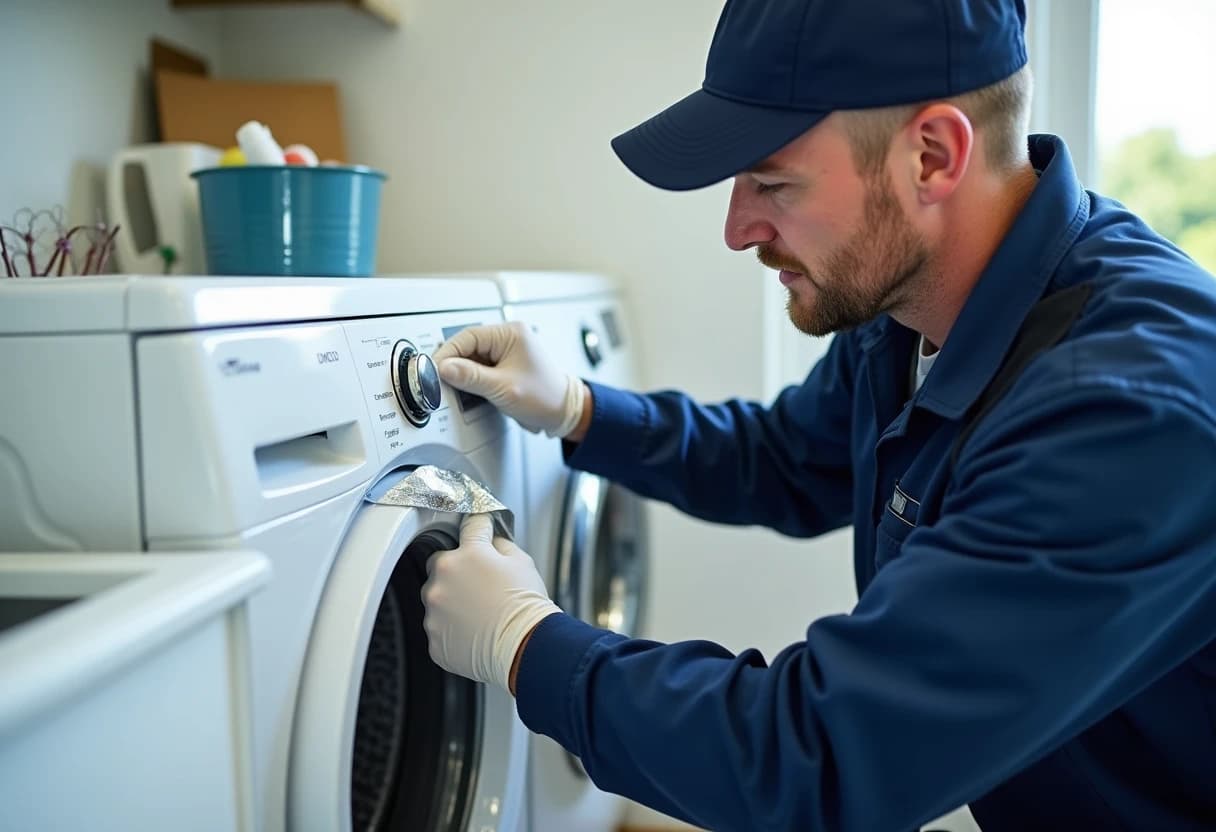
When a dryer vent leaks, the evidence shows up everywhere except the duct: lint drifting from a basement ceiling, a musty smell in the wall behind the laundry, moisture stains spreading across drywall, drying times that no cleaning improves. Our Belmont technicians diagnose the actual failure — a joint that separated, a section crushed during a renovation, a transition hose flattened behind the dryer, a hood damper wedged open or shut — and repair it properly with rigid metal duct, mechanical fastening and sealed seams. Most repairs finish the same visit, and we verify the result the only way that counts: strong, complete airflow at the exterior termination with the dryer running.
Why Dryer Vent Repair Matters for Belmont Homes
Condensation problems deserve their own diagnosis, because they mimic other failures and defeat simple cleaning. The physics: dryer exhaust leaves the drum warm and nearly saturated with moisture. If the duct passes through a cold basement, garage, crawlspace or attic — as most retrofitted Massachusetts laundry runs do — the exhaust cools below its dew point and water condenses inside the duct. The consequences cascade: condensate soaks passing lint into heavy mats that block the line; pooled water corrodes galvanized duct from the inside until pinholes leak onto ceilings; water drains backward through joints and drips behind the dryer; and in the worst winter cases, condensate freezes at the termination and seals the vent entirely. The repairs are specific and effective: restore continuous slope so water drains outward, seal the joints it has been escaping through, insulate the cold duct sections, shorten or reroute runs where the design is hopeless, and replace corroded segments. Guessing at it wastes money; our inspection identifies which combination your vent actually needs.
Winters around Belmont are hard on dryer vents in ways warmer regions never see. Belmont's 'Town of Homes' housing is being renovated at a furious pace, and we constantly clear plaster and sanding dust from duct systems after kitchen and bath remodels near Cushing Square. The town's mature street trees are beautiful, but their spring pollen load is heavy, and attic air handlers pull it in through every gap in old returns. Exhaust moisture condenses and freezes in duct sections crossing cold basements and exterior walls, dampers ice shut, and snow buries grade-level hoods. Belmont is famous for its early-1900s two-family homes marching up from Waverley and Cushing Squares, alongside handsome brick Tudors and colonials on Belmont Hill. Nearly all of it was built for steam or hot-water radiators, so the central air that most owners have since added lives in retrofit duct runs - attic systems, high-velocity mini-ducts and closet chases that need careful, low-pressure cleaning methods. Those homes often route vents through the coldest parts of the structure, which is why our Belmont condensation repairs so often involve insulating and re-sloping duct in unheated space. We fix the winter failure and the design weakness behind it, so the same problem does not return with the next cold snap.
Our Dryer Vent Repair Process in Belmont
1Diagnose the Full Exhaust Path
Your technician maps the vent's routing, materials and condition: transition hose state, joint integrity, crush points, sag, corrosion, termination function. Where the run is concealed, airflow measurements and inspection tools tell us what the walls hide. You get a photographed diagnosis and a flat repair quote before any work begins.
2Protect the Area & Open Access
Before repair work, we protect floors and finishes along the work path, move the dryer out carefully on sliders, and set up at the failure points. Where a concealed joint requires access, we discuss options first — many repairs can be made from existing openings, and when cutting is unavoidable we keep openings minimal and tell you exactly what restoration will involve.
3Reconnect & Properly Fasten Separated Joints
We do not just push a failed joint back together; we rebuild it so it cannot fail the same way. That means cleaning mating surfaces, correcting the misalignment or unsupported weight that pulled the joint apart, adding hangers or strapping where the run lacked support, and sealing the finished connection against both air and moisture leakage.
4Replace Crushed, Corroded or Non-Compliant Sections
Replacement is also the moment to correct design faults we find: a kink where two sections meet at a bad angle becomes a pair of smooth elbows; an unsupported span gets hangers; an oversized or undersized segment is brought back to uniform 4-inch diameter so airflow stops tumbling at transitions. We fix what failed and what made it fail.
5Cure Condensation: Slope, Seal & Insulate
Moisture-damaged components are replaced as part of the cure: corroded duct sections, rusted clamps, sodden insulation. We also check the termination damper, since a flap frozen or stuck partly shut is a common hidden cause of the backpressure that drives moist exhaust out through joints in the first place.
6Repair or Replace the Exterior Hood & Damper
The new hood is sealed to the wall correctly: fastened to siding or masonry, flashed and caulked so wind-driven rain stays out of the wall assembly, with the duct connection sealed inside. On brick and stone, we drill and anchor rather than improvise; on clapboard, we integrate with the siding plane. The termination should outlast the roof.
7Replace the Transition Duct & Reset the Dryer
The appliance connection is rebuilt to spec: a UL-listed semi-rigid aluminum transition duct, as short and straight as the layout allows, secured with clamps at both ends. We position the dryer so the connector keeps its full diameter — not crushed against the wall — and mark the safe distance so future pushes do not recreate the old kink.
8Verify Airflow & Document the Repair
The proof is at the hood: with the dryer running, the damper should stand fully open under a strong, steady exhaust stream. We verify it together, compare against the pre-repair condition, and confirm no leakage remains at any repaired joint. Then the work area is cleaned, the dryer set, and the laundry room returned to service.
Benefits of Professional Dryer Vent Repair in Belmont
Pest Entry Points Closed
We remove existing nesting material as part of termination repair and clean the affected duct section, because a nest is both a blockage and a sanitation issue in an airstream that passes your clothing. The new hood's pest protection is chosen to exclude animals without the lint-trapping mesh that code prohibits.
A Serious Fire Hazard, Eliminated
Code-compliant materials are themselves a safety upgrade: smooth rigid metal resists lint accumulation, clamped joints hold under heat and vibration, and a proper termination keeps nesting animals from plugging the line. A repaired vent is not just fixed — it is a fundamentally lower-risk system than what it replaces.
Lower Energy and Repair Bills
Blocked and breached vents are behind a large share of dryer service calls: blown thermal fuses, burned heating elements, failed high-limit switches. Each is a $150 to $400 appliance visit that recurs until the vent is fixed. One proper duct repair typically costs less than two of those visits and ends the cycle.
Decades of Reliable Service From One Repair
Repairs also make every future cleaning better: smooth interiors let rotary brushes work at full effectiveness, sealed joints keep the vacuum's suction where it belongs, and a free-swinging damper lets technicians verify airflow honestly. You are not just fixing today's failure — you are buying easier maintenance forever.
Moisture Out of Your Walls and Ceilings
Every load of laundry exhausts about a gallon of water. A repaired, sealed vent delivers all of it outdoors; a leaking one delivers it into insulation, framing and drywall. Stopping that daily soaking is the benefit homeowners feel longest — no more spreading stains, peeling paint, mildew odors or the mold remediation bills that chronic wall moisture eventually writes.
Code Compliance & Inspection-Ready Documentation
Compliance is not paperwork for its own sake; each code provision encodes a failure the industry learned about the hard way. Smooth interiors resist lint. Clamped joints survive heat. Unscreened dampers do not mat over. A to-code vent is simply a vent engineered not to fail the common ways.
Signs Your Belmont Home Needs Dryer Vent Repair
Lint Appearing Where It Shouldn't
Lint drifting from a basement ceiling, gathering on joists, puffing from a wall register or collecting behind the dryer means exhaust is escaping the duct before the termination. Lint marks the leak like dye in water — follow it and you find the separated joint or breach. This is a repair call, not a cleaning call, and it should not wait.
Slow Drying That Cleaning Didn't Fix
If a vent cleaning did not restore drying performance, the airflow restriction is structural: a crushed section, a collapsed inner liner, a separated joint dumping exhaust short of the hood, or a damper that cannot open. The next step is diagnosis, not another cleaning — we trace the path, find the mechanical fault, and quote its repair flat.
Visibly Damaged, Kinked or Sagging Duct
Trust your eyes: a transition hose flattened behind the dryer, a dented or crushed section in the basement, duct sagging between supports into a low belly, or a run held together with fabric duct tape are all failures in progress. Each restricts airflow, collects lint and moisture, and worsens with time. Photograph what you see and call — the quote is quick.
Exterior Damper Broken, Stuck or Missing
Evidence of animals — chirping in the duct, nesting material at the hood, droppings near the vent line — means the termination has already failed as a barrier. We remove the nest, clean the affected duct, and install a hood with real pest protection. Spring is nesting season; the repair is best made before it.
Water Stains, Drips or Peeling Paint Near the Vent Path
Condensation drips are easy to misattribute to plumbing. The tell is timing: moisture that appears during or after dryer use, and dries between laundry days, is exhaust-borne. We confirm with a running-dryer inspection before quoting, so you repair the actual source rather than the nearest pipe.
Musty or Mildew Smell in the Laundry Area
If freshly dried clothes pick up a sour or musty note, moisture is lingering somewhere in the exhaust path — often damp lint mats in a bellied or leaking duct section. Cleaning removes the mats; repair fixes the sag or leak that created them. Without the repair, the mats and the smell return.
Dryer Vent Repair Cost in Belmont, MA
It helps to know what drives repair pricing, because the failure type matters more than the home's size. Accessibility is the biggest factor: a joint hanging exposed in a basement is a fast fix, while the same failure above a finished ceiling involves careful access and restoration planning. Materials are second: quality rigid metal duct, UL-listed connectors, foil tape and a solid termination hood carry real parts costs — roughly $30 to $120 of most invoices — but they are why the repair lasts decades. Scope is third: many vents present multiple failures at once (a crushed transition and a failed damper and a leaking joint), and bundling them into one visit is significantly cheaper than three separate calls. What does not drive our pricing: drama. We quote from the diagnosis, show you the photos, and price the fix flat. Massachusetts homeowners have seen enough scare-based selling around dryer fires; the facts are alarming enough without embellishment, and the honest repair is usually a few hundred dollars.
Want the full pricing picture? See our complete Boston-area cost guide or call (617) 390-7145 for an exact flat quote for your Belmont home.
Local Knowledge: Belmont, Middlesex County
What makes Belmont different? Belmont is famous for its early-1900s two-family homes marching up from Waverley and Cushing Squares, alongside handsome brick Tudors and colonials on Belmont Hill. Nearly all of it was built for steam or hot-water radiators, so the central air that most owners have since added lives in retrofit duct runs - attic systems, high-velocity mini-ducts and closet chases that need careful, low-pressure cleaning methods. Belmont's 'Town of Homes' housing is being renovated at a furious pace, and we constantly clear plaster and sanding dust from duct systems after kitchen and bath remodels near Cushing Square. The town's mature street trees are beautiful, but their spring pollen load is heavy, and attic air handlers pull it in through every gap in old returns. For duct and dryer vent systems, those local factors translate into specific, predictable problems — and predictable problems are the ones we solve fastest. Call (617) 390-7145, tell us your street and home style, and we will quote the job accurately the first time, usually in under five minutes.
The Best Time of Year in Belmont
Humid Massachusetts summers stress the concealed portions of the vent. High dew points mean exhaust barely cools before reaching saturation, so any bellied, unsloped or leaking duct section collects water through the muggy months — soaking lint into mats, feeding the mildew smells homeowners notice in August, and rusting galvanized duct from the inside. Basement laundry areas, already fighting ambient summer humidity, compound the effect. Summer is consequently when condensation damage advances fastest and when its symptoms — sour-smelling laundry, damp walls near the vent path, visible drips at joints — are easiest to catch. A summer diagnostic visit finds the moisture while it is active, which makes the repair scope precise rather than speculative.
Why Choose Boston Air Duct Cleaners
What separates us from the coupon crowd is simple: we do the whole job, we prove it, and we charge what we quoted. Our technicians clean supplies, returns, trunks and blower compartments on every visit — never a cosmetic vent wipe. Photo documentation comes standard, pricing is flat and confirmed up front, and our trucks carry true commercial vacuum equipment, not rented shop-vacs. Based in West Newton and serving Belmont year-round, we answer our own phone at (617) 390-7145 and stand behind every cleaning with a satisfaction guarantee.
Serving Belmont and Surrounding Communities
Belmont sits in the heart of our service area, and neighboring Watertown, Arlington, Cambridge, Waltham, Lexington, Newton appointments share the same routes. That density is why our response times in this part of Middlesex County are among our fastest — and why you will see our trucks in the area week after week.