
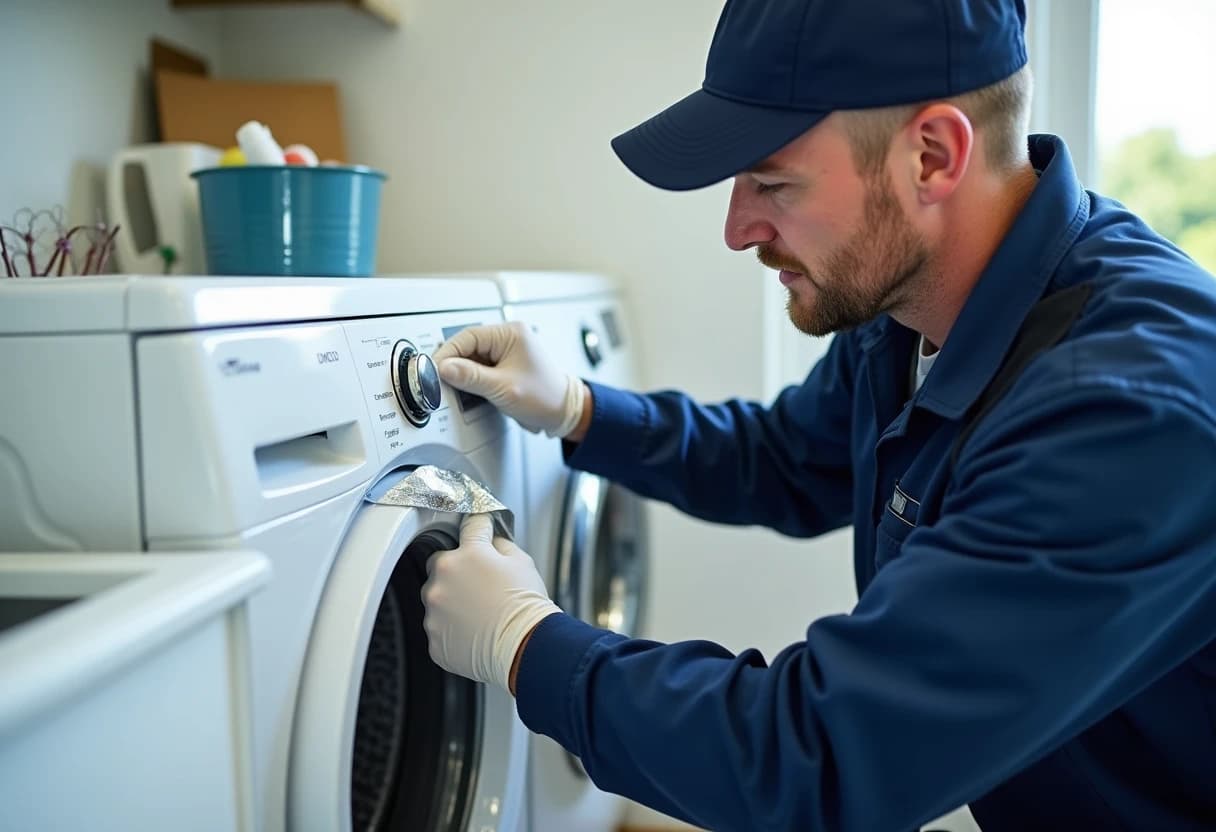
That flattened foil hose behind your dryer is doing more damage than it looks. Crushed transition ducts are the most common dryer vent failure we find in Newton homes — the machine gets pushed back against the wall, the accordion hose collapses to a fraction of its diameter, and the dryer spends years straining against a pinched exhaust while lint packs the kink. We replace these hazards with semi-rigid aluminum connectors and repair everything downstream too: separated joints, sagging runs, holes rusted through duct walls, and exterior hoods that no longer close against weather and pests. Done right, with the materials the code requires, a repaired vent runs trouble-free for decades.
Why Dryer Vent Repair Matters for Newton Homes
The exterior termination takes the worst weather abuse of any part of the system, and its failures invite problems in both directions. A damper flap that has rusted, cracked or lost its spring no longer closes — leaving a permanent 4-inch hole in your building envelope through which winter air pours in (homeowners feel it as a cold laundry room and see it on heating bills), and through which birds, squirrels and mice enter to nest in a warm, sheltered duct. A damper wedged shut by paint, ice or a failed hinge blocks the vent as thoroughly as any lint clog. Screened hoods, common on older installs and on handyman replacements, violate dryer-vent code for a simple reason: the mesh mats over with lint in months. We replace failed terminations with quality metal hoods sized to the duct, with free-swinging dampers and pest protection designed for dryer exhaust, sealed to the siding or masonry so the wall assembly stays dry. It is often the cheapest repair on the menu and one of the most consequential.
Ask a home inspector working around Boston College what they flag most in Newton laundry areas and dryer venting is near the top of the list: vinyl accordion hose, duct-taped joints, screened hoods, runs far beyond code length. Newton's thirteen villages are dominated by large Victorians, center-entrance Colonials and Tudors built between 1880 and 1940, joined by mid-century ranches near the western villages and a growing stock of high-end condo conversions. Renovation activity is constant, and many homes have had forced-air systems retrofitted into radiator-era floor plans, leaving long, joint-heavy duct runs threaded through old framing. Newton is our home city - our shop sits on Washington Street in West Newton - so Newton addresses get our fastest response times. The city's retrofit ductwork, finished basements and heavy remodeling culture make construction-dust contamination one of the most common problems we find here. We do the corrective work those inspection reports call for — rigid metal replacement, code-compliant reconnections, proper terminations — with documentation that satisfies buyers, sellers and insurers alike. Neighbors in Waltham and Watertown use us for the same pre-sale and post-purchase repairs, which keeps our trucks in this corner of Middlesex County nearly every week.
Our Dryer Vent Repair Process in Newton
1Diagnose the Full Exhaust Path
Repair starts with finding every failure, not just the obvious one. We trace the duct from the dryer's outlet to the exterior termination, inspecting each accessible section and joint, and test airflow at both ends with the dryer running. Weak exterior flow with strong drum heat means the exhaust is escaping en route — and we find where.
2Protect the Area & Open Access
Before repair work, we protect floors and finishes along the work path, move the dryer out carefully on sliders, and set up at the failure points. Where a concealed joint requires access, we discuss options first — many repairs can be made from existing openings, and when cutting is unavoidable we keep openings minimal and tell you exactly what restoration will involve.
3Reconnect & Properly Fasten Separated Joints
Separated joints are rejoined the way code intends: sections fitted male-to-female in the direction of airflow, secured with clamps or mechanical fasteners that do not pierce the airstream, and sealed with UL-listed metal foil tape — never fabric duct tape, which heat destroys, and never screws through the duct wall, whose tips become lint hooks inside the pipe.
4Replace Crushed, Corroded or Non-Compliant Sections
Vinyl and foil accordion duct found anywhere in the run is removed on sight and replaced: rigid metal for the concealed run, a short UL-listed semi-rigid aluminum connector at the appliance. The smooth interior of proper duct resists lint accumulation dramatically better than corrugations — the repair also makes every future cleaning faster and more effective.
5Cure Condensation: Slope, Seal & Insulate
Where a run's routing makes condensation inevitable — long passages through cold space, low points that cannot be drained — we say so plainly and price the better fix: shortening or rerouting the run, which we quote as a separate option. Honest diagnosis beats a repair that treats symptoms the routing will simply recreate.
6Repair or Replace the Exterior Hood & Damper
The new hood is sealed to the wall correctly: fastened to siding or masonry, flashed and caulked so wind-driven rain stays out of the wall assembly, with the duct connection sealed inside. On brick and stone, we drill and anchor rather than improvise; on clapboard, we integrate with the siding plane. The termination should outlast the roof.
7Replace the Transition Duct & Reset the Dryer
The appliance connection is rebuilt to spec: a UL-listed semi-rigid aluminum transition duct, as short and straight as the layout allows, secured with clamps at both ends. We position the dryer so the connector keeps its full diameter — not crushed against the wall — and mark the safe distance so future pushes do not recreate the old kink.
8Verify Airflow & Document the Repair
Finally we log the service and recommend a cleaning schedule for the repaired system — typically annual. A repaired vent with smooth rigid duct and a proper termination accumulates lint far more slowly than the failed system it replaced, and the documentation we leave shows exactly what is now behind your walls.
Benefits of Professional Dryer Vent Repair in Newton
Moisture Out of Your Walls and Ceilings
In New England's freeze-thaw climate, moisture in building assemblies does compounding damage each winter. Sealing a leaking dryer vent removes one of the few moisture sources that operates year-round, indoors, by the gallon. Building scientists put exhaust integrity high on the envelope checklist for exactly this reason.
Code Compliance & Inspection-Ready Documentation
For condo owners, documented code-compliant repair satisfies association requirements and insurance due diligence in one visit. We provide written scopes for board approval beforehand and completion records with photos afterward — paperwork that matters when a shared building's fire safety is the subject.
Decades of Reliable Service From One Repair
Done with rigid metal, mechanical fastening and a quality termination, a dryer vent repair is not a patch — it is infrastructure. Properly installed rigid duct routinely outlasts the dryers connected to it, needing only annual cleaning. The failure-prone materials and joints that caused your problem simply are not there anymore.
A Serious Fire Hazard, Eliminated
A breached or restricted dryer vent combines the two ingredients of the roughly 2,900 annual US dryer fires: accumulating lint and rising exhaust temperatures. Repair removes both — the escape points that seed wall cavities with fuel, and the crush points and blockages that overheat the system. It is fire prevention with a wrench, and it lasts for decades.
Pest Entry Points Closed
We remove existing nesting material as part of termination repair and clean the affected duct section, because a nest is both a blockage and a sanitation issue in an airstream that passes your clothing. The new hood's pest protection is chosen to exclude animals without the lint-trapping mesh that code prohibits.
Restored Drying Performance
A crushed or separated duct throttles airflow just like a lint clog, and no amount of cleaning fixes it. Repair restores the full 4-inch path, and drying performance returns immediately — one-cycle loads, accurate sensor-dry behavior, and a machine that stops straining against backpressure it was never designed to fight.
Signs Your Newton Home Needs Dryer Vent Repair
Water Stains, Drips or Peeling Paint Near the Vent Path
Condensation drips are easy to misattribute to plumbing. The tell is timing: moisture that appears during or after dryer use, and dries between laundry days, is exhaust-borne. We confirm with a running-dryer inspection before quoting, so you repair the actual source rather than the nearest pipe.
Lint Appearing Where It Shouldn't
Lint drifting from a basement ceiling, gathering on joists, puffing from a wall register or collecting behind the dryer means exhaust is escaping the duct before the termination. Lint marks the leak like dye in water — follow it and you find the separated joint or breach. This is a repair call, not a cleaning call, and it should not wait.
Slow Drying That Cleaning Didn't Fix
A dryer that dries poorly immediately after being moved, after appliance delivery, or after renovation work near the laundry almost certainly has a crushed transition or a disturbed joint — the timing is the clue. These are among the quickest, least expensive repairs we make, often at the bottom of the $150 to $450 range.
Musty or Mildew Smell in the Laundry Area
EPA guidance on mold is unambiguous: control the moisture and you control the growth. In laundry areas the dryer vent is a prime suspect moisture source, and a $150 to $450 repair is dramatically cheaper than the remediation an ignored leak can eventually require.
A Home Inspection or Appliance Tech Flagged the Vent
Inspection reports flag dryer venting constantly in Massachusetts: vinyl flex, taped or screwed joints, screened hoods, overlong concealed runs. Take the flag seriously — inspectors see the aftermath of ignored vents — and bring us the report. We translate findings into a flat-priced repair scope and documentation that closes the issue for buyers, sellers and insurers.
Exterior Damper Broken, Stuck or Missing
Evidence of animals — chirping in the duct, nesting material at the hood, droppings near the vent line — means the termination has already failed as a barrier. We remove the nest, clean the affected duct, and install a hood with real pest protection. Spring is nesting season; the repair is best made before it.
Dryer Vent Repair Cost in Newton, MA
It helps to know what drives repair pricing, because the failure type matters more than the home's size. Accessibility is the biggest factor: a joint hanging exposed in a basement is a fast fix, while the same failure above a finished ceiling involves careful access and restoration planning. Materials are second: quality rigid metal duct, UL-listed connectors, foil tape and a solid termination hood carry real parts costs — roughly $30 to $120 of most invoices — but they are why the repair lasts decades. Scope is third: many vents present multiple failures at once (a crushed transition and a failed damper and a leaking joint), and bundling them into one visit is significantly cheaper than three separate calls. What does not drive our pricing: drama. We quote from the diagnosis, show you the photos, and price the fix flat. Massachusetts homeowners have seen enough scare-based selling around dryer fires; the facts are alarming enough without embellishment, and the honest repair is usually a few hundred dollars.
Want the full pricing picture? See our complete Boston-area cost guide or call (617) 390-7145 for an exact flat quote for your Newton home.
Local Knowledge: Newton, Middlesex County
Every town's ductwork tells the story of its housing. Newton's thirteen villages are dominated by large Victorians, center-entrance Colonials and Tudors built between 1880 and 1940, joined by mid-century ranches near the western villages and a growing stock of high-end condo conversions. Renovation activity is constant, and many homes have had forced-air systems retrofitted into radiator-era floor plans, leaving long, joint-heavy duct runs threaded through old framing. Newton is our home city - our shop sits on Washington Street in West Newton - so Newton addresses get our fastest response times. The city's retrofit ductwork, finished basements and heavy remodeling culture make construction-dust contamination one of the most common problems we find here. We plan Newton jobs around those realities, from equipment selection to time on site, and it shows in the results. If you live near Boston College or anywhere across Newton's 02458 area, we have almost certainly cleaned a system like yours before — and we can tell you exactly what to expect before we arrive.
The Best Time of Year in Newton
There is also a renovation-season rhythm to dryer vent damage in Greater Boston. The region's busiest remodeling months — spring through fall — are when concealed ducts get crushed by new framing, disconnected by trades working in ceilings, buried behind new finishes, or simply forgotten in layout changes that leave the dryer farther from its termination than code allows. Many of our fall repair calls trace directly to summer projects. If your home was renovated this year and laundry performance changed afterward, the connection is likely literal: a disturbed joint or flattened section behind the new work. We diagnose with airflow testing before opening anything, and where access through fresh finishes is needed, we keep it minimal and coordinate with your contractor's restoration.
Why Choose Boston Air Duct Cleaners
Homeowners across Middlesex County choose Boston Air Duct Cleaners for three reasons. First, honesty: our inspection camera tells you whether your system actually needs cleaning — and sometimes the answer is no. Second, capability: truck-grade negative-air machines, rotary brush systems and HEPA filtration handle everything from antique gravity-furnace conversions to brand-new high-velocity systems. Third, accountability: flat quoted pricing, before-and-after photos, insured technicians, and a real local office you can call at (617) 390-7145. That combination is rarer in this industry than it should be.
Serving Newton and Surrounding Communities
Newton sits in the heart of our service area, and neighboring Waltham, Watertown, Brookline, Wellesley, Needham, Weston appointments share the same routes. That density is why our response times in this part of Middlesex County are among our fastest — and why you will see our trucks in the area week after week.