
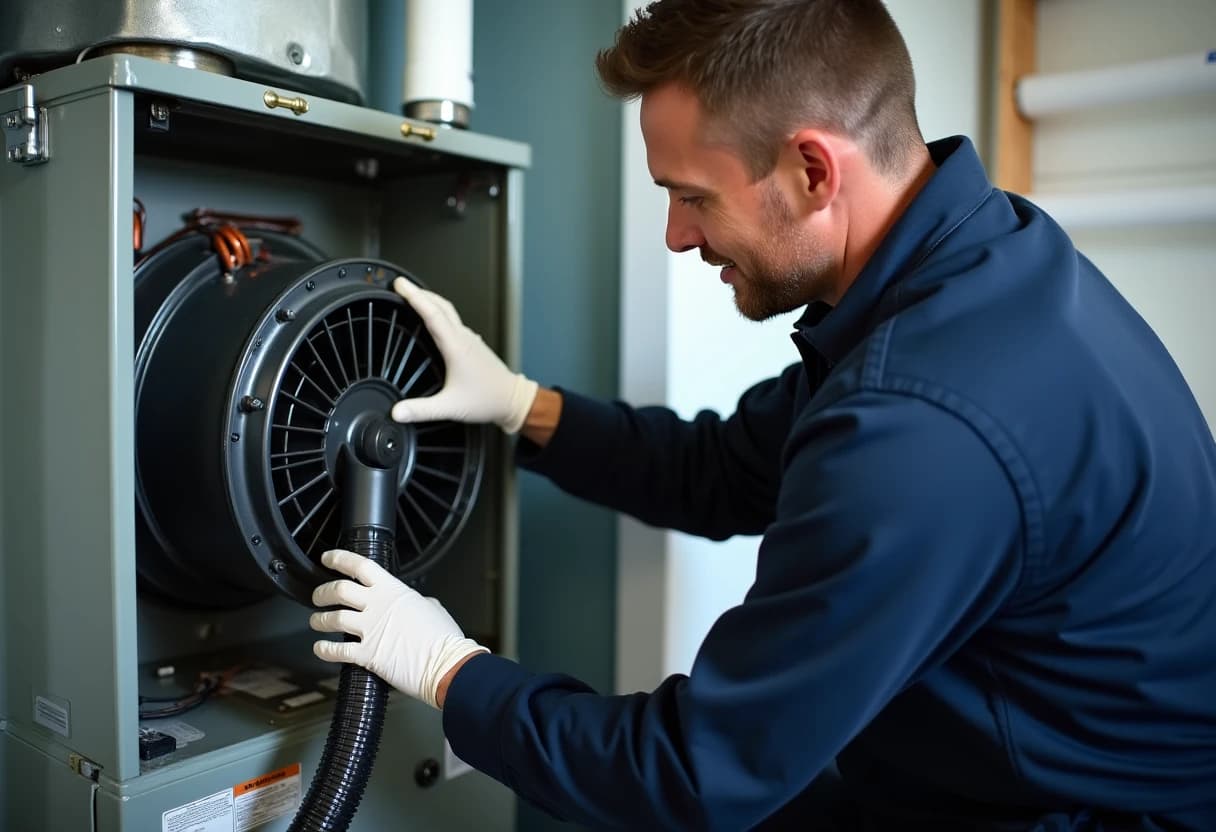
Think of HVAC system cleaning as a deep service interval for the largest appliance you own. Cars get more than oil changes; heating and cooling systems deserve more than filter swaps. In one visit we restore the entire air side: source-removal duct cleaning under negative pressure, blower wheel and motor compartment detailing, evaporator coil cleaning, drain pan and condensate service, plenum and cabinet cleanup, and a fresh filter to protect the work. Beacon Hill homeowners typically pair it with their annual furnace tune-up — the technician tuning combustion and the crew restoring airflow are complementary halves of the same maintenance logic — and the systems that get both run quieter, heat faster, cool harder and last visibly longer.
Why HVAC System Cleaning Matters for Beacon Hill Homes
Efficiency loss from a dirty air side is not folklore; it is measurable physics with a utility-bill signature. A dust-matted blower wheel loses blade profile and moving capacity, so the motor works harder to deliver less air. A fouled evaporator coil cannot exchange heat — the Department of Energy identifies dirty coils as a leading cause of degraded AC efficiency — so compressors run longer to move the same BTUs. Elevated duct static pressure from interior buildup compounds both. Stack the losses and a neglected system can consume meaningfully more energy than a clean one while delivering worse comfort, which in Massachusetts — where electricity prices run among the highest in the continental US and heating seasons stretch six months — converts to real money every single month. Whole-system cleaning recovers that capacity at once. Customers with visibly fouled systems routinely see the difference in the next billing cycle, and the improvement recurs monthly, which is why this service so often functions as an investment with a payback period rather than an expense.
From the homes around Massachusetts State House to the streets near Charles Street, Beacon Hill heating systems share a biography: long duty cycles, aging ductwork, and equipment maintained by filter changes alone for a decade or more. Beacon Hill's Federal and Greek Revival rowhouses date to the early 1800s, making them some of the oldest continuously occupied homes we service anywhere. Behind the brick facades and original shutters, owners have shoehorned modern HVAC into buildings that predate central heating entirely - slim-duct systems in closets, air handlers in former servant stairs, and condensers hidden on rear decks to satisfy the historic commission. Nearly every duct run here is a custom retrofit with tight bends that collect dust aggressively. When we open these air handlers, the buildup tells the story. Being based in West Newton, about 11 miles out, our crews serve Beacon Hill weekly — full system cleanings, ducts through coil, quoted flat and documented with before-and-after photos your HVAC tech will appreciate at the next tune-up.
Our HVAC System Cleaning Process in Beacon Hill
1Full System Inspection & Airflow Baseline
Every job opens with a complete assessment: ductwork mapped and inspected by camera, filter and filter rack checked, blower compartment and coil examined, and register airflow noted room by room as a baseline. You see the pre-cleaning photos — matted blower, grayed coil face, duct interiors — and approve a confirmed flat price before any equipment starts.
2Protection, Sealing & Negative Pressure
Floor protection goes down along every work path, registers come off, and all supply and return openings are sealed. A HEPA-filtered negative-air machine connects to the main trunks, placing the full duct network under continuous vacuum — the containment that lets us clean aggressively while your living spaces stay dust-free throughout the visit.
3Complete Duct Network Cleaning
The duct phase follows NADCA source-removal method end to end: mechanical agitation of every supply and return, trunk lines cleaned last so debris always moves toward the collection point, and appropriate tooling per duct type — aggressive brushes on rigid metal, gentler whips on flex runs and older panned returns common in Massachusetts homes.
4Blower Wheel & Motor Compartment Detailing
The blower assembly gets restoration-grade attention: wheel removed where design allows or detailed in place, blades cleared of the compacted felt that steals airflow, motor housing vacuumed and wiped, and the compartment HEPA-cleaned to bare metal. A clean wheel moves dramatically more air — this single component is where most of the felt recovery lives.
5Evaporator Coil Cleaning
Coil cleaning is precision work: fin surfaces are delicate, and the right approach depends on fouling depth — from HEPA vacuuming and soft brushing for surface dust to application of appropriate coil cleaners for bonded buildup. We work carefully, protect the surrounding cabinet and drain path, and photograph the coil face before and after so the recovery is visible fin by fin.
6Cabinet, Plenums & Condensate Service
The air handler cabinet and both plenums — the supply box distributing to the trunks and the return box feeding the blower — are HEPA-vacuumed and wiped to clean surfaces. The drain pan under the coil is scrubbed and the condensate line flushed clear, closing off the standing-water conditions behind musty odors and cooling-season microbial growth.
7Fresh Filter, Reassembly & Verified Results
The job ends with your system running and your questions answered. We review maintenance guidance — filter change intervals for your specific system, the case for pairing future cleanings with tune-ups, any conditions we flagged for your HVAC tech — and log your service date. Whole-system cleanings hold three to five years in typical homes; we will remind you when an inspection is actually due, not before.
Benefits of Professional HVAC System Cleaning in Beacon Hill
Lower Energy Bills, Month After Month
Six-plus months of heating and an increasingly serious cooling season give Massachusetts systems some of the longest annual runtimes in the country — so every point of recovered efficiency is multiplied across more operating hours than almost anywhere else. The same cleaning that is a modest comfort upgrade in a mild climate is a measurable utility-budget event here.
Airflow Restored to Design Capacity
Airflow is the product your HVAC system exists to deliver, and dust taxes it at every stage — matted blower blades, blanketed coil fins, narrowed duct runs. Whole-system cleaning refunds the tax in full. The most common customer report after our visits: rooms that had not heated or cooled properly in years suddenly behave, with no equipment replaced and nothing adjusted but cleanliness.
Cooling That Keeps Up in July
A blanketed evaporator coil cannot shed heat, so the AC runs longer, delivers less, and loses exactly when you need it most — the humid Massachusetts afternoons that now define our summers. Coil cleaning restores rated cooling capacity and, just as important here, dehumidification, so the house gets cool and dry instead of cool-ish and clammy.
Cleaner Air From a Cleaner Machine
The equipment matters to air quality more than the ducts do, per square inch: the coil and pan stay damp all cooling season, hosting the biology behind musty odors, while the blower sheds its buildup into the airstream continuously. Cleaning ducts around contaminated equipment leaves the worst sources running; cleaning the whole system actually finishes the job.
Quieter Operation, Fewer Odors
Noise and odor are the system's two honest condition reports, and both improve immediately after whole-system work: airflow stops whistling through restrictions, the blower stops droning against imbalance, startup smells vanish because there is nothing left to cook off. A quiet, odorless system is not a luxury spec — it is what clean equipment simply sounds and smells like.
Years Added to Equipment Life
HVAC technicians will tell you which systems reach old age: the ones with clean airflow. Limit-switch trips, cracked exchangers and burned motors cluster in fouled systems because restriction stresses everything upstream and downstream of it. Periodic whole-system cleaning is how a homeowner buys into the long-lived cohort — and why tune-up techs are among our steadiest referral sources.
Signs Your Beacon Hill Home Needs HVAC System Cleaning
Energy Bills Creeping Up Year Over Year
Compare this January's usage to the same month three years back, weather-adjusted even roughly. Steady growth without a rate change means the system works harder for the same heat — the signature of accumulating restriction. Cleaning recovers what buildup took; if the bills do not respond, the inspection will have flagged the mechanical issue that is actually responsible.
Visible Buildup on the Blower or Around the Air Handler
Check the filter's service history as a proxy: filters that load with dust unusually fast indicate a heavy circulating burden, and filters that were skipped for long stretches guarantee the equipment downstream absorbed the difference. Either pattern — fast-loading or long-neglected — predicts exactly what we find when the cabinet opens.
Uneven Rooms, Noisy Cycles, Dust Everywhere
The classic trio of a fouled air side: rooms that heat and cool unevenly, a system that has grown audibly louder over the years, and dust that returns to surfaces within days of cleaning. Each has other possible causes; together they point one direction. A single whole-system cleaning typically improves all three at once, which is itself diagnostic.
Weak Airflow at Some or All Registers
Hold a hand to the registers: airflow you can barely feel — especially in far rooms and upper floors — means the system is losing delivered air to restriction somewhere between blower and grille. Matted wheels, blanketed coils and dust-narrowed runs are the usual suspects, and whole-system cleaning addresses all three in one pass.
AC Struggling, Icing, or Running Nonstop
Watch for the humidity tell: a struggling AC that leaves the house cool but clammy is failing at dehumidification, which a blanketed coil surrenders first. In a Massachusetts July, moisture removal is half the job. If the air feels damp at setpoint, the coil face deserves a look before the thermostat takes any more blame.
Burnt-Dust Smell at Furnace Startup
The acrid smell when the heat first fires each fall is accumulation cooking off the heat exchanger, plenums and duct surfaces — a direct sensory report of what the system carries. A faint note that clears in an hour is common; a strong smell recurring for days, or returning at every cold-snap restart, indicates a load worth removing before the season.
HVAC System Cleaning Cost in Beacon Hill, MA
The pricing pathology in this market is the partial job sold as the whole one, so audit any quote for what it actually includes. A '$299 HVAC cleaning' that covers vents-only is a duct wipe with a system-sized name — no blower, no coil, no plenums, and the efficiency benefits the service is named for never arrive, because the components that determine efficiency were never touched. Ask three questions of any bidder: Is the blower wheel cleaned, and how? Is the evaporator coil included, and will you photograph it before and after? Are both plenums and the cabinet in scope? Vague answers predict vague results. Our quotes itemize all of it in writing, and our photo documentation proves delivery component by component. Priced against alternatives, the value case is stark: $450 to $900 for whole-system cleaning versus five figures for the premature equipment replacement that chronic fouling accelerates, or versus the compounding utility overspend a dirty system extracts every month — in Massachusetts, often enough to repay the cleaning within the first year or two of recovered efficiency.
Want the full pricing picture? See our complete Boston-area cost guide or call (617) 390-7145 for an exact flat quote for your Beacon Hill home.
Local Knowledge: Beacon Hill, Suffolk County
Every town's ductwork tells the story of its housing. Beacon Hill's Federal and Greek Revival rowhouses date to the early 1800s, making them some of the oldest continuously occupied homes we service anywhere. Behind the brick facades and original shutters, owners have shoehorned modern HVAC into buildings that predate central heating entirely - slim-duct systems in closets, air handlers in former servant stairs, and condensers hidden on rear decks to satisfy the historic commission. Nearly every duct run here is a custom retrofit with tight bends that collect dust aggressively. Two-hundred-year-old plaster, horsehair insulation and crumbling brick party walls shed fine mineral dust that ends up circulating through Beacon Hill's retrofit duct systems. Exterior work requires Beacon Hill Architectural Commission approval, so dryer vents and exhaust terminations are often routed to rear elevations through long concealed runs - exactly the kind of vent that quietly packs with lint. We clean these buildings with the care their age demands. We plan Beacon Hill jobs around those realities, from equipment selection to time on site, and it shows in the results. If you live near Acorn Street or anywhere across Beacon Hill's 02108 area, we have almost certainly cleaned a system like yours before — and we can tell you exactly what to expect before we arrive.
The Best Time of Year in Beacon Hill
New England's equipment stock adds a seasonal wrinkle worth naming: an enormous share of local systems are conversions and hybrids — forced-air retrofitted into homes built for radiators, hydro-air systems marrying boilers to air handlers, condo conversions threading flex duct through triple-decker framing. These systems run higher static pressure than clean-sheet designs, which means less margin for fouling: buildup that a generously ducted suburban system tolerates will noticeably choke a retrofit. The seasonal moisture cycle compounds it — humid summers make basement equipment buildup damp and sticky, long winters bake it hard — so accumulation here bonds faster and restricts sooner than national rules of thumb suggest. For conversion-era systems, we recommend the inspection interval owners of old houses already apply to everything else: regularly, and before the hard season rather than after it.
Why Choose Boston Air Duct Cleaners
What separates us from the coupon crowd is simple: we do the whole job, we prove it, and we charge what we quoted. Our technicians clean supplies, returns, trunks and blower compartments on every visit — never a cosmetic vent wipe. Photo documentation comes standard, pricing is flat and confirmed up front, and our trucks carry true commercial vacuum equipment, not rented shop-vacs. Based in West Newton and serving Beacon Hill year-round, we answer our own phone at (617) 390-7145 and stand behind every cleaning with a satisfaction guarantee.
Serving Beacon Hill and Surrounding Communities
Beacon Hill sits in the heart of our service area, and neighboring Back Bay, Boston, Charlestown, Cambridge, South End, Somerville appointments share the same routes. That density is why our response times in this part of Suffolk County are among our fastest — and why you will see our trucks in the area week after week.