
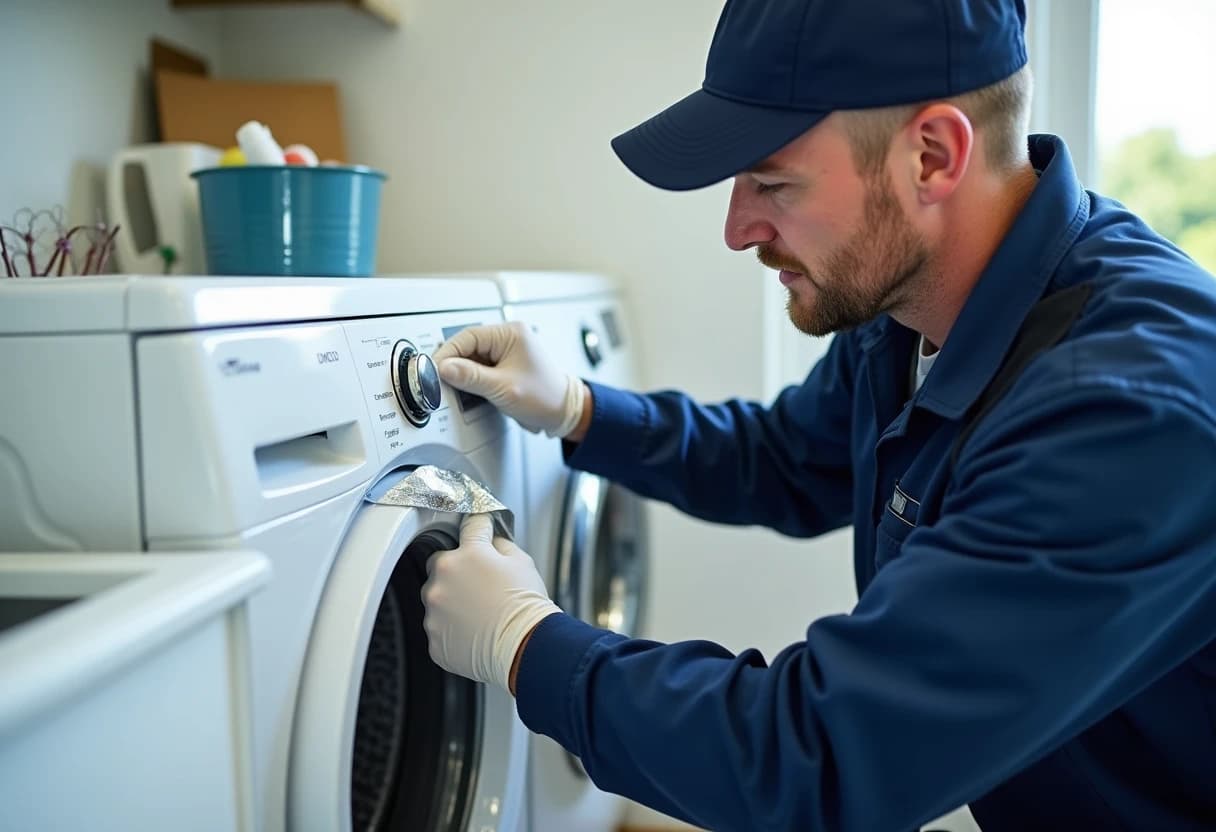
A dryer vent that is crushed, disconnected or leaking cannot be fixed by cleaning — it needs repair. Our Wilmington dryer vent repair service restores the exhaust path itself: reconnecting joints that have pulled apart inside walls and ceilings, replacing crushed or kinked sections with smooth rigid metal duct, sealing leaks with proper metal foil tape, and rebuilding exterior hoods whose dampers have broken or rusted shut. Every repair uses code-compliant materials and methods — 4-inch rigid metal, clamped connections with no screws intruding into the airstream — so the finished vent moves full airflow, keeps moisture out of your walls, and stops feeding lint into places it should never go.
Why Dryer Vent Repair Matters for Wilmington Homes
A damaged dryer vent fails on three fronts at once, and all three get worse with every load. Safety first: a disconnection or breach releases lint — one of the most flammable materials in a home — into wall cavities, ceilings and basements, where it accumulates near framing with no way to remove it, while the restriction at the damage point drives up exhaust temperatures exactly the way fire investigators describe in the roughly 2,900 US dryer fires each year. Moisture second: every load pushes about a gallon of water vapor through the vent, and a leak delivers it into building materials instead of outdoors — wet insulation, mold-friendly wall cavities, stained ceilings, rotted subfloor around the laundry. Performance third: crushed and separated ducts strangle airflow, stretching drying times and energy bills while overheating the appliance. Cleaning cannot fix any of this; the duct itself is broken. A proper repair — rigid metal, sealed joints, verified airflow — resolves all three failure modes in a single visit, usually for $150 to $450.
Multi-family Wilmington properties — triple-deckers, condo conversions, brownstone associations near Harnden Tavern — bring dryer venting problems that single-family playbooks miss: long shared-wall runs, terminations several stories up, and repairs that need association sign-off and insurance documentation. Wilmington is quintessential postwar suburbia - block after block of 1950s-1970s ranches, capes and split-entries built as Route 93 opened, now joined by teardown colonials and small subdivisions from the 1990s onward. The original tract homes typically have simple single-zone duct systems in shallow basements or crawlspaces, many still running their first-generation sheet metal. We handle all of it, providing certificates of insurance, written scopes for board approval, and photo documentation of completed work. Wilmington's split-entries and raised ranches often route ducts through slab-adjacent chases and garage-side walls where dust and moisture collect out of sight. With the town's industrial parks and busy I-93 and Route 38 corridors nearby, homeowners here also notice fine road and diesel dust loading filters faster than in quieter towns. When one unit's disconnected vent is loading a shared ceiling cavity with lint and moisture, the whole building has a stake in the repair — and we are the crew associations across Middlesex County call to make it right.
Our Dryer Vent Repair Process in Wilmington
1Diagnose the Full Exhaust Path
Your technician maps the vent's routing, materials and condition: transition hose state, joint integrity, crush points, sag, corrosion, termination function. Where the run is concealed, airflow measurements and inspection tools tell us what the walls hide. You get a photographed diagnosis and a flat repair quote before any work begins.
2Protect the Area & Open Access
Before repair work, we protect floors and finishes along the work path, move the dryer out carefully on sliders, and set up at the failure points. Where a concealed joint requires access, we discuss options first — many repairs can be made from existing openings, and when cutting is unavoidable we keep openings minimal and tell you exactly what restoration will involve.
3Reconnect & Properly Fasten Separated Joints
Separated joints are rejoined the way code intends: sections fitted male-to-female in the direction of airflow, secured with clamps or mechanical fasteners that do not pierce the airstream, and sealed with UL-listed metal foil tape — never fabric duct tape, which heat destroys, and never screws through the duct wall, whose tips become lint hooks inside the pipe.
4Replace Crushed, Corroded or Non-Compliant Sections
Duct that is crushed, kinked, rusted through or made of prohibited material gets replaced, not patched. We install 4-inch smooth-interior rigid metal duct — the material the IRC's dryer exhaust rules specify — cut to fit, joined without airstream-piercing fasteners, and supported so it cannot sag into water-pooling bellies.
5Cure Condensation: Slope, Seal & Insulate
Moisture-damaged components are replaced as part of the cure: corroded duct sections, rusted clamps, sodden insulation. We also check the termination damper, since a flap frozen or stuck partly shut is a common hidden cause of the backpressure that drives moist exhaust out through joints in the first place.
6Repair or Replace the Exterior Hood & Damper
The new hood is sealed to the wall correctly: fastened to siding or masonry, flashed and caulked so wind-driven rain stays out of the wall assembly, with the duct connection sealed inside. On brick and stone, we drill and anchor rather than improvise; on clapboard, we integrate with the siding plane. The termination should outlast the roof.
7Replace the Transition Duct & Reset the Dryer
Gas dryers are reconnected with the gas line unstrained and checked, electric dryers with cords properly routed clear of the hot duct. We level the machine, confirm the drum turns clean, and run a full test cycle — because a repair is not done until the system works as a system.
8Verify Airflow & Document the Repair
The proof is at the hood: with the dryer running, the damper should stand fully open under a strong, steady exhaust stream. We verify it together, compare against the pre-repair condition, and confirm no leakage remains at any repaired joint. Then the work area is cleaned, the dryer set, and the laundry room returned to service.
Benefits of Professional Dryer Vent Repair in Wilmington
A Serious Fire Hazard, Eliminated
Code-compliant materials are themselves a safety upgrade: smooth rigid metal resists lint accumulation, clamped joints hold under heat and vibration, and a proper termination keeps nesting animals from plugging the line. A repaired vent is not just fixed — it is a fundamentally lower-risk system than what it replaces.
Code Compliance & Inspection-Ready Documentation
Compliance is not paperwork for its own sake; each code provision encodes a failure the industry learned about the hard way. Smooth interiors resist lint. Clamped joints survive heat. Unscreened dampers do not mat over. A to-code vent is simply a vent engineered not to fail the common ways.
Decades of Reliable Service From One Repair
Repairs also make every future cleaning better: smooth interiors let rotary brushes work at full effectiveness, sealed joints keep the vacuum's suction where it belongs, and a free-swinging damper lets technicians verify airflow honestly. You are not just fixing today's failure — you are buying easier maintenance forever.
Moisture Out of Your Walls and Ceilings
Every load of laundry exhausts about a gallon of water. A repaired, sealed vent delivers all of it outdoors; a leaking one delivers it into insulation, framing and drywall. Stopping that daily soaking is the benefit homeowners feel longest — no more spreading stains, peeling paint, mildew odors or the mold remediation bills that chronic wall moisture eventually writes.
Restored Drying Performance
A crushed or separated duct throttles airflow just like a lint clog, and no amount of cleaning fixes it. Repair restores the full 4-inch path, and drying performance returns immediately — one-cycle loads, accurate sensor-dry behavior, and a machine that stops straining against backpressure it was never designed to fight.
Pest Entry Points Closed
Pest damage rarely stays at the hood: rodents that enter a duct chew insulation and nest against warm sections deep in the run. Closing the entry point promptly is far cheaper than the extended cleaning and repair an established rodent presence demands — one more reason failing dampers deserve fast attention.
Signs Your Wilmington Home Needs Dryer Vent Repair
Exterior Damper Broken, Stuck or Missing
Cold drafts in the laundry room trace to the damper more often than to windows: a flap that no longer closes turns the duct into a 4-inch outside-air inlet. If the laundry area runs noticeably colder in winter than adjacent rooms, put the hood on your inspection list — the heating-season savings from a tight new damper are immediate.
Water Stains, Drips or Peeling Paint Near the Vent Path
Condensation drips are easy to misattribute to plumbing. The tell is timing: moisture that appears during or after dryer use, and dries between laundry days, is exhaust-borne. We confirm with a running-dryer inspection before quoting, so you repair the actual source rather than the nearest pipe.
A Home Inspection or Appliance Tech Flagged the Vent
Condo associations increasingly require documented vent compliance after regional dryer fire losses. If your building has sent a notice, we handle the full cycle: inspection, written scope for board approval, code-compliant repair, and completion records with photos. One visit, and your unit's file is closed.
Slow Drying That Cleaning Didn't Fix
A dryer that dries poorly immediately after being moved, after appliance delivery, or after renovation work near the laundry almost certainly has a crushed transition or a disturbed joint — the timing is the clue. These are among the quickest, least expensive repairs we make, often at the bottom of the $150 to $450 range.
Visibly Damaged, Kinked or Sagging Duct
Trust your eyes: a transition hose flattened behind the dryer, a dented or crushed section in the basement, duct sagging between supports into a low belly, or a run held together with fabric duct tape are all failures in progress. Each restricts airflow, collects lint and moisture, and worsens with time. Photograph what you see and call — the quote is quick.
Musty or Mildew Smell in the Laundry Area
A persistent damp smell around the laundry — or in one adjacent wall or ceiling — often means exhaust moisture has been feeding hidden mildew via a leak or chronic condensation. The odor is the nose's report on a moisture problem the eyes cannot see. A vent-path inspection locates the escape point, and repair dries up its food supply.
Dryer Vent Repair Cost in Wilmington, MA
It helps to know what drives repair pricing, because the failure type matters more than the home's size. Accessibility is the biggest factor: a joint hanging exposed in a basement is a fast fix, while the same failure above a finished ceiling involves careful access and restoration planning. Materials are second: quality rigid metal duct, UL-listed connectors, foil tape and a solid termination hood carry real parts costs — roughly $30 to $120 of most invoices — but they are why the repair lasts decades. Scope is third: many vents present multiple failures at once (a crushed transition and a failed damper and a leaking joint), and bundling them into one visit is significantly cheaper than three separate calls. What does not drive our pricing: drama. We quote from the diagnosis, show you the photos, and price the fix flat. Massachusetts homeowners have seen enough scare-based selling around dryer fires; the facts are alarming enough without embellishment, and the honest repair is usually a few hundred dollars.
Want the full pricing picture? See our complete Boston-area cost guide or call (617) 390-7145 for an exact flat quote for your Wilmington home.
Local Knowledge: Wilmington, Middlesex County
What makes Wilmington different? Wilmington is quintessential postwar suburbia - block after block of 1950s-1970s ranches, capes and split-entries built as Route 93 opened, now joined by teardown colonials and small subdivisions from the 1990s onward. The original tract homes typically have simple single-zone duct systems in shallow basements or crawlspaces, many still running their first-generation sheet metal. Wilmington's split-entries and raised ranches often route ducts through slab-adjacent chases and garage-side walls where dust and moisture collect out of sight. With the town's industrial parks and busy I-93 and Route 38 corridors nearby, homeowners here also notice fine road and diesel dust loading filters faster than in quieter towns. For duct and dryer vent systems, those local factors translate into specific, predictable problems — and predictable problems are the ones we solve fastest. Call (617) 390-7145, tell us your street and home style, and we will quote the job accurately the first time, usually in under five minutes.
The Best Time of Year in Wilmington
The freeze-thaw cycle is uniquely hard on the exterior components of New England dryer vents. Damper hinges and springs work loose as metal expands and contracts; caulk joints between hood and siding crack open, letting wind-driven rain into the wall; and ice forming in the hood from condensing exhaust bends flaps out of true a little more each season. Coastal and near-coastal homes add salt corrosion, which seizes hinges and eats galvanized steel years ahead of schedule. This is why we treat termination inspection as part of every service call: the hood fails gradually, then suddenly, and replacing it during a routine visit costs a fraction of the cascade — drafts, pests, blockage — that a failed one begins.
Why Choose Boston Air Duct Cleaners
Homeowners across Middlesex County choose Boston Air Duct Cleaners for three reasons. First, honesty: our inspection camera tells you whether your system actually needs cleaning — and sometimes the answer is no. Second, capability: truck-grade negative-air machines, rotary brush systems and HEPA filtration handle everything from antique gravity-furnace conversions to brand-new high-velocity systems. Third, accountability: flat quoted pricing, before-and-after photos, insured technicians, and a real local office you can call at (617) 390-7145. That combination is rarer in this industry than it should be.
Serving Wilmington and Surrounding Communities
We serve every community around Wilmington as well: Burlington, Billerica, Tewksbury, Reading, North Reading, Woburn all fall inside our regular service routes. If you have a second property, a rental, or family nearby, ask about multi-home scheduling — grouped appointments on the same route are our most requested discount.