
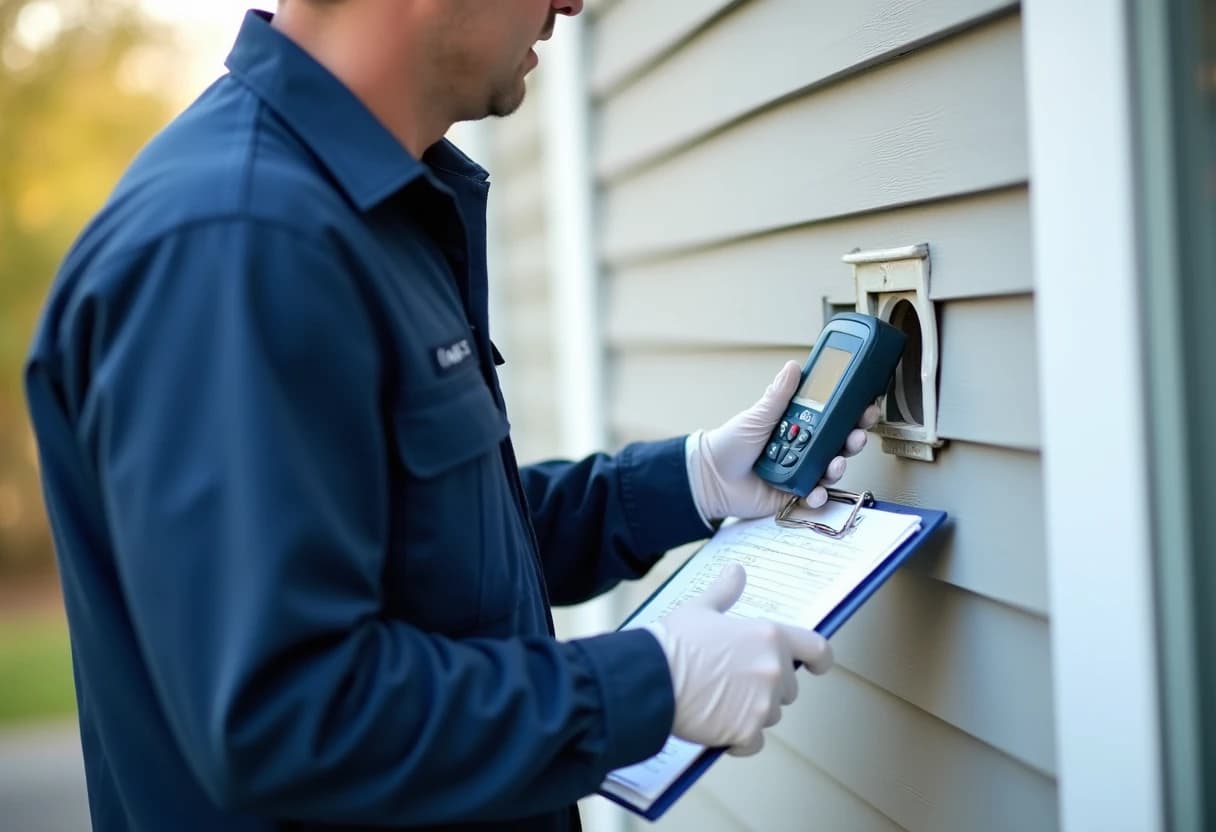
Not every dryer vent needs cleaning every year — but every dryer vent deserves inspecting every year, because the failure modes are silent and the worst-case outcome is a fire. Our West Roxbury inspection service exists for homeowners who want the truth about their vent without committing to a service they may not need. We measure exhaust airflow, camera the complete duct run, check the termination hood, verify the installation against code, and score the lint load. Roughly a third of the vents we inspect are fine, and we say so in writing. The rest get a documented finding and a flat-rate path to fixing it — your call, no pressure.
Why Dryer Vent Inspection & Safety Check Matters for West Roxbury Homes
The dryer vent is the only exhaust duct in your home that moves flammable material by design. Every load sheds lint; the trap catches most of it, and the rest travels the duct — where some fraction sticks at every elbow, joint, screw tip and rough surface along the way. Whether that accumulation is trivial or dangerous depends on the duct's length, geometry, material and history, which is exactly what an inspection evaluates. The residential code (IRC M1502) exists because these variables matter: it specifies smooth rigid metal duct, limits runs to 35 feet of equivalent length with deductions for every elbow, and prohibits screws that protrude into the airstream because each protruding tip becomes a lint anchor. Many Massachusetts homes — especially older ones retrofitted with laundry in basements or upper floors — violate one or more of these rules, often invisibly inside walls. A camera inspection is the only practical way to find out, and a written report is the only way to prove the vent's condition to an insurer, a buyer or a condo board.
Ask a West Roxbury firefighter what they think about dryer vents and you will get a strong opinion — lint fires are a call they run every year, and nearly all of them were preventable. West Roxbury feels more like a suburb than a Boston neighborhood, with tree-lined streets of 1920s-1950s Colonials, Capes, Tudors and brick ranches on real yards, plus larger Victorians on Bellevue Hill. Much of the stock was built with or converted early to forced-air heat, so ductwork here is older but more conventional than in the inner neighborhoods - full basement trunk-and-branch systems that have quietly collected fifty or more years of dust. Finished basements and additions often extended duct runs without upsizing returns. West Roxbury's stable, long-tenured homeownership means we frequently open up duct systems that have never been professionally cleaned since the house was built - the before-and-after photos from Bellevue Hill Colonials are some of our most dramatic. The neighborhood is also an easy run down the VFW Parkway from our West Newton shop, making scheduling here simple. That combination of aging housing and hardworking laundry rooms is precisely where annual inspections earn their keep. Our West Roxbury inspections take under an hour: airflow measured at the hood, camera run the length of the duct, termination and damper checked, lint load scored, code compliance reviewed. About a third of local vents pass clean. The rest get caught early — which is the entire point.
Our Dryer Vent Inspection & Safety Check Process in West Roxbury
1Interview & Visual Assessment
We start by listening: how long do loads take, has anything changed, when was the vent last cleaned, any moisture or odor issues? Then the technician examines the laundry area — dryer position, transition duct type and condition, visible connections — because the interview and the first look often predict exactly what the instruments will find.
2Airflow Measurement at the Termination
With the dryer running on air-only, we measure exhaust velocity at the exterior termination using a calibrated anemometer and convert it to airflow volume. A healthy vent typically delivers strong, steady flow; a weak reading quantifies restriction before we ever look inside. This number anchors the whole report — objective, repeatable and comparable year over year.
3Full-Length Camera Inspection
This is the step no flashlight can replace: a camera pass of the complete exhaust run, wall cavities and ceiling sections included. You can watch live as it travels. Lint depth, joint condition, duct material transitions and any obstructions are recorded, and representative frames go into your written report as evidence for every finding.
4Termination Hood & Damper Check
We check the exit as carefully as the run. A damper that will not open steals airflow; one that will not close invites cold air, moisture and animals. We also flag code and safety issues here: mesh screens that catch lint, terminations too close to openings or grade, and hoods damaged by weather or renovation work.
5Lint-Load Assessment & Fire-Risk Scoring
Not all lint findings are equal. A light, even film is normal; wet, matted accumulation at a low point signals condensation problems; heavy packing at elbows signals a duct working beyond its geometry. We grade what the camera found against how your household uses the dryer, so the recommendation matches your actual risk.
6Code-Compliance Review
We review the installation against the residential mechanical code for dryer exhaust: smooth rigid metal duct (not foil or plastic flex in concealed runs), a maximum of 35 feet equivalent length with deductions for each elbow, no screws penetrating the airstream, proper termination with a backdraft damper and no screen. Violations are photographed and explained.
7Written Safety Report & Recommendations
You receive a dated written report: airflow measurement, camera findings with photos, termination condition, lint-load score, code observations and a clear recommendation. It is formatted for practical reuse — insurance files, condo boards, real-estate disclosures — and it establishes the baseline every future annual inspection is compared against.
Benefits of Professional Dryer Vent Inspection & Safety Check in West Roxbury
Fire Risk Caught Before It Matters
The roughly 2,900 dryer fires U.S. homes suffer each year share a common history: a restriction that built silently for years. Annual inspection breaks that pattern by catching declining airflow and accumulating lint at the measurement stage — years before the ignition stage. It is the cheapest intervention in fire prevention.
Protection From Moisture & Carbon Monoxide
A leaking or restricted dryer duct pushes warm, saturated air into wall cavities and framing — a slow moisture problem that shows up later as mold, peeling paint or rot. For gas dryers, exhaust integrity also governs the removal of combustion byproducts, including carbon monoxide. Inspection verifies both.
A Written Report You Can Actually Use
The report is the product: dated, photographed, measured. Homeowners file it with insurance records, sellers attach it to disclosures, landlords and condo boards accept it as compliance documentation, and buyers use it to negotiate or verify. A verbal 'looks fine' from a handyman does none of those jobs.
No Unnecessary Cleanings
Fear sells a lot of dryer vent cleanings that ducts did not need. Our answer is evidence: your own duct on camera, your own airflow in numbers. When the data says clean, we quote it flat; when it says pass, you keep your money and gain a report. Either way you decide from facts.
Real-Estate & Insurance Documentation
Our report format was designed for transactions: dated findings, photographs, measurements and code notes that slide directly into a seller's disclosure package or answer an insurer's maintenance questionnaire. It is a small document that removes a large question mark from any file.
Lower Drying Costs & Longer Appliance Life
Dryers fail early for one dominant reason: heat stress from poor exhaust. High-limit switches, thermal fuses and heating elements all die young in restricted systems. An annual inspection keeps the appliance operating within its design envelope, which routinely doubles the useful life of components that cost $150+ per repair visit.
Signs Your West Roxbury Home Needs Dryer Vent Inspection & Safety Check
You Cannot Remember the Last Service
New homeowners inherit the previous owners' laundry habits inside their duct. Unless the sellers produced a dated inspection report, the vent's condition is unknown — and unknown is exactly the wrong state for the home's most fire-prone duct. A move-in inspection resolves it for under $150.
Burning or Musty Smells During Operation
Trust your nose. Scorched smells mean lint meeting heat; sour smells mean water pooling where it should not; animal odors mean something has moved into the duct or hood. Each has a distinct cause and a distinct fix, and a single camera inspection distinguishes among them definitively.
Insurance, Condo or Sale Requirements
Multi-family buildings across Massachusetts are adding periodic dryer vent verification to bylaws after highly publicized lint fires in stacked-laundry buildings. If a notice has landed in your mailbox, we handle single units and whole buildings, with per-unit documentation the board can file.
Recent Renovation, New Dryer or New Home
Just bought the house? Your home inspector almost certainly did not camera the dryer duct or measure its airflow — general inspections do not include it. Given that lint fires are among the most common preventable house fires, a dedicated vent inspection belongs on every new-owner checklist.
Clothes Take More Than One Cycle
When towels come out damp after a full cycle, most people blame the dryer and call an appliance tech. In our experience the appliance is usually fine — the exhaust path is not. A twenty-minute airflow measurement settles the question before you pay for a repair visit the machine never needed.
No Visible Exhaust at the Outside Hood
Step outside while the dryer runs: you should see the damper held open by strong airflow and feel a confident stream of warm air. A flap barely moving — or not moving at all — means severe restriction or a stuck damper, and the system needs professional attention.
Dryer Vent Inspection & Safety Check Cost in West Roxbury, MA
It helps to price the inspection against what it prevents. A restricted vent adds 20 to 40 minutes to every load; at Massachusetts electricity rates, heavy-laundry households can burn through several hundred dollars a year in wasted drying energy alone — several times the inspection fee. A thermal fuse or high-limit failure from chronic overheating means an appliance repair visit starting around $150 plus parts. A moisture leak inside a wall from a separated joint means drywall, paint and possibly mold remediation. And a lint fire, even a small contained one, means smoke damage, insurance claims and premiums that never quite come back down. Against that menu, $79–$149 once a year with a written report is the least expensive line item in home fire safety. We keep the price deliberately low because inspection is how responsible vent maintenance should start — measurement first, then only the work the measurements justify.
Want the full pricing picture? See our complete Boston-area cost guide or call (617) 390-7145 for an exact flat quote for your West Roxbury home.
Local Knowledge: West Roxbury, Suffolk County
Every town's ductwork tells the story of its housing. West Roxbury feels more like a suburb than a Boston neighborhood, with tree-lined streets of 1920s-1950s Colonials, Capes, Tudors and brick ranches on real yards, plus larger Victorians on Bellevue Hill. Much of the stock was built with or converted early to forced-air heat, so ductwork here is older but more conventional than in the inner neighborhoods - full basement trunk-and-branch systems that have quietly collected fifty or more years of dust. Finished basements and additions often extended duct runs without upsizing returns. West Roxbury's stable, long-tenured homeownership means we frequently open up duct systems that have never been professionally cleaned since the house was built - the before-and-after photos from Bellevue Hill Colonials are some of our most dramatic. The neighborhood is also an easy run down the VFW Parkway from our West Newton shop, making scheduling here simple. We plan West Roxbury jobs around those realities, from equipment selection to time on site, and it shows in the results. If you live near Millennium Park or anywhere across West Roxbury's 02132 area, we have almost certainly cleaned a system like yours before — and we can tell you exactly what to expect before we arrive.
The Best Time of Year in West Roxbury
Massachusetts winters stress the exhaust side of a dryer in ways most owners never see. Warm, moist exhaust meeting sub-freezing duct sections condenses, and that condensation turns dry lint into wet mats that cling and clog. Terminations ice up; damper flaps freeze shut overnight and get forced by the morning's first load; snow drifts bury low wall hoods entirely. A mid-winter inspection is often the year's most revealing one — we routinely find seasonal blockages that did not exist in September. If drying times slow every January in your house, that pattern itself is a finding worth investigating.
Why Choose Boston Air Duct Cleaners
Boston Air Duct Cleaners is a local, owner-operated company based at 1121 Washington St in West Newton — not a national franchise dispatching subcontractors. Every crew is our own: background-checked, factory-trained on commercial negative-pressure equipment, and fully insured. We quote flat prices before work begins, document every job with before-and-after photos, and follow NADCA-standard source-removal methods on every system we touch. That is why so much of our work comes from repeat customers, property managers and word-of-mouth referrals across Suffolk County.
Serving West Roxbury and Surrounding Communities
Beyond West Roxbury, our crews cover the surrounding communities daily — including Roslindale, Dedham, Newton, Needham, Jamaica Plain, Brookline. Because routes cluster geographically, booking alongside a neighboring appointment often unlocks same-day service and combined-visit savings. Wherever you are in Suffolk County, the same flat-rate pricing, insured technicians and photo-documented process applies.