
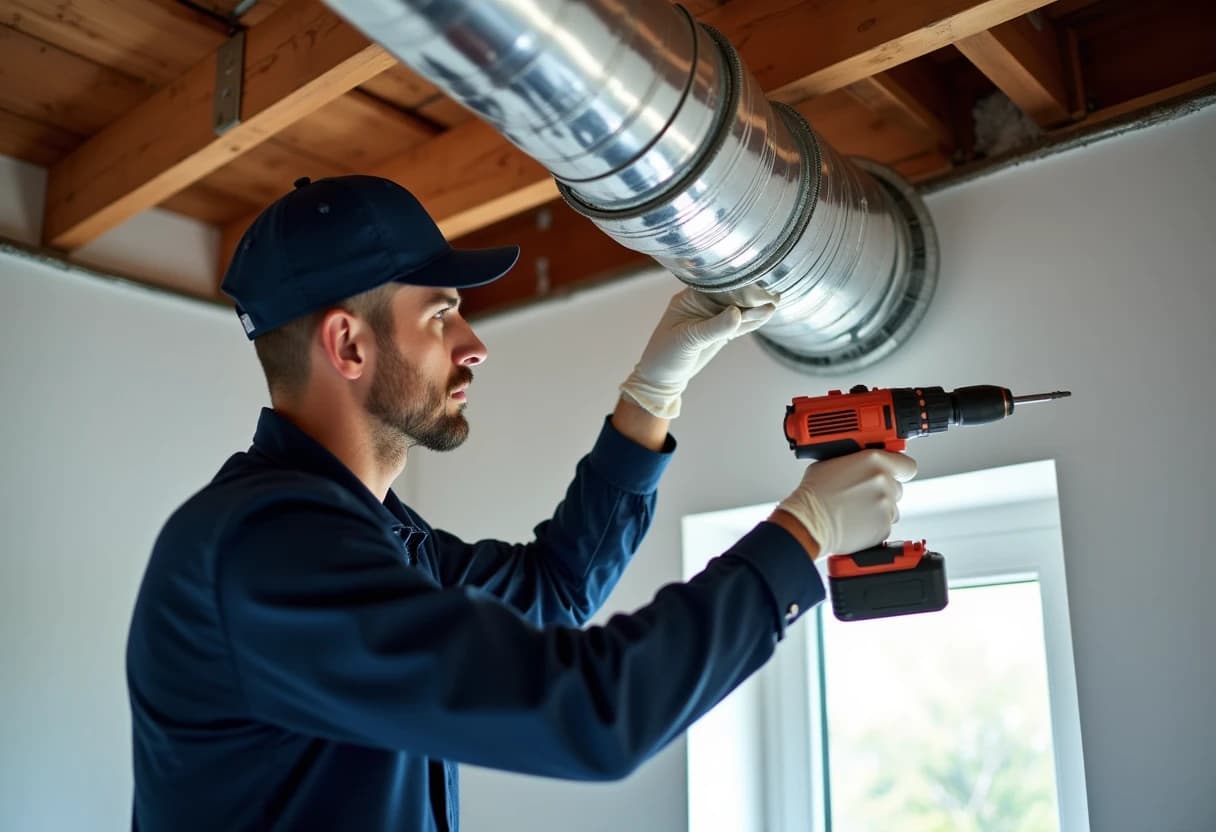
The building code is specific about dryer venting for a reason written in fire statistics: the IRC's dryer exhaust rules (Section M1502) call for smooth-interior rigid metal duct, a 4-inch diameter, a maximum equivalent length of 35 feet with deductions for every elbow, no fasteners protruding into the airstream, and a termination with a backdraft damper and no screen. Most Greater Boston homes fail several of those tests, because their vents were improvised generations ago. Our installation service brings your Tewksbury laundry up to that standard — a new route where the old one is hopeless, rigid metal end to end, and documentation that satisfies inspectors, insurers and condo boards.
Why Dryer Vent Installation & Rerouting Matters for Tewksbury Homes
There is also a straightforward performance and cost case. A dryer on a proper vent dries a standard load in one cycle; on a bad vent, in two — doubling energy per load, roughly $10 to $20 a month for a busy household, while heat-cycling the machine toward early component failure. A rigid, correctly sloped, correctly sized system also changes the maintenance economics: annual cleanings on smooth duct are quick and thorough, blockage-level service calls largely disappear, and appliance repairs caused by backpressure — thermal fuses, elements, high-limit switches — stop recurring. Add the avoided moisture damage (each load carries about a gallon of water that either exits the termination or enters your building assemblies) and the installation typically pays a real fraction of its cost back within a couple of years, then keeps paying. For homes about to sell, documented code-compliant venting removes a standard inspection flag before it costs a negotiation. For homes about to install a new dryer, it protects the warranty, which manufacturers condition on adequate exhaust. Either way, it is infrastructure bought once and used every laundry day for decades.
Basement laundries dominate Tewksbury's housing stock, and they are where thoughtful venting matters most. Tewksbury built out in waves - post-war ranches and capes near the Lowell line, 1970s-80s split-entries and garrisons through the center, and newer condo communities and 40B developments along Routes 38 and 133. The split-entry era homes typically run ducted systems through finished lower levels, where flex-duct branches get crushed above drop ceilings, and the new condos stack long dryer vent runs. A below-grade dryer must exhaust up and out — through the rim joist above the foundation, most often — and every foot of that run crosses cold space where moist exhaust wants to condense. Tewksbury's location between the Shawsheen River wetlands and busy I-93 and I-495 corridors means homes here collect both damp riverine air and fine highway particulates in their duct systems. The town's many finished-basement split-entries are also where we most often find supply runs contaminated by years of below-grade humidity. Our basement installations handle both problems by design: the shortest legal route to a rim-joist or high-wall termination, continuous slope so any condensate drains outward, and insulation on duct crossing unheated space. The result is a basement laundry that stays dry, and a vent that stays clear between annual cleanings.
Our Dryer Vent Installation & Rerouting Process in Tewksbury
1Site Assessment & Route Planning
Planning is where installations succeed or fail, so we do it deliberately: equivalent-length math on paper, termination clearances checked against grade, snow line, openings and property conditions, and the penetration point chosen for both duct efficiency and envelope integrity. For renovations, we are glad to plan while walls are open — the cheapest routing decisions are made before drywall.
2Demolition of Non-Compliant Venting
Old venting comes out carefully, not destructively: we protect finishes, keep openings minimal, and document conditions as we find them. What we uncover often explains years of symptoms — a crushed flex section behind a wall, a joint that separated a decade ago, a cavity lined with escaped lint. Photos go in your record.
3Cut & Flash the Exterior Penetration
Penetrations are where amateur installs leak — water into sheathing, air into cavities. Ours are built like window details: sized to the hood, flashed to shed water over the cladding, sealed with quality exterior sealant, and finished so the termination looks intentional on the facade. On masonry we drill and anchor; we never improvise attachment.
4Install Rigid Metal Duct on the Planned Route
The run goes in as 4-inch smooth-interior rigid metal duct — the material the IRC specifies — cut to fit, joined male-to-female in the direction of airflow, and assembled without a single screw protruding into the airstream: joints are clamped or externally fastened and sealed with UL-listed foil tape. Elbows are used sparingly and counted against the length budget.
5Mount the Termination Hood & Damper
Where pests are a known pressure — and in Greater Boston they are — we fit guard designs engineered for dryer exhaust: excluding birds and rodents without restricting airflow or trapping lint. We also note the hood in your service record so future cleanings include damper checks, keeping the one wear-prone component watched for the system's life.
6Connect the Appliance & Seal the System
At the dryer, we install a short UL-listed semi-rigid aluminum transition duct — the only place flexible material belongs — clamped at both ends and routed so it keeps full diameter when the machine is pushed to its working position. We mark the safe setback so the connector is never crushed by a future shove against the wall.
7Test, Verify & Document the Installation
Before we leave: work areas vacuumed with HEPA equipment, penetration debris removed, the dryer set and leveled, and a walkthrough of the finished system — where it runs, how the damper should look during a cycle, and when the first annual cleaning is due. A correctly built vent needs almost nothing from you; we make sure you know the little it does.
Benefits of Professional Dryer Vent Installation & Rerouting in Tewksbury
Dramatically Faster Drying
Shortening a wandering 40-foot run to a direct 12-foot route transforms drying performance: full airflow means each cycle actually exhausts the gallon of moisture a load releases, so sensor dryers stop running overtime and heavy loads finish in one pass. Customers routinely describe post-installation performance as having bought a new machine.
A Laundry Located Where You Actually Want It
Relocation also fixes inherited mistakes: many Tewksbury-area laundries sit where a previous owner could most easily improvise a vent, not where the household actually wants to do laundry. Once the exhaust is treated as a designed system, the laundry can finally move to where life happens.
Moisture Managed, Structure Protected
Moisture protection extends to the envelope itself: our flashed, sealed penetrations keep wind-driven rain out of walls and roofs for the long term. An installation is only as good as its weakest detail, and the exterior detail is the one that faces forty years of nor'easters. We build it like it will.
Decades of Service From a One-Day Job
The one-day timeline is real for most installations: assessment and route confirmation, demolition of old venting, penetration, duct assembly, termination, connection and commissioning typically fit a single visit. Complex reroutes through finished space may take a second day. Either way, laundry is back in service the same evening.
Permanently Lower Energy Costs
Sealed rigid duct also stops the hidden energy leaks of bad systems: conditioned air escaping through gapped joints, winter infiltration through failed dampers, and the heating-season cost of a laundry room with a permanent 4-inch draft. A tight system with a tight damper closes all of it.
Fire-Safe by Design, Not by Vigilance
Roughly 2,900 US home dryer fires a year trace overwhelmingly to lint, and lint traces to the installation faults a proper build eliminates: flex corrugations, overlong runs, obstructed airstreams. Replacing an improvised vent with an engineered one is the single largest permanent reduction in dryer fire risk available to a homeowner.
Signs Your Tewksbury Home Needs Dryer Vent Installation & Rerouting
A New Laundry Location Needs Its First Vent
Renovation is the moment of maximum leverage: we consult with homeowners and contractors while framing is open, position the laundry within the length budget, and rough in the run for pennies on the retrofit dollar. If your project touches the laundry's walls or ceiling, call before drywall — future you will be grateful.
Blockages and Repairs Keep Recurring
The tell is the fade: a fresh cleaning helps for a few weeks, then performance sags again as lint resettles in the same flex ridges and dead-air corners. Well-designed systems hold their cleaning for a full year. If yours cannot, stop paying to maintain the flaw and price the fix.
Your Vent Is Flexible Plastic or Foil Duct
Look behind and beyond your dryer: if the exhaust path is white vinyl or shiny foil accordion hose — especially if it disappears into a wall or ceiling that way — the system needs replacement, not another cleaning. Flex materials trap lint in every corrugation, crush at a touch, and in vinyl's case can melt. Codes and manufacturers rejected them long ago.
The Dryer Vents Indoors — Anywhere
Indoor venting is often invisible until you look: the duct disappears upward and no exterior hood exists anywhere on the house. If you cannot find your termination outside, find out where the exhaust actually goes — attic discoveries after years of indoor venting routinely involve soaked insulation, staining and mold remediation on top of the vent work.
Chronic Condensation the Route Guarantees
Some vents condense because of damage; others condense because of design — long uninsulated passages through cold basements, garages or attics where exhaust cannot stay above its dew point, or bellied routes with no slope to drain. When repair visits keep treating water in the same duct, the route is the diagnosis, and rerouting or rebuilt insulation and slope is the cure.
The Run Is Overlong or Elbow-Heavy
The symptom pattern of an overlong run: drying times that were never good, cleanings that help briefly and fade fast, and lint accumulating mid-run rather than at the ends. No maintenance schedule fixes a route that exceeds the appliance's reach; rerouting to a shorter path is the only durable answer.
Dryer Vent Installation & Rerouting Cost in Tewksbury, MA
Rerouting deserves its own cost frame, because its value is measured against the run it replaces. Shortening a 40-foot flex wander to a 12-foot rigid route typically costs $500 to $900 — and permanently removes the conditions that were costing you money continuously: second drying cycles (roughly $10 to $20 a month in energy for a busy household), twice-yearly cleanings instead of annual, recurring blockage calls, and the appliance repairs that backpressure schedules (thermal fuses and elements at $150 to $400 a visit). Most households with genuinely bad routes recover the rerouting cost within two to three years through those avoided expenses, then keep the savings for decades. There is also the risk column, harder to price but real: overlong flex runs are heavily represented in the roughly 2,900 annual US dryer fires, and their moisture leakage feeds mold remediation bills that start around $1,500. When we quote a reroute, we show you this math against your actual route — some marginal systems are worth keeping and maintaining, and we say so when they are.
Want the full pricing picture? See our complete Boston-area cost guide or call (617) 390-7145 for an exact flat quote for your Tewksbury home.
Local Knowledge: Tewksbury, Middlesex County
What makes Tewksbury different? Tewksbury built out in waves - post-war ranches and capes near the Lowell line, 1970s-80s split-entries and garrisons through the center, and newer condo communities and 40B developments along Routes 38 and 133. The split-entry era homes typically run ducted systems through finished lower levels, where flex-duct branches get crushed above drop ceilings, and the new condos stack long dryer vent runs. Tewksbury's location between the Shawsheen River wetlands and busy I-93 and I-495 corridors means homes here collect both damp riverine air and fine highway particulates in their duct systems. The town's many finished-basement split-entries are also where we most often find supply runs contaminated by years of below-grade humidity. For duct and dryer vent systems, those local factors translate into specific, predictable problems — and predictable problems are the ones we solve fastest. Call (617) 390-7145, tell us your street and home style, and we will quote the job accurately the first time, usually in under five minutes.
The Best Time of Year in Tewksbury
New England's building stock gives installation a seasonal maintenance logic too. Coastal and near-coastal homes lose termination hardware to salt corrosion years ahead of inland schedules, making hood quality and periodic inspection part of the design conversation. Freeze-thaw cycles work on every exterior penetration, which is why our flashing details are built to roofing standards rather than caulk-and-hope. And the region's centuries-old walls — balloon framing, stone foundations, triple wythe brick — reward installers who have opened them before and punish those improvising on the day. We schedule the weather-sensitive stages around the forecast, stock the fittings old construction demands, and build every system for the specific abuse a Massachusetts year delivers: forty inches of snow, ninety-degree dew-point weeks, and the two hundred laundry days in between.
Why Choose Boston Air Duct Cleaners
As a West Newton-based company, we treat Tewksbury like the neighborhood it is — because for us, it is. Our reputation lives or dies on local referrals, so every job gets the full process: complete system cleaning under negative pressure, mechanical agitation of every run, blower compartment service, and a documented walkthrough before we leave. We are licensed and insured, our estimates are free and flat, and our schedule holds same-day slots for urgent calls. One visit and you will understand why neighbors keep our magnet on the fridge.
Serving Tewksbury and Surrounding Communities
Beyond Tewksbury, our crews cover the surrounding communities daily — including Lowell, Billerica, Wilmington, Andover, Dracut, Chelmsford. Because routes cluster geographically, booking alongside a neighboring appointment often unlocks same-day service and combined-visit savings. Wherever you are in Middlesex County, the same flat-rate pricing, insured technicians and photo-documented process applies.