
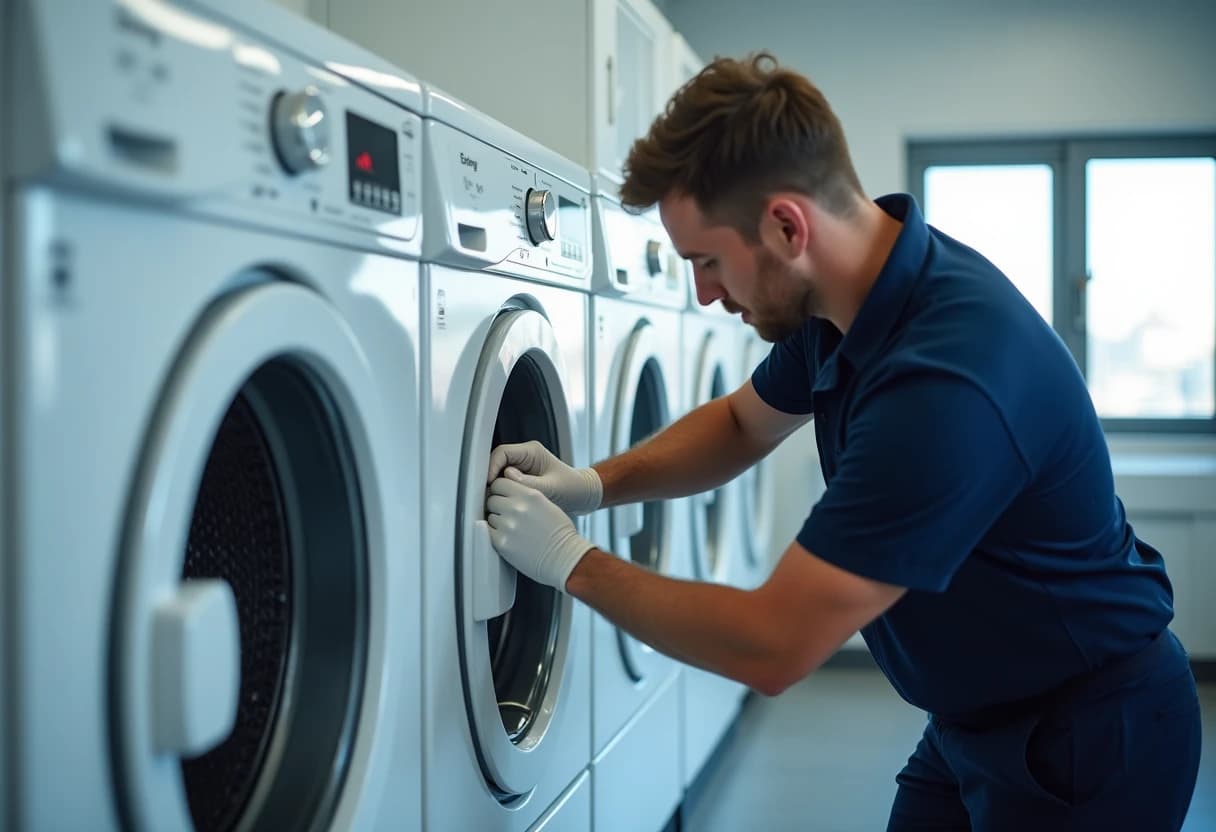
Lint is the most flammable substance most buildings produce daily, and dryer vents concentrate it precisely where heat lives. The National Fire Protection Association's data is blunt: failure to clean is the leading factor in home clothes dryer fires, and multi-family buildings carry the compounded exposure of many dryers behind one set of walls. Our Stoneham commercial program serves condominiums, apartment buildings, townhome HOAs, senior housing and laundromats with full-building vent cleaning: every run brushed and vacuumed end to end, terminations and dampers cleared and checked, hazardous transition ducts flagged, and airflow measured after cleaning. Boards get one flat proposal, residents get minimal disruption, and everyone gets the report that proves it happened.
Why Commercial & Multi-Unit Dryer Vent Cleaning Matters for Stoneham Homes
Laundromats and high-duty commercial laundry face the same physics at industrial intensity. A commercial dryer cycling ten hours a day produces more lint in a week than a household machine does in a year, and that lint loads into manifolded duct systems that were often sized optimistically to begin with. The operational symptoms arrive before the fire risk peaks: dry times stretch, customers complain and leave, gas consumption climbs, high-limit switches trip, and machines cook their own components in the trapped heat. NFPA 211 and equipment manufacturers alike call for regular exhaust cleaning at commercial duty cycles — quarterly or better in busy stores, not the annual rhythm of a home. Our commercial program matches the interval to your throughput: full mechanical cleaning of each machine's run and every common trunk, termination and damper service, booster fan cleaning where installed, and airflow verification numbers before and after so you can see the recovery. Most operators find the service pays for itself in gas savings and machine uptime before the fire-safety benefit is even counted.
Multi-unit housing defines Stoneham, and its dryer venting shows the accumulated improvisation of decades. Stoneham's shoe-industry roots left a core of 1880s-1920s Victorians and colonials around the Town Common, surrounded by capes and ranches from the post-war years and condo developments near the Fells and along Route 28. Many of the older homes converted from steam or gravity heat to forced air decades ago, and those first-generation duct retrofits are now well past due for attention. In buildings like these, vents were often added long after construction — routed through basements, snaked to whatever wall was nearest, extended during renovations — and many have never been professionally cleaned since installation. Wrapped on two sides by the Middlesex Fells and Spot Pond, Stoneham homes take in heavy woodland pollen in spring and damp, leafy air each fall that settles through duct systems. The town's steady turnover of mid-century homes to young families also means lots of renovation projects sending drywall and sanding dust into ductwork. Our crews work Stoneham buildings regularly and carry what its stock demands: rotary systems for long improvised runs, ladder and roof access for upper-floor terminations, and the patience for buildings where every unit's vent tells a different story. Boards get one proposal, one project, one per-unit report.
Our Commercial & Multi-Unit Dryer Vent Cleaning Process in Stoneham
1Building Walkthrough & Per-Unit Proposal
Every building project starts with a walkthrough: we identify how each unit vents — individual wall runs, shared vertical risers, common trunk lines — locate terminations on walls and roofs, note access requirements, and inspect representative runs. The proposal that follows prices the building flat, per unit, with riser and common-duct service itemized, so boards approve a known number.
2Resident Coordination & Scheduling
For occupied buildings, logistics decide whether a project succeeds. Ours run on a simple system: management distributes our notice template with dates; we sequence units floor by floor to keep crews moving; a coordinator handles reschedules and lockouts as they arise; and the final report distinguishes cleaned, no-access and exception units explicitly, because an insurer reading it will want exactly that distinction.
3Dryer-Side Service: Transition Duct & Connection
The first feet of the vent path fail most often: crushed transition hoses behind the dryer, lint packed at the wall connection, and prohibited foil accordion duct that sags into lint-collecting bellies. We service this section in every unit — machine pulled, area vacuumed, transition cleaned or replacement offered, connection remade properly — because a clean wall duct fed through a clogged transition solves nothing.
4Mechanical Cleaning of the Full Vent Run
The in-wall duct is cleaned end to end with rotary brush systems driven through the full run while a high-powered vacuum captures dislodged lint — the same agitation-plus-extraction principle as NADCA duct cleaning, sized for 4-inch dryer duct. Long runs and multiple elbows get repeat passes; the pass is complete when the brush returns clean and airflow verifies.
5Shared Risers, Common Trunks & Booster Fans
Common-element ducts get common-element treatment: documented condition before and after, cleaning with equipment sized for vertical and long-trunk work, and function checks on the mechanical components — booster fans, backdraft dampers, rooftop exhaust terminations — that keep a shared system moving air. For associations, this is the portion of the project that most clearly discharges the board's maintenance duty, and we document it accordingly.
6Termination Service & Exterior Verification
Every vent ends at a termination, and terminations fail constantly: flaps stuck open to pests or frozen shut with lint, screens added by well-meaning painters (code prohibits them — they trap lint), caps crushed or painted over, bird and rodent nests in the hood. We clear and verify every termination, on walls or roofs, with ladder and roof access included in the project scope.
7Airflow Verification & Building Compliance Report
Verification is what separates a maintenance program from a receipt. We confirm restored airflow run by run, re-photograph representative ducts against their before images, and compile the compliance report: every unit's status, every exception explained, every hazard located and pictured, every recommendation priced separately for board action. Associations on our annual program receive the same format each cycle, so year-over-year condition is genuinely comparable.
Benefits of Professional Commercial & Multi-Unit Dryer Vent Cleaning in Stoneham
Insurance & Liability Documentation That Holds Up
Documentation converts maintenance into protection. The same cleaning, undocumented, protects the building physically but leaves the association exposed on paper. Our reports close that gap: scope, method, dates, per-unit outcomes and photographic evidence, delivered in a format managers file once and retrieve in minutes when the renewal questionnaire arrives.
Hazard Discovery Before It Costs You
The inspection value of a building-wide project rivals the cleaning value. Our unit-by-unit documentation regularly surfaces conditions associations did not know they had — moisture damage from leaking ducts, code violations from old renovations, pest entry at damaged terminations — while they are still inexpensive line items rather than insurance claims.
Volume Pricing That Beats Unit-by-Unit Service
A single-home dryer vent cleaning in Greater Boston runs $150–$250; on a coordinated building project, per-unit pricing drops steeply — often to a fraction of retail — because mobilization, travel and setup are shared across dozens of units. The building gets professional service in every unit for less than residents could ever arrange individually.
Longer Dryer Life & Fewer Appliance Failures
Dryers venting against a clogged duct cook themselves: heating elements cycle against trapped heat, thermostats and thermal fuses trip and fail, motors run hot and die early. Clear venting is the cheapest appliance-life extension available — a point every appliance manufacturer's manual makes, and every burned-out element invoice repeats.
Directly Reduced Fire Risk, Building-Wide
Fire prevention in shared-wall housing is collective by nature: one blocked vent endangers the neighbors, and no resident can clean the common risers. A coordinated cleaning is the only mechanism that actually resets the whole building's risk — every run, every riser, every termination verified clear on the same dated report.
A Program, Not a Project
One-time cleanings decay; lint production never stops. An annual program keeps every run permanently inside its safe accumulation window, keeps documentation permanently current for insurers, and keeps the cost flat and predictable. Associations that institutionalize it typically spend less per year than their first catch-up cleaning cost — and never face a catch-up again.
Signs Your Stoneham Home Needs Commercial & Multi-Unit Dryer Vent Cleaning
High-Duty Operations: Laundromats & Common Laundry Rooms
Shared laundry rooms in apartment and condo buildings combine commercial duty with residential oversight — machines run all day, but no one owns the maintenance. Booster fans cake with lint and stall, common trunks load up, and the room runs hot. If your building's laundry room fits that description, it is the building's single most overdue vent.
Lint Visible at Terminations or on the Building Exterior
Lint beards on wall caps, gray fuzz on the siding below terminations, or lint scatter on the roof around stack outlets mean the ducts are so loaded they are extruding their contents. What escapes outside is the overflow; the accumulation inside the run is worse, and the affected units are drying against serious restriction.
No One Can Say When Vents Were Last Cleaned
Buildings inherit their venting history blind: previous owners' renovations, decades of resident turnover, and zero records. FEMA's dryer-fire data — about 2,900 a year, led by failure to clean — describes exactly this population of never-serviced vents. A documented first cleaning moves your building out of that statistic's denominator.
Insurance Questionnaires or Post-Incident Requirements
Carriers writing habitational risk in Massachusetts have tightened on dryer venting because loss data justifies it. Boards seeing new questionnaire language, inspection requirements or premium credits tied to vent maintenance should read the market signal: this is now standard due diligence for multi-unit buildings, and the documented program is what compliance looks like.
Burning Smells, Hot Laundry Areas or Tripped Thermal Fuses
Laundry rooms that run noticeably hot and humid indicate exhaust air staying in the building — restricted ducts, failed boosters or leaking joints. Beyond discomfort, that moisture feeds mold in shared spaces and the heat stresses every machine in the room. Both symptoms resolve when the common venting actually moves its design airflow.
Dryers Taking Two or More Cycles Per Load
The test is simple: a healthy dryer with clear venting dries a standard load in one cycle. Track your building's work orders — clusters of slow-dry, no-heat and thermal-fuse tickets are the venting system asking for service, and each ticket represents a unit running its dryer at elevated temperature against a restricted duct.
Commercial & Multi-Unit Dryer Vent Cleaning Cost in Stoneham, MA
Three questions frame every building quote: How many units, and how does each vent? What common-element ductwork exists — risers, trunks, boosters, laundry-room manifolds? And what does access require — resident scheduling only, or ladder, lift and roof work? A six-unit triple-decker pair with individual wall vents might quote near $300–$600 total. A 40-unit garden complex typically lands in the $1,600–$3,000 range. A high-rise with shared risers is quoted as units plus riser service, often phased across budget years. What associations should refuse to pay: per-unit teaser rates that exclude the dryer pull, the transition duct or the termination (the three most failure-prone segments), 'discovery' surcharges invented mid-project, and any proposal without per-unit completion reporting — because in multi-unit work, undocumented cleaning fails at half its job.
Want the full pricing picture? See our complete Boston-area cost guide or call (617) 390-7145 for an exact flat quote for your Stoneham home.
Local Knowledge: Stoneham, Middlesex County
Every town's ductwork tells the story of its housing. Stoneham's shoe-industry roots left a core of 1880s-1920s Victorians and colonials around the Town Common, surrounded by capes and ranches from the post-war years and condo developments near the Fells and along Route 28. Many of the older homes converted from steam or gravity heat to forced air decades ago, and those first-generation duct retrofits are now well past due for attention. Wrapped on two sides by the Middlesex Fells and Spot Pond, Stoneham homes take in heavy woodland pollen in spring and damp, leafy air each fall that settles through duct systems. The town's steady turnover of mid-century homes to young families also means lots of renovation projects sending drywall and sanding dust into ductwork. We plan Stoneham jobs around those realities, from equipment selection to time on site, and it shows in the results. If you live near Stone Zoo or anywhere across Stoneham's 02180 area, we have almost certainly cleaned a system like yours before — and we can tell you exactly what to expect before we arrive.
The Best Time of Year in Stoneham
Budget season is the other calendar that matters. Condo boards and HOAs typically set budgets in fall for January fiscal years, and management companies batch portfolio maintenance into spring and fall windows — so the associations that get the best scheduling are the ones whose proposals are in hand before the budget meeting, not after the insurance renewal letter. Our walkthroughs and written building proposals are free and typically delivered within a week, which makes September the ideal month to price a program for board approval, October through November the prime execution window, and spring the natural slot for portfolio managers batching multiple properties. Insurance renewal dates deserve the same planning: a completed compliance report dated before the questionnaire arrives reads as a program; one dated after reads as a scramble. We calendar program buildings so the report always predates the renewal.
Why Choose Boston Air Duct Cleaners
What separates us from the coupon crowd is simple: we do the whole job, we prove it, and we charge what we quoted. Our technicians clean supplies, returns, trunks and blower compartments on every visit — never a cosmetic vent wipe. Photo documentation comes standard, pricing is flat and confirmed up front, and our trucks carry true commercial vacuum equipment, not rented shop-vacs. Based in West Newton and serving Stoneham year-round, we answer our own phone at (617) 390-7145 and stand behind every cleaning with a satisfaction guarantee.
Serving Stoneham and Surrounding Communities
Stoneham sits in the heart of our service area, and neighboring Melrose, Wakefield, Reading, Woburn, Winchester, Medford appointments share the same routes. That density is why our response times in this part of Middlesex County are among our fastest — and why you will see our trucks in the area week after week.