
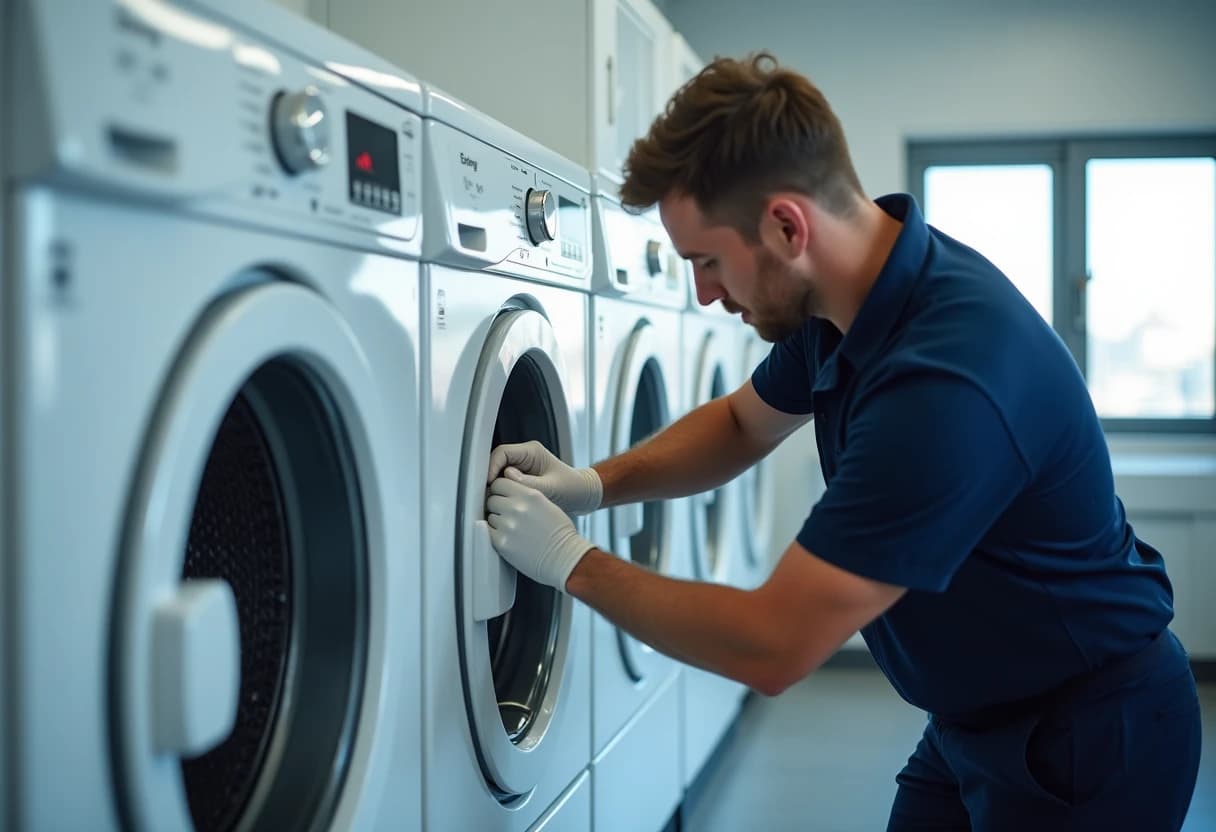
Laundromats and shared laundry rooms push dryer venting harder than any residential setting: commercial dryers cycling all day, multiple machines manifolded into common ducts, and lint production measured in pounds per week. A clogged vent in this environment does not just risk fire — it lengthens dry times, drives up gas and electric costs, trips high-limit switches and burns out machines. Our commercial dryer vent service covers Rowley laundromats, coin-op rooms in apartment buildings, salons, gyms and any business that dries in volume: full mechanical cleaning of each duct run and common manifold, termination and damper service, before-and-after airflow verification, and maintenance intervals matched to your machine duty cycle rather than a generic calendar.
Why Commercial & Multi-Unit Dryer Vent Cleaning Matters for Rowley Homes
Multi-family buildings accumulate venting problems single homes never see. Stacked units in mid-rise and high-rise construction often share vertical risers — one common duct serving multiple dryers — where lint from every household compounds and where no individual resident can clean even if they try. Long horizontal runs snake through ceiling plenums to reach an outside wall, exceeding the code intent of the IRC's 35-foot equivalent-length limit once elbows are deducted. Renovations leave behind crushed flex duct, illegal screw-joined sections that snag lint, and foil accordion transitions that both the code and every dryer manufacturer warn against. Terminations get painted shut, screened over (another code violation — screens trap lint), or blocked by bird nests three stories up where nobody looks. Our crews see all of it weekly, and the whole-building service is designed for it: equipment for vertical risers and roof terminations, unit-by-unit condition documentation, and honest flagging of the hazards that cleaning alone cannot fix, priced separately for board approval. You cannot manage what has never been inspected — and most buildings have never been inspected.
Multi-unit housing defines Rowley, and its dryer venting shows the accumulated improvisation of decades. Rowley pairs genuine First Period and Colonial farmhouses around the Town Common with rural ranches, capes and 1990s-2000s colonials set on large lots along Routes 1 and 1A. The antique homes typically run ductless or hybrid heating, while the newer subdivision colonials carry full forced-air systems with long basement trunk lines feeding sprawling floor plans. In buildings like these, vents were often added long after construction — routed through basements, snaked to whatever wall was nearest, extended during renovations — and many have never been professionally cleaned since installation. Bordering the Great Marsh puts Rowley homes in the path of persistent coastal moisture that encourages mildew in basements and duct runs, especially in houses closed up tight through winter. Rural gravel drives, farm fields and the weekly crowds at Todd Farm also generate fine dust that finds its way into return ducts season after season. Our crews work Rowley buildings regularly and carry what its stock demands: rotary systems for long improvised runs, ladder and roof access for upper-floor terminations, and the patience for buildings where every unit's vent tells a different story. Boards get one proposal, one project, one per-unit report.
Our Commercial & Multi-Unit Dryer Vent Cleaning Process in Rowley
1Building Walkthrough & Per-Unit Proposal
We scope before we quote: unit count and layout, vent configurations and lengths, termination locations and access (ladder, lift or roof), laundry room and common-area equipment, and any known problem units. Associations receive a fixed proposal with volume per-unit pricing, a project schedule with resident notice templates, and the reporting format agreed in advance so the board knows exactly what deliverable closes the project.
2Resident Coordination & Scheduling
For occupied buildings, logistics decide whether a project succeeds. Ours run on a simple system: management distributes our notice template with dates; we sequence units floor by floor to keep crews moving; a coordinator handles reschedules and lockouts as they arise; and the final report distinguishes cleaned, no-access and exception units explicitly, because an insurer reading it will want exactly that distinction.
3Dryer-Side Service: Transition Duct & Connection
In each unit we pull the dryer, clean behind and beneath it — a major hidden lint reservoir — and service the transition duct between machine and wall. Foil accordion transitions, which manufacturers prohibit and which trap lint in every corrugation, are flagged and can be replaced on the spot with code-appropriate material. The connection is reseated and secured without airstream-penetrating screws, per code.
4Mechanical Cleaning of the Full Vent Run
Compressed-air whips and rotary brushes work the duct from the unit connection toward the termination, mechanically stripping the lint mat that blowers and leaf-blower shortcuts merely compact. Every elbow — each one worth 5 feet of equivalent length under code math, and each one a lint trap in practice — gets deliberate attention. Extracted lint is bagged per unit, which residents find quietly persuasive.
5Shared Risers, Common Trunks & Booster Fans
Stacked buildings route multiple dryers into shared vertical risers, and these common elements are where multi-unit lint risk concentrates — no resident can clean them, and every household loads them. We service risers from terminations and access points with vertical-run equipment, clean common horizontal trunks and basement manifolds, and service inline booster fans, whose blades cake with lint and quietly fail.
6Termination Service & Exterior Verification
Every vent ends at a termination, and terminations fail constantly: flaps stuck open to pests or frozen shut with lint, screens added by well-meaning painters (code prohibits them — they trap lint), caps crushed or painted over, bird and rodent nests in the hood. We clear and verify every termination, on walls or roofs, with ladder and roof access included in the project scope.
7Airflow Verification & Building Compliance Report
The project closes with documentation built for its real audiences. Management receives a unit-by-unit log with service dates and technician notes; the board receives a summary with building-level findings — riser condition, termination issues, prohibited transition ducts by unit — and prioritized recommendations; and the insurance-ready certificate states scope, method and completion date. Next year's cycle is calendared before we leave.
Benefits of Professional Commercial & Multi-Unit Dryer Vent Cleaning in Rowley
Longer Dryer Life & Fewer Appliance Failures
In buildings where management owns the machines — common laundry rooms, included-appliance rentals, laundromats — vent restriction is a direct capital cost: premature element, fuse and motor failures across the fleet. Regular vent service is fleet maintenance, and operators who adopt it consistently report fewer service calls and longer replacement cycles.
Shorter Dry Times & Lower Utility Costs
Every minute of extra runtime is heat pushed against a clogged duct: wasted energy, elevated temperatures, and accelerated wear. Post-cleaning, residents notice loads finishing in one cycle again — the most tangible everyday benefit of the program and the one that quiets the steady trickle of 'my dryer is broken' maintenance tickets.
Directly Reduced Fire Risk, Building-Wide
Lint-clogged venting is the leading factor in the roughly 2,900 US dryer fires FEMA counts each year, and multi-unit buildings multiply the exposure by their unit count. Whole-building cleaning removes the fuel and restores the airflow that keeps duct temperatures in design range — addressing the top cause of a genuinely common fire, in every unit at once.
Volume Pricing That Beats Unit-by-Unit Service
Coordinated projects are simply more efficient: one mobilization, sequenced access, crews completing multiple units per hour, shared risers cleaned once for everyone above them. We pass that efficiency through as per-unit volume pricing scaled to building size, which is why an annual program typically costs an association less per door than one emergency service call.
Insurance & Liability Documentation That Holds Up
Boards carry a duty to maintain common elements, and in most governing documents the vent path beyond the unit wall qualifies. A dated, unit-by-unit report demonstrates that duty discharged — and the annual repetition of it demonstrates a program, which is what diligence actually looks like to a carrier or a court.
A Program, Not a Project
One-time cleanings decay; lint production never stops. An annual program keeps every run permanently inside its safe accumulation window, keeps documentation permanently current for insurers, and keeps the cost flat and predictable. Associations that institutionalize it typically spend less per year than their first catch-up cleaning cost — and never face a catch-up again.
Signs Your Rowley Home Needs Commercial & Multi-Unit Dryer Vent Cleaning
Insurance Questionnaires or Post-Incident Requirements
When the master-policy renewal asks 'When were dryer vents last professionally cleaned?', the underwriting message is explicit: this risk is on their radar, and undocumented buildings price accordingly. A completed building-wide cleaning with per-unit reporting answers the question directly — and answering it before renewal season is markedly cheaper than answering it after a nonrenewal notice.
Lint Visible at Terminations or on the Building Exterior
Walk the building perimeter and look at every vent hood: visible lint at the flap, caps that no longer close, vegetation fuzzy with fibers below the outlet. These external tells are free inspection data, and they reliably indicate runs overdue for mechanical cleaning — plus terminations that need damper service while the crew is there.
Burning Smells, Hot Laundry Areas or Tripped Thermal Fuses
Thermal fuses and high-limit switches exist to interrupt exactly this failure, and their tripping is diagnostic: heat had nowhere to go. Repeated no-heat service calls on building machines are the venting system burning through safety margins. Clean the exhaust paths before the next component in that chain is the lint itself.
No One Can Say When Vents Were Last Cleaned
Buildings inherit their venting history blind: previous owners' renovations, decades of resident turnover, and zero records. FEMA's dryer-fire data — about 2,900 a year, led by failure to clean — describes exactly this population of never-serviced vents. A documented first cleaning moves your building out of that statistic's denominator.
Dryers Taking Two or More Cycles Per Load
Residents report it as an appliance problem — 'the dryer is getting old' — but two-cycle drying is a venting symptom far more often than a machine failure. Before replacing dryers or fielding another season of complaints, verify the exhaust path; in multi-unit buildings a pattern of slow-dry complaints maps reliably onto clogged runs and risers.
High-Duty Operations: Laundromats & Common Laundry Rooms
Commercial duty cycles compress the maintenance calendar: a laundromat dryer produces in weeks the lint a household machine makes in a year, loading manifolded ducts continuously. If your store has never set a cleaning interval matched to throughput, the venting is overdue by definition — quarterly service is typical for busy operations.
Commercial & Multi-Unit Dryer Vent Cleaning Cost in Rowley, MA
Three questions frame every building quote: How many units, and how does each vent? What common-element ductwork exists — risers, trunks, boosters, laundry-room manifolds? And what does access require — resident scheduling only, or ladder, lift and roof work? A six-unit triple-decker pair with individual wall vents might quote near $300–$600 total. A 40-unit garden complex typically lands in the $1,600–$3,000 range. A high-rise with shared risers is quoted as units plus riser service, often phased across budget years. What associations should refuse to pay: per-unit teaser rates that exclude the dryer pull, the transition duct or the termination (the three most failure-prone segments), 'discovery' surcharges invented mid-project, and any proposal without per-unit completion reporting — because in multi-unit work, undocumented cleaning fails at half its job.
Want the full pricing picture? See our complete Boston-area cost guide or call (617) 390-7145 for an exact flat quote for your Rowley home.
Local Knowledge: Rowley, Essex County
Every town's ductwork tells the story of its housing. Rowley pairs genuine First Period and Colonial farmhouses around the Town Common with rural ranches, capes and 1990s-2000s colonials set on large lots along Routes 1 and 1A. The antique homes typically run ductless or hybrid heating, while the newer subdivision colonials carry full forced-air systems with long basement trunk lines feeding sprawling floor plans. Bordering the Great Marsh puts Rowley homes in the path of persistent coastal moisture that encourages mildew in basements and duct runs, especially in houses closed up tight through winter. Rural gravel drives, farm fields and the weekly crowds at Todd Farm also generate fine dust that finds its way into return ducts season after season. We plan Rowley jobs around those realities, from equipment selection to time on site, and it shows in the results. If you live near Todd Farm Flea Market or anywhere across Rowley's 01969 area, we have almost certainly cleaned a system like yours before — and we can tell you exactly what to expect before we arrive.
The Best Time of Year in Rowley
Budget season is the other calendar that matters. Condo boards and HOAs typically set budgets in fall for January fiscal years, and management companies batch portfolio maintenance into spring and fall windows — so the associations that get the best scheduling are the ones whose proposals are in hand before the budget meeting, not after the insurance renewal letter. Our walkthroughs and written building proposals are free and typically delivered within a week, which makes September the ideal month to price a program for board approval, October through November the prime execution window, and spring the natural slot for portfolio managers batching multiple properties. Insurance renewal dates deserve the same planning: a completed compliance report dated before the questionnaire arrives reads as a program; one dated after reads as a scramble. We calendar program buildings so the report always predates the renewal.
Why Choose Boston Air Duct Cleaners
Homeowners across Essex County choose Boston Air Duct Cleaners for three reasons. First, honesty: our inspection camera tells you whether your system actually needs cleaning — and sometimes the answer is no. Second, capability: truck-grade negative-air machines, rotary brush systems and HEPA filtration handle everything from antique gravity-furnace conversions to brand-new high-velocity systems. Third, accountability: flat quoted pricing, before-and-after photos, insured technicians, and a real local office you can call at (617) 390-7145. That combination is rarer in this industry than it should be.
Serving Rowley and Surrounding Communities
Beyond Rowley, our crews cover the surrounding communities daily — including Ipswich, Georgetown, Topsfield, Hamilton, Essex, Wenham. Because routes cluster geographically, booking alongside a neighboring appointment often unlocks same-day service and combined-visit savings. Wherever you are in Essex County, the same flat-rate pricing, insured technicians and photo-documented process applies.