
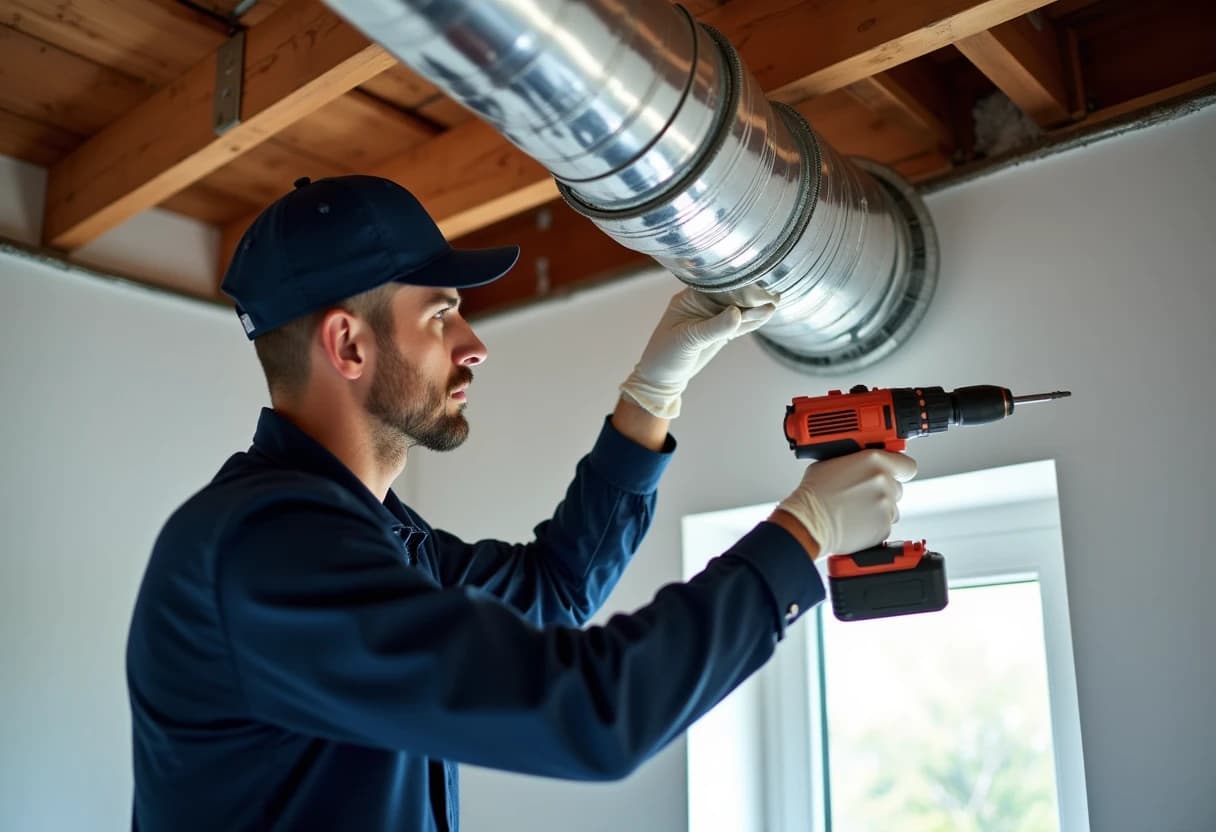
An overlong dryer vent is a permanent tax on every load of laundry. Each foot of duct and every elbow adds resistance; the code caps the total at 35 equivalent feet — with each 90-degree elbow typically counting as five feet — because beyond that, dryers simply cannot push lint and moisture to the outlet. Yet Greater Boston basements are full of runs half again that long, snaking around decades of renovations. Our rerouting service shortens them: we find the nearest legal path outdoors, often cutting a 40-foot wander to a 12-foot straight shot, and rebuild it in rigid metal. Drying times drop immediately, lint accumulation slows permanently, and the fire-risk math improves for good.
Why Dryer Vent Installation & Rerouting Matters for Revere Homes
Length is the invisible constraint most existing vents violate. A dryer is a modest blower pushing moist, fiber-laden air, and its reach is finite: the code's 35-foot equivalent-length budget shrinks fast when elbows are counted — a typical deduction of five feet per 90-degree bend and two and a half per 45 means a run with four corners has spent twenty feet of budget before its first straight section. Exceed the limit and physics takes over: airflow velocity drops below what carries lint, fibers settle in the duct, moisture condenses instead of exiting, and the system clogs on a schedule no cleaning interval can economically match. This is precisely the condition of countless Greater Boston vents, installed when the laundry moved but routed around, rather than through, whatever stood in the way. Rerouting solves it at the root. Our crews measure the true equivalent length, find the shortest legal path — often through a rim joist or closer wall the original installer ignored — and rebuild. Customers whose dryers limped for years routinely describe the result as getting a new appliance.
Renovation activity around Bell Circle keeps our Revere installation calendar full: finished basements, relocated laundries, in-law suites and condo conversions all need new dryer exhaust, and general contractors do not always give it the attention a fire-safety system deserves. Sitting on America's first public beach means Revere homes live with salt-laden ocean air that corrodes ductwork and vent terminations faster than inland systems. In the multifamily housing that dominates the city, we regularly find dryer vents shared or rerouted over decades of remodels, making lint blockages a genuine fire concern here. Revere is dense with early-1900s two-families, triple-deckers and closely spaced single-families in Beachmont and along Shirley Avenue, joined by new transit-oriented apartment blocks rising near Wonderland and the beachfront. Older multifamily buildings often have separate systems per unit and long, aging dryer vent runs, while the new buildings stack units on shared vertical vent chases. We work alongside contractors and homeowners at the planning stage — advising on laundry placement while walls are still open, when a ten-minute routing decision can save thirty feet of duct — and we build the vent to code with documentation your building inspector will recognize. Neighbors in Chelsea and East Boston use us the same way, which is why our trucks are on renovation sites across Suffolk County all season.
Our Dryer Vent Installation & Rerouting Process in Revere
1Site Assessment & Route Planning
Planning is where installations succeed or fail, so we do it deliberately: equivalent-length math on paper, termination clearances checked against grade, snow line, openings and property conditions, and the penetration point chosen for both duct efficiency and envelope integrity. For renovations, we are glad to plan while walls are open — the cheapest routing decisions are made before drywall.
2Demolition of Non-Compliant Venting
Replacement jobs start with removing what failed: vinyl and foil flex pulled from cavities and joist bays, abandoned duct capped or extracted, screened hoods and window inserts taken out, and improvised terminations into attics or crawlspaces closed off. We vacuum the lint these systems have shed along their routes — hidden accumulation that should not stay in the structure.
3Cut & Flash the Exterior Penetration
The exterior opening is cut precisely for the termination: hole saw through clapboard and sheathing, core drill through brick, block or stone, or a framed opening at the rim joist. We locate it to respect required clearances from grade, openings and inside corners, then flash and seal it so wind-driven New England rain stays out of the wall assembly permanently.
4Install Rigid Metal Duct on the Planned Route
Where the route crosses unheated space — a cold basement, garage bay, attic run — we insulate the duct so exhaust stays above its dew point until it exits, which is the difference between a dry duct and a condensation problem in a Massachusetts winter. Concealed sections are completed and verified before any finishes close them in.
5Mount the Termination Hood & Damper
The termination is a quality metal hood matched to the 4-inch duct, with a backdraft damper that swings fully open under airflow and closes tight against weather, drafts and pests — and no screen, which the code prohibits on dryer terminations because mesh mats over with lint. It is fastened to the cladding, sealed at the perimeter, and tested by hand before the first cycle.
6Connect the Appliance & Seal the System
Gas dryers are handled with the care the fuel demands: the flexible gas connector unstrained, the machine leveled and positioned, and the connection checked before operation. Electric units get cords routed clear of the duct. The appliance end is where good systems get ruined by casual reconnection, so we finish it to the same standard as the concealed run.
7Test, Verify & Document the Installation
Before we leave: work areas vacuumed with HEPA equipment, penetration debris removed, the dryer set and leveled, and a walkthrough of the finished system — where it runs, how the damper should look during a cycle, and when the first annual cleaning is due. A correctly built vent needs almost nothing from you; we make sure you know the little it does.
Benefits of Professional Dryer Vent Installation & Rerouting in Revere
Dramatically Faster Drying
Shortening a wandering 40-foot run to a direct 12-foot route transforms drying performance: full airflow means each cycle actually exhausts the gallon of moisture a load releases, so sensor dryers stop running overtime and heavy loads finish in one pass. Customers routinely describe post-installation performance as having bought a new machine.
Moisture Managed, Structure Protected
For basement laundries — the Massachusetts default — proper installation is the difference between a dry basement and a damp one. Vents that dump into crawlspaces, leak at joints or condense in cold runs feed exactly the humidity and mold problems New England basements already fight; a correct rim-joist installation removes the dryer from that fight entirely.
Fire-Safe by Design, Not by Vigilance
A code-compliant installation attacks fire risk structurally: smooth rigid metal that lint slides across instead of catching on, a run short enough that exhaust velocity carries fibers all the way out, joints without screw tips to snag them, and a termination that cannot mat over. The system accumulates fuel slowly by design — safety that does not depend on anyone remembering anything.
A Laundry Located Where You Actually Want It
For renovations, early vent planning is leverage: consulted while walls are open, we can route a short, straight, fully concealed run that would be expensive or impossible after drywall. A ten-minute conversation at framing stage regularly saves homeowners hundreds of dollars and a compromised route.
Permanently Lower Energy Costs
The efficiency also shows up in maintenance economics: smooth, short, sealed runs need only quick annual cleanings, while flex mazes generate blockage-level service calls and appliance repairs. Over ten years, the well-installed vent is the cheaper vent by a wide margin, before counting a single kilowatt-hour.
Code Compliance That Closes Every Question
Insurers and condo associations increasingly ask about dryer venting after regional fire losses, and 'professionally installed to code, with photos' is the answer that ends the conversation. We provide certificates of insurance for association work and per-unit records for multi-family buildings as standard practice.
Signs Your Revere Home Needs Dryer Vent Installation & Rerouting
Inspection, Insurance or Association Requirements
Appliance warranties add quiet pressure: manufacturers condition coverage on adequate exhaust, and a warranty claim on a dryer connected to a non-compliant vent can be denied on that basis. If you are buying a premium machine, the few hundred dollars of proper venting is also warranty insurance.
Your Vent Is Flexible Plastic or Foil Duct
Flex duct concealed in walls and cavities is the worst case: it cannot be effectively brushed, so no cleaning ever truly clears it, and it accumulates lint until it blocks. If a cleaning service has ever told you your run 'can't really be cleaned,' this is what they meant — and rigid replacement is the answer.
The Run Is Overlong or Elbow-Heavy
Count the route: if your duct wanders more than roughly 25 linear feet, or turns more than three corners, it is likely past the code's 35-foot equivalent-length budget once elbows are deducted — typically five feet per 90-degree bend. Beyond the budget, the dryer physically cannot keep lint moving to the outlet, and chronic clogging is built in.
A New Laundry Location Needs Its First Vent
New dryer purchases trigger the question too: installers deliver the machine but rarely build ductwork, and a new appliance connected to no vent — or a condemned one — sits unusable. If your delivery is scheduled, get the vent designed and installed ahead of it, so the first load runs the day the dryer arrives.
Blockages and Repairs Keep Recurring
Recurring appliance failures tell the same story from the other end: thermal fuses, heating elements and high-limit switches that fail repeatedly are a dryer protesting a duct it cannot push through. Each repair buys months. A rerouted, rigid, code-length run buys decades — and usually costs less than three appliance service calls.
The Dryer Vents Indoors — Anywhere
Indoor venting is often invisible until you look: the duct disappears upward and no exterior hood exists anywhere on the house. If you cannot find your termination outside, find out where the exhaust actually goes — attic discoveries after years of indoor venting routinely involve soaked insulation, staining and mold remediation on top of the vent work.
Dryer Vent Installation & Rerouting Cost in Revere, MA
Rerouting deserves its own cost frame, because its value is measured against the run it replaces. Shortening a 40-foot flex wander to a 12-foot rigid route typically costs $500 to $900 — and permanently removes the conditions that were costing you money continuously: second drying cycles (roughly $10 to $20 a month in energy for a busy household), twice-yearly cleanings instead of annual, recurring blockage calls, and the appliance repairs that backpressure schedules (thermal fuses and elements at $150 to $400 a visit). Most households with genuinely bad routes recover the rerouting cost within two to three years through those avoided expenses, then keep the savings for decades. There is also the risk column, harder to price but real: overlong flex runs are heavily represented in the roughly 2,900 annual US dryer fires, and their moisture leakage feeds mold remediation bills that start around $1,500. When we quote a reroute, we show you this math against your actual route — some marginal systems are worth keeping and maintaining, and we say so when they are.
Want the full pricing picture? See our complete Boston-area cost guide or call (617) 390-7145 for an exact flat quote for your Revere home.
Local Knowledge: Revere, Suffolk County
What makes Revere different? Revere is dense with early-1900s two-families, triple-deckers and closely spaced single-families in Beachmont and along Shirley Avenue, joined by new transit-oriented apartment blocks rising near Wonderland and the beachfront. Older multifamily buildings often have separate systems per unit and long, aging dryer vent runs, while the new buildings stack units on shared vertical vent chases. Sitting on America's first public beach means Revere homes live with salt-laden ocean air that corrodes ductwork and vent terminations faster than inland systems. In the multifamily housing that dominates the city, we regularly find dryer vents shared or rerouted over decades of remodels, making lint blockages a genuine fire concern here. For duct and dryer vent systems, those local factors translate into specific, predictable problems — and predictable problems are the ones we solve fastest. Call (617) 390-7145, tell us your street and home style, and we will quote the job accurately the first time, usually in under five minutes.
The Best Time of Year in Revere
Winter is the season your vent's design gets examined, whether it passed inspection or not. Cold amplifies every routing flaw: exhaust crossing uninsulated basements and garages condenses hard, marginal slopes pool water into lint mats, and terminations without quality dampers ice open or shut. Meanwhile the laundry load peaks — sweaters, blankets, snow-soaked layers — pushing maximum moisture through the system at its coldest. Installations we design for New England build the winter case in from the start: insulated duct across unheated space, continuous outward slope, and dampers chosen to swing free at ten degrees in a nor'easter. If last winter exposed your current vent's design — drips, frost, February blockages — this year's install season is the time to retire it.
Why Choose Boston Air Duct Cleaners
As a West Newton-based company, we treat Revere like the neighborhood it is — because for us, it is. Our reputation lives or dies on local referrals, so every job gets the full process: complete system cleaning under negative pressure, mechanical agitation of every run, blower compartment service, and a documented walkthrough before we leave. We are licensed and insured, our estimates are free and flat, and our schedule holds same-day slots for urgent calls. One visit and you will understand why neighbors keep our magnet on the fridge.
Serving Revere and Surrounding Communities
Revere sits in the heart of our service area, and neighboring Chelsea, East Boston, Winthrop, Everett, Malden, Saugus appointments share the same routes. That density is why our response times in this part of Suffolk County are among our fastest — and why you will see our trucks in the area week after week.