
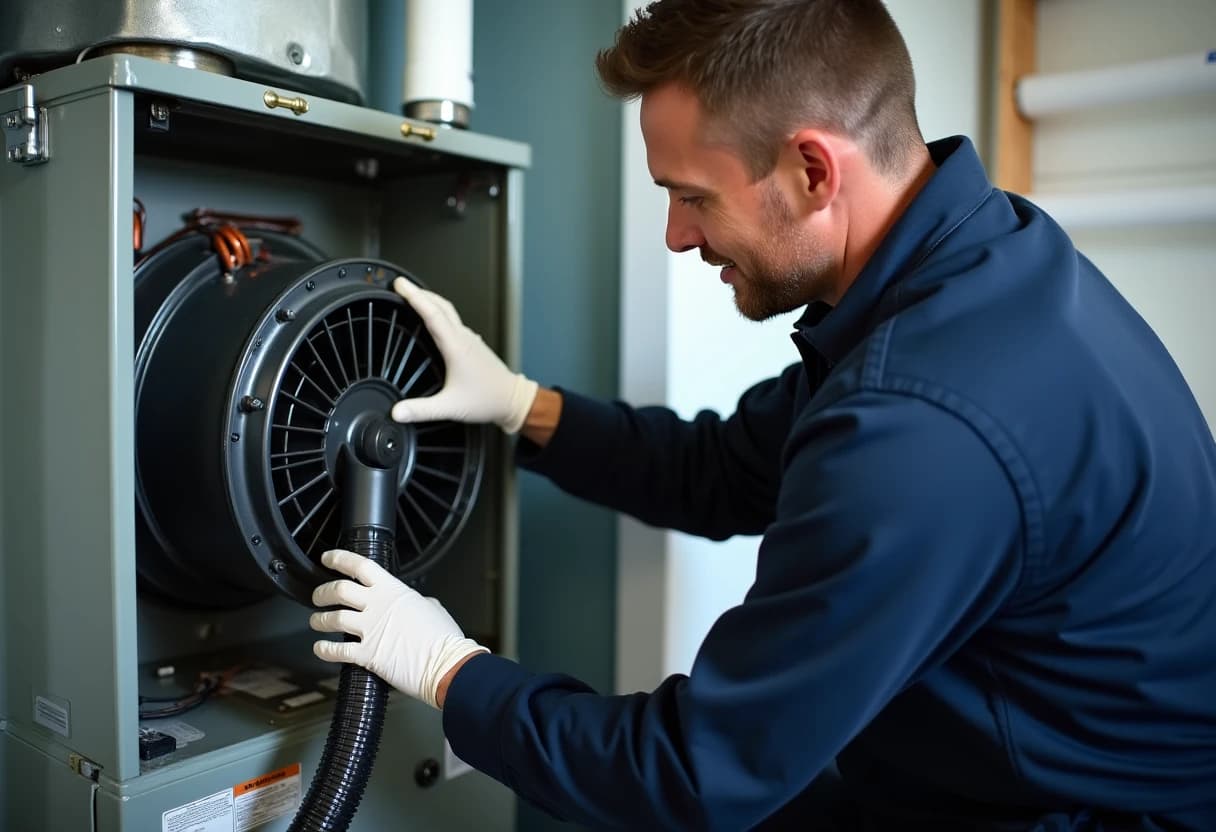
Think of HVAC system cleaning as a deep service interval for the largest appliance you own. Cars get more than oil changes; heating and cooling systems deserve more than filter swaps. In one visit we restore the entire air side: source-removal duct cleaning under negative pressure, blower wheel and motor compartment detailing, evaporator coil cleaning, drain pan and condensate service, plenum and cabinet cleanup, and a fresh filter to protect the work. Reading homeowners typically pair it with their annual furnace tune-up — the technician tuning combustion and the crew restoring airflow are complementary halves of the same maintenance logic — and the systems that get both run quieter, heat faster, cool harder and last visibly longer.
Why HVAC System Cleaning Matters for Reading Homes
The air side of an HVAC system fouls as a circuit, and it must be cleaned as one. Return ducts inhale household dust and deliver it to the blower; the blower drives it through the coil, where the wet fin surfaces trap a share of everything passing; the rest coats the supply plenum and duct runs on its way to the rooms, which shed it back toward the returns. Clean any single stage and the others reseed it — a fresh blower behind dirty returns is matted again within a season, and pristine ducts fed by a fouled blower gray out just as fast. That is the engineering case for whole-system cleaning, and it is also the economics: mobilization, system sealing and negative-pressure setup are the expensive parts of the visit, so cleaning the equipment while the system is already open costs far less than a second appointment ever would. NADCA's cleaning standard reflects the same logic — it defines HVAC cleaning as the full air-conveyance system, components included, precisely because partial cleanings produce temporary results.
HVAC systems in Reading work harder than their owners realize. Reading's streets are lined with center-entrance Colonials, gambrel capes and 1920s-40s craftsman-style homes near the Common and the Depot, ringed by larger post-war and 1980s-2000s colonials farther out toward Route 128. Many of the older homes have been converted from oil boilers to forced-air heat pumps or gas furnaces, leaving retrofit duct runs squeezed through original framing and attic chases. Equipment serving these homes typically sits in basement mechanical spaces, breathing fieldstone dust and summer humidity, pushing air through duct runs extended and patched across generations of renovations. Reading is a classic commuter-rail renovation town - kitchens, additions and finished basements go in constantly, and construction dust ends up circulating through duct systems for years afterward. The heat-pump conversion wave here has also created many attic-run duct systems where summer condensation can feed dust buildup and musty odors. Our whole-system cleanings in Reading routinely find blower wheels matted to half their capacity and coils that have never been opened — and the airflow recovery afterward is exactly as dramatic as that suggests.
Our HVAC System Cleaning Process in Reading
1Full System Inspection & Airflow Baseline
The baseline matters because this service promises measurable results. We record starting conditions — equipment buildup, duct interiors, airflow strength at the weakest registers — so the after-photos and the final walkthrough demonstrate recovery rather than assert it. Systems with issues cleaning cannot fix, like failed dampers or crushed runs, get flagged now, in writing, before work begins.
2Protection, Sealing & Negative Pressure
Floor protection goes down along every work path, registers come off, and all supply and return openings are sealed. A HEPA-filtered negative-air machine connects to the main trunks, placing the full duct network under continuous vacuum — the containment that lets us clean aggressively while your living spaces stay dust-free throughout the visit.
3Complete Duct Network Cleaning
The duct phase follows NADCA source-removal method end to end: mechanical agitation of every supply and return, trunk lines cleaned last so debris always moves toward the collection point, and appropriate tooling per duct type — aggressive brushes on rigid metal, gentler whips on flex runs and older panned returns common in Massachusetts homes.
4Blower Wheel & Motor Compartment Detailing
Dust mats on blower blades change their aerodynamic profile, and the loss compounds every year — wheels a decade in can be down a startling share of rated capacity. We strip the buildup mechanically, degrease where residue demands it, and leave the assembly balanced and bare. The before-and-after photos of this step sell the service better than we ever could.
5Evaporator Coil Cleaning
The coil is the system's radiator and its biggest hidden airflow chokepoint — fins spaced tighter than a millimeter apart trap fine dust that filters miss, and the wet cooling-season surface glues it in place. We clean the coil face and fins with methods matched to buildup severity, restoring the heat transfer and airflow the Department of Energy identifies as central to system efficiency.
6Cabinet, Plenums & Condensate Service
This stage finishes the wet section: pan cleaned of the biofilm and sludge that clog drains and breed odor, trap flushed, line verified flowing, float switch checked where fitted. Cooling-season backups — water around the air handler, tripped switches, ceiling stains under attic units — trace here, and ten minutes of prevention now beats an August service call later.
7Fresh Filter, Reassembly & Verified Results
Reassembly is checklist-driven: panels sealed properly so the blower compartment holds no bypass leaks, filter seated with no gaps, registers remounted, thermostat restored, work areas HEPA-vacuumed. Then verification — strong, clean-smelling airflow at every register, quieter operation, and photo documentation matched shot-for-shot to the pre-cleaning set.
Benefits of Professional HVAC System Cleaning in Reading
Lower Energy Bills, Month After Month
Six-plus months of heating and an increasingly serious cooling season give Massachusetts systems some of the longest annual runtimes in the country — so every point of recovered efficiency is multiplied across more operating hours than almost anywhere else. The same cleaning that is a modest comfort upgrade in a mild climate is a measurable utility-budget event here.
Years Added to Equipment Life
Heat is the enemy of mechanical equipment, and dirt manufactures heat: insulated coils, blanketed motors, restricted exchangers all run hotter than design. Every degree accelerates wear on windings, bearings, igniters and boards. A clean air side is thermal relief for the whole machine — the difference, over a decade, between a system that retires on schedule and one that fails in a January cold snap.
Airflow Restored to Design Capacity
The felt difference has a mechanical explanation: a fouled system fights elevated static pressure and degraded fan performance simultaneously, and the losses multiply. Removing both restores the delivered-air volume the ductwork was engineered around — which is why post-cleaning systems reach setpoint faster, cycle less, and finally push meaningful air to the far registers upstairs.
One Visit, Complete Documentation
For condo associations, landlords and buyers, the documentation is the deliverable: proof the full air side was professionally cleaned to NADCA method, dated, photographed and itemized. It answers inspector questions before they are asked, satisfies board maintenance requirements in one submission, and reads — accurately — as the record of a well-kept mechanical plant.
Cleaner Air From a Cleaner Machine
Whole-system cleaning is the complete version of the air-quality upgrade: the duct reservoir removed and the equipment surfaces — wet coil, biofilmed pan, shedding blower — cleaned behind it. Air crossing clean components picks up nothing on its way to your rooms, which is why households report less dust, neutral-smelling airflow and easier breathing within days.
Cooling That Keeps Up in July
A blanketed evaporator coil cannot shed heat, so the AC runs longer, delivers less, and loses exactly when you need it most — the humid Massachusetts afternoons that now define our summers. Coil cleaning restores rated cooling capacity and, just as important here, dehumidification, so the house gets cool and dry instead of cool-ish and clammy.
Signs Your Reading Home Needs HVAC System Cleaning
Energy Bills Creeping Up Year Over Year
Massachusetts energy costs turn small efficiency losses into visible money, which cuts both ways: fouling hurts faster here, and cleaning pays back faster too. If you are budgeting more for the same comfort every year, audit the air side before blaming the utility — a matted blower wheel is a cheaper fix than a supplier switch is a solution.
Visible Buildup on the Blower or Around the Air Handler
Pull the blower compartment door and look at the wheel with a flashlight: blades carrying a visible felt of compacted dust are stealing airflow every minute the system runs, and the wheel you can see is cleaner than the coil you cannot. Visible equipment buildup is definitive — no further diagnosis needed, the system is due.
AC Struggling, Icing, or Running Nonstop
An air conditioner that runs all afternoon without reaching setpoint on hot days is usually starved, not undersized: a fouled coil cannot shed heat and a matted blower cannot feed it enough air. If your AC 'got old' over a few seasons rather than gradually across decades, buildup is the likelier culprit — and cleaning is the cheaper test than replacement.
Weak Airflow at Some or All Registers
Weak flow paired with a system that sounds like it is working hard — motor droning, air whistling at returns — is restriction announcing itself twice. The fan is fighting elevated static pressure and losing. Filters get checked first, and should be; when a fresh filter does not restore the registers, the buildup is deeper in the circuit and needs mechanical removal.
No Record of the System Ever Being Cleaned
The test costs nothing: open the blower door and look. NADCA guidance suggests inspection every couple of years; systems with no history reliably fail the eyeball test on the first try. In Greater Boston's older housing stock, where systems run long seasons and hard duty, 'never cleaned' and 'needs cleaning' are functionally the same finding.
Uneven Rooms, Noisy Cycles, Dust Everywhere
Fast-returning household dust means the system is redistributing a stored reservoir — and in a fouled system, the ducts, blower and cabinet all contribute. Cleaning only the ducts leaves the equipment share circulating. If a previous duct cleaning disappointed on the dust front, the blower wheel and plenums are usually the reason, and the whole-system version is the fix.
HVAC System Cleaning Cost in Reading, MA
The pricing pathology in this market is the partial job sold as the whole one, so audit any quote for what it actually includes. A '$299 HVAC cleaning' that covers vents-only is a duct wipe with a system-sized name — no blower, no coil, no plenums, and the efficiency benefits the service is named for never arrive, because the components that determine efficiency were never touched. Ask three questions of any bidder: Is the blower wheel cleaned, and how? Is the evaporator coil included, and will you photograph it before and after? Are both plenums and the cabinet in scope? Vague answers predict vague results. Our quotes itemize all of it in writing, and our photo documentation proves delivery component by component. Priced against alternatives, the value case is stark: $450 to $900 for whole-system cleaning versus five figures for the premature equipment replacement that chronic fouling accelerates, or versus the compounding utility overspend a dirty system extracts every month — in Massachusetts, often enough to repay the cleaning within the first year or two of recovered efficiency.
Want the full pricing picture? See our complete Boston-area cost guide or call (617) 390-7145 for an exact flat quote for your Reading home.
Local Knowledge: Reading, Middlesex County
What makes Reading different? Reading's streets are lined with center-entrance Colonials, gambrel capes and 1920s-40s craftsman-style homes near the Common and the Depot, ringed by larger post-war and 1980s-2000s colonials farther out toward Route 128. Many of the older homes have been converted from oil boilers to forced-air heat pumps or gas furnaces, leaving retrofit duct runs squeezed through original framing and attic chases. Reading is a classic commuter-rail renovation town - kitchens, additions and finished basements go in constantly, and construction dust ends up circulating through duct systems for years afterward. The heat-pump conversion wave here has also created many attic-run duct systems where summer condensation can feed dust buildup and musty odors. For duct and dryer vent systems, those local factors translate into specific, predictable problems — and predictable problems are the ones we solve fastest. Call (617) 390-7145, tell us your street and home style, and we will quote the job accurately the first time, usually in under five minutes.
The Best Time of Year in Reading
Winter raises the stakes on airflow more than any other season. Restricted systems run their heat exchangers hot, and hot exchangers trip limit switches — the no-heat service call that fills HVAC dispatch boards every January cold snap, frequently traced to nothing more mechanical than a fouled blower and choked returns. Winter is also when the household lives sealed inside the system's output: windows shut November through March, the blower running hours daily, the home's air recirculated through whatever the ducts, wheel and coil carry. A system cleaned before the closed-window months delivers both reliability — components running at design temperatures through their hardest season — and air quality, with five months of recirculation drawing from a clean circuit instead of a loaded one.
Why Choose Boston Air Duct Cleaners
Homeowners across Middlesex County choose Boston Air Duct Cleaners for three reasons. First, honesty: our inspection camera tells you whether your system actually needs cleaning — and sometimes the answer is no. Second, capability: truck-grade negative-air machines, rotary brush systems and HEPA filtration handle everything from antique gravity-furnace conversions to brand-new high-velocity systems. Third, accountability: flat quoted pricing, before-and-after photos, insured technicians, and a real local office you can call at (617) 390-7145. That combination is rarer in this industry than it should be.
Serving Reading and Surrounding Communities
Beyond Reading, our crews cover the surrounding communities daily — including North Reading, Wakefield, Stoneham, Wilmington, Woburn, Lynnfield. Because routes cluster geographically, booking alongside a neighboring appointment often unlocks same-day service and combined-visit savings. Wherever you are in Middlesex County, the same flat-rate pricing, insured technicians and photo-documented process applies.