
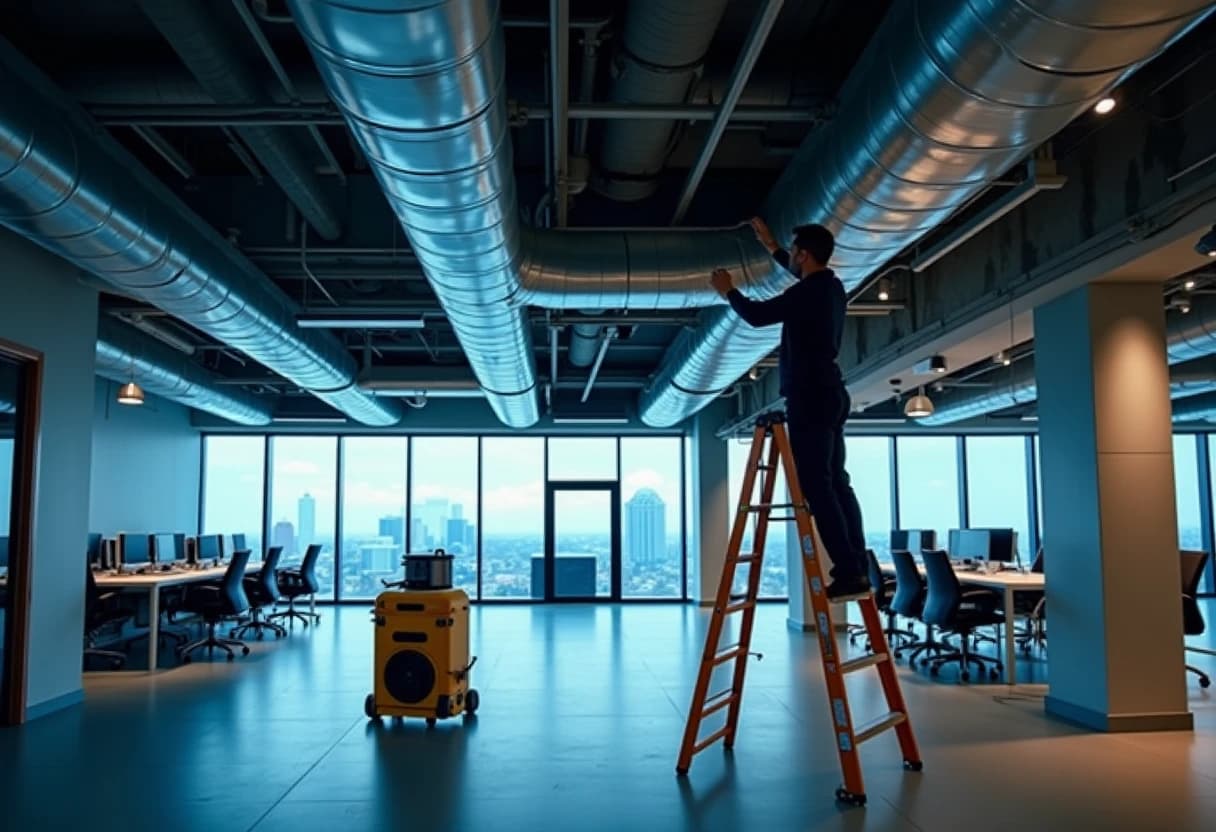
Indoor air quality is now a lease issue, an HR issue and a liability issue. ASHRAE and NADCA both recognize that accumulated duct contamination degrades ventilation performance, and the EPA notes indoor air is routinely two to five times more polluted than outdoor air — a figure that matters when dozens of people share one air handler for forty hours a week. Our commercial air duct cleaning service gives Pembroke businesses and building owners a documented fix: complete source-removal cleaning of supply and return systems, rooftop and interior units, exhaust runs, and terminal equipment. We bring commercial-scale negative-air machines, lift and roof access equipment, insured uniformed technicians, and the scheduling flexibility that occupied buildings demand. Most projects are quoted flat from a brief site walk.
Why Commercial Air Duct Cleaning Matters for Pembroke Homes
The energy case for commercial duct cleaning is straightforward arithmetic. Commercial HVAC is typically the largest line on a building's utility bill, and air-side fouling attacks it from every direction: dust-blanketed evaporator coils lose heat-transfer capacity, dirt-loaded blower wheels lose airflow, and debris-narrowed ducts raise static pressure so fans work harder to deliver less. Studies of commercial systems consistently attribute meaningful efficiency losses to fouled air-side components, which is why coil and system cleaning frequently pays back within a season or two on buildings with long operating hours. Beyond kilowatt-hours, restored airflow rebalances the building — the conference room that never cools, the corner suite that never heats, the back-of-house that always smells stale are frequently airflow problems wearing comfort-complaint costumes. Cleaning the ducts, boxes and unit interiors restores the design airflow the mechanical engineer originally specified. Pair it with a coil cleaning on your rooftop units and the building runs closer to its commissioned performance than it has in years — measurable at the meter and noticeable in the comfort log.
Air quality expectations for Pembroke workplaces have never been higher — employees, tenants and customers all notice stale air and dusty diffusers, and they say so. Pembroke's pond-cottage heritage means we regularly work in winterized summer homes where ductwork was squeezed into crawlspaces never meant to hold it, and pond-side humidity keeps those runs damp. Wood stoves remain popular backup heat here, and their fine ash finds its way into return ducts all over town. Pembroke grew fastest in the 1960s through 1990s, filling in around its ponds with capes, ranches and Colonials, many originally built as summer cottages on Oldham and Furnace Ponds and later winterized. Those converted cottages carry improvised heating systems with short, awkward duct runs, while the later subdivision homes run standard forced-air setups now reaching the age of failing joints. Newer developments off Route 53 add fresh construction with attic-based systems. Those conditions load commercial duct systems with precisely the contaminants that generate complaints and drag down HVAC efficiency. Our crews clean Pembroke commercial systems to NADCA standards: seal and depressurize each zone, agitate every trunk and branch mechanically, hand-clean unit interiors and terminal boxes, verify with imaging. Businesses in Hanover and Hanson use the same service on recurring maintenance schedules, which is why our commercial trucks are in this part of Plymouth County nearly every week.
Our Commercial Air Duct Cleaning Process in Pembroke
1Site Walk, System Mapping & Flat Quote
Every engagement begins with documentation, not equipment. We map your system zone by zone, photograph baseline conditions inside representative ducts and unit interiors, flag any disconnections, damage or microbial concerns, and confirm insurance and access requirements with your property team. Only after you approve the written scope, price and schedule does the crew mobilize.
2Certificates of Insurance & Scheduling Around Your Operations
Commercial work runs on paperwork and timing, and we treat both as part of the service. COIs naming your entity and landlord go out in advance; technicians carry ID and follow your building's access and alarm protocols. Scheduling is genuinely flexible — most of our commercial cleaning happens between close and open, and phased projects are sequenced so each area is finished, cleaned and back in service before occupants return.
3Containment & Protection of Finished Spaces
Retail merchandise, exam rooms, server closets, commercial kitchens — commercial spaces contain things that must not get dusty, and our protection plan is written into every project scope. Sensitive areas are draped or excluded and sequenced appropriately, negative pressure ensures loosened debris travels into HEPA collection rather than the space, and each night's work area is inspected and restored before the crew leaves.
4Negative Pressure on Each Zone
Zone by zone, the duct network becomes a controlled vacuum circuit. Our negative-air machines pull thousands of cubic feet per minute through HEPA filtration, maintaining continuous negative pressure for the entire agitation phase. On multi-unit buildings we isolate and clean one system at a time, which keeps containment tight and lets partially occupied buildings continue operating around the work.
5Mechanical Agitation of Trunks, Branches & Terminal Units
With each zone under vacuum, technicians agitate every run: rotary brushes sized to duct dimensions scrub mains and branches, compressed-air whips chase debris from diffuser takeoffs back toward collection, and directional skipper nozzles sweep long horizontal trunks. VAV and fan-powered boxes are opened and hand-cleaned — they are debris traps that blown-air-only crews skip entirely.
6Air Handler, Rooftop Unit & Coil Cleaning
Rooftop units live a hard life above Massachusetts weather, and their interiors show it — wet-matted dust, corroded pans, biofilm on coil faces. Our crews are equipped and insured for roof work, and RTU interior cleaning is a routine scope item: blower and cabinet cleaning, drain pan service, coil cleaning where warranted, and photographs of everything so your facilities file shows unit condition, not just duct condition.
7Verification, Restoration & Completion Report
The last step is a walkthrough with your facilities contact or property manager: systems running, airflow verified at representative diffusers, documentation reviewed page by page. Everything we observed inside your system goes in writing, including items outside our scope that deserve your HVAC contractor's attention. We then log your property for the maintenance interval you choose, so recurring cleanings arrive as calendar items, not emergencies.
Benefits of Professional Commercial Air Duct Cleaning in Pembroke
Lower Energy Costs Across Long Operating Hours
Static pressure is a tax on every fan in your building. Dust on blower blades, mats on coil faces and debris in trunk lines all force motors to work harder for less delivered air. Removing that resistance shortens run times, reduces demand peaks, and eases strain on compressors and motors — savings that recur every month the building operates.
Zero Disruption to Business Operations
Overnight, weekend and phased scheduling are the default for our commercial work, not a premium add-on. Retail spaces are cleaned between close and open; offices over weekends; multi-tenant buildings floor by floor with each area restored before occupants return. The only evidence of the project your customers ever see is cleaner air.
Extended Rooftop Unit & Equipment Life
Every hour a fan motor fights choked airflow shortens its life, and commercial motors log thousands of hours a year. Source-removal cleaning takes the strain off the entire mechanical chain — motors, bearings, belts, compressors — which is why HVAC contractors themselves routinely refer their commercial clients to us before recommending equipment replacement.
Fewer IAQ Complaints, Happier Tenants & Staff
For employers, air quality is a retention and productivity issue — workplace studies consistently link ventilation quality to cognitive performance and absenteeism. For landlords, it is a lease-renewal issue. Removing years of accumulated contamination from the system every occupant shares is one of the few facility investments both groups notice within the first week.
A Visibly Cleaner, Fresher-Smelling Space
Dust-streaked diffusers and gray-ringed ceiling tiles quietly undermine every impression your space makes — customers, patients and job candidates all register them. Cleaning the system and its visible terminals removes both the staining source and the stains, and the persistent stale-building odor that clings to occupied commercial space typically leaves with the duct dust that harbored it.
Documentation for Insurance, Leases & Compliance
Commercial leases, accreditation standards and insurance carriers are steadily adding IAQ maintenance language, and 'we changed the filters' does not satisfy it. A NADCA-standard cleaning with dated photo documentation does. Property managers file our reports the way they file fire-system inspections: proof of diligence, ready before anyone asks for it.
Signs Your Pembroke Home Needs Commercial Air Duct Cleaning
Recent Fit-Out, Renovation or Construction
If your building has had any recent renovation — your own or a neighboring tenancy sharing the same air handler — assume the ductwork participated. Shared systems distribute one suite's construction dust to every suite downstream. A camera inspection confirms it in minutes, and cleaning before complaints start is far cheaper than after.
Odors That Return Every Operating Day
'Dirty sock' odors at system startup indicate microbial activity on coils or in ducts — most common after humid summers in systems with marginal condensate drainage. It deserves prompt attention: the same conditions producing odor can progress to visible growth, which escalates the fix from cleaning to remediation.
Tenant or Employee Air Quality Complaints
The complaint pattern tells the story: symptoms that ease when occupants leave the building, worsen when the system runs hardest, and cluster in specific zones implicate the ductwork serving those zones. An inspection settles it in an hour, and cleaning resolves what the inspection finds — with photos to close the loop with complainants.
Dust Streaking on Diffusers, Grilles & Ceiling Tiles
Janitorial crews wiping the same diffusers every month are documenting the problem, not fixing it. Persistent re-soiling of terminals means the duct interiors upstream are shedding continuously. After a proper source-removal cleaning, terminal surfaces stay clean for years instead of weeks — an easy before-and-after your maintenance log will show.
No Service History Anyone Can Find
NADCA guidance calls for periodic inspection of commercial air systems, with cleaning as conditions warrant — and in Greater Boston's older commercial stock, conditions almost always warrant. Starting a documented maintenance cycle now costs a site walk; explaining a decade of missing records to an insurer or a tenant's counsel later costs considerably more.
Water Intrusion, Mold Findings or Pest Evidence
Roof leaks, burst pipes and humidification failures routinely wet commercial ductwork, and damp duct dust becomes a microbial growth site within about 48 hours. Any water event near air-handling equipment warrants a duct inspection now — EPA guidance is explicit that visibly contaminated ducts serving occupied space should be professionally cleaned.
Commercial Air Duct Cleaning Cost in Pembroke, MA
Beware the two failure modes of commercial duct-cleaning pricing. The first is the residential coupon crew quoting a commercial building at house prices: they arrive with one portable vacuum, wipe the diffusers, skip the returns, boxes and units entirely, and leave no documentation — money spent for nothing but a false sense of maintenance. The second is the restoration-industry bid at two to three times market, justified by equipment lists rather than scope. The defensible middle for Eastern Massachusetts commercial work runs roughly $0.15–$0.50 per square foot or $500–$5,000 per typical project, executed by an insured crew with commercial negative-air equipment, and concluded with photographic before-and-after documentation. Get the scope in writing — every system, every zone, terminal units included, report included — and any bid becomes comparable. Ours arrives that way by default, usually within two business days of the site walk.
Want the full pricing picture? See our complete Boston-area cost guide or call (617) 390-7145 for an exact flat quote for your Pembroke home.
Local Knowledge: Pembroke, Plymouth County
What makes Pembroke different? Pembroke grew fastest in the 1960s through 1990s, filling in around its ponds with capes, ranches and Colonials, many originally built as summer cottages on Oldham and Furnace Ponds and later winterized. Those converted cottages carry improvised heating systems with short, awkward duct runs, while the later subdivision homes run standard forced-air setups now reaching the age of failing joints. Newer developments off Route 53 add fresh construction with attic-based systems. Pembroke's pond-cottage heritage means we regularly work in winterized summer homes where ductwork was squeezed into crawlspaces never meant to hold it, and pond-side humidity keeps those runs damp. Wood stoves remain popular backup heat here, and their fine ash finds its way into return ducts all over town. For duct and dryer vent systems, those local factors translate into specific, predictable problems — and predictable problems are the ones we solve fastest. Call (617) 390-7145, tell us your street and home style, and we will quote the job accurately the first time, usually in under five minutes.
The Best Time of Year in Pembroke
New England's commercial building stock adds an age dimension to every season. Many Plymouth County offices, storefronts and mixed-use buildings run on duct systems installed decades ago and modified through every subsequent tenancy — long joint-heavy trunk runs, abandoned takeoffs, plenum returns above dropped ceilings that collect everything. Winter ice dams and freeze-thaw roof leaks introduce moisture into exactly those ceiling cavities; summer humidity keeps it there. The intersection of antique ductwork and seasonal moisture is where microbial problems start, which is why we recommend older commercial buildings pair duct inspection with their spring roof inspection — the two failures travel together, and catching either early prevents the expensive combination.
Why Choose Boston Air Duct Cleaners
Homeowners across Plymouth County choose Boston Air Duct Cleaners for three reasons. First, honesty: our inspection camera tells you whether your system actually needs cleaning — and sometimes the answer is no. Second, capability: truck-grade negative-air machines, rotary brush systems and HEPA filtration handle everything from antique gravity-furnace conversions to brand-new high-velocity systems. Third, accountability: flat quoted pricing, before-and-after photos, insured technicians, and a real local office you can call at (617) 390-7145. That combination is rarer in this industry than it should be.
Serving Pembroke and Surrounding Communities
We serve every community around Pembroke as well: Hanover, Hanson, Marshfield, Norwell, Whitman, Rockland all fall inside our regular service routes. If you have a second property, a rental, or family nearby, ask about multi-home scheduling — grouped appointments on the same route are our most requested discount.