
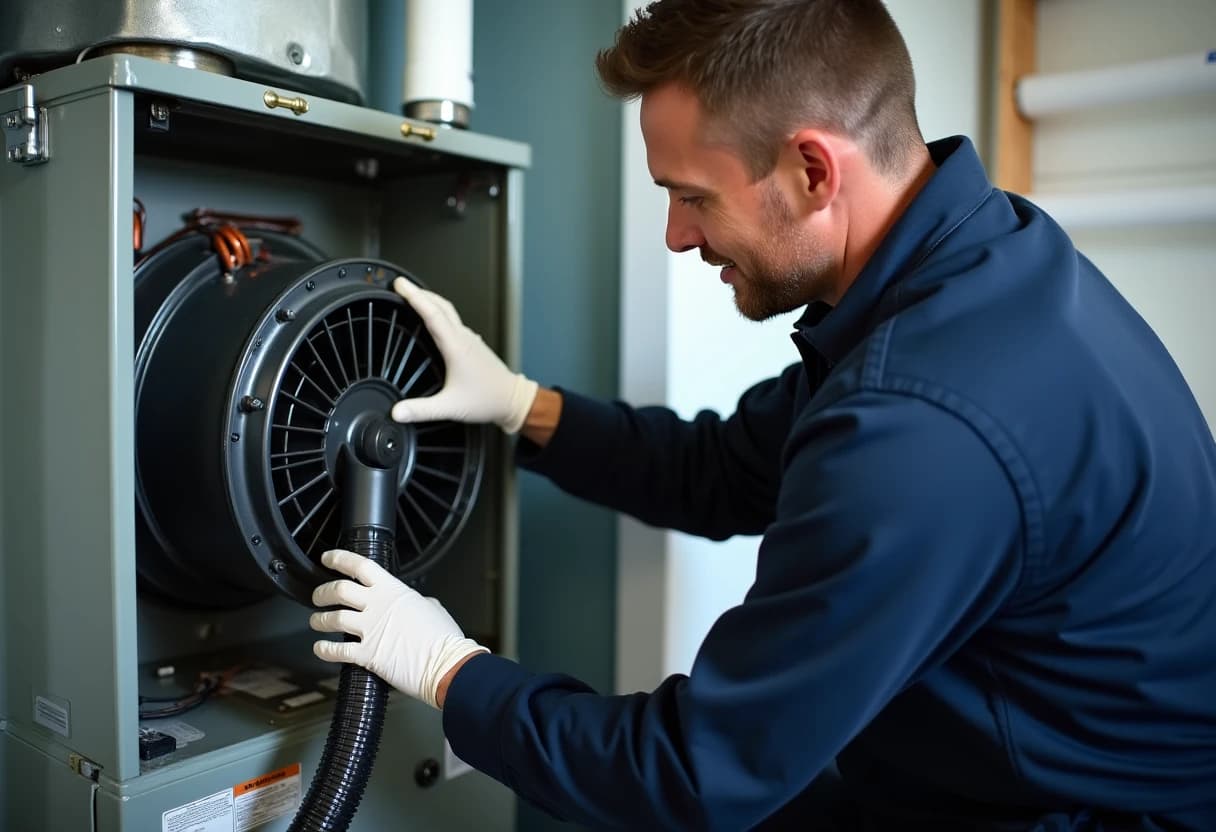
Your furnace and air conditioner were engineered around one assumption: clean airflow. Every gram of dust the system accumulates violates it — matting the blower wheel until it moves a fraction of its rated air, blanketing the evaporator coil until heat transfer chokes, and narrowing duct runs until rooms at the end of the line barely feel the system running. HVAC system cleaning reverses all of it at once. Our Norwell technicians place the ductwork under commercial negative pressure, mechanically agitate every run, then open the equipment itself: blower assembly degreased and detailed, coil cleaned fin by fin, cabinet and plenums HEPA-vacuumed and wiped. The result is the closest thing to factory airflow your system has seen since installation day.
Why HVAC System Cleaning Matters for Norwell Homes
Efficiency loss from a dirty air side is not folklore; it is measurable physics with a utility-bill signature. A dust-matted blower wheel loses blade profile and moving capacity, so the motor works harder to deliver less air. A fouled evaporator coil cannot exchange heat — the Department of Energy identifies dirty coils as a leading cause of degraded AC efficiency — so compressors run longer to move the same BTUs. Elevated duct static pressure from interior buildup compounds both. Stack the losses and a neglected system can consume meaningfully more energy than a clean one while delivering worse comfort, which in Massachusetts — where electricity prices run among the highest in the continental US and heating seasons stretch six months — converts to real money every single month. Whole-system cleaning recovers that capacity at once. Customers with visibly fouled systems routinely see the difference in the next billing cycle, and the improvement recurs monthly, which is why this service so often functions as an investment with a payback period rather than an expense.
Norwell homeowners usually find us through a symptom: the upstairs that will not cool, the bills that climb every winter, the AC that runs all afternoon during a Plymouth County heat wave without catching up. Norwell's housing runs from shipbuilding-era antiques along the North River to large 1980s-and-newer Colonials on wooded two-acre lots, with very little in between. The newer homes typically carry dual forced-air systems and generous finished basements, while the antiques hide narrow retrofit duct chases behind original wide-pine walls. Long driveways and big footprints mean dryer vents here often run twenty feet or more before reaching daylight. The North River valley wraps Norwell in humid, marsh-influenced air for much of the year, and we see more moisture-streaked duct interiors here than in inland towns. Norwell's oversized homes also hide some of the longest dryer vent runs on the South Shore - a fire-safety issue we take seriously. Those symptoms almost always trace to the air side — fouled blower, blanketed coil, restricted ducts — and a whole-system cleaning resolves them together. We bring truck-grade negative pressure and NADCA-standard methods to every Norwell job, and we leave photo proof of the recovery.
Our HVAC System Cleaning Process in Norwell
1Full System Inspection & Airflow Baseline
Every job opens with a complete assessment: ductwork mapped and inspected by camera, filter and filter rack checked, blower compartment and coil examined, and register airflow noted room by room as a baseline. You see the pre-cleaning photos — matted blower, grayed coil face, duct interiors — and approve a confirmed flat price before any equipment starts.
2Protection, Sealing & Negative Pressure
The system becomes a closed circuit before anything gets agitated: sealed openings, depressurized trunks, HEPA-filtered collection. This setup is what separates source removal from dust redistribution, and it protects the equipment work too — debris loosened in the ducts flows to the vacuum rather than settling into the freshly opened blower compartment downstream.
3Complete Duct Network Cleaning
Under negative pressure, every run gets individually agitated: rotary brushes sized to each duct scrub the walls while compressed-air whips chase debris from the register end back toward the vacuum. Supplies, returns, vertical risers and both main trunks are cleaned in sequence — no run skipped, with repeat passes wherever camera checks show buildup remaining.
4Blower Wheel & Motor Compartment Detailing
Dust mats on blower blades change their aerodynamic profile, and the loss compounds every year — wheels a decade in can be down a startling share of rated capacity. We strip the buildup mechanically, degrease where residue demands it, and leave the assembly balanced and bare. The before-and-after photos of this step sell the service better than we ever could.
5Evaporator Coil Cleaning
The coil is the system's radiator and its biggest hidden airflow chokepoint — fins spaced tighter than a millimeter apart trap fine dust that filters miss, and the wet cooling-season surface glues it in place. We clean the coil face and fins with methods matched to buildup severity, restoring the heat transfer and airflow the Department of Energy identifies as central to system efficiency.
6Cabinet, Plenums & Condensate Service
Plenums collect the heaviest drifts in many systems — every airstream in the house passes through them — and they are routinely skipped by duct-only services because access takes cabinet work. We clean both, plus the cabinet interior, the filter rack and its sealing surfaces, and the condensate path, so the equipment core matches the freshly cleaned network around it.
7Fresh Filter, Reassembly & Verified Results
The job ends with your system running and your questions answered. We review maintenance guidance — filter change intervals for your specific system, the case for pairing future cleanings with tune-ups, any conditions we flagged for your HVAC tech — and log your service date. Whole-system cleanings hold three to five years in typical homes; we will remind you when an inspection is actually due, not before.
Benefits of Professional HVAC System Cleaning in Norwell
Lower Energy Bills, Month After Month
Efficiency loss from fouling is a compounding leak: the blower draws more power to move less air, the compressor and burners run longer to deliver the same comfort, and every cycle costs more than design intended. Whole-system cleaning plugs the leak at every point at once — which is why it is the rare home service with a genuine payback period rather than just a benefit.
Cooling That Keeps Up in July
Icing is the dramatic version: a starved coil runs too cold, condensation freezes, airflow collapses entirely and the system shuts down mid-heat-wave. The root cause is almost always airflow restriction — dirty coil, matted blower, choked returns. Cleaning the circuit end to end is both the cure and the prevention, and July is when the prevention proves its price.
One Visit, Complete Documentation
You receive the complete photo record — every duct run, the blower before and after, the coil face, the plenums — plus written notes on system condition. That file has compounding value: it informs your HVAC tech's next tune-up, supports home-sale disclosures with evidence instead of assertions, and establishes the maintenance baseline future service gets measured against.
Airflow Restored to Design Capacity
Airflow is the product your HVAC system exists to deliver, and dust taxes it at every stage — matted blower blades, blanketed coil fins, narrowed duct runs. Whole-system cleaning refunds the tax in full. The most common customer report after our visits: rooms that had not heated or cooled properly in years suddenly behave, with no equipment replaced and nothing adjusted but cleanliness.
Years Added to Equipment Life
HVAC technicians will tell you which systems reach old age: the ones with clean airflow. Limit-switch trips, cracked exchangers and burned motors cluster in fouled systems because restriction stresses everything upstream and downstream of it. Periodic whole-system cleaning is how a homeowner buys into the long-lived cohort — and why tune-up techs are among our steadiest referral sources.
Quieter Operation, Fewer Odors
The burnt-dust smell of October's first furnace cycle is the equipment announcing its buildup — accumulation on the exchanger and in the plenums cooking off at first heat. A system cleaned before the season starts silent and neutral instead. Likewise the musty cooling-season note from a biofilmed coil and pan: cleaned and treated, the wet section stops perfuming the house.
Signs Your Norwell Home Needs HVAC System Cleaning
Burnt-Dust Smell at Furnace Startup
Take the smell seriously as information: it means the airstream crosses surfaces loaded enough to volatilize, and what you smell burning in October you are breathing unburnt the rest of the year. Persistent or acrid versions merit prompt inspection anyway, to rule out the electrical and overheating causes that share the odor profile.
No Record of the System Ever Being Cleaned
The test costs nothing: open the blower door and look. NADCA guidance suggests inspection every couple of years; systems with no history reliably fail the eyeball test on the first try. In Greater Boston's older housing stock, where systems run long seasons and hard duty, 'never cleaned' and 'needs cleaning' are functionally the same finding.
Visible Buildup on the Blower or Around the Air Handler
Check the filter's service history as a proxy: filters that load with dust unusually fast indicate a heavy circulating burden, and filters that were skipped for long stretches guarantee the equipment downstream absorbed the difference. Either pattern — fast-loading or long-neglected — predicts exactly what we find when the cabinet opens.
AC Struggling, Icing, or Running Nonstop
An air conditioner that runs all afternoon without reaching setpoint on hot days is usually starved, not undersized: a fouled coil cannot shed heat and a matted blower cannot feed it enough air. If your AC 'got old' over a few seasons rather than gradually across decades, buildup is the likelier culprit — and cleaning is the cheaper test than replacement.
Weak Airflow at Some or All Registers
Weak flow paired with a system that sounds like it is working hard — motor droning, air whistling at returns — is restriction announcing itself twice. The fan is fighting elevated static pressure and losing. Filters get checked first, and should be; when a fresh filter does not restore the registers, the buildup is deeper in the circuit and needs mechanical removal.
Uneven Rooms, Noisy Cycles, Dust Everywhere
Fast-returning household dust means the system is redistributing a stored reservoir — and in a fouled system, the ducts, blower and cabinet all contribute. Cleaning only the ducts leaves the equipment share circulating. If a previous duct cleaning disappointed on the dust front, the blower wheel and plenums are usually the reason, and the whole-system version is the fix.
HVAC System Cleaning Cost in Norwell, MA
Whole-system HVAC cleaning in Greater Boston typically runs $450 to $900 — the ductwork cleaning plus blower detailing, evaporator coil cleaning, plenum and cabinet work, and condensate service in one visit. The comparison worth making: booked piecemeal, duct cleaning ($350–$700), coil cleaning ($150–$350) and blower service ($100–$250) sum well past the bundled price, because mobilization, system sealing and negative-pressure setup — the expensive parts of any visit — get paid once instead of three times. Within our range, price tracks system size (vent and return count, zone count), equipment configuration (coil accessibility varies enormously between furnace-with-A-coil setups and air handlers; some coils require panel work to reach), buildup severity (heavily fouled blowers and bonded coil blankets take repeat passes), and access (finished basements, attic air handlers, rooftop condos). Multi-system homes are quoted per system with multi-system discounts. Every quote is flat, confirmed after inspection, and inclusive — no per-main surcharges, no fuel fees, no on-site renegotiation.
Want the full pricing picture? See our complete Boston-area cost guide or call (617) 390-7145 for an exact flat quote for your Norwell home.
Local Knowledge: Norwell, Plymouth County
What makes Norwell different? Norwell's housing runs from shipbuilding-era antiques along the North River to large 1980s-and-newer Colonials on wooded two-acre lots, with very little in between. The newer homes typically carry dual forced-air systems and generous finished basements, while the antiques hide narrow retrofit duct chases behind original wide-pine walls. Long driveways and big footprints mean dryer vents here often run twenty feet or more before reaching daylight. The North River valley wraps Norwell in humid, marsh-influenced air for much of the year, and we see more moisture-streaked duct interiors here than in inland towns. Norwell's oversized homes also hide some of the longest dryer vent runs on the South Shore - a fire-safety issue we take seriously. For duct and dryer vent systems, those local factors translate into specific, predictable problems — and predictable problems are the ones we solve fastest. Call (617) 390-7145, tell us your street and home style, and we will quote the job accurately the first time, usually in under five minutes.
The Best Time of Year in Norwell
New England's equipment stock adds a seasonal wrinkle worth naming: an enormous share of local systems are conversions and hybrids — forced-air retrofitted into homes built for radiators, hydro-air systems marrying boilers to air handlers, condo conversions threading flex duct through triple-decker framing. These systems run higher static pressure than clean-sheet designs, which means less margin for fouling: buildup that a generously ducted suburban system tolerates will noticeably choke a retrofit. The seasonal moisture cycle compounds it — humid summers make basement equipment buildup damp and sticky, long winters bake it hard — so accumulation here bonds faster and restricts sooner than national rules of thumb suggest. For conversion-era systems, we recommend the inspection interval owners of old houses already apply to everything else: regularly, and before the hard season rather than after it.
Why Choose Boston Air Duct Cleaners
Boston Air Duct Cleaners is a local, owner-operated company based at 1121 Washington St in West Newton — not a national franchise dispatching subcontractors. Every crew is our own: background-checked, factory-trained on commercial negative-pressure equipment, and fully insured. We quote flat prices before work begins, document every job with before-and-after photos, and follow NADCA-standard source-removal methods on every system we touch. That is why so much of our work comes from repeat customers, property managers and word-of-mouth referrals across Plymouth County.
Serving Norwell and Surrounding Communities
Beyond Norwell, our crews cover the surrounding communities daily — including Hanover, Scituate, Hingham, Rockland, Marshfield, Pembroke. Because routes cluster geographically, booking alongside a neighboring appointment often unlocks same-day service and combined-visit savings. Wherever you are in Plymouth County, the same flat-rate pricing, insured technicians and photo-documented process applies.