If you can write your name in the dust on a supply register, imagine what is coating the ductwork behind it. Air duct cleaning is one of the most effective single steps a North Reading homeowner can take to improve indoor air quality, and it is one of the most commonly skipped. We clean the complete system — every supply run, every return, the main trunks, and the components around your air handler — using commercial negative-pressure equipment that pulls debris out of the home rather than blowing it around. Most homes are finished in a few hours, and the difference in air quality is noticeable the same day.
Why Air Duct Cleaning Matters for North Reading Homes
Most duct systems have never been cleaned since the day they were installed. Over a decade or two, they accumulate a startling load: drywall dust from renovations, sawdust from the original construction, decades of household dust, pet hair, insect debris, and in humid basements, active microbial growth. That material does three damaging things. First, it degrades air quality — fine particles recirculate into living spaces and aggravate allergies, asthma and sinus issues. Second, it chokes airflow — a thin mat of dust on duct walls and blower blades measurably reduces system output, forcing longer run times and higher utility bills. Third, it holds odors — pet, smoke and cooking smells cling to dust and re-release every time air moves. Professional cleaning addresses all three at once. It is especially important after renovations, water events, or buying a home, when you inherit the previous owner's decades of accumulation, whatever pets they kept, and whatever they smoked.
Ask anyone who has renovated near Flint Memorial Library or opened up walls in an older North Reading property: the dust gets everywhere, and the ductwork inhales it. North Reading is classic postwar-to-1990s suburbia: capes and split-levels from the 1950s and 60s near Route 28, ringed by later Colonial subdivisions on wooded lots. Many of the older splits and ranches have had central air bolted onto original heating ducts, and their low crawlspace-style basements make for cramped, kink-prone runs. The newer homes favor two-zone systems with attic-mounted second floors served entirely by flex duct. Layer on New England's humid summers and long heating seasons and you get duct interiors that alternate between damp and baked — ideal for odor buildup and, where moisture persists, microbial growth. Bordered by the Ipswich River and Harold Parker State Forest, North Reading gets dense spring and fall pollen drops that we find layered inside return trunks all over town. Damp riverside basements also push humidity into ductwork, so musty supply-air odors are one of the most common calls we get here. Our source-removal process is built for this housing stock: negative pressure strong enough for long trunk runs, brushes sized for both modern rigid duct and older transite or panned-joist returns, and camera verification so you see the finished result.
Our Air Duct Cleaning Process in North Reading
1Whole-Home Inspection & System Assessment
Every job starts with eyes on the system. Your technician inspects the furnace or air handler, counts and maps every supply and return, checks filter condition, and looks inside accessible ducts — with an inspection camera when useful. You get a clear picture of contamination levels and a confirmed flat price before any work begins.
2Protect the Home & Seal the System
We treat your home like a finished space, not a job site: drop cloths, boot covers and careful hose routing are standard. Registers come off, openings get sealed, and the system becomes a controlled vacuum circuit. This containment step is the difference between professional source removal and the dust-scattering shortcuts of discount operators.
3Establish Negative Pressure
Next, our negative-air machine goes online. Think of it as making your entire duct system exhale through a HEPA filter for the duration of the job. Industry guidelines call for this continuous negative pressure precisely because it guarantees loosened contaminants leave the system instead of resettling elsewhere in the ductwork or escaping into the home.
4Mechanical Agitation of Every Duct Run
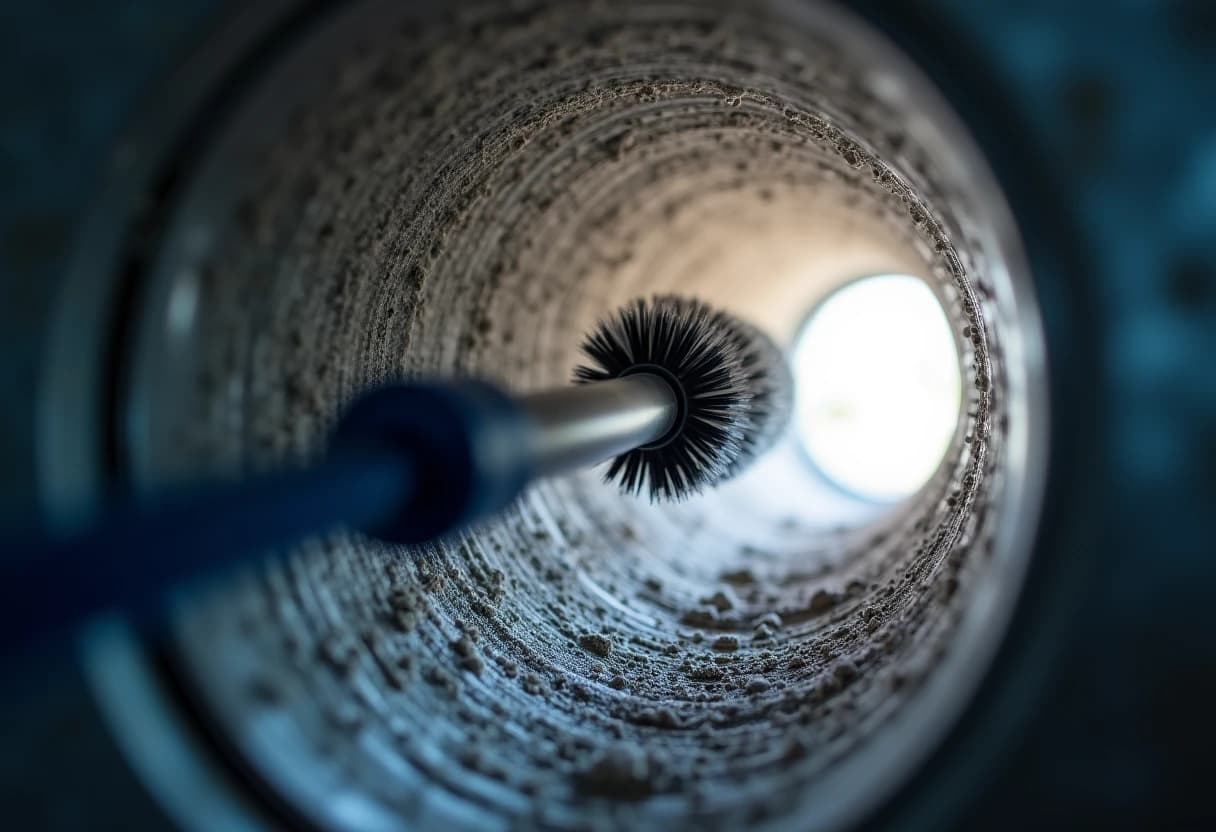
This is where the real cleaning happens. Pneumatic whips, rotating brushes and directional air nozzles are fed through every supply and return run, physically dislodging the mat of dust, hair and debris bonded to duct surfaces. The negative pressure immediately carries everything to the collection unit. Stubborn buildup gets repeat passes until camera checks show bare metal.
5Clean the Air Handler Components
While the ducts drain into the vacuum, your technician opens the furnace or air handler and details the components air actually touches: blower assembly, housing interior, plenums and accessible panels. This step matters because a freshly cleaned duct system fed by a dust-caked blower re-contaminates in months.
6Optional Sanitizing & Deodorizing Treatment
For homes with pet odors, smoke history, or past moisture problems, the final touch is an atomized sanitizing treatment using EPA-registered products designed for HVAC use. Fogged into the ducts while the blower circulates, it treats the entire air path. It is optional, priced up front, and recommended only when the inspection actually justifies it.
7Final Verification & Walkthrough
We re-photograph the duct interiors we imaged at the start, reinstall registers, restore the thermostat and filter, and walk the house with you room by room. You see the before-and-after evidence, the debris we removed, and the system running. We leave only when you are satisfied — and the work area cleaner than we found it.
Benefits of Professional Air Duct Cleaning in North Reading
Less Dust on Every Surface
There is a simple test: hold a white cloth over a supply register while the fan runs. If it grays, that is what settles on your furniture daily. Post-cleaning, that same test comes back clean — and so, noticeably, do your surfaces, week after week.
Relief for Allergy & Asthma Sufferers
Dust mites, pet dander, pollen and mold spores are the four dominant household allergy triggers, and ductwork stores all four. Families with allergic or asthmatic members frequently see symptom improvement after cleaning because trigger levels in circulated air drop sharply — particularly overnight, when bedroom supply ducts run for hours.
Lower Energy Bills & Better Airflow
Dust narrowing your ducts and coating your blower forces the system to run longer to hit the same thermostat setting. The Department of Energy notes that fouled HVAC components can cut efficiency significantly — clean systems simply move more air per watt. Many customers notice weak rooms finally getting proper airflow after cleaning.
A Documented, Healthier Home
Peace of mind is the quiet benefit. Knowing the air path serving your children's bedrooms is verifiably clean — photographed, inspected, and free of the previous decade's accumulation — is worth the visit by itself. The energy savings and reduced dusting are the ongoing dividends.
Measurably Cleaner Indoor Air
Removing the duct-borne reservoir of dust, dander, pollen and spores means the air leaving your registers is no longer recontaminated on its way to you. Households consistently report less airborne dust, fresher-smelling rooms and easier breathing within a day of a proper source-removal cleaning — because the source really is gone.
Longer HVAC Equipment Life
Your blower motor was engineered to push air through clean ducts. Ask it to push through dust-choked runs year after year and it wears out early — usually mid-January. Keeping the air path clean lets every component run cooler and last longer, deferring the biggest repair bills a homeowner faces.
Signs Your North Reading Home Needs Air Duct Cleaning
Mold, Moisture or Pest Evidence
Water events — burst pipes, roof leaks, flooded basements — frequently wet duct runs, and wet dust becomes a mold farm within 48 hours. If your system may have taken on moisture, an inspection now prevents a colonization problem later.
Recent Renovation or Construction Work
Post-construction cleaning is standard practice for good reason: fine silica and gypsum particulates are respiratory irritants, and ducts inhale them by the pound during any project involving cutting or sanding. A source-removal cleaning is the only way to fully evict them.
Dust Returns Days After Cleaning House
Count the days between dusting and visible film. Under five is a strong indicator of duct shedding, especially if the film is uniform across rooms served by the same system. After professional cleaning, that interval typically triples.
Allergies or Asthma Acting Up Indoors
Pay attention to the pattern: symptoms that spike when the system runs, improve away from home, and worsen in rooms with strong airflow implicate the ductwork specifically. Cleaning removes the stored dander, dust-mite debris and pollen feeding that pattern at its source.
It Has Simply Never Been Done
New homeowners inherit ducts as-is: the previous owners' pets, smoke, renovations and neglect included. A move-in cleaning resets the system to your baseline — one of the most recommended and most skipped items on the new-home checklist.
Musty Smell When Heat or AC Turns On
'Dirty sock syndrome' — a sour, musty blast when the system starts — comes from bacteria and mold metabolizing the organic film inside your air path. Masking it with fragrance feeds the cycle. Source-removal cleaning plus an EPA-registered sanitizing treatment eliminates it.
Air Duct Cleaning Cost in North Reading, MA
Expect professional source-removal duct cleaning to cost roughly $25 to $45 per vent as a rule of thumb, which lands most Greater Boston single-families between $350 and $700. Pricing rises with additional HVAC zones, long or complex duct runs in older homes, significant buildup requiring repeat agitation passes, and optional services like evaporator coil cleaning ($150–$350) or EPA-registered sanitizing treatment ($75–$200). Duct repairs discovered during cleaning are always quoted separately and never performed without approval. National averages from cost-tracking services put typical jobs near $380–$500, and our pricing tracks that honest middle — enough to do the work properly with commercial equipment and insured technicians, without the inflated 'restoration company' rates at the top of the market.
Want the full pricing picture? See our complete Boston-area cost guide or call (617) 390-7145 for an exact flat quote for your North Reading home.
Local Knowledge: North Reading, Middlesex County
Every town's ductwork tells the story of its housing. North Reading is classic postwar-to-1990s suburbia: capes and split-levels from the 1950s and 60s near Route 28, ringed by later Colonial subdivisions on wooded lots. Many of the older splits and ranches have had central air bolted onto original heating ducts, and their low crawlspace-style basements make for cramped, kink-prone runs. The newer homes favor two-zone systems with attic-mounted second floors served entirely by flex duct. Bordered by the Ipswich River and Harold Parker State Forest, North Reading gets dense spring and fall pollen drops that we find layered inside return trunks all over town. Damp riverside basements also push humidity into ductwork, so musty supply-air odors are one of the most common calls we get here. We plan North Reading jobs around those realities, from equipment selection to time on site, and it shows in the results. If you live near North Reading Town Common or anywhere across North Reading's 01864 area, we have almost certainly cleaned a system like yours before — and we can tell you exactly what to expect before we arrive.
The Best Time of Year in North Reading
Greater Boston's climate works ducts hard from both directions: a heating season that can run October into April, and increasingly humid summers that push indoor moisture into the duct network. That cycle — damp organic dust in summer, baked dust in winter — is precisely what generates odor complaints and microbial growth in local systems. Homes that close up tight for winter also concentrate whatever the ducts hold, which is why indoor air complaints peak in January and February. A clean system heading into the closed-window months is the single best air-quality preparation a Massachusetts homeowner can make.
Why Choose Boston Air Duct Cleaners
Choosing a duct cleaner is really a trust decision — you are letting a crew work inside the system that feeds air to your family. We make that decision easy: a local West Newton company with insured, uniformed technicians, transparent flat-rate quotes, NADCA-standard equipment and methods, and photographic proof of the finished work. No door-to-door sales, no bait-and-switch coupons, no invented 'mold emergencies.' Just honest mechanical cleaning done properly the first time, backed by a written guarantee.
Serving North Reading and Surrounding Communities
Beyond North Reading, our crews cover the surrounding communities daily — including Reading, Wilmington, Middleton, Andover, Lynnfield, Tewksbury. Because routes cluster geographically, booking alongside a neighboring appointment often unlocks same-day service and combined-visit savings. Wherever you are in Middlesex County, the same flat-rate pricing, insured technicians and photo-documented process applies.