
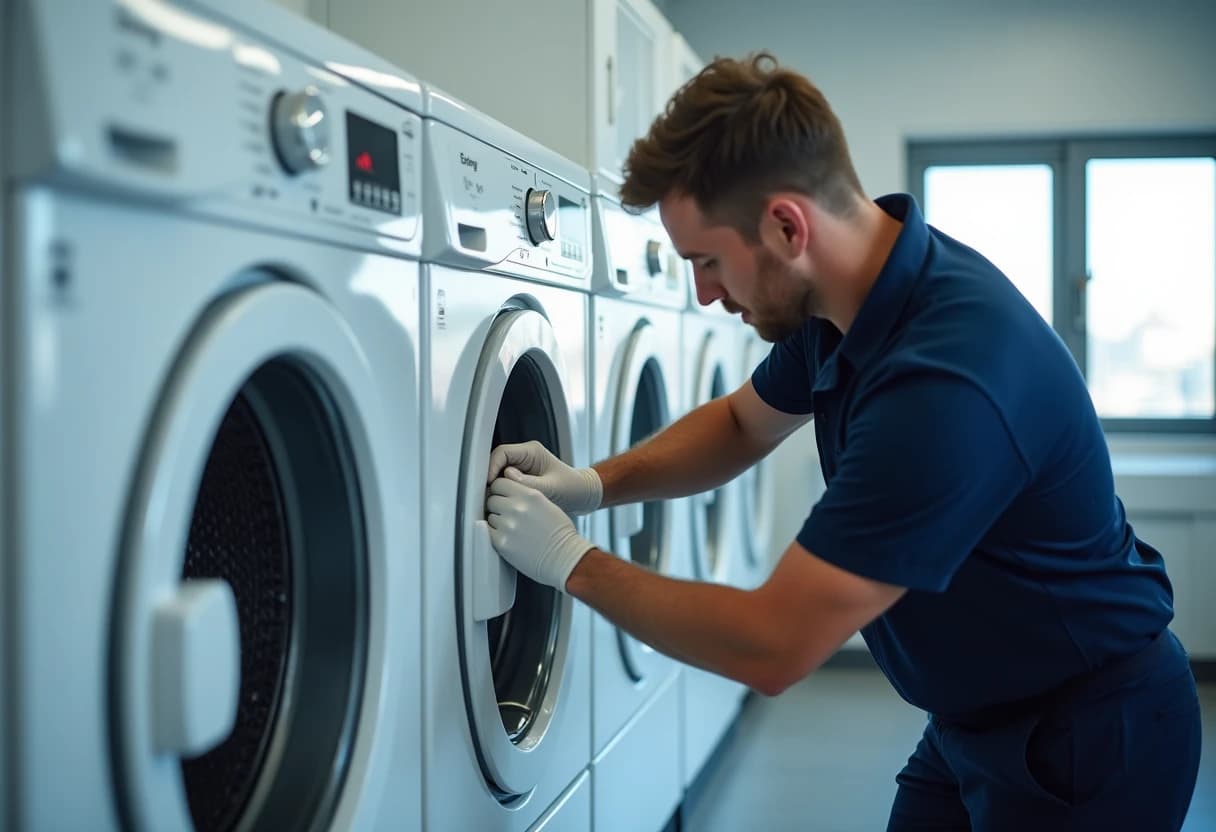
If you manage or sit on the board of a multi-unit building in Medfield, dryer vents are one of the few line items where deferred maintenance converts directly into fire risk and liability. Building codes cap dryer duct runs for a reason — the IRC allows a maximum equivalent length of 35 feet with deductions for every elbow — yet many Massachusetts buildings run longer, older, or shared configurations that clog years faster than a textbook run. Our whole-building service cleans every vent with mechanical agitation and vacuum extraction, addresses stacked and shared risers common in mid-rise and high-rise construction, documents code and safety exceptions unit by unit, and prices the work on a per-unit volume scale that makes annual programs genuinely affordable.
Why Commercial & Multi-Unit Dryer Vent Cleaning Matters for Medfield Homes
The fire math of multi-unit buildings is unforgiving. FEMA estimates about 2,900 residential clothes dryer fires per year, causing deaths, injuries and roughly $35 million in property loss — and the leading factor, cited in around a third of these fires, is failure to clean. A single-family dryer fire endangers one household; the same fire in a triple-decker, garden apartment or high-rise endangers dozens, spreads through shared walls and chases, and lands on the association's master policy. Every dryer in your building produces lint with every load, and every foot of vent duct collects it — narrowing airflow, extending dry times, and raising temperatures inside the duct until the day lint, heat and airflow restriction intersect. Professional cleaning resets every run in the building to clear, and the documentation resets your liability posture: when an insurer, an attorney or a fire marshal asks about vent maintenance, a dated per-unit report is the difference between diligence and exposure. No board wants to explain a preventable fire; a maintenance program means never having to.
Ask any fire official who works near Medfield State Hospital grounds: dryer fires in multi-family buildings are among the most preventable calls they run. Medfield blends a historic town center - including the 17th-century Peak House - with large 1960s-to-1990s Colonial subdivisions built for commuting families, plus scattered high-end new construction on former farmland. The subdivision stock runs classic two-zone forced-air systems whose attic runs and basement trunks accumulate decades of dust between rare cleanings. Older multi-unit stock compounds the risk — long vent runs to reach exterior walls, shared chases, foil accordion transitions installed decades ago that code and manufacturers now prohibit. Medfield's family-sized Colonials are heavily renovated as they change hands, and post-remodel construction dust in ductwork is the most common issue we encounter in town. Homes bordering Rocky Woods and the Charles River wetlands also draw in heavy seasonal pollen and damp basement air. Our whole-building service is built for exactly this: every Medfield unit's vent mechanically cleaned end to end, hazardous configurations photographed and flagged in writing, terminations cleared and damper function verified, and a compliance report your association's insurer will actually accept.
Our Commercial & Multi-Unit Dryer Vent Cleaning Process in Medfield
1Building Walkthrough & Per-Unit Proposal
First we learn your building's venting anatomy, because no two multi-unit buildings vent alike. Stacked risers, basement manifolds, improvised renovation-era runs and individual wall vents each demand different equipment and time. The walkthrough maps it, a camera check of representative runs establishes condition honestly, and your written proposal reflects the actual building — not a per-vent teaser that grows on site.
2Resident Coordination & Scheduling
We treat resident experience as part of the deliverable: clear advance notices, tight arrival windows, uniformed technicians who protect floors and finish each unit in roughly 20 to 40 minutes, and a same-day completion log to management. Units we cannot access are documented — not silently skipped — and a make-up window is scheduled so the building report ends with every unit accounted for.
3Dryer-Side Service: Transition Duct & Connection
In each unit we pull the dryer, clean behind and beneath it — a major hidden lint reservoir — and service the transition duct between machine and wall. Foil accordion transitions, which manufacturers prohibit and which trap lint in every corrugation, are flagged and can be replaced on the spot with code-appropriate material. The connection is reseated and secured without airstream-penetrating screws, per code.
4Mechanical Cleaning of the Full Vent Run
We clean mechanically, not just pneumatically: a spinning brush head sized to the duct scrubs the full circumference along the entire run while vacuum extraction carries lint out of the building. Runs that exceed sensible lengths, hidden crush points and disconnections announce themselves during this pass, and anything cleaning cannot fix is documented with location and photos for the building's repair planning.
5Shared Risers, Common Trunks & Booster Fans
Stacked buildings route multiple dryers into shared vertical risers, and these common elements are where multi-unit lint risk concentrates — no resident can clean them, and every household loads them. We service risers from terminations and access points with vertical-run equipment, clean common horizontal trunks and basement manifolds, and service inline booster fans, whose blades cake with lint and quietly fail.
6Termination Service & Exterior Verification
Exterior work is where multi-unit projects earn their price: terminations three stories up that no resident has ever seen, roof caps buried under winter ice damage, wall hoods behind shrubs. Each one is cleared of lint and debris, checked for damper function so it seals when idle and opens fully under flow, and photographed for the report. Damaged or non-compliant caps are flagged with replacement pricing.
7Airflow Verification & Building Compliance Report
Verification is what separates a maintenance program from a receipt. We confirm restored airflow run by run, re-photograph representative ducts against their before images, and compile the compliance report: every unit's status, every exception explained, every hazard located and pictured, every recommendation priced separately for board action. Associations on our annual program receive the same format each cycle, so year-over-year condition is genuinely comparable.
Benefits of Professional Commercial & Multi-Unit Dryer Vent Cleaning in Medfield
Shorter Dry Times & Lower Utility Costs
Utility waste from restricted venting is invisible but continuous, accruing on every load in every unit. Cleaning removes the restriction building-wide at once, which is why managers of buildings with house-paid gas or electric can often see the program's effect in the utility data — a rare maintenance item with a measurable meter-level return.
Insurance & Liability Documentation That Holds Up
Boards carry a duty to maintain common elements, and in most governing documents the vent path beyond the unit wall qualifies. A dated, unit-by-unit report demonstrates that duty discharged — and the annual repetition of it demonstrates a program, which is what diligence actually looks like to a carrier or a court.
Longer Dryer Life & Fewer Appliance Failures
Dryers venting against a clogged duct cook themselves: heating elements cycle against trapped heat, thermostats and thermal fuses trip and fail, motors run hot and die early. Clear venting is the cheapest appliance-life extension available — a point every appliance manufacturer's manual makes, and every burned-out element invoice repeats.
Directly Reduced Fire Risk, Building-Wide
Lint-clogged venting is the leading factor in the roughly 2,900 US dryer fires FEMA counts each year, and multi-unit buildings multiply the exposure by their unit count. Whole-building cleaning removes the fuel and restores the airflow that keeps duct temperatures in design range — addressing the top cause of a genuinely common fire, in every unit at once.
A Program, Not a Project
One-time cleanings decay; lint production never stops. An annual program keeps every run permanently inside its safe accumulation window, keeps documentation permanently current for insurers, and keeps the cost flat and predictable. Associations that institutionalize it typically spend less per year than their first catch-up cleaning cost — and never face a catch-up again.
Hazard Discovery Before It Costs You
Cleaning puts trained eyes and cameras into duct paths nobody has seen in years, and the discoveries matter: prohibited foil accordion transitions, disconnected runs dumping humid lint-laden air into wall cavities, vents terminating in attics or soffits, screens trapping lint at caps. Each is photographed, located and priced for correction — found on your schedule instead of an incident report's.
Signs Your Medfield Home Needs Commercial & Multi-Unit Dryer Vent Cleaning
Insurance Questionnaires or Post-Incident Requirements
Carriers writing habitational risk in Massachusetts have tightened on dryer venting because loss data justifies it. Boards seeing new questionnaire language, inspection requirements or premium credits tied to vent maintenance should read the market signal: this is now standard due diligence for multi-unit buildings, and the documented program is what compliance looks like.
Foil Accordion Ducts or Improvised Vent Runs in Units
If your association has never inspected what connects residents' dryers to the walls, assume nonconformance: transition duct is resident-installed, unregulated in practice, and frequently the worst link in the chain. Our unit visits document and correct these connections — the cheap fix that removes the most flammable segment of the entire vent path.
Lint Visible at Terminations or on the Building Exterior
Lint beards on wall caps, gray fuzz on the siding below terminations, or lint scatter on the roof around stack outlets mean the ducts are so loaded they are extruding their contents. What escapes outside is the overflow; the accumulation inside the run is worse, and the affected units are drying against serious restriction.
High-Duty Operations: Laundromats & Common Laundry Rooms
Watch the operational metrics: creeping gas consumption per load, customer complaints about damp clothes, machines cycling on high-limit switches. Each is restricted exhaust translated into operating cost. Duty-matched vent cleaning restores throughput and typically pays for itself in energy and uptime before its fire-safety value is even priced in.
Dryers Taking Two or More Cycles Per Load
Extended dry times are the classic first symptom of vent restriction: moist air cannot exit, so clothes tumble in humidity until the machine times out. When this complaint appears across multiple units in a building, the shared venting is implicated — and every affected dryer is running hotter and longer than its design intends.
No One Can Say When Vents Were Last Cleaned
Buildings inherit their venting history blind: previous owners' renovations, decades of resident turnover, and zero records. FEMA's dryer-fire data — about 2,900 a year, led by failure to clean — describes exactly this population of never-serviced vents. A documented first cleaning moves your building out of that statistic's denominator.
Commercial & Multi-Unit Dryer Vent Cleaning Cost in Medfield, MA
Three questions frame every building quote: How many units, and how does each vent? What common-element ductwork exists — risers, trunks, boosters, laundry-room manifolds? And what does access require — resident scheduling only, or ladder, lift and roof work? A six-unit triple-decker pair with individual wall vents might quote near $300–$600 total. A 40-unit garden complex typically lands in the $1,600–$3,000 range. A high-rise with shared risers is quoted as units plus riser service, often phased across budget years. What associations should refuse to pay: per-unit teaser rates that exclude the dryer pull, the transition duct or the termination (the three most failure-prone segments), 'discovery' surcharges invented mid-project, and any proposal without per-unit completion reporting — because in multi-unit work, undocumented cleaning fails at half its job.
Want the full pricing picture? See our complete Boston-area cost guide or call (617) 390-7145 for an exact flat quote for your Medfield home.
Local Knowledge: Medfield, Norfolk County
Serving Medfield means knowing Medfield. Medfield blends a historic town center - including the 17th-century Peak House - with large 1960s-to-1990s Colonial subdivisions built for commuting families, plus scattered high-end new construction on former farmland. The subdivision stock runs classic two-zone forced-air systems whose attic runs and basement trunks accumulate decades of dust between rare cleanings. Medfield's family-sized Colonials are heavily renovated as they change hands, and post-remodel construction dust in ductwork is the most common issue we encounter in town. Homes bordering Rocky Woods and the Charles River wetlands also draw in heavy seasonal pollen and damp basement air. Those conditions shape how we work here: which brush heads come off the truck, how we protect finishes in older interiors, and what we expect to find when the camera goes into a 02052 duct system. Our crews are in and around Medfield nearly every week — often for neighbors of past customers — so scheduling is fast and our arrival windows hold.
The Best Time of Year in Medfield
Budget season is the other calendar that matters. Condo boards and HOAs typically set budgets in fall for January fiscal years, and management companies batch portfolio maintenance into spring and fall windows — so the associations that get the best scheduling are the ones whose proposals are in hand before the budget meeting, not after the insurance renewal letter. Our walkthroughs and written building proposals are free and typically delivered within a week, which makes September the ideal month to price a program for board approval, October through November the prime execution window, and spring the natural slot for portfolio managers batching multiple properties. Insurance renewal dates deserve the same planning: a completed compliance report dated before the questionnaire arrives reads as a program; one dated after reads as a scramble. We calendar program buildings so the report always predates the renewal.
Why Choose Boston Air Duct Cleaners
What separates us from the coupon crowd is simple: we do the whole job, we prove it, and we charge what we quoted. Our technicians clean supplies, returns, trunks and blower compartments on every visit — never a cosmetic vent wipe. Photo documentation comes standard, pricing is flat and confirmed up front, and our trucks carry true commercial vacuum equipment, not rented shop-vacs. Based in West Newton and serving Medfield year-round, we answer our own phone at (617) 390-7145 and stand behind every cleaning with a satisfaction guarantee.
Serving Medfield and Surrounding Communities
We serve every community around Medfield as well: Dover, Millis, Walpole, Norfolk, Sherborn, Medway all fall inside our regular service routes. If you have a second property, a rental, or family nearby, ask about multi-home scheduling — grouped appointments on the same route are our most requested discount.