
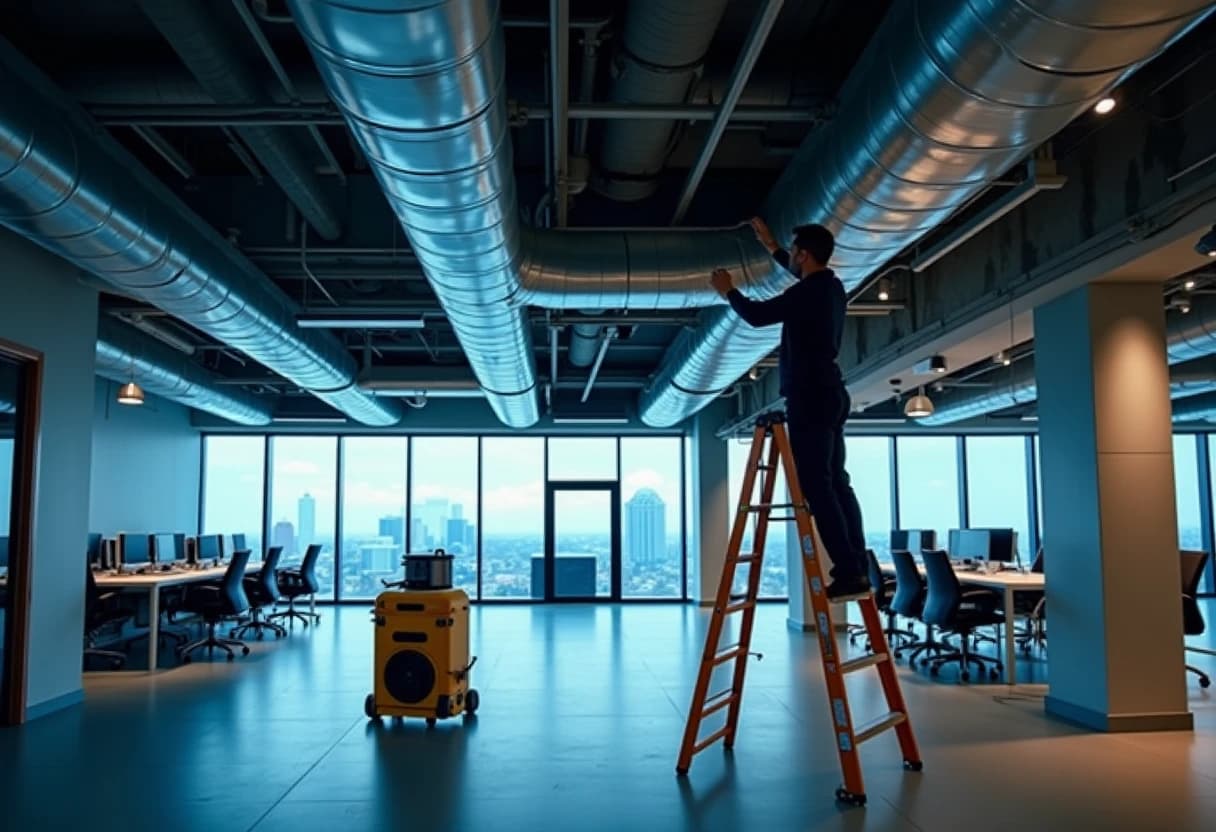
Commercial HVAC systems move enormous volumes of air through long trunk lines, VAV boxes, rooftop units and hundreds of diffusers — and every square foot of that ductwork collects dust, fibers, and whatever the building's occupants generate. Our commercial air duct cleaning crews serve Lynn offices, retail spaces, restaurants, medical suites, schools and fitness facilities with the same NADCA-standard source-removal method we use everywhere: the system goes under negative pressure with HEPA-filtered collection equipment, every run is mechanically agitated, and the work is documented in a written report your insurer, landlord or facilities director can file. We schedule nights and weekends so your business never loses an operating hour, and we carry the certificates of insurance commercial properties require before we ever set foot on site.
Why Commercial Air Duct Cleaning Matters for Lynn Homes
Commercial ductwork works harder than residential ductwork and gets dirtier faster. A typical office system runs ten to twelve hours a day, moving air for dozens of occupants who each shed skin cells, clothing fibers and tracked-in street dust; retail and restaurant systems add door-traffic grit, paper dust and cooking aerosols on top. Ceiling plenum returns — standard in commercial construction — inhale everything above the ceiling tiles: fireproofing fibers, construction debris left from every past fit-out, and decades of settled dust. All of it recirculates through the space every operating hour. The consequences show up three ways. Occupants complain: headaches, irritated eyes, allergy flare-ups and the persistent 'stale office' smell that no janitorial contract fixes. Equipment suffers: fouled coils, blower wheels and filters drive up energy consumption and shorten the life of rooftop units that cost five figures to replace. And liability accumulates: documented IAQ maintenance is increasingly what insurers, tenants' counsel and health inspectors ask to see. A professional source-removal cleaning addresses all three at once, and the written report is often as valuable as the cleaning itself.
Air quality expectations for Lynn workplaces have never been higher — employees, tenants and customers all notice stale air and dusty diffusers, and they say so. Between salt air off Lynn Shore Drive and the sheer age of the city's triple-decker stock, we see more corroded vent terminations and moisture-streaked ductwork here than almost anywhere on the North Shore. Shared basements and stacked units also mean one clogged dryer duct can affect three households at once. Lynn is one of the North Shore's densest triple-decker cities, layered with Victorian two-families in the Diamond District, shoe-factory-era workers' housing near downtown and post-war capes out toward Wyoma. Many multifamilies have had gas furnaces and ducted systems squeezed into basements and closets over the decades, producing tight, kinked runs that trap dust and lint. Those conditions load commercial duct systems with precisely the contaminants that generate complaints and drag down HVAC efficiency. Our crews clean Lynn commercial systems to NADCA standards: seal and depressurize each zone, agitate every trunk and branch mechanically, hand-clean unit interiors and terminal boxes, verify with imaging. Businesses in Swampscott and Nahant use the same service on recurring maintenance schedules, which is why our commercial trucks are in this part of Essex County nearly every week.
Our Commercial Air Duct Cleaning Process in Lynn
1Site Walk, System Mapping & Flat Quote
Every engagement begins with documentation, not equipment. We map your system zone by zone, photograph baseline conditions inside representative ducts and unit interiors, flag any disconnections, damage or microbial concerns, and confirm insurance and access requirements with your property team. Only after you approve the written scope, price and schedule does the crew mobilize.
2Certificates of Insurance & Scheduling Around Your Operations
Commercial work runs on paperwork and timing, and we treat both as part of the service. COIs naming your entity and landlord go out in advance; technicians carry ID and follow your building's access and alarm protocols. Scheduling is genuinely flexible — most of our commercial cleaning happens between close and open, and phased projects are sequenced so each area is finished, cleaned and back in service before occupants return.
3Containment & Protection of Finished Spaces
Before any agitation begins, each zone is isolated and sealed: supply diffusers and return grilles covered, access openings cut and collared at trunk lines, and the work area protected with floor coverings and poly sheeting where overhead work occurs. This containment is what separates source-removal cleaning from the dust-scattering shortcuts that give commercial occupants a bad Monday morning.
4Negative Pressure on Each Zone
Zone by zone, the duct network becomes a controlled vacuum circuit. Our negative-air machines pull thousands of cubic feet per minute through HEPA filtration, maintaining continuous negative pressure for the entire agitation phase. On multi-unit buildings we isolate and clean one system at a time, which keeps containment tight and lets partially occupied buildings continue operating around the work.
5Mechanical Agitation of Trunks, Branches & Terminal Units
This is the labor the price reflects. Every supply branch from diffuser to trunk, every return path including plenum-connected grilles, and every accessible terminal unit gets individual mechanical agitation — not just a blast of air from one end. Stubborn accumulation gets repeat passes until inspection imaging shows clean metal. Access panels are installed where the system lacks them, per NADCA standards, and sealed properly afterward.
6Air Handler, Rooftop Unit & Coil Cleaning
Rooftop units live a hard life above Massachusetts weather, and their interiors show it — wet-matted dust, corroded pans, biofilm on coil faces. Our crews are equipped and insured for roof work, and RTU interior cleaning is a routine scope item: blower and cabinet cleaning, drain pan service, coil cleaning where warranted, and photographs of everything so your facilities file shows unit condition, not just duct condition.
7Verification, Restoration & Completion Report
Projects close with proof. We re-image the duct sections photographed at the start, reinstall grilles and diffusers, replace ceiling tiles, restore thermostat settings and filters, and run each system to verify airflow. Your completion report includes before-and-after photos, a zone-by-zone scope checklist, observations on duct condition and recommended repairs, and the service date — formatted for owners, boards and insurance files.
Benefits of Professional Commercial Air Duct Cleaning in Lynn
One Vendor for Whole Portfolios
Recurring commercial clients get priority scheduling, locked maintenance-interval pricing and proactive reminders when each property comes due. For managers, that converts duct cleaning from a reactive scramble — usually triggered by a tenant complaint — into a quiet line item that renews itself, with documentation accumulating in each property's file automatically.
Lower Energy Costs Across Long Operating Hours
Static pressure is a tax on every fan in your building. Dust on blower blades, mats on coil faces and debris in trunk lines all force motors to work harder for less delivered air. Removing that resistance shortens run times, reduces demand peaks, and eases strain on compressors and motors — savings that recur every month the building operates.
Extended Rooftop Unit & Equipment Life
Replacing a commercial rooftop unit in Massachusetts runs well into five figures with crane time, curb adapters and controls. Dust is the primary aging accelerant — insulating coils, overheating motors, unbalancing blowers. Keeping the air path clean lets equipment run at design conditions, deferring the largest capital expenses on a building's mechanical schedule.
Documentation for Insurance, Leases & Compliance
Every project produces a completion report with photographic evidence, scope checklist and service date — the paper trail insurers, medical tenants, franchise inspectors and boards increasingly expect. When an air-quality question arises later, a documented maintenance history is the difference between a closed inquiry and an exposure. We format reports for exactly that use.
A Visibly Cleaner, Fresher-Smelling Space
Dust-streaked diffusers and gray-ringed ceiling tiles quietly undermine every impression your space makes — customers, patients and job candidates all register them. Cleaning the system and its visible terminals removes both the staining source and the stains, and the persistent stale-building odor that clings to occupied commercial space typically leaves with the duct dust that harbored it.
Zero Disruption to Business Operations
Downtime is a cost most vendors ignore and we design around. Projects are sequenced so no zone is out of service during your operating hours, containment keeps adjacent areas usable during phased work, and every shift ends with the space inspected, restored and ready for business. Your revenue never subsidizes your maintenance.
Signs Your Lynn Home Needs Commercial Air Duct Cleaning
No Service History Anyone Can Find
If neither the maintenance file nor the longest-tenured employee can name when the ducts were last cleaned, they almost certainly never have been. Commercial systems accumulate contamination continuously across every tenancy; a camera inspection settles the question in an hour and costs little, and we quote cleaning only when the imaging justifies it.
Tenant or Employee Air Quality Complaints
Recurring complaints about stuffy air, odors, headaches or allergy symptoms that filter changes never resolve point upstream — into the duct network that filters never touch. When multiple occupants in zones served by the same unit report symptoms, the distribution system is the common denominator and the first place a camera should look.
Rising Energy Bills or Weak Airflow in Certain Zones
Track runtime: systems compensating for fouled air paths cycle longer to reach setpoint, and long operating hours multiply the waste. If your building automation or utility data shows creeping consumption alongside comfort complaints, air-side fouling is the first hypothesis worth testing — and the cheapest one to fix.
Dust Streaking on Diffusers, Grilles & Ceiling Tiles
Gray streaks fanning out from supply diffusers and dark rings on surrounding ceiling tiles are the system's contamination made visible: dust-laden supply air depositing its cargo at the exit. Wiping the diffusers treats the symptom for a week; the trunk and branch surfaces upstream hold the resupply until they are mechanically cleaned.
Recent Fit-Out, Renovation or Construction
Tenant fit-outs fill duct systems with drywall, concrete and wood dust — the system inhales the job site through every open takeoff and unsealed return, and ceiling plenums collect the rest. Occupying the space without a post-construction duct cleaning means months of construction particulate delivered to desks, merchandise and lungs.
Water Intrusion, Mold Findings or Pest Evidence
Roof leaks, burst pipes and humidification failures routinely wet commercial ductwork, and damp duct dust becomes a microbial growth site within about 48 hours. Any water event near air-handling equipment warrants a duct inspection now — EPA guidance is explicit that visibly contaminated ducts serving occupied space should be professionally cleaned.
Commercial Air Duct Cleaning Cost in Lynn, MA
Why does the per-square-foot rate vary from $0.15 to $0.50? Density and difficulty. A modern open-plan office with exposed spiral duct cleans efficiently and prices near the bottom of the range. A medical suite with many small rooms, dense branch runs and infection-control protocols prices higher per foot. Restaurants add grease-influenced dust and overnight-only access; older buildings add long trunk runs, missing access panels (which NADCA-standard work requires us to install properly) and decades of accumulation requiring repeat agitation passes. Add-ons are quoted separately and honestly: evaporator or RTU coil cleaning typically $250–$600 per unit, EPA-registered sanitizing treatment $150–$500 depending on system size, and duct repairs always priced for approval before work. Nothing is 'discovered' on site and added to your invoice without a signed change.
Want the full pricing picture? See our complete Boston-area cost guide or call (617) 390-7145 for an exact flat quote for your Lynn home.
Local Knowledge: Lynn, Essex County
Serving Lynn means knowing Lynn. Lynn is one of the North Shore's densest triple-decker cities, layered with Victorian two-families in the Diamond District, shoe-factory-era workers' housing near downtown and post-war capes out toward Wyoma. Many multifamilies have had gas furnaces and ducted systems squeezed into basements and closets over the decades, producing tight, kinked runs that trap dust and lint. Between salt air off Lynn Shore Drive and the sheer age of the city's triple-decker stock, we see more corroded vent terminations and moisture-streaked ductwork here than almost anywhere on the North Shore. Shared basements and stacked units also mean one clogged dryer duct can affect three households at once. Those conditions shape how we work here: which brush heads come off the truck, how we protect finishes in older interiors, and what we expect to find when the camera goes into a 01902 duct system. Our crews are in and around Lynn nearly every week — often for neighbors of past customers — so scheduling is fast and our arrival windows hold.
The Best Time of Year in Lynn
Winter is when commercial IAQ complaints peak in Greater Boston, and the mechanism is simple: buildings close up tight, ventilation air is minimized against heating costs, and occupants spend the darkest months breathing recirculated air that passes through the duct system dozens of times a day. Whatever the ducts hold — dust, fibers, allergens, odor-saturated film — winter concentrates it. HR inboxes and property management ticket queues both show the January-February spike. A system cleaned before the closed-window months delivers its benefit exactly when occupants need it most, which is why our commercial calendar fills from the fall backward and why recurring clients anchor their intervals to early autumn.
Why Choose Boston Air Duct Cleaners
We built this company around the jobs other duct cleaners do badly: the 130-year-old Victorian with panned-joist returns, the Lynn condo with a 60-foot dryer run to the roof, the post-renovation house full of drywall dust. Our crews see Greater Boston's hardest systems every week, and the experience shows in the details — floor protection on the way in, sealed registers during the work, HEPA-vacuumed work areas on the way out, and imagery that proves the ducts are actually clean. Call (617) 390-7145 and judge the difference from the first conversation.
Serving Lynn and Surrounding Communities
Beyond Lynn, our crews cover the surrounding communities daily — including Swampscott, Nahant, Saugus, Salem, Peabody, Revere. Because routes cluster geographically, booking alongside a neighboring appointment often unlocks same-day service and combined-visit savings. Wherever you are in Essex County, the same flat-rate pricing, insured technicians and photo-documented process applies.