
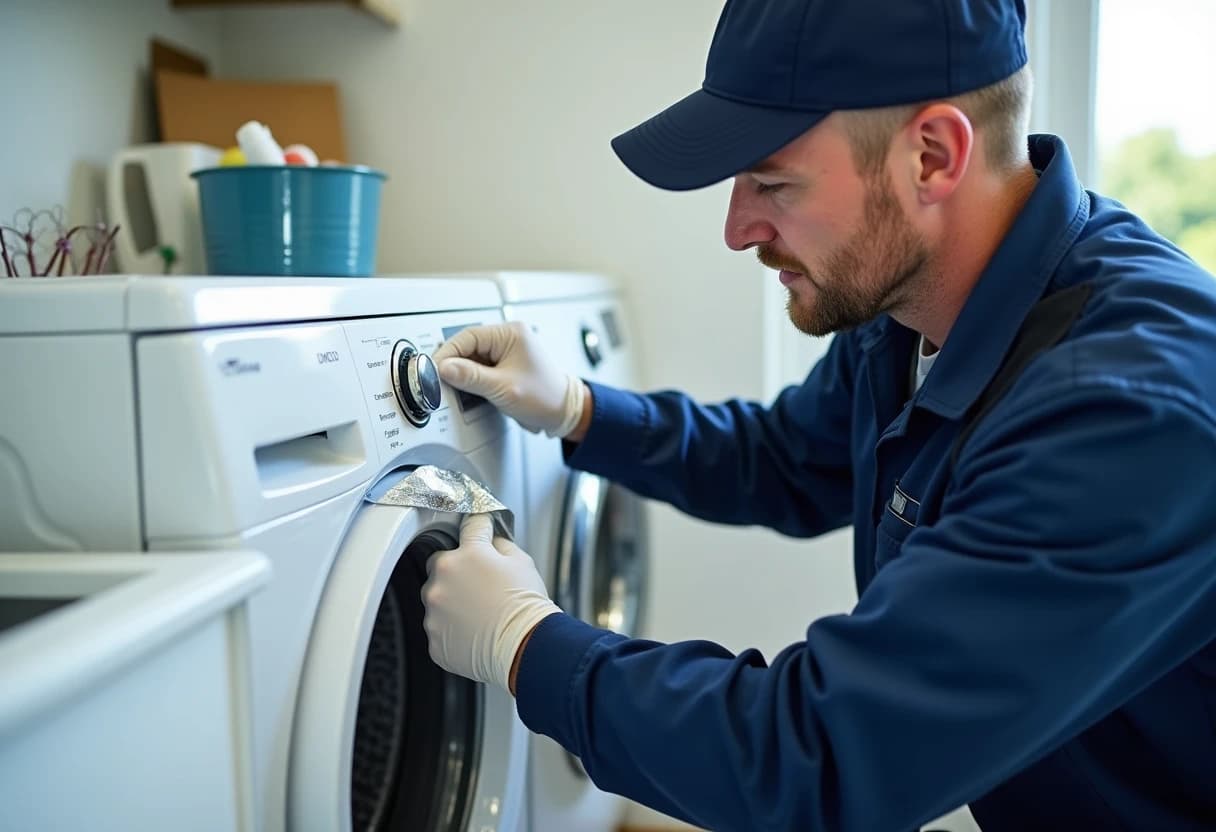
A dryer vent that is crushed, disconnected or leaking cannot be fixed by cleaning — it needs repair. Our Lowell dryer vent repair service restores the exhaust path itself: reconnecting joints that have pulled apart inside walls and ceilings, replacing crushed or kinked sections with smooth rigid metal duct, sealing leaks with proper metal foil tape, and rebuilding exterior hoods whose dampers have broken or rusted shut. Every repair uses code-compliant materials and methods — 4-inch rigid metal, clamped connections with no screws intruding into the airstream — so the finished vent moves full airflow, keeps moisture out of your walls, and stops feeding lint into places it should never go.
Why Dryer Vent Repair Matters for Lowell Homes
There is also a timing argument: dryer vent damage compounds, and early repair is dramatically cheaper than late repair. A loose joint today is a separated joint next year — and a wall cavity full of lint and moisture the year after, when the fix has grown from a $150 reconnection into drywall opening, cavity cleaning, and possibly mold remediation. A crushed transition hose today is a strained heating element and blown thermal fuse next winter, adding an appliance repair bill to the vent repair that was needed anyway. A failing damper today is a nest blockage by spring. This is why we treat inspection as the heart of the service: our technicians walk the entire exhaust path, test airflow at both ends, and give you a photographed, prioritized picture of what is failing and what it costs to fix now versus later. Most Lowell repairs land between $150 and $450 and finish in a single visit — a modest price for closing off the expensive futures.
Multi-family Lowell properties — triple-deckers, condo conversions, brownstone associations near Merrimack River — bring dryer venting problems that single-family playbooks miss: long shared-wall runs, terminations several stories up, and repairs that need association sign-off and insurance documentation. Lowell's housing runs from grand Victorians in Belvidere to dense triple-deckers and workers' cottages in The Acre and Centralville, with the downtown canal district full of textile mills converted to lofts and condos. Mill conversions rely on long shared duct trunks and rooftop air handlers, while the triple-decker stock is a patchwork of retrofitted furnaces, ductless heads and decades-old sheet metal. We handle all of it, providing certificates of insurance, written scopes for board approval, and photo documentation of completed work. The mill-to-loft conversions along Lowell's canals recirculate air for dozens of units at a time, so a neglected trunk line affects entire floors, not just one apartment. Add a large stock of pre-1940 multifamilies with basement mechanicals near the Merrimack, and dust, humidity and lint problems compound quickly here. When one unit's disconnected vent is loading a shared ceiling cavity with lint and moisture, the whole building has a stake in the repair — and we are the crew associations across Middlesex County call to make it right.
Our Dryer Vent Repair Process in Lowell
1Diagnose the Full Exhaust Path
Your technician maps the vent's routing, materials and condition: transition hose state, joint integrity, crush points, sag, corrosion, termination function. Where the run is concealed, airflow measurements and inspection tools tell us what the walls hide. You get a photographed diagnosis and a flat repair quote before any work begins.
2Protect the Area & Open Access
Laundry areas are tight, finished spaces, and we work in them accordingly: drop cloths, boot covers, and careful handling of the appliance and its gas or electrical connections. Gas dryers get particular care around the flexible connector — we never strain a gas line to reach a duct.
3Reconnect & Properly Fasten Separated Joints
Where lint and moisture have escaped into a cavity through a long-standing disconnection, we vacuum accessible accumulation with HEPA equipment and document conditions with photos. Removing that hidden fuel load matters as much as the reconnection itself — and the photos give you a record for insurance or future renovation planning.
4Replace Crushed, Corroded or Non-Compliant Sections
Vinyl and foil accordion duct found anywhere in the run is removed on sight and replaced: rigid metal for the concealed run, a short UL-listed semi-rigid aluminum connector at the appliance. The smooth interior of proper duct resists lint accumulation dramatically better than corrugations — the repair also makes every future cleaning faster and more effective.
5Cure Condensation: Slope, Seal & Insulate
Condensation repairs follow the water. We restore continuous slope toward the termination so condensate drains out instead of pooling; seal the joints it has been leaking through with foil tape rated for the duty; and insulate duct sections crossing unheated basements, garages, attics and exterior wall bays so exhaust stays above its dew point until it exits.
6Repair or Replace the Exterior Hood & Damper
Where pests have entered through a failed damper, we remove nesting material from the duct, clean the affected section, and install a termination with pest protection that does not restrict airflow. If the old hood was painted shut — common on older multi-family buildings — we free or replace it and note the repaint risk for the future.
7Replace the Transition Duct & Reset the Dryer
The appliance connection is rebuilt to spec: a UL-listed semi-rigid aluminum transition duct, as short and straight as the layout allows, secured with clamps at both ends. We position the dryer so the connector keeps its full diameter — not crushed against the wall — and mark the safe distance so future pushes do not recreate the old kink.
8Verify Airflow & Document the Repair
You receive photo documentation of the failures found and the repairs made — valuable for insurance files, condo associations, home sales and your own records. We also note the condition of everything we did not repair, so you have an honest picture of the vent's remaining lifespan and its next likely maintenance date.
Benefits of Professional Dryer Vent Repair in Lowell
Decades of Reliable Service From One Repair
We stand behind the work: repairs are documented, photographed and guaranteed, and because we also clean vents, we see our own repairs again on annual visits — a feedback loop that keeps our standards honest. The repair you buy is one we expect to inspect ourselves for years.
Restored Drying Performance
Because the leak or crush also lets conditioned air escape or exhaust recirculate, repairs frequently improve more than laundry: cold-air infiltration through a stuck-open damper ends, and the laundry room stops swinging between sauna and icebox with the seasons.
Lower Energy and Repair Bills
A dryer fighting a damaged vent runs longer per load and hotter per minute — both metered directly on your utility bill, often $10 to $20 a month for a busy household. Repair returns cycles to design length. The savings recur every laundry day, quietly repaying the one-time repair cost within the first year or two.
A Serious Fire Hazard, Eliminated
Code-compliant materials are themselves a safety upgrade: smooth rigid metal resists lint accumulation, clamped joints hold under heat and vibration, and a proper termination keeps nesting animals from plugging the line. A repaired vent is not just fixed — it is a fundamentally lower-risk system than what it replaces.
Pest Entry Points Closed
Pest damage rarely stays at the hood: rodents that enter a duct chew insulation and nest against warm sections deep in the run. Closing the entry point promptly is far cheaper than the extended cleaning and repair an established rodent presence demands — one more reason failing dampers deserve fast attention.
Code Compliance & Inspection-Ready Documentation
Compliance is not paperwork for its own sake; each code provision encodes a failure the industry learned about the hard way. Smooth interiors resist lint. Clamped joints survive heat. Unscreened dampers do not mat over. A to-code vent is simply a vent engineered not to fail the common ways.
Signs Your Lowell Home Needs Dryer Vent Repair
Slow Drying That Cleaning Didn't Fix
The symptom pattern is diagnostic: strong heat in the drum with weak or absent airflow at the exterior hood means exhaust is going somewhere else. That somewhere is the failure point. It is a fifteen-minute find for a technician with airflow instruments and knowledge of how these runs are routed in local housing.
Exterior Damper Broken, Stuck or Missing
Cold drafts in the laundry room trace to the damper more often than to windows: a flap that no longer closes turns the duct into a 4-inch outside-air inlet. If the laundry area runs noticeably colder in winter than adjacent rooms, put the hood on your inspection list — the heating-season savings from a tight new damper are immediate.
A Home Inspection or Appliance Tech Flagged the Vent
Inspection reports flag dryer venting constantly in Massachusetts: vinyl flex, taped or screwed joints, screened hoods, overlong concealed runs. Take the flag seriously — inspectors see the aftermath of ignored vents — and bring us the report. We translate findings into a flat-priced repair scope and documentation that closes the issue for buyers, sellers and insurers.
Lint Appearing Where It Shouldn't
Lint drifting from a basement ceiling, gathering on joists, puffing from a wall register or collecting behind the dryer means exhaust is escaping the duct before the termination. Lint marks the leak like dye in water — follow it and you find the separated joint or breach. This is a repair call, not a cleaning call, and it should not wait.
Water Stains, Drips or Peeling Paint Near the Vent Path
Condensation drips are easy to misattribute to plumbing. The tell is timing: moisture that appears during or after dryer use, and dries between laundry days, is exhaust-borne. We confirm with a running-dryer inspection before quoting, so you repair the actual source rather than the nearest pipe.
Visibly Damaged, Kinked or Sagging Duct
Accordion-style foil or vinyl duct anywhere in the run is damage by definition — materials that codes and manufacturers rejected because they crush, snag lint and (in vinyl's case) melt. If you can see corrugations along your vent path, the repair recommendation writes itself: replace with smooth rigid metal.
Dryer Vent Repair Cost in Lowell, MA
Dryer vent repair in Greater Boston typically runs $150 to $450, and the spread is about what failed and where. At the low end: transition hose replacement with a compliant semi-rigid connector, exterior hood and damper replacement, or reconnecting an accessible separated joint — each roughly $150 to $250 including parts. Mid-range, $250 to $350, covers replacing damaged duct sections with rigid metal, curing condensation with re-sloping, sealing and insulation, or repairs involving moderate access work. The top of the range, $350 to $450, reflects concealed-joint repairs requiring access openings, multi-failure jobs combining several fixes, corroded runs needing substantial replacement, or difficult terminations on upper walls and roofs. Every quote is flat and follows a diagnosis you can see — photos of the actual failure — so you know what you are paying to fix. If damage is extensive enough that full replacement or rerouting makes better sense than repair, we say so and quote that option separately rather than selling repairs onto a duct that has reached its end.
Want the full pricing picture? See our complete Boston-area cost guide or call (617) 390-7145 for an exact flat quote for your Lowell home.
Local Knowledge: Lowell, Middlesex County
Serving Lowell means knowing Lowell. Lowell's housing runs from grand Victorians in Belvidere to dense triple-deckers and workers' cottages in The Acre and Centralville, with the downtown canal district full of textile mills converted to lofts and condos. Mill conversions rely on long shared duct trunks and rooftop air handlers, while the triple-decker stock is a patchwork of retrofitted furnaces, ductless heads and decades-old sheet metal. The mill-to-loft conversions along Lowell's canals recirculate air for dozens of units at a time, so a neglected trunk line affects entire floors, not just one apartment. Add a large stock of pre-1940 multifamilies with basement mechanicals near the Merrimack, and dust, humidity and lint problems compound quickly here. Those conditions shape how we work here: which brush heads come off the truck, how we protect finishes in older interiors, and what we expect to find when the camera goes into a 01852 duct system. Our crews are in and around Lowell nearly every week — often for neighbors of past customers — so scheduling is fast and our arrival windows hold.
The Best Time of Year in Lowell
There is also a renovation-season rhythm to dryer vent damage in Greater Boston. The region's busiest remodeling months — spring through fall — are when concealed ducts get crushed by new framing, disconnected by trades working in ceilings, buried behind new finishes, or simply forgotten in layout changes that leave the dryer farther from its termination than code allows. Many of our fall repair calls trace directly to summer projects. If your home was renovated this year and laundry performance changed afterward, the connection is likely literal: a disturbed joint or flattened section behind the new work. We diagnose with airflow testing before opening anything, and where access through fresh finishes is needed, we keep it minimal and coordinate with your contractor's restoration.
Why Choose Boston Air Duct Cleaners
As a West Newton-based company, we treat Lowell like the neighborhood it is — because for us, it is. Our reputation lives or dies on local referrals, so every job gets the full process: complete system cleaning under negative pressure, mechanical agitation of every run, blower compartment service, and a documented walkthrough before we leave. We are licensed and insured, our estimates are free and flat, and our schedule holds same-day slots for urgent calls. One visit and you will understand why neighbors keep our magnet on the fridge.
Serving Lowell and Surrounding Communities
We serve every community around Lowell as well: Chelmsford, Dracut, Tewksbury, Billerica, Lawrence, Methuen all fall inside our regular service routes. If you have a second property, a rental, or family nearby, ask about multi-home scheduling — grouped appointments on the same route are our most requested discount.