
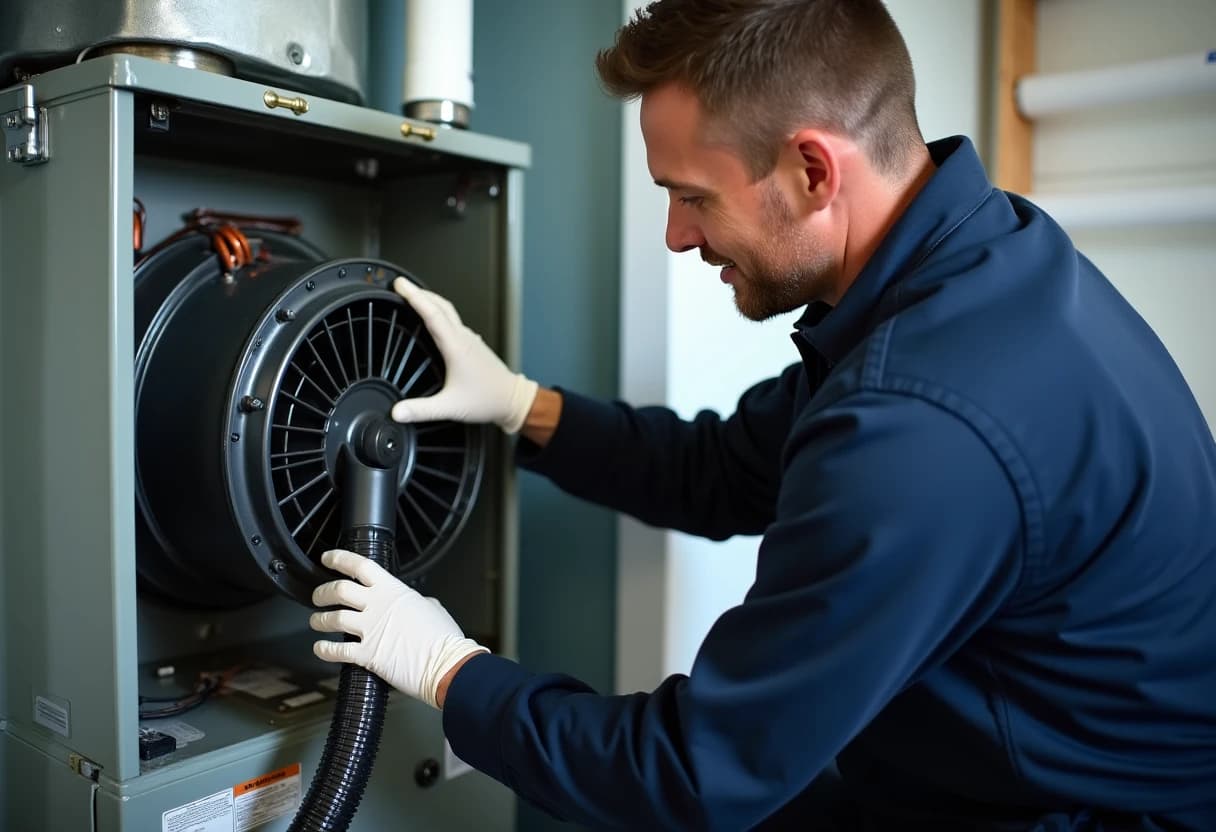
Think of HVAC system cleaning as a deep service interval for the largest appliance you own. Cars get more than oil changes; heating and cooling systems deserve more than filter swaps. In one visit we restore the entire air side: source-removal duct cleaning under negative pressure, blower wheel and motor compartment detailing, evaporator coil cleaning, drain pan and condensate service, plenum and cabinet cleanup, and a fresh filter to protect the work. Lincoln homeowners typically pair it with their annual furnace tune-up — the technician tuning combustion and the crew restoring airflow are complementary halves of the same maintenance logic — and the systems that get both run quieter, heat faster, cool harder and last visibly longer.
Why HVAC System Cleaning Matters for Lincoln Homes
Filters cannot do this job, and understanding why explains the service. A furnace filter sits at one point in the circuit, typically protecting only the equipment downstream of the return drop — everything upstream of it, meaning the entire return duct network, runs unfiltered by design, inhaling whatever the rooms produce. Standard filters also pass a large share of fine particulate even where they do sit, and every gap, bypass and late filter change compounds the leakage. The result is universal: open any air handler that has run a decade on filter changes alone and the blower wheel carries a felt of compacted dust, the coil face is gray, and the cabinet floor holds drifts. None of that is a filter failure exactly — it is the filter doing a limited job in a system that needs more. Periodic whole-system cleaning is the more: it removes the accumulation the filter was never positioned to prevent, resets the equipment to clean baseline, and — paired with a quality filter afterward — dramatically slows the rebuild.
The equipment serving Lincoln homes was mostly asked to do a job it was never sized for. Lincoln pairs 18th-century farmhouses and estate properties with one of the country's most significant concentrations of modernist homes, including the Gropius House and the mid-century enclaves inspired by it, all set on large conservation-minded lots. The modernist houses often use radiant slabs or unconventional duct layouts hidden in flat-roof assemblies, while the antique farmhouses carry delicate retrofit forced-air systems threaded through original timber frames. Systems extended through renovations, condo conversions and added zones run higher static pressure than their designs intended — and interior dust buildup pushes them past the margin. With more than a third of the town preserved as conservation land and working farms like Drumlin Farm and Codman Community Farms, Lincoln's air carries a real seasonal load of pollen, field dust and farm particulates that settles in return ducts. The flat-roofed modernist homes here also hide compact duct runs that are easy to neglect and tricky to access without experience. Whole-system cleaning recovers what the buildup took: we clean the complete duct network, then detail the blower, coil, plenums and cabinet, restoring capacity these hard-working systems cannot spare. Lincoln, Concord and Lexington are on our routes every week.
Our HVAC System Cleaning Process in Lincoln
1Full System Inspection & Airflow Baseline
We begin where the problems live: the air handler comes open first, because blower and coil condition determine half the scope. The technician documents the equipment, cameras representative duct runs, checks the condensate path, and walks you through findings with photos. The quote you approve reflects exactly what the inspection found — no mid-job discoveries priced from a flashlight.
2Protection, Sealing & Negative Pressure
The system becomes a closed circuit before anything gets agitated: sealed openings, depressurized trunks, HEPA-filtered collection. This setup is what separates source removal from dust redistribution, and it protects the equipment work too — debris loosened in the ducts flows to the vacuum rather than settling into the freshly opened blower compartment downstream.
3Complete Duct Network Cleaning
The duct phase follows NADCA source-removal method end to end: mechanical agitation of every supply and return, trunk lines cleaned last so debris always moves toward the collection point, and appropriate tooling per duct type — aggressive brushes on rigid metal, gentler whips on flex runs and older panned returns common in Massachusetts homes.
4Blower Wheel & Motor Compartment Detailing
The blower assembly gets restoration-grade attention: wheel removed where design allows or detailed in place, blades cleared of the compacted felt that steals airflow, motor housing vacuumed and wiped, and the compartment HEPA-cleaned to bare metal. A clean wheel moves dramatically more air — this single component is where most of the felt recovery lives.
5Evaporator Coil Cleaning
The coil is the system's radiator and its biggest hidden airflow chokepoint — fins spaced tighter than a millimeter apart trap fine dust that filters miss, and the wet cooling-season surface glues it in place. We clean the coil face and fins with methods matched to buildup severity, restoring the heat transfer and airflow the Department of Energy identifies as central to system efficiency.
6Cabinet, Plenums & Condensate Service
This stage finishes the wet section: pan cleaned of the biofilm and sludge that clog drains and breed odor, trap flushed, line verified flowing, float switch checked where fitted. Cooling-season backups — water around the air handler, tripped switches, ceiling stains under attic units — trace here, and ten minutes of prevention now beats an August service call later.
7Fresh Filter, Reassembly & Verified Results
We close the system with a fresh filter — quality pleated media, or your preferred spec — reinstall every register, and run the system live. The walkthrough covers register-by-register airflow against the morning's baseline, the complete before-and-after photo set, and written notes on anything worth watching. You see the recovery, not just an invoice describing it.
Benefits of Professional HVAC System Cleaning in Lincoln
Airflow Restored to Design Capacity
The felt difference has a mechanical explanation: a fouled system fights elevated static pressure and degraded fan performance simultaneously, and the losses multiply. Removing both restores the delivered-air volume the ductwork was engineered around — which is why post-cleaning systems reach setpoint faster, cycle less, and finally push meaningful air to the far registers upstairs.
Lower Energy Bills, Month After Month
Efficiency loss from fouling is a compounding leak: the blower draws more power to move less air, the compressor and burners run longer to deliver the same comfort, and every cycle costs more than design intended. Whole-system cleaning plugs the leak at every point at once — which is why it is the rare home service with a genuine payback period rather than just a benefit.
One Visit, Complete Documentation
You receive the complete photo record — every duct run, the blower before and after, the coil face, the plenums — plus written notes on system condition. That file has compounding value: it informs your HVAC tech's next tune-up, supports home-sale disclosures with evidence instead of assertions, and establishes the maintenance baseline future service gets measured against.
Cleaner Air From a Cleaner Machine
The equipment matters to air quality more than the ducts do, per square inch: the coil and pan stay damp all cooling season, hosting the biology behind musty odors, while the blower sheds its buildup into the airstream continuously. Cleaning ducts around contaminated equipment leaves the worst sources running; cleaning the whole system actually finishes the job.
Years Added to Equipment Life
The failure modes that kill furnaces and condensers early — overheated blower motors, stress-cycled heat exchangers, iced coils, overworked compressors — all begin with restricted, dirty airflow. Whole-system cleaning removes the root cause, letting every component run at the temperatures and loads it was engineered for. Against five-figure Massachusetts replacement costs, it is the cheapest longevity insurance available.
Quieter Operation, Fewer Odors
The burnt-dust smell of October's first furnace cycle is the equipment announcing its buildup — accumulation on the exchanger and in the plenums cooking off at first heat. A system cleaned before the season starts silent and neutral instead. Likewise the musty cooling-season note from a biofilmed coil and pan: cleaned and treated, the wet section stops perfuming the house.
Signs Your Lincoln Home Needs HVAC System Cleaning
Visible Buildup on the Blower or Around the Air Handler
Pull the blower compartment door and look at the wheel with a flashlight: blades carrying a visible felt of compacted dust are stealing airflow every minute the system runs, and the wheel you can see is cleaner than the coil you cannot. Visible equipment buildup is definitive — no further diagnosis needed, the system is due.
No Record of the System Ever Being Cleaned
The test costs nothing: open the blower door and look. NADCA guidance suggests inspection every couple of years; systems with no history reliably fail the eyeball test on the first try. In Greater Boston's older housing stock, where systems run long seasons and hard duty, 'never cleaned' and 'needs cleaning' are functionally the same finding.
Weak Airflow at Some or All Registers
Hold a hand to the registers: airflow you can barely feel — especially in far rooms and upper floors — means the system is losing delivered air to restriction somewhere between blower and grille. Matted wheels, blanketed coils and dust-narrowed runs are the usual suspects, and whole-system cleaning addresses all three in one pass.
Uneven Rooms, Noisy Cycles, Dust Everywhere
The classic trio of a fouled air side: rooms that heat and cool unevenly, a system that has grown audibly louder over the years, and dust that returns to surfaces within days of cleaning. Each has other possible causes; together they point one direction. A single whole-system cleaning typically improves all three at once, which is itself diagnostic.
Energy Bills Creeping Up Year Over Year
If usage climbs while rates and habits hold steady, your system is paying an efficiency tax somewhere — and the air side is the usual collector. Fouled blowers and coils force longer runtimes for the same comfort, and the loss compounds annually as buildup grows. A bill trending wrong across two or three seasons is a cleaning inspection's strongest referral.
Burnt-Dust Smell at Furnace Startup
Take the smell seriously as information: it means the airstream crosses surfaces loaded enough to volatilize, and what you smell burning in October you are breathing unburnt the rest of the year. Persistent or acrid versions merit prompt inspection anyway, to rule out the electrical and overheating causes that share the odor profile.
HVAC System Cleaning Cost in Lincoln, MA
Three questions determine your number. First, how many runs and zones? System size is the base driver, same as any duct cleaning. Second, what equipment, and where? A standard basement furnace with an accessible A-coil is the baseline; attic air handlers, closet units in condos, and coils buried behind refrigerant plumbing add access time that honest quotes price in advance. Third, when was anything last cleaned? First-time cleanings of decade-plus systems carry the heaviest buildup and sit higher in the range; maintenance cleanings of previously serviced systems run quicker and cheaper — one reason the three-to-five-year cycle costs less over time than the wait-until-symptoms approach. Across Middlesex County, typical outcomes: $450–$600 for compact systems, $600–$750 for average homes, $750–$900 for large ones. Two honest caveats: coils fouled beyond in-place cleaning methods occasionally need an HVAC tech's pull-and-clean, which we flag rather than fake; and duct repairs are always a separate, approved line — cleaning quotes that quietly absorb repair work are hiding the cost somewhere.
Want the full pricing picture? See our complete Boston-area cost guide or call (617) 390-7145 for an exact flat quote for your Lincoln home.
Local Knowledge: Lincoln, Middlesex County
What makes Lincoln different? Lincoln pairs 18th-century farmhouses and estate properties with one of the country's most significant concentrations of modernist homes, including the Gropius House and the mid-century enclaves inspired by it, all set on large conservation-minded lots. The modernist houses often use radiant slabs or unconventional duct layouts hidden in flat-roof assemblies, while the antique farmhouses carry delicate retrofit forced-air systems threaded through original timber frames. With more than a third of the town preserved as conservation land and working farms like Drumlin Farm and Codman Community Farms, Lincoln's air carries a real seasonal load of pollen, field dust and farm particulates that settles in return ducts. The flat-roofed modernist homes here also hide compact duct runs that are easy to neglect and tricky to access without experience. For duct and dryer vent systems, those local factors translate into specific, predictable problems — and predictable problems are the ones we solve fastest. Call (617) 390-7145, tell us your street and home style, and we will quote the job accurately the first time, usually in under five minutes.
The Best Time of Year in Lincoln
The first furnace start of fall is New England's annual system inspection, whether owners want one or not: accumulation on the heat exchanger and in the plenums cooks off at first fire, and the burnt-dust smell reports exactly how much the system carries. Homes that treat the smell as an October tradition are breathing that accumulation unburnt the rest of the year. Pairing whole-system cleaning with the fall tune-up — cleaning first, tune-up after — has become our most-recommended sequence: the tech tunes combustion on a system breathing at design airflow, limit-trip and short-cycle risks drop for the winter, and the heating season opens quiet, odorless and at full delivery. Fall books heavily; September appointments get the sequence done before the tune-up rush.
Why Choose Boston Air Duct Cleaners
Homeowners across Middlesex County choose Boston Air Duct Cleaners for three reasons. First, honesty: our inspection camera tells you whether your system actually needs cleaning — and sometimes the answer is no. Second, capability: truck-grade negative-air machines, rotary brush systems and HEPA filtration handle everything from antique gravity-furnace conversions to brand-new high-velocity systems. Third, accountability: flat quoted pricing, before-and-after photos, insured technicians, and a real local office you can call at (617) 390-7145. That combination is rarer in this industry than it should be.
Serving Lincoln and Surrounding Communities
Beyond Lincoln, our crews cover the surrounding communities daily — including Concord, Lexington, Weston, Waltham, Sudbury, Wayland. Because routes cluster geographically, booking alongside a neighboring appointment often unlocks same-day service and combined-visit savings. Wherever you are in Middlesex County, the same flat-rate pricing, insured technicians and photo-documented process applies.