
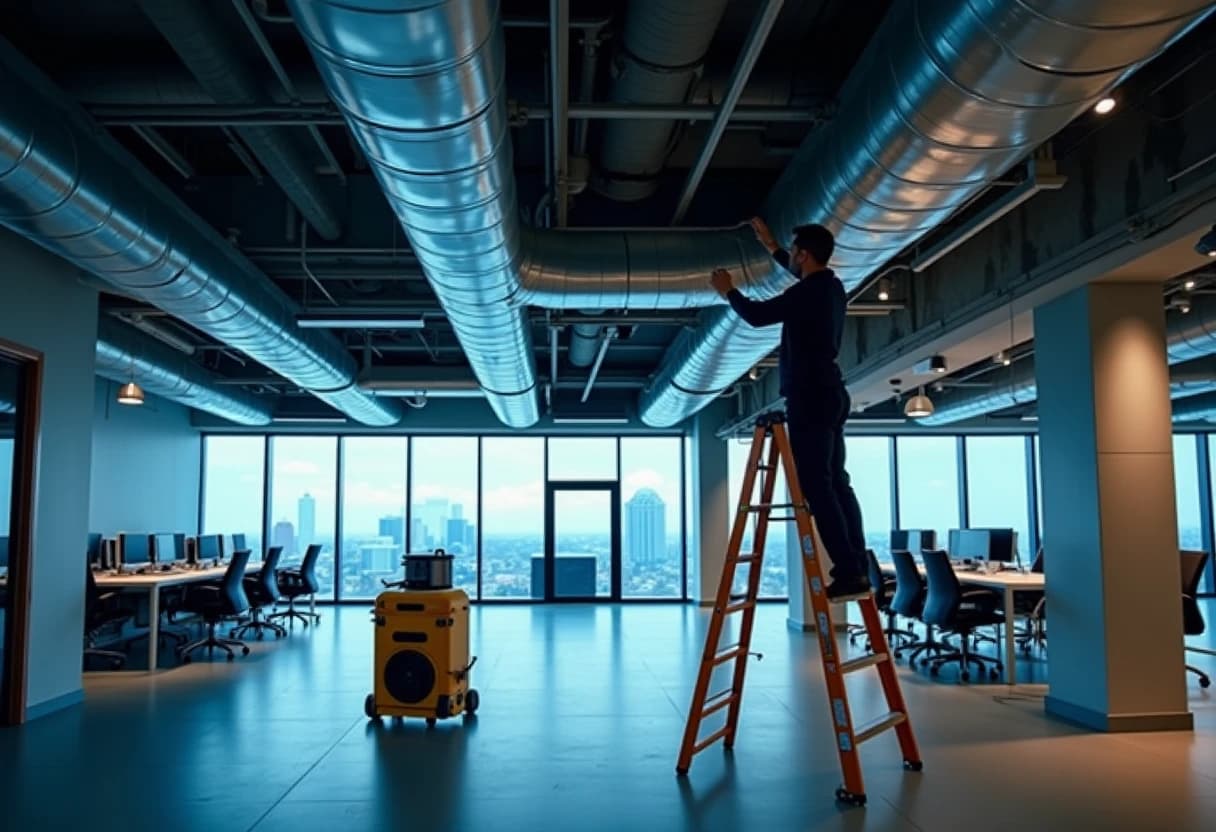
A commercial duct system is a shared resource: one contaminated trunk line serves every office, exam room, dining room or workout floor downstream of it. Our Lexington commercial cleaning service treats it that way, cleaning the complete air path from rooftop unit or air handler through mains, branches and terminal boxes to each diffuser. We use truck-grade and portable HEPA negative-air machines sized to commercial static pressures, rotary brush and compressed-air agitation matched to duct construction, and containment practices that keep finished spaces spotless. Whether you manage a single storefront or a portfolio of properties across Middlesex County, you get one point of contact, flat project pricing quoted from plans or a walkthrough, and reporting formatted for owners, boards and insurance carriers.
Why Commercial Air Duct Cleaning Matters for Lexington Homes
Commercial buildings in Greater Boston carry a particular burden: age. Much of the region's office, retail and mixed-use stock predates modern ventilation standards, and its duct systems have been extended, spliced and re-zoned through every tenancy since installation. Original trunk lines from the 1960s serve suites built out in the 1990s and re-divided in the 2010s; abandoned runs dead-end above ceilings collecting dust; flexible duct from a dozen different fit-outs sags between joists. These systems hold decades of accumulation that no filter has ever protected against, because most of it entered from the return side or during construction with the system exposed. Cleaning is also frequently the first time anyone has looked inside in years — our crews routinely discover disconnected branches dumping conditioned air into plenums, crushed flex starving whole suites, and pest evidence that explains long-standing odor complaints. The cleaning restores the system; the inspection that comes with it frequently saves the owner from paying to heat and cool the space above the ceiling tiles for another decade.
Air quality expectations for Lexington workplaces have never been higher — employees, tenants and customers all notice stale air and dusty diffusers, and they say so. Lexington's teardown-and-rebuild wave means many streets host active construction, and neighboring homes routinely pull that airborne dust into their return ducts for months. In the town's cherished mid-century modern homes, slab-level and ceiling-mounted duct runs are original equipment that has often gone half a century without cleaning. The birthplace of the American Revolution mixes colonial-era landmarks near the Battle Green with an unusually deep stock of mid-century modern and 1950s-60s ranch and split-level neighborhoods - and, increasingly, large new homes replacing them through the town's active teardown-rebuild market. The mid-century houses were early adopters of forced-air heat, so original sixty-plus-year-old ductwork is common, while the new builds carry tightly sealed envelopes that make duct hygiene matter even more. Those conditions load commercial duct systems with precisely the contaminants that generate complaints and drag down HVAC efficiency. Our crews clean Lexington commercial systems to NADCA standards: seal and depressurize each zone, agitate every trunk and branch mechanically, hand-clean unit interiors and terminal boxes, verify with imaging. Businesses in Arlington and Belmont use the same service on recurring maintenance schedules, which is why our commercial trucks are in this part of Middlesex County nearly every week.
Our Commercial Air Duct Cleaning Process in Lexington
1Site Walk, System Mapping & Flat Quote
First we scope the job properly: which units serve which spaces, where the trunk lines run, what the ceiling plenum situation looks like, and what condition the ducts are actually in. A borescope camera look at representative runs keeps the assessment honest. The result is a fixed project price and a phasing plan built around your operating hours — no unit rates that balloon mid-project.
2Certificates of Insurance & Scheduling Around Your Operations
We plan commercial projects like contractors, not like a residential crew squeezing in a big job. That means pre-mobilization insurance certificates, coordination with your facilities or property management team, protection plans for finished spaces and merchandise, and crews scheduled for the windows when your building is emptiest — nights, weekends and holidays included at no scheduling premium for standard projects.
3Containment & Protection of Finished Spaces
Before any agitation begins, each zone is isolated and sealed: supply diffusers and return grilles covered, access openings cut and collared at trunk lines, and the work area protected with floor coverings and poly sheeting where overhead work occurs. This containment is what separates source-removal cleaning from the dust-scattering shortcuts that give commercial occupants a bad Monday morning.
4Negative Pressure on Each Zone
We connect HEPA-filtered negative-air machines to the trunk lines of each zone through sealed access ports, placing the ductwork under continuous vacuum. Commercial systems demand serious equipment — long trunk runs and high static pressures swallow underpowered vacuums — so we size machines to the system, sometimes running multiple units on large floors. Debris loosened downstream travels one direction: into collection.
5Mechanical Agitation of Trunks, Branches & Terminal Units
This is the labor the price reflects. Every supply branch from diffuser to trunk, every return path including plenum-connected grilles, and every accessible terminal unit gets individual mechanical agitation — not just a blast of air from one end. Stubborn accumulation gets repeat passes until inspection imaging shows clean metal. Access panels are installed where the system lacks them, per NADCA standards, and sealed properly afterward.
6Air Handler, Rooftop Unit & Coil Cleaning
The units themselves get hands-on attention: blower assemblies and housings cleaned, unit cabinets HEPA-vacuumed and wiped, condensate pans cleared and treated, fresh filters installed. Evaporator coil cleaning — the single highest-return item on most commercial systems — is available on every project, and on rooftop units we handle roof access, weather constraints and panel restoration as part of the scope.
7Verification, Restoration & Completion Report
The last step is a walkthrough with your facilities contact or property manager: systems running, airflow verified at representative diffusers, documentation reviewed page by page. Everything we observed inside your system goes in writing, including items outside our scope that deserve your HVAC contractor's attention. We then log your property for the maintenance interval you choose, so recurring cleanings arrive as calendar items, not emergencies.
Benefits of Professional Commercial Air Duct Cleaning in Lexington
A Visibly Cleaner, Fresher-Smelling Space
Front-of-house cleanliness stops at the ceiling for most cleaning contracts. When the HVAC system itself is clean, the difference is felt rather than seen: air that smells neutral at the door, diffusers that stay white, and surfaces that need visibly less dusting between janitorial visits. It reads as a well-run building because it is one.
Lower Energy Costs Across Long Operating Hours
Commercial HVAC runs ten to fourteen hours a day, so every efficiency point lost to fouled coils, dirty blower wheels and debris-narrowed ducts compounds across thousands of operating hours a year. Cleaning restores design airflow and heat transfer, and buildings with long-neglected systems frequently see the project pay for itself at the utility meter within a couple of seasons.
Extended Rooftop Unit & Equipment Life
Every hour a fan motor fights choked airflow shortens its life, and commercial motors log thousands of hours a year. Source-removal cleaning takes the strain off the entire mechanical chain — motors, bearings, belts, compressors — which is why HVAC contractors themselves routinely refer their commercial clients to us before recommending equipment replacement.
Fewer IAQ Complaints, Happier Tenants & Staff
For employers, air quality is a retention and productivity issue — workplace studies consistently link ventilation quality to cognitive performance and absenteeism. For landlords, it is a lease-renewal issue. Removing years of accumulated contamination from the system every occupant shares is one of the few facility investments both groups notice within the first week.
Documentation for Insurance, Leases & Compliance
For medical, dental, childcare and food-service tenants, documented HVAC hygiene is part of operating credibly — inspectors notice dusty diffusers, and patients and parents notice them sooner. Our reports give these businesses a dated, photographic answer, and give their landlords a template for building-wide maintenance that keeps every tenancy covered.
Zero Disruption to Business Operations
Overnight, weekend and phased scheduling are the default for our commercial work, not a premium add-on. Retail spaces are cleaned between close and open; offices over weekends; multi-tenant buildings floor by floor with each area restored before occupants return. The only evidence of the project your customers ever see is cleaner air.
Signs Your Lexington Home Needs Commercial Air Duct Cleaning
Tenant or Employee Air Quality Complaints
Recurring complaints about stuffy air, odors, headaches or allergy symptoms that filter changes never resolve point upstream — into the duct network that filters never touch. When multiple occupants in zones served by the same unit report symptoms, the distribution system is the common denominator and the first place a camera should look.
Recent Fit-Out, Renovation or Construction
Tenant fit-outs fill duct systems with drywall, concrete and wood dust — the system inhales the job site through every open takeoff and unsealed return, and ceiling plenums collect the rest. Occupying the space without a post-construction duct cleaning means months of construction particulate delivered to desks, merchandise and lungs.
Rising Energy Bills or Weak Airflow in Certain Zones
Suites that never cool, conference rooms that never warm, and utility bills creeping up without rate changes all point to airflow loss — and dust is its quietest cause. Debris-narrowed branches, clogged VAV inlets and fouled coils steal delivered air zone by zone. Cleaning restores the balance the system was commissioned with.
Dust Streaking on Diffusers, Grilles & Ceiling Tiles
Janitorial crews wiping the same diffusers every month are documenting the problem, not fixing it. Persistent re-soiling of terminals means the duct interiors upstream are shedding continuously. After a proper source-removal cleaning, terminal surfaces stay clean for years instead of weeks — an easy before-and-after your maintenance log will show.
No Service History Anyone Can Find
Building acquisitions inherit ductwork as-is: every previous tenant's dust, every fit-out's debris, every deferred year. A duct inspection belongs on the due-diligence checklist alongside the roof and the boilers — it is among the cheapest items on the list and regularly surfaces disconnections and damage that affect the negotiation.
Odors That Return Every Operating Day
A building that smells stale at opening, musty after humid stretches, or faintly of last year's kitchen operations is broadcasting from its ductwork. Odor molecules bind to the organic dust film inside ducts and re-release with every operating hour. No cleaning contract or air freshener reaches the source; source removal takes it out of the building.
Commercial Air Duct Cleaning Cost in Lexington, MA
Budget-minded facilities teams should weigh interval against invoice. A commercial system cleaned to NADCA standards stays serviceably clean for three to five years in typical use, so a $3,000 project annualizes to under a thousand dollars — less than most buildings lose annually to the energy penalty of fouled coils and choked airflow. Recurring-program clients do better still: properties on our maintenance calendar receive locked interval pricing, priority scheduling in the spring and fall rush, and inspection-first service where we camera-check the system and clean only when imaging justifies it. That inspect-first discipline matters; some intervals we recommend deferring a cleaning, and clients tell us that honesty is why entire portfolios end up on our schedule. Multi-property managers should ask about portfolio pricing — consolidated scheduling across sites reduces our mobilization costs, and we pass the difference through.
Want the full pricing picture? See our complete Boston-area cost guide or call (617) 390-7145 for an exact flat quote for your Lexington home.
Local Knowledge: Lexington, Middlesex County
Every town's ductwork tells the story of its housing. The birthplace of the American Revolution mixes colonial-era landmarks near the Battle Green with an unusually deep stock of mid-century modern and 1950s-60s ranch and split-level neighborhoods - and, increasingly, large new homes replacing them through the town's active teardown-rebuild market. The mid-century houses were early adopters of forced-air heat, so original sixty-plus-year-old ductwork is common, while the new builds carry tightly sealed envelopes that make duct hygiene matter even more. Lexington's teardown-and-rebuild wave means many streets host active construction, and neighboring homes routinely pull that airborne dust into their return ducts for months. In the town's cherished mid-century modern homes, slab-level and ceiling-mounted duct runs are original equipment that has often gone half a century without cleaning. We plan Lexington jobs around those realities, from equipment selection to time on site, and it shows in the results. If you live near Munroe Tavern or anywhere across Lexington's 02420 area, we have almost certainly cleaned a system like yours before — and we can tell you exactly what to expect before we arrive.
The Best Time of Year in Lexington
Winter is when commercial IAQ complaints peak in Greater Boston, and the mechanism is simple: buildings close up tight, ventilation air is minimized against heating costs, and occupants spend the darkest months breathing recirculated air that passes through the duct system dozens of times a day. Whatever the ducts hold — dust, fibers, allergens, odor-saturated film — winter concentrates it. HR inboxes and property management ticket queues both show the January-February spike. A system cleaned before the closed-window months delivers its benefit exactly when occupants need it most, which is why our commercial calendar fills from the fall backward and why recurring clients anchor their intervals to early autumn.
Why Choose Boston Air Duct Cleaners
We built this company around the jobs other duct cleaners do badly: the 130-year-old Victorian with panned-joist returns, the Lexington condo with a 60-foot dryer run to the roof, the post-renovation house full of drywall dust. Our crews see Greater Boston's hardest systems every week, and the experience shows in the details — floor protection on the way in, sealed registers during the work, HEPA-vacuumed work areas on the way out, and imagery that proves the ducts are actually clean. Call (617) 390-7145 and judge the difference from the first conversation.
Serving Lexington and Surrounding Communities
Lexington sits in the heart of our service area, and neighboring Arlington, Belmont, Bedford, Burlington, Waltham, Lincoln appointments share the same routes. That density is why our response times in this part of Middlesex County are among our fastest — and why you will see our trucks in the area week after week.