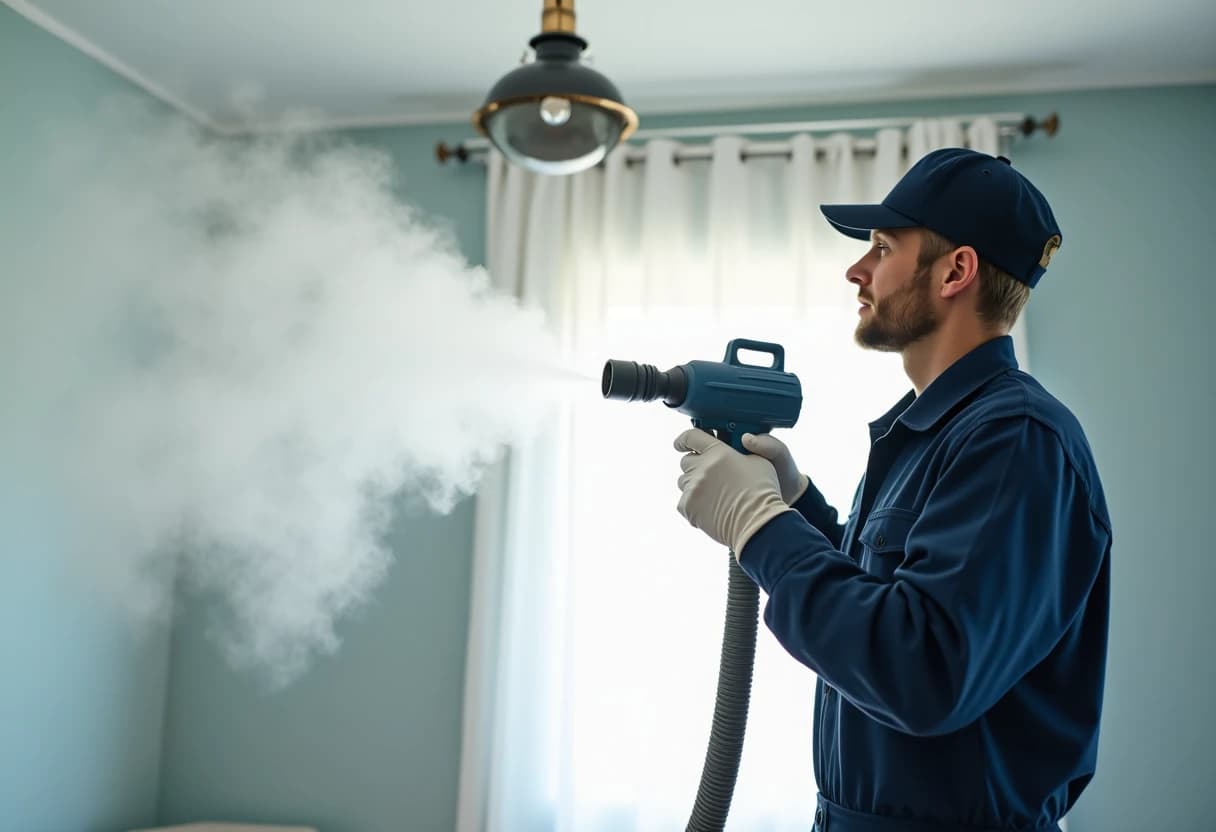
The EPA's guidance on duct treatments is specific: chemical biocides should be applied only after mechanical cleaning, and only products registered for use in HVAC systems belong in your air path. That is exactly how we sanitize ducts in Holliston. First the system is cleaned to bare surfaces under negative pressure; then an EPA-registered antimicrobial is atomized through the supply and return network at label rates, treating the seams, joints and textures no brush can fully reach. The treatment kills odor-causing bacteria, neutralizes microbial residue and inhibits regrowth — and because it lands on clean metal rather than a dust blanket, it actually works. We will also tell you plainly when your system does not need it.
Why Air Duct Sanitizing & Deodorizing Matters for Holliston Homes
Certain situations turn sanitizing from optional to strongly advised. After confirmed microbial growth or a mold finding, treatment of the cleaned surfaces inhibits recolonization while the moisture fix takes hold. After rodent or pest activity in the ductwork, sanitizing addresses the bacterial and viral load droppings leave behind — a genuine health matter, not merely an aesthetic one. After fire or heavy smoke exposure, deodorizing treatment neutralizes the acrid residue that otherwise off-gasses for years. After a water event, it suppresses the microbial bloom that damp ducts incubate. And at move-in, it resets a system whose history you cannot verify. In each case the logic is the same: cleaning removes what is visible, sanitizing addresses what is biological. Conversely — and we say this plainly because the industry often will not — a routinely maintained system with no odor, no moisture history and no contamination event does not need sanitizing, and the EPA does not recommend routine biocide use in ducts. We inspect first and recommend accordingly. Roughly a third of the time, our recommendation is to skip it.
We treat a steady stream of odor calls from Holliston, from condos near Upper Charles Rail Trail to family homes out toward Goodwill Park, and the pattern is consistent: the smell survives every surface remedy because it lives in the air system. Holliston blends Victorian-era homes in its walkable downtown and the historic Mudville neighborhood with large waves of 1960s-1990s Colonials and capes on wooded half-acre lots. The downtown antiques often run retrofit ductwork alongside original radiators, while the subdivision-era homes carry full forced-air systems that are now decades past their last thorough cleaning. That age of housing stock means duct film with a long biography. Because our shop is in West Newton, roughly 18 miles away, we can usually schedule Holliston sanitizing visits within days — often bundled with cleaning in one appointment, which is both cheaper and more effective.
Our Air Duct Sanitizing & Deodorizing Process in Holliston
1Odor Assessment & Honest Qualification
We qualify the job before we book the fog. Odors that ride the airflow, spike at cycle start, or track the seasons implicate the system; odors independent of airflow usually do not. The assessment separates the two, checks for the moisture or contamination that sometimes underlies duct smells, and produces a flat written quote for exactly the work your situation supports.
2Source-Removal Cleaning First
Step one is removing the reservoir. The odor-saturated film lining your ducts is physically extracted under negative pressure — rotary brushes and pneumatic whips strip it from every supply, return and trunk while the HEPA vacuum captures it. Most of the odor leaves the house in this step; the fogging that follows neutralizes what remains and prevents the smell from rebuilding.
3Product Selection & Preparation
Preparation is checklist work that determines results: product selected for your specific odor profile, dilution mixed to label specification, fogging equipment matched to your system's size so droplet distribution covers the full duct network. We also plan the airflow path — which registers stay open, how the blower assists — so the treatment reaches the far end of every run, not just the trunks.
4Whole-System Antimicrobial Fogging
The treatment is atomized into a fine fog and introduced through the duct network while controlled airflow carries it the length of every supply and return. The fog deposits on all interior surfaces — including the seams, joints and corrugations mechanical cleaning cannot polish — killing odor-causing bacteria and neutralizing microbial residue on contact. Full-system coverage takes under an hour in most homes.
5Coil, Drain Pan & Blower Treatment
Every fogging visit includes hands-on treatment of the components the fog alone cannot adequately address: coil fins treated with appropriate cleaner, drain pan scrubbed and sanitized, condensate line flushed, blower compartment wiped and treated. If we find heavy coil fouling or standing water that signals a bigger problem, we document it with photos and quote the fix separately — informed consent, never ambush.
6Deodorizing Pass for Stubborn Odors
Smoke and heavy pet situations get a second, targeted pass with odor-counteractant chemistry — products that bind and neutralize odor molecules rather than perfume over them. Tobacco residue in particular clings aggressively to metal and re-releases for years; the counteractant pass addresses it specifically. This step is included when the assessment calls for it and skipped, with the price reflecting that, when it does not.
7System Airing, Verification & Walkthrough
The finish is verification by nose and by paper: a room-by-room airflow check confirming neutral odor at every register, before-and-after photos of the duct interiors, and a written record of products applied with their EPA registration numbers. Surfaces are dry and the home fully usable by the time we pack up in nearly all cases — we review any exceptions before we start, never after.
Benefits of Professional Air Duct Sanitizing & Deodorizing in Holliston
Small Add-On Cost, Outsized Payoff
Bundled with duct cleaning, sanitizing adds roughly $75 to $200 to the visit — the system is already sealed, accessed and under negative pressure, so you pay for chemistry and application time, not a second mobilization. Against the hundreds homeowners spend annually on masking products that fix nothing, the one-time source treatment is the plainly economical choice.
A True Reset for Newly Purchased Homes
You inspected the roof, the furnace and the foundation before buying; the air system's biological history was invisible on every report. A move-in sanitizing closes that gap, decontaminating the one system that touches every room before your family settles in. Scheduled between closing and move-in, it is the cheapest and easiest it will ever be — empty house, open access, one afternoon.
Pet Odor Elimination That Actually Holds
Multi-pet and long-tenure pet households benefit most: the accumulation scales with animal-years, and no surface cleaning touches the duct-borne share. Post-treatment, the improvement compounds — ongoing dander still sheds, but it lands in a neutral system rather than layering onto decades of saturated film, and routine filter changes keep the new baseline for years.
Smoke Ghosts Finally Evicted
Fire and smoke events leave the same signature at higher intensity: acrid residue through every duct the system ran during or after the event. Alongside your restoration work, duct cleaning with counteractant treatment prevents the classic post-fire complaint — a rebuilt, repainted home that still exhales smoke on warm days. We coordinate with restoration timelines regularly.
Microbial Load Reduced System-Wide
Beyond odor, the treatment is a sanitizing pass over the one surface network your household's air touches continuously. EPA-registered antimicrobials kill odor bacteria and mold spores resident in the duct film and inhibit their regrowth — meaningful for households with allergy sufferers, young children, elderly members or anyone for whom airborne biology is more than an abstraction.
Musty Summer Smell Broken for Good
The musty cycle is self-reinforcing: each humid season's growth adds residue that feeds the next season's growth. Breaking it requires actually removing the substrate, which is what the cleaning-plus-treatment pairing does. Homeowners who assumed the smell was 'just what old houses do' discover it was just what untreated ducts do — old houses smell fine with a neutral air path.
Signs Your Holliston Home Needs Air Duct Sanitizing & Deodorizing
You Just Bought the Home
Even a home that smells fine at purchase benefits from the reset when history is unknown: odor thresholds are personal, previous owners' normal may not be yours, and the first heating season has a way of releasing what summer showings concealed. Buyers who sanitize at move-in never have to wonder what October's first furnace cycle will announce.
Pets Present or Past
Allergy dynamics compound the odor case: duct-borne dander affects sensitive visitors and family members even when the smell is subtle. A treated system cuts both the odor and the circulating allergen load, which is why families expecting a new baby, hosting an allergic relative, or rehoming after a pet's passing all book this same service.
Smoke History in the Home
The classic frustration: a fully renovated home that still exhales cigarettes on the first hot day. The renovation never entered the ductwork, where smoke residue coats every run the returns fed for years. If your renovation checklist did not include the air system, the smell has a protected reservoir — and an easy explanation for its persistence.
Guests Notice a Smell You No Longer Can
A useful self-test: leave home for a full week, then pay attention in the first ten seconds through the front door before your nose recalibrates. Whatever you catch in that window is what everyone else gets every visit. If there is anything there — mustiness, animals, staleness — the air system is the first place to look.
After Pests, Mold or Water in the System
Water events prime duct systems for microbial bloom: damp film, warm darkness, abundant food. If your basement flooded, a pipe let go, or humidity ran uncontrolled for a season, sanitizing after cleanup suppresses the bloom before it establishes — cheaper and easier than the mold removal that established growth eventually demands.
Odors Return No Matter How Much You Clean
The tell is the rhythm: rooms smell fine with the system off, and the odor rebuilds when it runs. Surfaces cannot cause that pattern; airflow can. Homeowners often spend months eliminating suspects — carpets, drains, trash areas, basements — before checking the one system that touches every room. The register test takes ten seconds: smell the air it delivers.
Air Duct Sanitizing & Deodorizing Cost in Holliston, MA
Three questions set your price. First, is the system clean? Freshly cleaned ducts qualify for standalone treatment pricing; ducts carrying normal accumulation need the cleaning-plus-sanitizing bundle, because fogging over dust fails chemically. Second, what is the odor? Musty, pet and general staleness respond to the EPA-registered antimicrobial pass; tobacco, fire smoke and heavy cooking residue need the additional counteractant chemistry, which adds modestly to the price. Third, how big is the system? A compact ranch with ten runs sits at the range's bottom; a three-zone colonial with twenty-five runs sits at the top, purely on product volume and application time. Across Middlesex County, typical outcomes: $325 to $550 bundled for average homes, $500 to $700 bundled for large ones, standalone treatments from $250. Every quote includes the wet-section work — coil, pan, blower — because skipping the system's dampest components to hit a teaser price defeats the treatment, and we would rather explain the honest number than discount our way to a callback.
Want the full pricing picture? See our complete Boston-area cost guide or call (617) 390-7145 for an exact flat quote for your Holliston home.
Local Knowledge: Holliston, Middlesex County
Every town's ductwork tells the story of its housing. Holliston blends Victorian-era homes in its walkable downtown and the historic Mudville neighborhood with large waves of 1960s-1990s Colonials and capes on wooded half-acre lots. The downtown antiques often run retrofit ductwork alongside original radiators, while the subdivision-era homes carry full forced-air systems that are now decades past their last thorough cleaning. Holliston has no municipal water connection to the MWRA - the town runs on local wells - and its heavily wooded lots deliver a strong spring pollen load that ends up caked on return grilles and filters. Homes near Lake Winthrop also contend with extra summertime humidity that encourages microbial growth inside cool supply ducts. We plan Holliston jobs around those realities, from equipment selection to time on site, and it shows in the results. If you live near Our Lady of Fatima Shrine or anywhere across Holliston's 01746 area, we have almost certainly cleaned a system like yours before — and we can tell you exactly what to expect before we arrive.
The Best Time of Year in Holliston
Summer humidity is the engine of Greater Boston's duct-odor cycle. When dew points camp in the high 60s, moisture condenses on every cool surface in the air path — coil, pan, basement trunk lines — and the organic film absorbs it like a sponge. Bacteria respond within days, and their metabolism is the musty smell that arrives with every cooling cycle from July onward. Coastal and near-coastal homes get an extended version, with marine air keeping duct-adjacent spaces damp well into fall. Sanitizing breaks the biological half of the cycle; pairing it with the moisture-side fixes — insulating sweating runs, managing basement humidity, keeping condensate lines clear — breaks the whole loop, and the pairing is what turns a yearly complaint into a solved problem.
Why Choose Boston Air Duct Cleaners
We built this company around the jobs other duct cleaners do badly: the 130-year-old Victorian with panned-joist returns, the Holliston condo with a 60-foot dryer run to the roof, the post-renovation house full of drywall dust. Our crews see Greater Boston's hardest systems every week, and the experience shows in the details — floor protection on the way in, sealed registers during the work, HEPA-vacuumed work areas on the way out, and imagery that proves the ducts are actually clean. Call (617) 390-7145 and judge the difference from the first conversation.
Serving Holliston and Surrounding Communities
Beyond Holliston, our crews cover the surrounding communities daily — including Ashland, Sherborn, Hopkinton, Milford, Medway, Framingham. Because routes cluster geographically, booking alongside a neighboring appointment often unlocks same-day service and combined-visit savings. Wherever you are in Middlesex County, the same flat-rate pricing, insured technicians and photo-documented process applies.